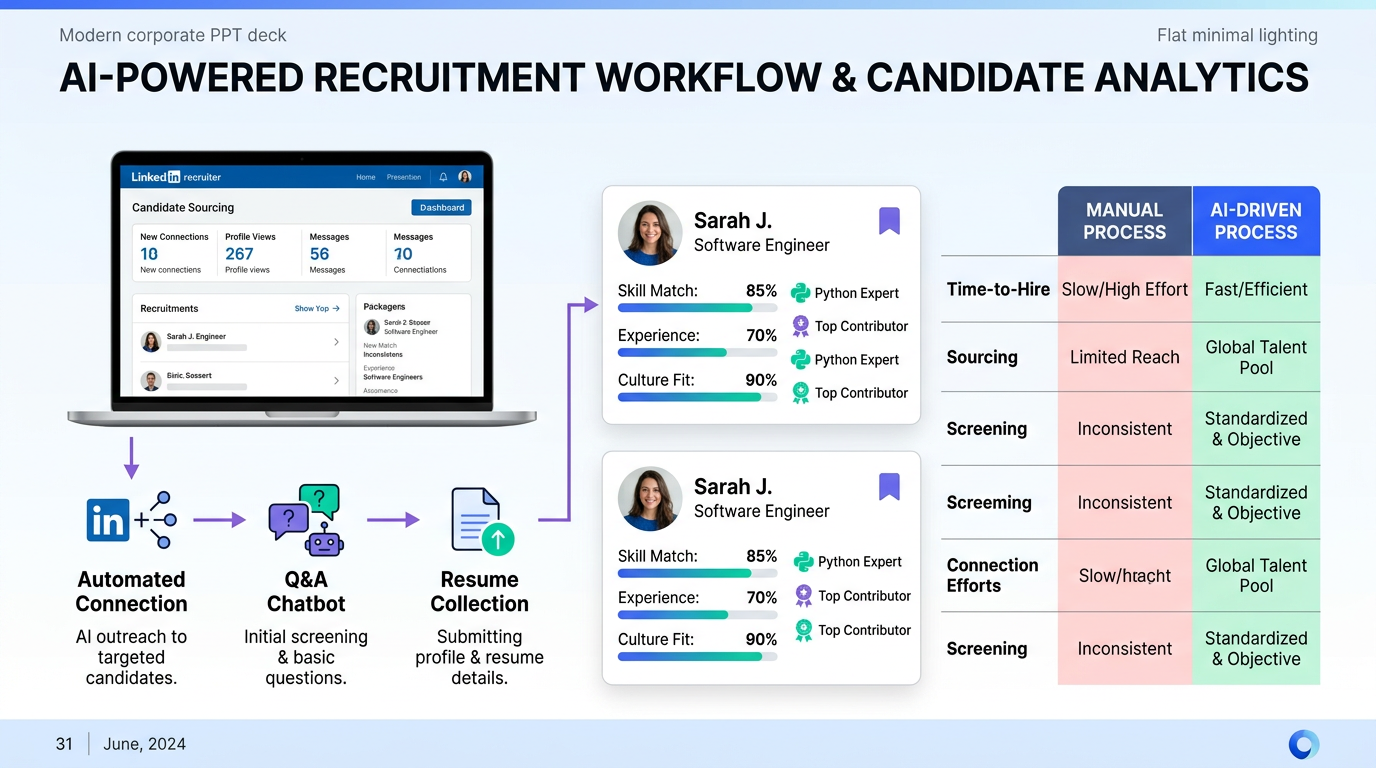
An ai recruiting tool is most useful when job hopping is common because it helps you evaluate candidates on performance evidence instead of tenure, while keeping outreach and follow up consistent. A widely cited Canadian dataset analysis reported that the share of people staying at a job for less than 2 years rose from 16% (1990 to 2000) to 33%, then to 51% (2000 to present), and that only 30% held any one job for over 4 years. In our own recruiting ops tests on LinkedIn workflows, the biggest bottleneck was not sourcing, it was the manual back and forth. That is where StrategyBrain AI Recruiter fits naturally: it can automate initial LinkedIn connections, introduce the role, answer questions about compensation and benefits, confirm interview interest, and collect resumes and contact details, while your team focuses on assessing achievements and running interviews.
Key Takeaways
- Tenure is a weaker signal in 2026: A Canadian analysis reported 51% of workers stayed under 2 years in the 2000 to present period, and only 30% stayed over 4 years in one job.
- Upgrade your rubric: Score candidates on quantifiable achievements per role, not “years stayed.”
- Use candidate tracking software as the system of record: Store evidence, interview notes, and follow up status in one place.
- Automate the repetitive LinkedIn layer: StrategyBrain AI Recruiter can handle initial outreach, Q and A, interest confirmation, and resume collection.
- Be honest about limits: AI Recruiter can confirm interest, but final qualification still requires a recruiter review of the resume and role fit.
- Onboarding speed matters more: Shorter stays increase the value of a fast onboarding process so new hires contribute sooner.
What the tenure shift means for hiring managers
When short stints become common, filtering out candidates purely for “too many moves” can shrink your pipeline at the exact moment you need options. The more practical question becomes: did the candidate deliver results during each stint, regardless of whether it lasted 18 months or 6 years?
In other words, tenure is context, not a verdict. A high performer who elevates a team for 2 years can be more valuable than a mediocre performer who stays for 7. That is why an ai recruiting tool is best used to standardize evidence collection and reduce process friction, not to rubber stamp decisions.
How to evaluate job hoppers without lowering your bar
Define “achievement evidence” before you screen
Start by writing down what “good” looks like for the role in measurable terms. Achievement evidence is any proof that a candidate moved a metric, shipped a deliverable, or improved a process. Examples include revenue impact, cost reduction, cycle time reduction, quality improvements, or customer outcomes.
Use a consistent scorecard across short and long tenures
We have found that inconsistency is what creates bias. If you ask long tenure candidates about outcomes but only ask short tenure candidates “why did you leave,” you will over index on narrative instead of performance. A scorecard keeps the interview anchored to evidence.
Ask “why now” and “why this role” after evidence is captured
Motivation still matters, but it should come after you have captured achievements. This sequencing reduces the risk of rejecting strong candidates early based on assumptions about job hopping.
Practical template: copyable screening checklist
- Role outcomes defined: 3 measurable outcomes for the first 90 days are written down.
- Evidence captured: 2 achievements per prior role are documented with metrics and scope.
- Constraints noted: Team size, budget, and tools used are recorded for each achievement.
- Reason for change: 1 sentence summary, then move on.
- Next step decided: Interview, hold, or reject with a single reason tied to the rubric.
A practical workflow using an AI recruiting tool
This workflow is designed for teams that source heavily on LinkedIn and want a repeatable process that works even when tenure patterns are changing. Here, “candidate tracking software” means the system where you store candidate status, notes, and documents. “Recruitment CRM” means the relationship layer that tracks conversations and follow ups. Some teams use one platform for both. Others combine tools, including free recruitment CRM software for early stage pipelines.
Steps
- Set your evidence rubric: Define 3 to 5 measurable outcomes for the role and add them as required fields in your candidate tracking software.
- Source and segment: Build a LinkedIn search list and segment by must have skills and location or time zone.
- Automate first contact and Q and A: Use an ai recruiting tool to send consistent outreach, answer common questions, and confirm interest.
- Collect resumes and contact details: Capture documents and contact info only after interest is confirmed to reduce noise.
- Human review and interview: Recruiters review resumes for fit, then run structured interviews using the scorecard.
- Accelerate onboarding: Shorter tenures increase the ROI of a fast onboarding process, so prepare a 30, 60, 90 day plan before the offer is accepted.
Limitations to plan for
- AI does not replace final qualification: Interest confirmation is not the same as role fit.
- Messaging still needs governance: You need approved templates, compensation ranges, and escalation rules.
- Data privacy is non negotiable: Ensure your process aligns with applicable privacy requirements and internal policy.
Where StrategyBrain AI Recruiter fits in the workflow
StrategyBrain AI Recruiter is built for LinkedIn hiring workflows where the repetitive work is connecting, introducing roles, handling early questions, and following up. In our experience, this is the part that breaks first when job hopping increases because you need more conversations to reach the same number of qualified interviews.
What it automates on LinkedIn
- Candidate connection and introduction: Automatically connects with candidates who match your search criteria and introduces the opportunity.
- Role and compensation Q and A: Answers candidate questions about the role, company, compensation, and benefits using the information you provide.
- Interest confirmation: Confirms whether the candidate wants to interview.
- Resume and contact capture: Collects resumes and contact details from interested candidates and marks resumes as received when provided.
- 24/7 multilingual communication: Responds around the clock in the candidate’s native language to reduce delays across time zones.
How it supports scale
If your organization runs multiple LinkedIn seats, AI Recruiter supports managing more than 100 LinkedIn accounts so you can build an AI powered recruiting team model. This is most useful when you need consistent outreach volume without adding headcount.
What it does not do
AI Recruiter can identify willingness to communicate or interview, but it does not decide whether a resume fully matches job requirements. Recruiters still review the resume and make the final qualification decision.
Operational note on cost and efficiency claims
StrategyBrain states that AI Recruiter can replace up to 90% of manual LinkedIn recruiting work and can lower LinkedIn recruiting costs to as little as USD 2.40 per resume. Treat these as product reported results that depend on role type, market, and messaging quality.
Quick comparison: manual vs AI assisted recruiting ops
| Workflow area | Manual process | AI assisted process (with StrategyBrain AI Recruiter) |
|---|---|---|
| Initial LinkedIn outreach | Recruiter sends messages one by one and tracks replies manually | Automated connection and introduction based on your criteria |
| Candidate Q and A | Recruiter answers repeated questions about role and compensation | AI answers common questions using your provided job and company details |
| Follow up | Often delayed by time zones and workload | 24/7 follow up with multilingual communication |
| Resume and contact collection | Recruiter requests documents and copies details into candidate tracking software | AI requests resumes and captures contact details from interested candidates |
| Final qualification | Recruiter reviews resume and interviews | Recruiter still reviews resume and interviews, AI supports the front end |
FAQ
Is an ai recruiting tool the same as candidate tracking software?
No. An ai recruiting tool typically automates tasks like outreach, screening conversations, and follow up. Candidate tracking software is the system of record that stores candidate status, notes, and documents across the hiring pipeline.
How do I evaluate candidates with short tenure fairly?
Use a scorecard that prioritizes measurable achievements per role and captures context like team size and scope. Ask about reasons for leaving after you document evidence, so the decision is anchored to performance.
Can StrategyBrain AI Recruiter run LinkedIn outreach while I sleep?
Yes. StrategyBrain AI Recruiter is designed for 24/7 candidate messaging and follow up, including multilingual communication, so conversations do not stall across time zones.
Does StrategyBrain AI Recruiter decide who is qualified?
No. It can confirm willingness to communicate or interview and collect resumes and contact details, but recruiters still review resumes and determine role fit.
What information do I need to provide to set up AI Recruiter?
You provide your LinkedIn account access and job details such as company information, compensation, benefits, and candidate search criteria. The AI uses that information to personalize outreach and answer candidate questions.
Is free recruitment CRM software enough for early stage hiring?
Sometimes. If you are hiring for a small number of roles, free recruitment CRM software can be sufficient for tracking conversations and follow ups. As volume grows, you typically need stronger candidate tracking software plus automation for outreach and resume collection.
How should onboarding change if job hopping is common?
Shorter stays increase the value of fast time to productivity. Prepare a structured onboarding plan with clear 30, 60, 90 day outcomes and ensure managers can start execution in week 1.
What is the biggest risk when adding AI to recruiting?
The biggest operational risk is inconsistent governance, including unclear messaging rules, missing compensation details, and weak escalation paths. The biggest compliance risk is mishandling personal data, so align your workflow with privacy requirements and internal policy.
Conclusion
Job hopping is no longer a niche pattern, so hiring teams need a process that rewards performance evidence over tenure. The most reliable approach we have used is a structured scorecard inside candidate tracking software, paired with an ai recruiting tool that keeps outreach, Q and A, and follow up consistent. If LinkedIn is your primary channel, StrategyBrain AI Recruiter is a practical way to automate the front end of the funnel, including interest confirmation and resume collection, while your recruiters focus on qualification and interviews. Next step: write your 3 to 5 outcome rubric, then pilot AI assisted outreach on one role for 14 days and measure interview ready candidates per week.