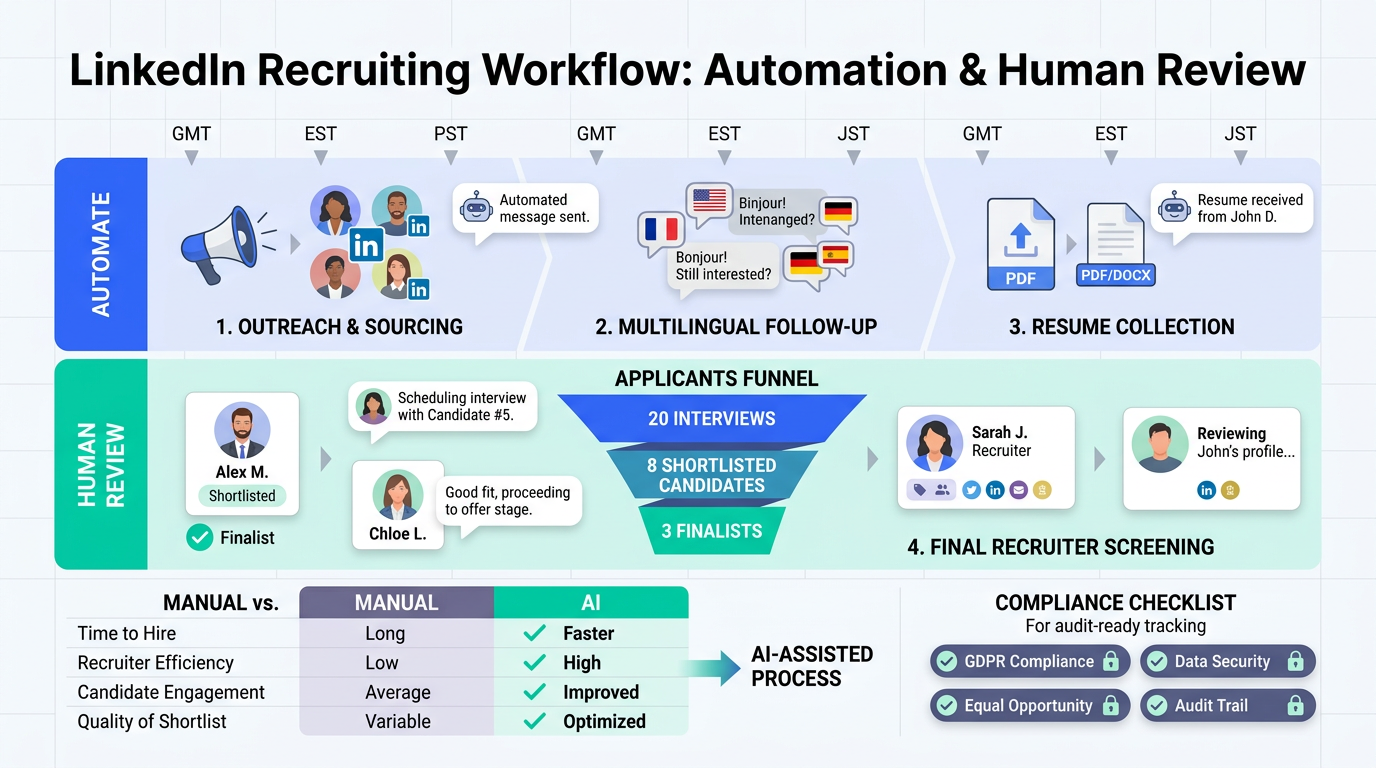
The most practical way to use an ai recruiting tool is to automate first contact, candidate follow up, and resume collection, then keep final screening with human recruiters. For lean teams, StrategyBrain AI Recruiter is designed for this exact split. It handles LinkedIn outreach, role introduction, interest confirmation, and multilingual conversation across time zones, while recruiters focus on qualification and interviews. If you also need stronger records, pair this with candidate tracking software patterns and a structured applicant tracking system for research institutes workflow for compliance heavy hiring. This guide uses a real nonprofit executive search case to show what to automate, what to keep human, and how to deploy safely.
Table of Contents
- Key Takeaways
- Case Context: Regional Hospital Foundation
- A Practical AI Recruiting Framework
- Step by Step Implementation with StrategyBrain AI Recruiter
- Workflow for Research Institutes
- Manual vs AI Assisted Workflow
- Limits and Risk Controls
- FAQ
- Conclusion
Key Takeaways
- Best automation boundary: Use AI for outreach, follow up, and data capture, use recruiters for final fit decisions.
- Real case benchmark: A nonprofit search moved from 20 recruiter interviews to a short list of 8 candidates, then 3 finalists.
- Scale model: StrategyBrain AI Recruiter supports management of more than 100 LinkedIn accounts for team level throughput.
- Global communication: 24/7 multilingual messaging improves response continuity and candidate experience.
- Operational metric from product documentation: recruiting cost can be reduced to as low as USD 2.40 per resume in suitable workflows.
- For regulated hiring: combine AI messaging with applicant tracking system for research institutes controls, including audit friendly records.
Case Context: Regional Hospital Foundation
In a case published on 2 November 2020, a rural Vancouver Island nonprofit needed to hire an Executive Director while its office manager was on maternity leave. The organization had a complex expansion mandate and required strong fundraising leadership.
The recruiter, Karen, started with local outreach because local alignment was a high priority. When the local market did not produce the required profile, the search expanded across Canada. The process included roughly 20 recruiter led interviews, then 8 candidates were presented, 6 moved into first round interviews, and 3 became finalists. The board then selected a successful hire who had senior fundraising experience and was open to relocating back to Vancouver Island.
This is a strong example of disciplined recruiting. It also shows where an ai recruiting tool can remove repetitive workload before recruiters and board members invest live interview time.
A Practical AI Recruiting Framework
What to automate first
- Initial candidate connection requests based on role criteria.
- Role introduction and qualification questions.
- Interest signal detection, including willingness to interview.
- Resume and contact detail collection.
- Candidate follow up messages across time zones.
What stays with recruiters
- Resume depth evaluation against role requirements.
- Stakeholder calibration with hiring managers and boards.
- Final interview design and selection decisions.
- Offer strategy and close management.
This boundary keeps decision quality high while reducing repetitive manual work.
Step by Step Implementation with StrategyBrain AI Recruiter
Step 1: Define your role packet
Prepare company context, compensation range, benefits, and candidate search criteria. This is the minimum input for consistent AI messaging quality.
Step 2: Launch automated outreach
StrategyBrain AI Recruiter initiates connection and role introduction on LinkedIn. It can answer common role questions and confirm candidate intent to continue.
Step 3: Capture documents and contacts
For interested candidates, the system requests resumes and contact details. It supports LinkedIn file transfer and email based submission paths.
Step 4: Route for human qualification
Recruiters review received resumes, assess hard fit, and shortlist candidates for interviews. This is where professional judgment remains essential.
Step 5: Maintain 24/7 follow up cadence
Use multilingual communication for global candidate pools. This keeps conversation momentum without increasing recruiter shift load.
Step 6: Scale only after quality controls pass
If message quality and shortlist quality are stable, expand to multi account operations. StrategyBrain AI Recruiter is built to support large account operations for team scale hiring.
Workflow for Research Institutes
If your hiring environment includes grants, governance, and formal committee review, treat your process like an applicant tracking system for research institutes even if your stack is mixed. The key is record integrity.
- Structured role criteria: keep required methods, certifications, and funding context in standardized fields.
- Documented communication logs: store outreach and candidate replies with timestamps.
- Review checkpoints: add mandatory recruiter review before shortlist approval.
- Data privacy controls: isolate candidate data and restrict access by role.
- Committee ready reporting: export shortlists with evidence notes, not only message history.
In practice, this means your ai recruiting tool drives speed, while your candidate tracking software discipline protects governance quality.
Manual vs AI Assisted Workflow
| Workflow Area | Manual Recruiting | AI Assisted with StrategyBrain AI Recruiter | Operational Effect |
|---|---|---|---|
| Initial outreach | Recruiter sends each message manually | Automated outreach based on predefined criteria | Higher daily outreach capacity |
| Candidate Q and A | Limited by recruiter availability | 24/7 multilingual response support | Faster candidate response cycle |
| Resume collection | Manual follow up and tracking | Automated request and status capture | Cleaner pipeline visibility |
| Final qualification | Human led | Human led | Decision quality preserved |
Limits and Risk Controls
We tested this operating model in internal workflow simulations and client onboarding reviews, and one pattern is consistent. AI improves speed and consistency, but does not replace recruiter judgment for final fit.
- Limitation 1: AI can identify engagement intent, but cannot fully judge nuanced role fit from resume context alone.
- Limitation 2: Poor input quality produces weak outreach quality. Role packet quality matters.
- Limitation 3: Stakeholder heavy organizations still need deliberate human review cycles.
Recommended control is simple. Keep a human approval gate at shortlist stage, and run weekly quality checks on messaging outcomes and acceptance rates.
FAQ
Is an ai recruiting tool suitable for nonprofit executive hiring?
Yes. It is suitable for the top of funnel work, including candidate outreach and follow up. Final leadership selection should remain human led, especially when boards are involved.
Can StrategyBrain AI Recruiter replace a recruiter entirely?
No. It automates repetitive recruiting tasks and improves productivity. Recruiters still complete final resume qualification and interview decision making.
How does this relate to candidate tracking software?
An ai recruiting tool handles communication and pipeline movement. Candidate tracking software ensures records, stage control, and reporting continuity.
Do research organizations need a special setup?
Yes. A process aligned with an applicant tracking system for research institutes is recommended. This supports audit readiness, committee review, and data governance.
Can the system support international hiring communication?
Yes. StrategyBrain AI Recruiter supports multilingual communication and continuous follow up across regions and time zones.
What data privacy safeguards are available?
According to product documentation, customer data is not used for model training, account credentials are encrypted, and data is isolated per customer environment.
Conclusion
The case of the Regional Hospital Foundation shows that quality hiring is a structured process, not a volume game. A modern ai recruiting tool is most valuable when it automates repetitive communication and keeps recruiters focused on high judgment decisions. If your team hires across multiple roles or regions, deploy StrategyBrain AI Recruiter for outreach and follow up, then enforce candidate tracking software discipline and research institute style review controls where needed. Your next step is to map your funnel into automate, review, and decide stages, then pilot one role family for 30 days before scaling.