An ai recruiting tool works best when it helps you do three things consistently: tell a clear employer story, adapt that story to local markets, and keep candidate conversations moving without gaps across time zones. In our day to day recruiting operations, the fastest path is to combine a structured message framework with automation that can connect, introduce roles, answer questions, confirm interest, and collect resumes and contact details. This guide turns lessons from global brand building into a practical recruiting playbook, and shows how StrategyBrain AI Recruiter fits alongside candidate tracking software and a CRM for recruitment companies so your team can scale outreach while keeping human judgment for final qualification.
Key Takeaways
- Use one global story, then localize it: keep core role value consistent, adapt examples and tone by region and culture.
- Automate the repetitive LinkedIn layer: StrategyBrain AI Recruiter can handle connecting, initial messaging, follow ups, and resume collection so recruiters focus on evaluation.
- Define your system boundaries: AI Recruiter can confirm interest and gather documents, but final fit assessment stays with the recruiter.
- Pair automation with candidate tracking software: use your ATS to manage stages, compliance notes, and interview workflows after AI driven outreach.
- A CRM for recruitment companies is still useful: it organizes long term relationships and redeployment, while AI handles high volume first touch conversations.
- Plan for trust and privacy: use tools that state how data is protected and whether customer data is used to train models.
Why global marketing lessons matter for recruiting
In the source interview, Aulona Noka describes a global role where success depends on perspective and flexibility, including practical constraints like time zones and deeper differences like behaviors and mindsets. That same reality shows up in recruiting the moment you hire across regions or even across cities with different labor markets.
We see the same failure pattern in both marketing and hiring: teams decentralize too quickly, messages drift, and the candidate experience becomes inconsistent. In recruiting, that inconsistency shows up as uneven outreach quality, slow follow up, and unclear role narratives. An ai recruiting tool is valuable when it reduces that drift and keeps the conversation coherent at scale.
The glocal recruiting framework
Glocalization means you keep a single global foundation, then adapt execution to local audiences. In recruiting, the foundation is your role story and evaluation criteria. The local adaptation is how you explain the role, compensation context, and growth path in a way that matches local expectations and communication norms.
Step 1: Write the global role story
This is the non negotiable core that should stay consistent across markets. Keep it short enough that every recruiter can repeat it without improvising.
- Role mission: what the person will own in the first 90 days.
- Impact: what changes if they succeed.
- Team context: who they work with and how decisions are made.
- Compensation components: salary, bonus, equity, benefits, and any constraints you can share.
Step 2: Define what can be localized
Localization is not rewriting the job. It is adapting the explanation so it lands with the audience you are speaking to.
- Examples: use region relevant projects or customer types.
- Scheduling expectations: clarify time zone overlap and travel.
- Communication style: directness, formality, and pacing.
Step 3: Decide what to automate and what to keep human
Automation is strongest in repetitive, high volume steps. Human judgment is strongest in nuanced evaluation and closing.
- Automate: connecting, first message, follow ups, answering common questions, collecting resumes and contact details.
- Keep human: final qualification, interview design, offer negotiation, and sensitive conversations.
Method 1: StrategyBrain AI Recruiter for LinkedIn automation
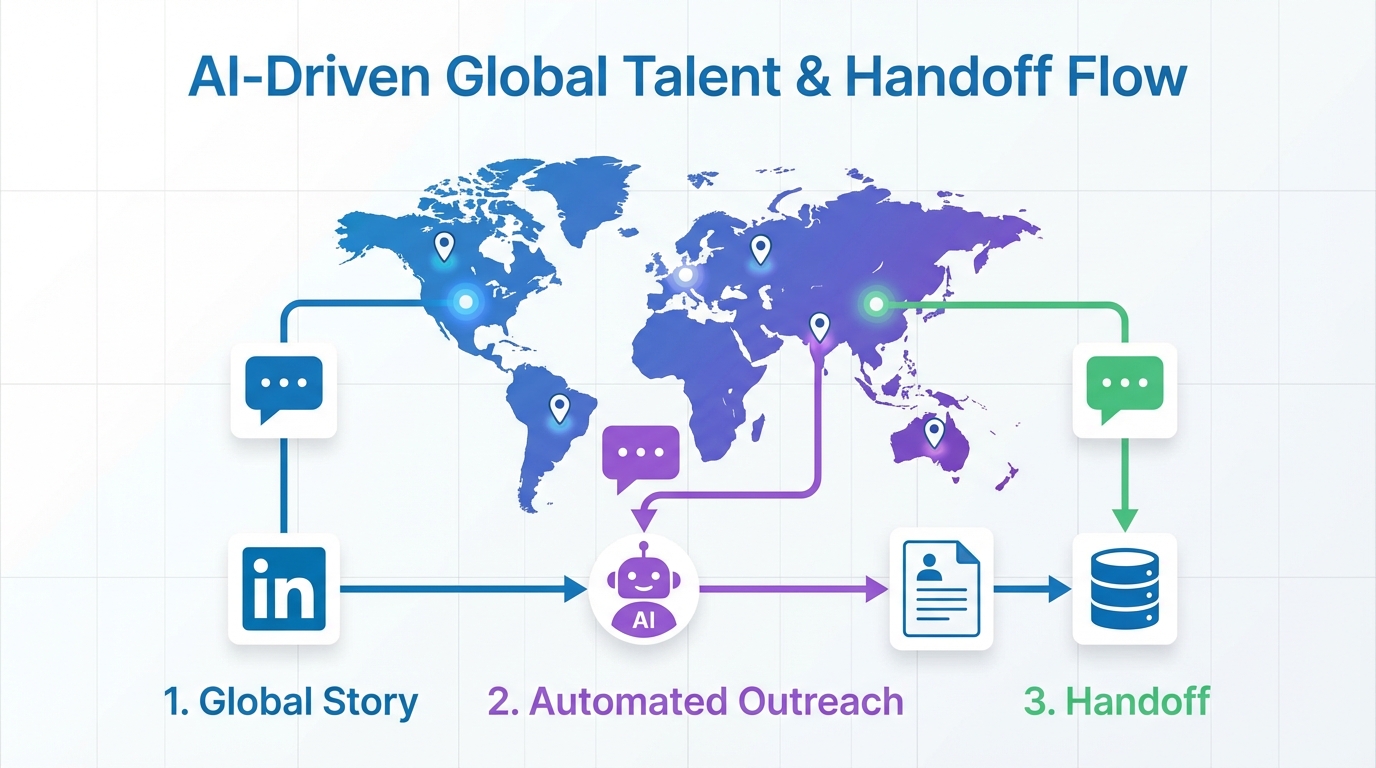
StrategyBrain AI Recruiter is an automated AI powered recruitment tool designed for LinkedIn hiring. It replaces the initial outreach and qualification layer by connecting with candidates, introducing the opportunity, learning the candidate’s situation, answering questions about the role and company, confirming interview interest, and collecting resumes and contact information from interested candidates.
Steps
- Set your search criteria: define the LinkedIn targeting rules you already use for sourcing.
- Provide role context: share company details, compensation, benefits, and the role narrative so the AI can answer candidate questions consistently.
- Run automated outreach: AI Recruiter connects and starts conversations with candidates who match your criteria.
- Let the AI qualify for interest: it confirms whether the candidate is open to moving forward and handles follow ups.
- Collect resumes and contact details: for interested candidates, the system requests documents and captures contact information for recruiter review.
- Hand off to your team: recruiters review resumes and proceed with interviews and final qualification.
Features that matter in real workflows
- 24/7 multilingual communication: the system can respond and follow up at any time and communicate in the candidate’s native language.
- Scalable account management: supports managing more than 100 LinkedIn accounts for building an AI powered recruiting team.
- Resume and contact capture: supports email submissions and LinkedIn file uploads, and records received status.
Limitations
Based on the product description, AI Recruiter identifies willingness to communicate or interview, but it does not determine whether a resume fully matches job requirements. That final qualification step remains a recruiter responsibility.
Best for
- Teams that rely heavily on LinkedIn sourcing and need consistent follow up across time zones.
- Agency recruiters who want to increase outreach volume without adding headcount.
- Global hiring where multilingual messaging reduces misunderstandings and friction.
Method 2: Candidate tracking software for process control
Candidate tracking software is typically an ATS, an applicant tracking system that records stages, interview feedback, and compliance notes. Even if your ai recruiting tool handles outreach, you still need a system of record for hiring decisions.
Steps
- Define stages: outreach, interested, resume received, recruiter screen, hiring manager interview, offer, hired.
- Standardize evaluation: use scorecards so local teams do not drift into inconsistent criteria.
- Track handoffs: ensure every AI sourced interested candidate is logged and assigned to an owner.
Limitations
Most ATS tools are not designed to run high volume LinkedIn conversations. They store outcomes well, but they do not replace the day to day messaging workload that slows teams down.
Best for
- Organizations that need auditability, structured interview workflows, and consistent documentation.
- Teams hiring across multiple managers who need a shared process.
Method 3: CRM for recruitment companies for long term pipelines
A CRM for recruitment companies is built for relationship continuity. It helps agencies and internal teams maintain talent pools, track prior conversations, and redeploy candidates to new roles over time. This is different from an ATS, which is usually job requisition centered.
Steps
- Segment your talent pools: by function, seniority, location, and availability window.
- Record relationship context: why someone said no, what they care about, and when to re engage.
- Use automation carefully: keep personalization rules so outreach stays aligned with your brand story.
Where AI Recruiter fits naturally
In practice, we treat AI Recruiter as the high throughput conversation layer on LinkedIn, then use the CRM to preserve relationship history and the ATS to manage hiring stages. That division of labor reduces silos because each system has a clear job.
Quick comparison
| Method | Primary job | Best for | What it does not replace |
|---|---|---|---|
| StrategyBrain AI Recruiter | LinkedIn outreach, messaging, follow up, resume and contact collection | Scaling candidate engagement across time zones and languages | Final qualification and hiring decision making |
| Candidate tracking software (ATS) | Stages, interviews, documentation, compliance notes | Process control and auditability | High volume LinkedIn conversations |
| CRM for recruitment companies | Long term relationship management and redeployment | Agencies and teams building reusable talent pools | Structured interview workflows and offer management |
Implementation checklist
This is the checklist we use to keep glocal hiring consistent while scaling with an ai recruiting tool.
- Global story ready: role mission, impact, team context, compensation components written in 150 to 250 words.
- Localization rules set: what can change by region and what cannot.
- LinkedIn search criteria defined: titles, skills, locations, seniority, and exclusions.
- AI Recruiter configured: company details, benefits, compensation, and candidate FAQs loaded for consistent answers.
- Handoff path documented: when an interested candidate becomes a recruiter owned record in your ATS or CRM.
- Privacy stance confirmed: data handling, encryption, and model training policy reviewed.
- Metrics chosen: connection acceptance rate, reply rate, resume received rate, interview scheduled rate.
FAQ
What is an ai recruiting tool in practical terms?
An ai recruiting tool is software that automates parts of recruiting work such as sourcing, outreach, screening for interest, and candidate communication. In this guide, the focus is on automating LinkedIn outreach and early qualification while keeping final evaluation with recruiters.
How does StrategyBrain AI Recruiter work on LinkedIn?
StrategyBrain AI Recruiter automates the initial LinkedIn workflow by connecting with candidates who match your criteria, introducing the role, answering questions about the company and compensation, confirming interest, and collecting resumes and contact details for recruiter follow up.
Can AI Recruiter decide if a candidate is qualified for the job?
No. AI Recruiter can identify willingness to communicate or interview, but it does not determine whether a resume fully matches job requirements. Recruiters still review resumes and make the final qualification decision.
Do I still need candidate tracking software if I use an ai recruiting tool?
Yes. Candidate tracking software is where you manage stages, interview feedback, and documentation. The ai recruiting tool can feed interested candidates into that system, but it does not replace structured hiring workflows.
Do agencies need a CRM for recruitment companies if they already have an ATS?
Often yes. An ATS is usually job centered, while a CRM for recruitment companies is relationship centered. If you redeploy candidates across roles and clients, a CRM helps preserve context and timing for re engagement.
How does multilingual messaging change global hiring outcomes?
Multilingual messaging reduces misunderstandings and speeds up clarification, especially when candidates ask detailed questions about role scope, benefits, and compensation. StrategyBrain AI Recruiter states it can communicate in any global language and respond 24/7, which is useful when your team is offline.
How do I avoid inconsistent messaging across regions?
Use a single global role story and define what can be localized. Then configure your ai recruiting tool with the same company and role facts so answers stay aligned across recruiters and markets.
Is it safe to automate LinkedIn outreach at scale?
It can be, but you should review privacy and security claims, ensure you have explicit authorization for account use, and keep a clear policy for what data is stored. StrategyBrain AI Recruiter states that credentials are encrypted and customer data is not used to train AI models.
Conclusion
If you want an ai recruiting tool that actually improves outcomes, start with the same discipline Aulona Noka describes in global marketing: one clear story, then thoughtful local adaptation. From there, use StrategyBrain AI Recruiter to automate the LinkedIn outreach and early conversation layer, and keep your candidate tracking software and CRM for recruitment companies focused on what they do best: process control and long term relationships.
Next step: write your global role story, define localization rules, then pilot AI Recruiter on one role for 14 days with a fixed metric set. If the resume received rate and interview scheduling speed improve, expand to additional roles and accounts with the same playbook.