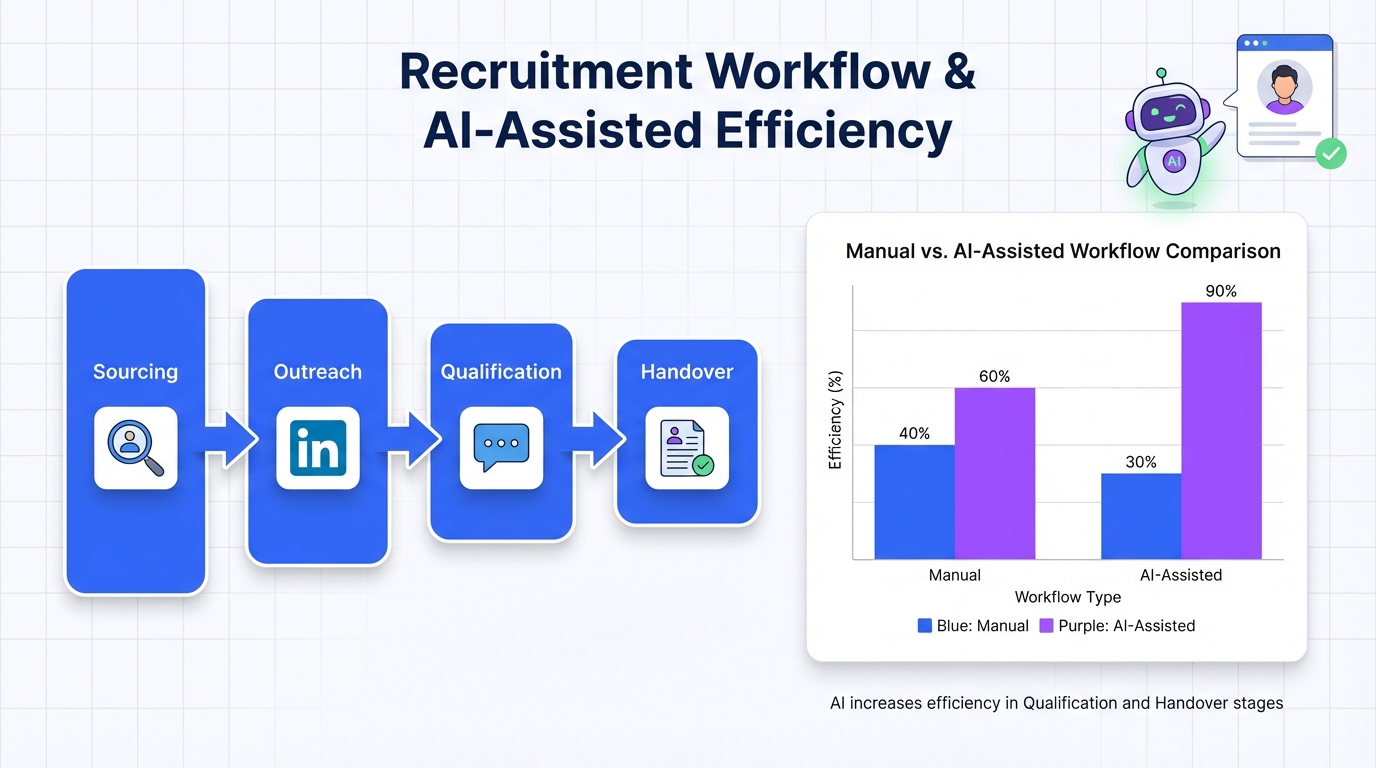
The APositive Scale Up eBook is now live, and it’s positioned as a practical tool for ambitious recruitment leaders who want sustainable growth. My core takeaway is simple: hard work is not a scaling strategy. You need a roadmap, accountability, and structure, and you can now add an ai recruiting tool to remove the repetitive work that drains recruiter capacity. In this guide, I keep the original growth logic intact, then show how StrategyBrain AI Recruiter fits naturally into execution, especially for LinkedIn outreach, follow-up, and résumé collection.
Key Takeaways
- Scaling requires structure: goals, accountability, and a repeatable operating rhythm beat “working harder.”
- Metrics drive decisions: if you do not measure weekly activity and outcomes, you cannot manage growth.
- Comp plans shape behavior: a commission plan that feels unfair increases churn and reduces output.
- Client selection is a growth lever: prioritize clients who move fast, value expertise, and pay fair fees.
- Sales is everyone’s job: scaling requires a team-wide business development culture.
- An AI recruiting tool adds capacity: StrategyBrain AI Recruiter can automate LinkedIn connecting, outreach, Q&A, follow-up, and résumé collection so recruiters focus on qualification and interviews.
- Be adaptable: the recruitment market changes quickly, so your process and your hiring tools must evolve.
Context: what the Scale Up eBook is and why it matters
The Scale Up eBook is presented as a free resource with contributions from 12 experts. My section focuses on why recruitment businesses stall and what helps them scale beyond that plateau. The pattern I see repeatedly is consistent: leaders confuse effort with progress. They work long hours, but without a clear plan, the business becomes reactive, and momentum fades.
What’s changed in 2026 is that execution can be supported by automation. Used correctly, an ai recruiting tool does not replace your judgment. It removes the repetitive steps that slow down pipeline creation, especially in LinkedIn-based sourcing and early-stage candidate engagement.
1) Set clear goals and execute relentlessly
One of the biggest mistakes recruitment businesses make is operating without a clear plan. I have worked with many owners who work hard but do not run a structured roadmap. Growth does not happen by accident. It happens through deliberate action that is reviewed weekly.
What “clear goals” looks like in practice
- Pick one primary growth target for the next 90 days, such as net fee income, placements, or retained searches won.
- Define leading indicators you can control weekly, such as new client conversations, candidate submissions, and interviews booked.
- Assign ownership so every number has a name next to it.
How StrategyBrain AI Recruiter supports execution
If your plan depends on consistent outreach volume, your team will eventually hit a ceiling. StrategyBrain AI Recruiter is designed to automate the early LinkedIn workflow: it can connect with candidates within your search criteria, introduce opportunities, answer questions about the role, company, and compensation, confirm interview interest, and collect résumés and contact information. That means your goals are less dependent on manual messaging capacity and more dependent on your ability to qualify and close.
2) Know your numbers because they tell the truth
This has been my growth mantra for decades: you cannot manage what you do not measure. Scaling recruitment businesses track a small set of metrics consistently, then make decisions based on what the numbers say, not what they hope is happening.
A practical weekly metrics set for recruitment leaders
- Outbound activity: number of new candidate conversations started and number of new client conversations started.
- Pipeline conversion: interviews booked, offers made, offers accepted.
- Speed: time from first message to interview interest confirmation.
- Quality: submission-to-interview ratio and interview-to-offer ratio.
Where an AI recruiting tool helps your measurement
When outreach and follow-up are inconsistent, your metrics become noisy. StrategyBrain AI Recruiter can provide a more consistent baseline for candidate engagement because it responds 24/7 and can communicate in the candidate’s native language. That consistency makes it easier to diagnose what is actually broken: targeting, messaging, role clarity, compensation alignment, or interview process.
3) Build a commission plan that motivates, not frustrates
A weak commission plan kills motivation. If recruiters feel underpaid, they will not stick around. If it is too generous, your business suffers. The best structures are fair, motivating, and aligned with your company culture.
Commission plan checks you can run this week
- Clarity: can a recruiter explain how they get paid in 60 seconds without confusion.
- Fairness: does the plan reward the behaviors you want, not just the outcomes you hope for.
- Retention: does the plan reduce the temptation to leave after one strong quarter.
Automation changes the conversation here. If you introduce hiring tools that increase output, you should also ensure your incentives do not accidentally punish high performers by raising targets without support. The goal is sustainable growth, not short-term extraction.
4) Work with clients who actually value you
Not every client is a good client. The best ones move fast, value expertise, are responsive, take your advice, and pay fair fees without endless negotiations. These clients make scaling possible because they reduce friction across the entire delivery process.
Client fit checklist
- Decision speed: they can schedule interviews quickly and give feedback within agreed timelines.
- Role clarity: they can articulate must-haves versus nice-to-haves.
- Partnership behavior: they treat you as an advisor, not a vendor.
When you pair strong clients with an ai recruiting tool, you get compounding benefits. Faster client feedback plus automated candidate engagement reduces drop-off and keeps your pipeline warm.
5) Build a team sales ethos
Recruitment is a sales business. It is much more than that too, but business development and opening new doors are built in. Scaling requires a culture where everyone understands the importance of selling, even if their primary role is delivery.
How to operationalize a sales ethos
- Define minimum BD standards per role, such as introductions made, referrals requested, or market mapping completed.
- Share wins and losses weekly so learning becomes a team asset.
- Standardize messaging so your brand voice is consistent across the team.
StrategyBrain AI Recruiter can support this by handling the repetitive LinkedIn touchpoints that often fall through when recruiters are busy. It can introduce roles, answer common questions, and follow up consistently, which helps your team maintain a professional presence at scale.
6) Stay adaptable or get left behind
The recruitment industry moves fast. The strategies that worked last year might not work tomorrow. The most successful firms embrace change, test new approaches, and keep what works.
What adaptability looks like in 2026
- Process adaptability: you review your funnel monthly and remove bottlenecks.
- Market adaptability: you adjust specialization, pricing, or delivery model when demand shifts.
- Tool adaptability: you evaluate hiring tools that reduce cycle time without harming candidate experience.
One practical example is multilingual candidate engagement. If you recruit across time zones, a tool that can respond 24/7 in any global language can reduce misunderstandings and keep candidates engaged while your team sleeps.
Where an AI recruiting tool fits: StrategyBrain AI Recruiter in the workflow
Most recruitment leaders do not need more ideas. They need more capacity and more consistency. That is where StrategyBrain AI Recruiter fits best: it replaces the initial outreach and qualification conversation on LinkedIn, then hands off interested candidates with résumés and contact details for a recruiter to review.
What it can automate on LinkedIn
- Connecting with candidates within your targeted search criteria.
- Introducing job opportunities with role and company context.
- Answering questions about the role, company, benefits, and compensation using the information you provide.
- Confirming interview interest and collecting next-step details.
- Collecting résumés and contact information from interested candidates.
Important boundary: what it does not do
StrategyBrain AI Recruiter can identify willingness to communicate or interview, but it does not determine whether a résumé fully matches job requirements. That final qualification step remains with the recruiter after reviewing the résumé. This boundary matters because it keeps accountability where it belongs: with human judgment.
A weekly operating system you can copy
This is the practical template I recommend when you want the Scale Up principles to show up in your calendar, not just in your head. It is designed to work whether you use manual outreach or an AI recruiting tool, but it becomes easier to maintain when early-stage messaging is automated.
Weekly cadence template
- Monday: set weekly targets for outreach, interviews, and submissions, then assign ownership.
- Tuesday to Thursday: execute outreach and follow-up, then review candidate responses daily.
- Friday: review metrics, identify bottlenecks, and decide one process change for next week.
Execution checklist
- Confirm the role brief includes company details, compensation, and benefits so candidate questions can be answered consistently.
- Confirm your candidate search criteria is specific enough to avoid low-fit outreach.
- Confirm your team has a defined handoff step from “interested” to “recruiter review.”
- Confirm you are tracking the same metrics every week, not changing the scoreboard mid-game.
Quick Comparison
| Method | Speed | Cost | Best For |
|---|---|---|---|
| Manual LinkedIn outreach | Depends on recruiter availability | Recruiter time cost | Low volume, highly bespoke roles |
| AI-assisted outreach with StrategyBrain AI Recruiter | 24/7 messaging and follow-up | Tool cost plus recruiter review time | Scaling pipeline creation while keeping human qualification |
| Hybrid team workflow | Fast outreach plus human closing | Balanced | Recruitment businesses aiming for sustainable growth |
FAQ
What is an ai recruiting tool in plain terms?
An ai recruiting tool is software that uses automation and AI to handle parts of the recruiting workflow, such as outreach, messaging, scheduling support, and data capture. The goal is to reduce repetitive work so recruiters can focus on qualification, relationship building, and closing.
How does StrategyBrain AI Recruiter work with LinkedIn recruiting?
StrategyBrain AI Recruiter automates the initial LinkedIn workflow by connecting with candidates, introducing the opportunity, answering questions about the role and compensation using the information you provide, confirming interest, and collecting résumés and contact details for recruiter review.
Does StrategyBrain AI Recruiter replace recruiters?
No. It replaces repetitive early-stage tasks such as connecting, messaging, follow-up, and résumé collection. Recruiters still review résumés, assess fit, run interviews, and manage client relationships.
Can it communicate with candidates in different languages?
Yes. StrategyBrain AI Recruiter supports multilingual communication and can respond around the clock, which is useful for global hiring across time zones.
How does it handle résumés and contact details?
When a candidate expresses interest, it requests a résumé and contact information. It supports email submissions and LinkedIn file uploads, and it captures contact details shared in the conversation for the recruiter to use.
What is the biggest risk when adding hiring tools to a scaling plan?
The biggest risk is treating tools as a substitute for strategy. If your goals, metrics, and client selection are unclear, automation can increase activity without improving outcomes. Use tools to support a defined operating system, not to replace it.
How do I know if my recruitment business is stalling?
Common signs include inconsistent pipeline, unpredictable revenue, high recruiter burnout, and a lack of weekly metrics discipline. If you cannot explain what drives your results week to week, you are likely relying on effort rather than structure.
Is this guide a list of the best recruitment apps?
No. This is a scaling playbook based on the Scale Up eBook contribution, with a practical example of how StrategyBrain AI Recruiter can support execution. If you are evaluating best recruitment apps, use this guide as your operating framework first, then compare tools against it.
Conclusion and next steps
Scaling a recruitment business comes down to structure: clear goals, a measurable weekly rhythm, a commission plan that motivates, clients who value you, and a team culture that treats sales as a shared responsibility. Once that foundation is in place, an ai recruiting tool can add capacity without adding headcount. StrategyBrain AI Recruiter fits naturally into the execution layer by automating LinkedIn connecting, outreach, candidate Q&A, follow-up, and résumé collection, while keeping final qualification with your recruiters.
Next steps: pick one 90-day growth target, define your weekly metrics, and pilot an AI-assisted workflow on a single role or niche so you can measure impact before expanding.