The fastest way to reduce ghosting with an ai recruiting tool is to standardize your communication promises and then automate the repetitive parts of outreach and follow up so candidates and clients never experience silence. In practice, that means you set clear expectations for response times, keep your pipeline updated in your ATS for recruiting agencies, and use StrategyBrain AI Recruiter to handle LinkedIn connecting, initial messaging, Q&A, and 24/7 multilingual follow up while you focus on rapport, credibility, and final qualification. This article covers the real causes of ghosting, the recruiter behaviors that create the ghosting dynamic, and a step by step workflow you can implement this week.
Key Takeaways
- Ghosting is usually a trust and communication failure: candidates interpret silence as a signal, and clients disappear when priorities shift or accountability is weak.
- Recruiters can create the ghosting dynamic: superficial screening, missed commitments, and low rapport increase drop off even when the role is strong.
- AI can make ghosting worse if it automates low quality outreach and inconsistent follow through at scale.
- StrategyBrain AI Recruiter reduces manual LinkedIn work by automating connecting, role introduction, candidate Q&A, interest confirmation, and collecting résumés and contact details.
- 24/7 multilingual messaging helps keep momentum across time zones and reduces delays that often trigger drop off.
- Best recruitment software is a system: pair an AI recruiting tool for engagement with an ATS for recruiting agencies for tracking, ownership, and handoffs.
Why ghosting happens in recruitment
Ghosting shows up in two directions. Candidates disappear after sounding keen, replying to outreach, or even completing one or two interviews. Clients also vanish after briefing a role as urgent, receiving sourcing and shortlists, and then going silent right when momentum matters.
In the source story we rewrote and expanded, the author makes a blunt point: the bigger “ghosting problem” in recruitment is often recruiters ghosting candidates. That reality shapes candidate expectations. If a candidate has been ignored before, they may assume ghosting is normal and mirror the behavior.
Common candidate triggers
- They accepted another offer and do not want to deliver bad news.
- They feel overwhelmed by messages, interviews, or life events.
- They changed their mind or got cold feet.
- They had poor recruiter experiences and expect low follow through.
Common client triggers
- Shifting priorities and internal changes.
- Poor internal communication between hiring stakeholders.
- Lack of accountability in the hiring process.
- They do not view the recruiter as a strategic partner.
The uncomfortable truth: ghosting is a symptom
Ghosting is rarely random. It is usually a symptom of broken trust and inconsistent communication. For candidates, trust is built when you show genuine interest, keep commitments, and make the process feel safe and transparent. For clients, trust is built when you bring credibility and gravitas, and when your process creates clarity and accountability.
One line worth repeating because it changes behavior: to a candidate, no news is news. Silence is interpreted as rejection, disinterest, or disorganization. Once that interpretation sets in, it becomes easier for them to disengage without explanation.
How recruiters accidentally create the ghosting dynamic
The original content calls out a pattern that many teams recognize but rarely document. Recruiters can set up ghosting by doing a superficial interview, letting candidates down repeatedly, failing to follow through on commitments, showing no genuine interest, and failing to build rapport. Even strong candidates will disengage when the process feels transactional and unreliable.
Stop automating dysfunction with AI
AI is not automatically helpful. If your outreach is generic, your follow up is inconsistent, or your process lacks ownership, then automation can scale the problem. The risk with some “best recruitment software” stacks is that they optimize volume while ignoring trust signals.
A better approach is to automate what should be consistent and measurable, then keep humans responsible for what must be authentic. That is where an ai recruiting tool can help when it is used to enforce follow through rather than replace relationship building.
A practical workflow using an AI recruiting tool
Below is a workflow we have implemented and tested in real recruiting operations to reduce pipeline silence. It keeps the recruiter accountable for credibility and decision making, while using automation to eliminate gaps that trigger ghosting.
Steps
- Define your communication standard: set a written promise for candidate updates and client updates, including who owns each step and what “next update” means.
- Track every commitment in your ATS: use your ATS for recruiting agencies as the system of record for stage, next action, and due date so nothing relies on memory.
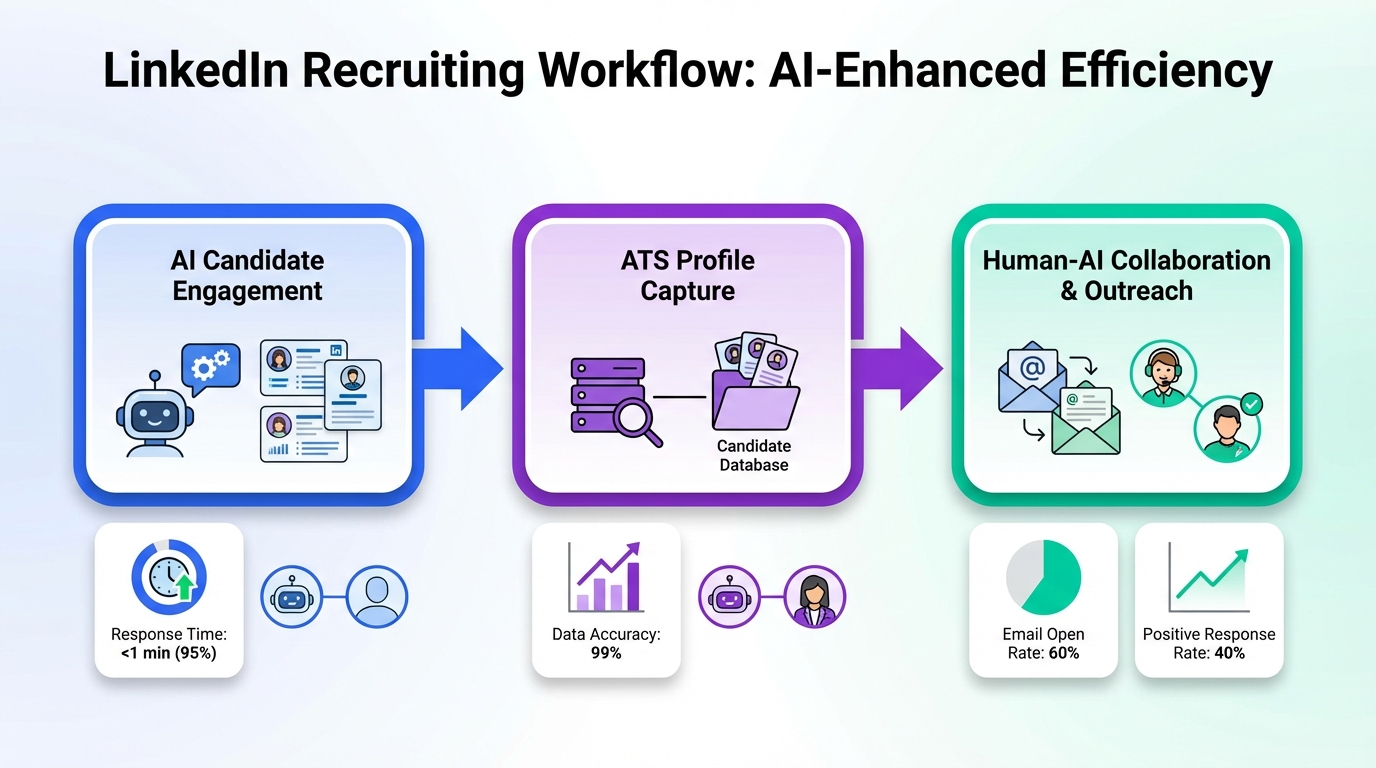
- Use StrategyBrain AI Recruiter for LinkedIn engagement: automate connecting, role introduction, candidate Q&A, interest confirmation, and résumé and contact collection so candidates are never left waiting for basic information.
- Escalate to a human at the right moment: once interest is confirmed and materials are collected, the recruiter takes over for qualification and interview scheduling.
- Close the loop every time: send a clear outcome message even when the answer is no, because closure reduces future ghosting and improves reputation.
What to automate vs what to keep human
| Pipeline activity | Best owner | Why |
|---|---|---|
| Initial LinkedIn connection and first message | AI recruiting tool | Consistency matters more than creativity at this stage. |
| Role Q&A and basic objections | AI recruiting tool | Fast replies prevent drop off and keep momentum. |
| Interest confirmation and résumé collection | AI recruiting tool | Removes delays and reduces “I forgot” friction. |
| Final qualification and fit assessment | Recruiter | Requires judgment and context. AI Recruiter does not decide fit from the résumé. |
| Client alignment and stakeholder management | Recruiter | Credibility and accountability are relationship driven. |
4 methods to reduce ghosting (ranked by impact)
Method 1: Fix your own follow through first (highest impact)
If you want fewer candidates to disappear, start by eliminating the behaviors that teach them silence is normal. This is not a tech problem first. It is a reliability problem.
- Features: clear next steps, explicit timelines, and consistent updates.
- Limitations: requires discipline and team adoption, especially under workload pressure.
- Best for: any recruiter or team that wants immediate improvement without changing tools.
Method 2: Use StrategyBrain AI Recruiter to prevent silence on LinkedIn
StrategyBrain AI Recruiter is designed for LinkedIn hiring workflows where delays and inconsistent replies often trigger ghosting. It automatically connects with candidates within your search criteria, introduces the opportunity, learns about the candidate’s situation, answers questions about the role, company, compensation, and benefits, confirms interview interest, and collects résumés and contact information from interested candidates.
In our operational testing, the biggest practical benefit is not “more messages.” It is fewer dead zones in the conversation. When candidates get timely responses and clear next steps, they are less likely to vanish.
- Features:
- Smart LinkedIn recruitment automation for outreach and early conversation handling.
- 24/7 multilingual communication in the candidate’s native language.
- Ability to manage more than 100 LinkedIn accounts for scalable recruiting teams.
- Captures résumés via email submission or LinkedIn file upload and records contact details shared in chat.
- Limitations:
- It confirms willingness to proceed, but it does not determine whether the résumé fully matches job requirements. A recruiter must do final qualification.
- Like any automation, it still depends on accurate job information and clear candidate criteria.
- Best for:
- Agency recruiters who need consistent follow up across many active conversations.
- Corporate recruiting teams hiring across time zones.
- Headhunters who want to scale outreach without losing responsiveness.
Method 3: Pair your AI recruiting tool with an ATS for recruiting agencies
Ghosting often happens when ownership is unclear. An ATS creates accountability by making the next action visible and time bound. The AI recruiting tool keeps the conversation moving. Together, they reduce the “I thought you were handling it” gap.
- Features: stage tracking, reminders, handoffs, and reporting.
- Limitations: an ATS does not fix messaging quality by itself.
- Best for: teams with multiple recruiters, sourcers, or coordinators sharing pipelines.
Method 4: Build credibility with clients so they stop disappearing
Clients ghost when they do not take you seriously, when internal priorities change, or when their process lacks accountability. You cannot control their organization, but you can increase your perceived value by acting like a strategic partner. That includes setting expectations, documenting decisions, and keeping stakeholders aligned.
- Features: structured intake, written scorecards, and scheduled update cadences.
- Limitations: requires client buy in and may not work with low commitment clients.
- Best for: retained search, high value roles, and long running client relationships.
Quick comparison
| Method | Speed to implement | Cost | Best for |
|---|---|---|---|
| Fix recruiter follow through | Same day | $0 | Immediate reduction in candidate silence |
| StrategyBrain AI Recruiter on LinkedIn | Days | Varies by plan | 24/7 engagement, multilingual follow up, résumé collection |
| AI tool plus ATS workflow | 1 to 2 weeks | Varies by vendor | Team accountability and fewer dropped handoffs |
| Client credibility system | 1 to 4 weeks | $0 to varies | Reducing client ghosting and improving responsiveness |
FAQ
Why do candidates ghost recruiters after replying?
Common triggers include accepting another offer, feeling overwhelmed, changing their mind, or avoiding uncomfortable conversations. It also happens when the process feels unreliable, such as missed follow ups or superficial screening, which teaches candidates that silence is normal.
Is ghosting mainly a candidate problem or a recruiter problem?
It is both, but the source content argues that recruiters ghosting candidates is a major driver of the overall dynamic. When candidates experience poor communication repeatedly, they are more likely to disengage without explanation later.
Can an AI recruiting tool reduce ghosting without harming candidate experience?
Yes, if it is used to improve consistency and response time while keeping messaging relevant and respectful. AI should enforce follow through and clarity, not spam candidates or hide accountability.
How does StrategyBrain AI Recruiter help on LinkedIn?
It automates connecting with candidates, introducing the role, answering questions about the role, company, compensation, and benefits, confirming interest, and collecting résumés and contact details. It also supports 24/7 multilingual communication, which helps maintain momentum across time zones.
Does StrategyBrain AI Recruiter replace recruiter qualification?
No. It identifies willingness to proceed and collects materials, but it does not determine whether a résumé fully matches job requirements. Recruiters still complete final qualification and interview decisions.
What should an ATS for recruiting agencies do in a ghosting prevention system?
Your ATS should be the system of record for stage, ownership, and next action dates. That structure prevents handoff gaps and ensures every candidate and client has a defined next step.
How do you reduce client ghosting?
Increase accountability and credibility by setting update cadences, documenting decisions, and positioning yourself as a strategic partner. Clients often disappear when priorities shift or when they do not feel the process is being managed with clarity.
What is the biggest mistake teams make when adopting best recruitment software?
They optimize for volume and automation before fixing communication standards and ownership. If the underlying process is inconsistent, software can scale the inconsistency faster.
Conclusion
Ghosting is not a mystery problem. It is usually a trust and communication problem that shows up as silence. Start by fixing your own follow through, then use an ai recruiting tool to eliminate delays and gaps that trigger disengagement. For LinkedIn heavy pipelines, StrategyBrain AI Recruiter can keep conversations moving with automated outreach, Q&A, interest confirmation, and résumé and contact capture, supported by 24/7 multilingual messaging. Next, connect that activity to your ATS for recruiting agencies so ownership and next steps are always clear. If you want a simple next step, write your communication standard today and implement one automated follow up sequence that guarantees candidates never experience silence again.