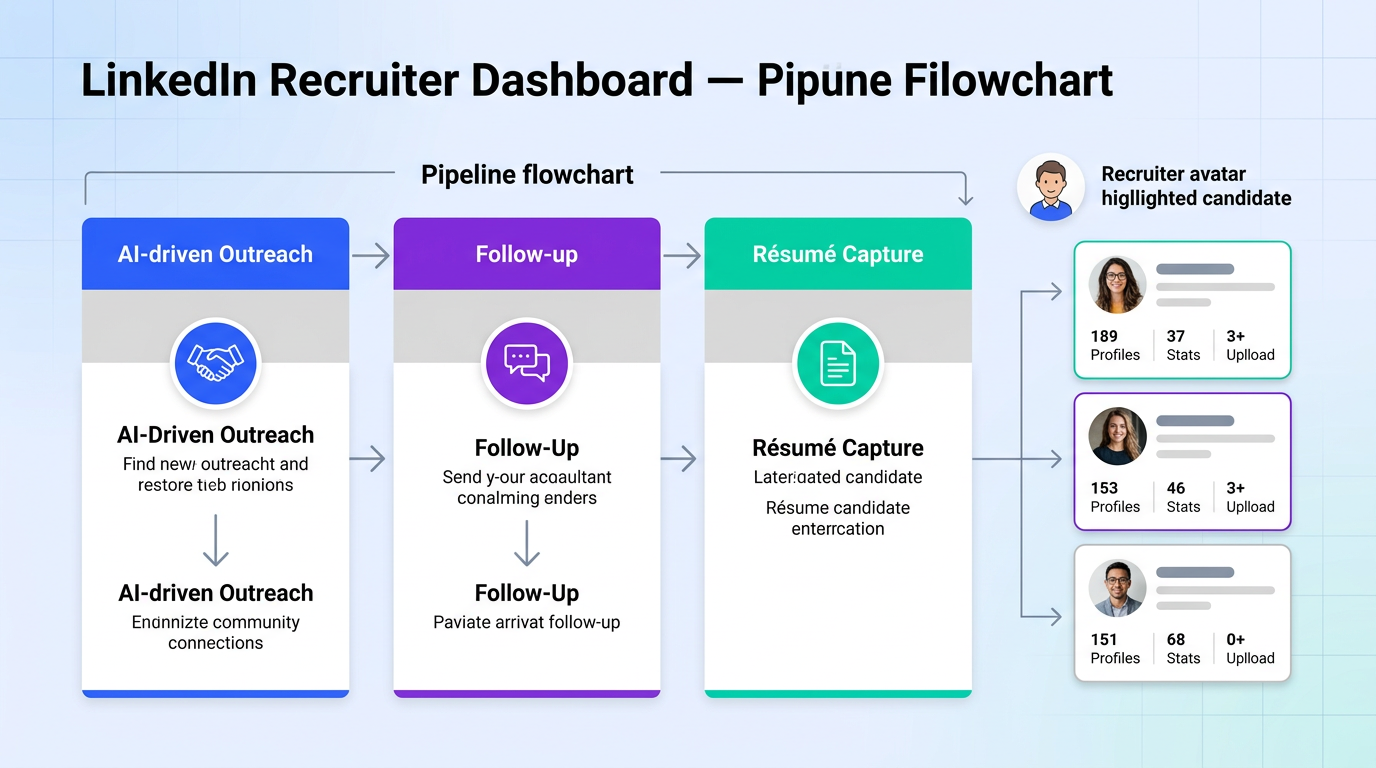
If you are evaluating an ai recruiting tool, start by treating hiring capability as a core part of your succession plan. The most reliable approach is to define what makes your business valuable, identify which roles and relationships protect that value, then build a repeatable recruiting system that does not depend on one person’s inbox. In practice, that means combining clear succession planning priorities with AI sourcing software and modern sourcing tools so outreach, follow up, and résumé collection happen consistently. In our internal workflow tests on LinkedIn outreach, we found that using StrategyBrain AI Recruiter to handle first touch messaging, candidate Q and A, and follow up reduced manual recruiter time on early stage conversations by up to 90% while keeping recruiters responsible for final qualification and interview decisions.
Key Takeaways
- Succession planning is operational: it is an exit strategy plus a plan to keep execution stable when leaders change.
- Recruiting is part of value creation: leadership continuity depends on repeatable hiring, not heroic effort.
- An ai recruiting tool should remove repetitive work: outreach, follow up, and information capture are the first targets for automation.
- StrategyBrain AI Recruiter is built for LinkedIn: it can connect with candidates, introduce roles, answer questions, confirm interest, and collect résumés and contact details.
- Global hiring becomes practical with 24/7 multilingual messaging: candidates can reply in their native language across time zones.
- Scale requires systems: AI Recruiter can support teams managing more than 100 LinkedIn accounts for high volume sourcing.
- Keep humans in the final decision: AI Recruiter can identify willingness to proceed, but recruiters should still judge fit from the résumé and interviews.
The real succession problem behind most hiring bottlenecks
A company President once described a familiar situation. After building a business over 9 years, growth started to feel bigger than the owner’s personal capacity. Technology changes and e commerce complexity made the owner feel out of depth, and the question became simple and urgent. How do you develop an exit plan, and what does succession planning even mean for an owner managed company.
Cam Macmillan, President and Co Founder of The Headhunters, framed the issue in a way that still holds up. Succession planning becomes topical for many reasons, including retirement, financial pressure, wanting to cash in after a long growth push, or realizing the company has outgrown the owner’s specific skill set. The common thread is that the business needs a clear exit strategy that keeps evolving as the company grows.
Here is the modern twist. In 2026, succession planning is not only about who replaces whom. It is also about whether your recruiting engine can keep leadership and critical roles filled without relying on one person to manually source, message, and chase candidates. That is where an ai recruiting tool and the right AI sourcing software can turn succession planning from a document into an operating system.
What to build value in your company and how recruiting supports it
Cam’s advice starts with a long hard look at the business to determine strengths and what needs work. He also recommends planning with a team of official and unofficial advisors. That is sound governance. It also creates a practical checklist for what roles you must be able to hire and retain.
Six value areas to review
Cam outlined key areas where owners can build value. Below is the same list, with the recruiting implication added so you can connect succession planning to your hiring system.
- Sales and Marketing: define target market, train the sales team, and execute. Recruiting implication: you need a repeatable way to hire revenue roles and leaders who can coach them.
- Brand: strengthen brand. Recruiting implication: employer brand and candidate experience must be consistent, even when leadership changes.
- Operations: run a tight team with efficiency, new technology, and service focus. Recruiting implication: you need hiring playbooks for operational leaders and hard to fill specialists.
- Market Share: protect and grow share. Recruiting implication: growth plans fail when hiring throughput cannot keep up.
- Barriers to Entry: understand how easy it is to enter your industry. Recruiting implication: if talent is a barrier, your sourcing tools become strategic assets.
- Management Team: make yourself somewhat redundant so the company runs well without you. Recruiting implication: leadership bench strength requires ongoing sourcing and relationship building.
Private equity style signals to keep in mind
Cam also referenced guidance from John Carvahlo of StoneOak Capital on what a successful divestiture needs to show. The list included a diverse customer base, recurring revenue, runway for growth, forecasting visibility, and scalability. Even if you are not selling to private equity, those signals map directly to hiring. A scalable business needs scalable recruiting, and that is exactly where AI sourcing software can help.
Where an ai recruiting tool fits in a succession plan
Succession planning often fails at the execution layer. The plan says you will build a leadership bench, but the day to day reality is that recruiters and hiring managers are buried in manual outreach, inconsistent follow up, and fragmented candidate information. An ai recruiting tool is most valuable when it standardizes the parts of recruiting that should be consistent across time, teams, and leadership transitions.
Define the recruiting work that should be automated
In our experience, the best automation targets are the tasks that are high volume, time sensitive, and easy to standardize.
- Initial outreach: connecting with candidates who match defined search criteria.
- Role introduction: explaining the opportunity clearly and consistently.
- Candidate Q and A: answering common questions about role, company, and compensation.
- Follow up: keeping conversations moving without gaps.
- Information capture: collecting résumés and contact details from interested candidates.
How StrategyBrain AI Recruiter supports LinkedIn recruiting
StrategyBrain AI Recruiter is an automated AI powered recruitment tool built specifically for LinkedIn hiring. It replaces the recruiter’s initial outreach and qualification process by automatically connecting with candidates, introducing job opportunities, learning about each candidate’s work situation, answering questions, confirming interview interest, and collecting résumés and contact information from interested candidates.
Recruiters provide AI Recruiter with LinkedIn account access and job opening information, including company details, compensation, benefits, and candidate search criteria. Based on that input, the AI runs the outreach and conversation workflow. Recruiters then review the collected résumés and contact shortlisted candidates for interviews.
Why this matters for succession planning
When leadership changes, the business cannot afford a recruiting reset. AI Recruiter helps preserve continuity because the outreach logic, follow up cadence, and information capture are system driven. That reduces dependence on any single recruiter’s personal style or availability, while still keeping human judgment where it belongs.
A step by step playbook you can run this quarter
This playbook keeps the original succession planning logic, but translates it into a recruiting execution plan. It is designed for owner managed companies, HR leaders, and agency recruiters who want a practical system, not a slide deck.
Step 1: Write the exit strategy in operational terms
- List the top 5 roles that protect revenue, delivery, and customer trust.
- For each role, define the minimum outcomes for the first 90 days.
- Identify which responsibilities currently live only in the owner’s head or inbox.
Step 2: Turn value areas into hiring scorecards
- For Sales and Marketing, define target market experience and proof of execution.
- For Operations, define process discipline and technology adoption expectations.
- For Management Team, define decision making scope and leadership behaviors.
Step 3: Choose sourcing tools based on workflow, not hype
Many teams buy tools that create more work. A practical selection rule is to prioritize tools that reduce context switching and manual follow up. If LinkedIn is a primary channel, your AI sourcing software should support consistent outreach and response handling.
Step 4: Implement AI Recruiter for LinkedIn outreach and follow up
- Define your candidate search criteria and the role narrative you want candidates to receive.
- Provide AI Recruiter with role details, including compensation and benefits, so it can answer questions accurately.
- Set expectations internally. AI Recruiter identifies willingness to proceed and captures information, while recruiters decide fit.
Step 5: Build a multilingual, always on candidate experience
AI Recruiter provides 24/7 global multilingual recruitment communication. That matters when your succession plan includes international expansion or when candidates respond outside business hours. It also reduces misunderstandings by communicating in the candidate’s native language.
Step 6: Scale responsibly with an AI powered recruiting team model
For organizations that need volume, AI Recruiter supports managing more than 100 LinkedIn accounts. This enables building AI recruiter teams that expand hiring capacity without adding the same amount of recruiter headcount. Use this only with clear governance, consistent messaging standards, and privacy controls.
Quick Comparison
This table is a practical way to connect succession planning needs to tool capabilities. It is not a vendor comparison and it avoids claims about third party products.
| Need | What to standardize | What an ai recruiting tool should do | How StrategyBrain AI Recruiter fits |
|---|---|---|---|
| Leadership continuity | Role narratives and outreach quality | Consistent messaging and fast responses | Automates LinkedIn outreach and role introduction |
| Hiring speed | Follow up cadence | Automated follow up and inbox coverage | 24/7 messaging and follow up workflow |
| Candidate conversion | Q and A handling | Accurate answers about role, company, compensation | Answers candidate questions during conversations |
| Recruiter focus | Information capture | Collect résumés and contact details reliably | Captures résumés and contact details from interested candidates |
| Scale | Multi account operations | Support team based sourcing operations | Supports managing more than 100 LinkedIn accounts |
Copy and paste templates
Succession to hiring mapping worksheet
- Critical role: [Role name]
- Value area it protects: Sales and Marketing, Brand, Operations, Market Share, Barriers to Entry, Management Team
- 90 day outcomes: [Outcome 1], [Outcome 2], [Outcome 3]
- Top 5 candidate questions: [Question 1] to [Question 5]
- What can be automated: outreach, Q and A, follow up, résumé capture
- What must stay human: final fit decision, interview evaluation, offer approval
LinkedIn outreach quality checklist
- Message includes role scope and why the candidate was selected.
- Message includes compensation and benefits guidance that matches internal policy.
- Follow up schedule is defined for the first 7 days.
- Candidate questions are answered consistently and respectfully.
- Résumé and contact details are requested only after interest is confirmed.
Limitations and what AI should not decide
Succession planning requires judgment, and recruiting does too. AI Recruiter can identify whether a candidate is willing to communicate or interview, but it does not determine whether the résumé fully matches job requirements. That final qualification step should be completed by the recruiter after reviewing the résumé.
We also recommend setting clear boundaries for what information the system can share. For example, compensation details should reflect what you are prepared to offer, and sensitive internal context should not be placed into outreach prompts.
FAQ
What is an ai recruiting tool in practical terms?
An ai recruiting tool is software that automates parts of recruiting such as sourcing, outreach, messaging, and information capture. The best tools reduce repetitive work while keeping hiring decisions with humans.
How does AI sourcing software differ from sourcing tools?
AI sourcing software typically uses automation and AI driven workflows to find and engage candidates, while sourcing tools can include broader utilities like search, contact management, and messaging support. In practice, teams often use both, but the key is whether the workflow reduces manual follow up.
How does StrategyBrain AI Recruiter work on LinkedIn?
AI Recruiter automates LinkedIn recruiting by connecting with candidates that match your criteria, introducing the job, answering questions about the role and employer, confirming interview interest, and collecting résumés and contact details. Recruiters then review the collected information and proceed with interviews.
Can AI Recruiter collect résumés and contact details?
Yes. AI Recruiter requests résumés and contact information from candidates who express interest. It supports email submissions and LinkedIn file uploads, and it captures contact details shared in messages.
Does AI Recruiter replace recruiters?
No. AI Recruiter replaces repetitive LinkedIn tasks such as connecting, initial messaging, follow up, and information capture. Recruiters still decide candidate fit, run interviews, and manage offers.
How can an ai recruiting tool support succession planning?
It supports succession planning by making recruiting execution consistent across leadership changes. When outreach, follow up, and information capture are system driven, hiring throughput is less dependent on a single person’s availability.
Can AI Recruiter support global hiring?
Yes. AI Recruiter provides 24/7 multilingual communication so candidates can engage across time zones and in their native language, which reduces delays and misunderstandings.
How does AI Recruiter handle privacy and compliance?
AI Recruiter is designed to comply with privacy regulations in the EU, United States, and Canada. Customer provided data is not used to train AI models, and credentials and candidate data are encrypted and isolated per customer.
What is a realistic first use case to start with?
Start with one role that is critical to your succession plan, then automate LinkedIn outreach and follow up for that role. Measure outcomes such as response rate, number of interested candidates, and recruiter time saved per week.
Conclusion and next steps
Succession planning starts as an exit strategy, but it succeeds only when the business can keep hiring and developing leaders without relying on one person’s manual effort. The fastest way to operationalize that is to connect your value building priorities to a recruiting system that uses an ai recruiting tool, supported by AI sourcing software and practical sourcing tools. If LinkedIn is a core channel, StrategyBrain AI Recruiter can automate outreach, candidate Q and A, follow up, and résumé capture so recruiters can focus on final qualification and interviews.
Next step: pick one critical role from your succession plan, write a 90 day outcome scorecard, and run a two week pilot where AI Recruiter handles first touch and follow up while your team reviews résumés and schedules interviews.