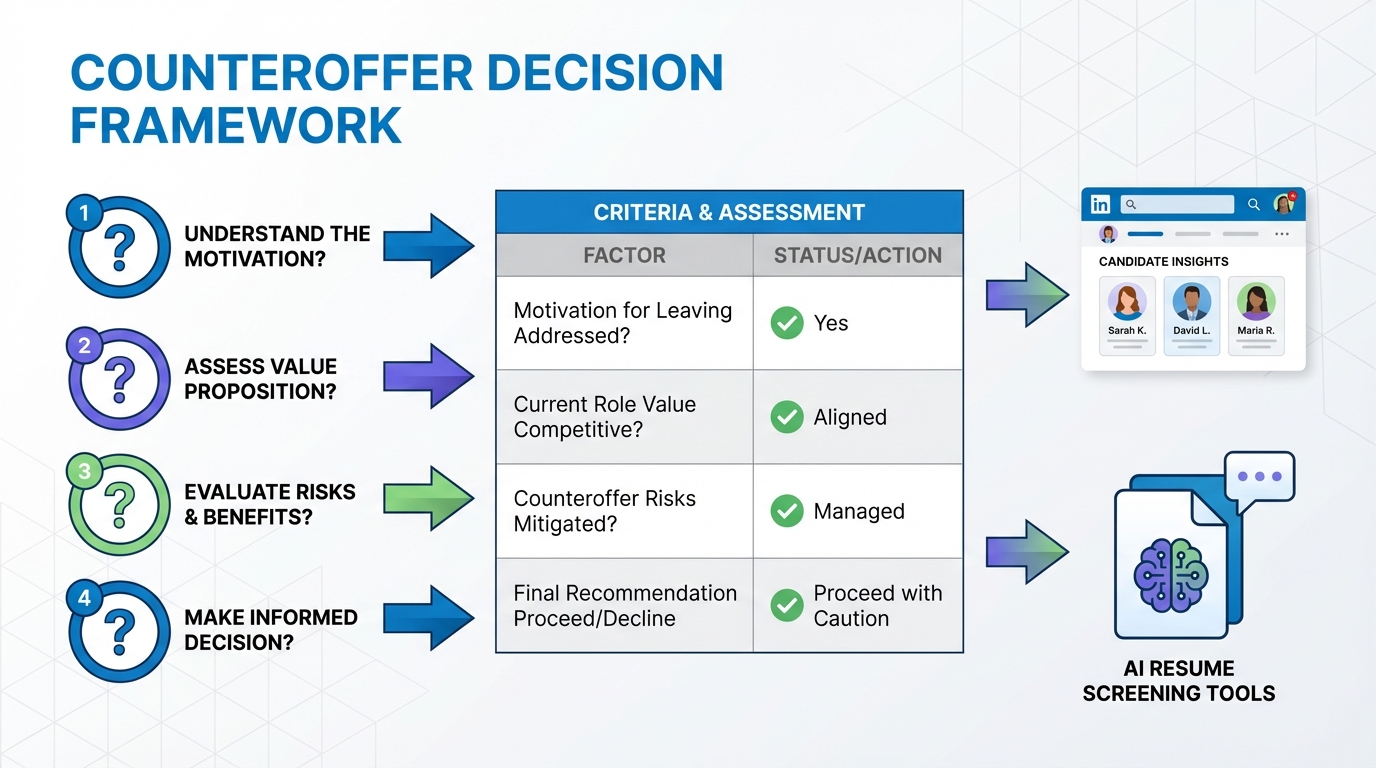
If you are considering a counteroffer after accepting a new job, the most reliable approach is to slow down and answer four questions: why you were not valued earlier, what staying will feel like after trust changes, why you wanted to leave in the first place, and whether you can afford the reputational risk of backing out. This decision also intersects with modern hiring operations that use ai resume screening tools, because employers often commit real time and budget before an offer is issued. In this guide, I keep the original four question framework, add a practical checklist you can copy, and share how teams using StrategyBrain AI Recruiter can reduce last minute offer churn by improving candidate communication and follow up.
What changes the moment a counteroffer appears
A counteroffer can feel flattering because it arrives at the exact moment you have leverage. Still, leverage is not the same as long term alignment. The practical risk is that the counteroffer is sometimes driven by urgency and inconvenience rather than a durable change in how you are valued.
From the employer side, the offer stage is also where hiring teams are most exposed. If a candidate backs out late, the team loses time spent on interviews, approvals, and onboarding planning. In organizations that rely on ai resume screening tools, the pipeline can move faster, but the cost of late stage drop off can still be high because the process is optimized for throughput.
Question 1: Why was I not valued before
Ask yourself why it took your resignation to trigger a compensation or title correction. If you previously asked for a raise or promotion and were declined, the counteroffer may be less about recognizing your value and more about avoiding the disruption of replacing you.
Also ask where the budget is coming from and what changed in the business case. If the answer is vague, treat the counteroffer as a short term patch, not a long term plan. In my experience reviewing offer scenarios with candidates, the most stable counteroffers are the ones that come with a clear scope change, a documented plan, and a timeline for follow through.
Question 2: What will it be like if I stay
Once you resign, your intent is known. Even if you stay, your manager now knows you were ready to leave. That can change trust dynamics, future opportunities, and how your actions are interpreted.
Think through day to day reality. Will you feel comfortable asking for time off, taking a personal appointment, or showing up dressed for an interview day. Will leadership assume you are still looking. If the workplace becomes tense, the counteroffer can turn into a delay rather than a solution.
Question 3: Why did I want to leave
Money is rarely the only reason people resign. Revisit the top three reasons you wanted to leave and write them down in plain language. Common categories include role scope, growth path, team health, culture, and management style.
Then evaluate whether the counteroffer addresses those reasons or only increases compensation. If your employer promises change, be careful with timelines and accountability. Habitual patterns and ingrained culture are difficult to change quickly, even with good intentions.
Question 4: Am I willing to risk burning bridges
Backing out after accepting an offer can damage relationships with the new employer, the recruiter, and sometimes the broader industry network. The new employer likely invested time in interviews, internal alignment, and negotiation. Pulling out late can create real operational pain.
Step back and look at the big picture. Is this a company you might want to work with later. Will rejecting the offer affect your reputation with that team or recruiter. If you decide to say no, do it quickly and professionally so you minimize disruption.
Final note on communication: Whatever you decide, be intentional about how you communicate it. Do not disappear on either party. A clear, respectful message protects your reputation and keeps future doors open.
Decision tools you can copy
Counteroffer decision checklist
- Value history: I can explain why I was not valued earlier and what has materially changed.
- Trust reality: I have a realistic view of how staying will affect trust, visibility, and future promotions.
- Root causes: The counteroffer addresses my top three reasons for leaving, not only compensation.
- Written commitments: Any promised changes are documented with owners and dates.
- Reputation risk: I understand the impact of backing out on the new employer and recruiter relationships.
- Decision speed: I will decide within 48 hours and communicate clearly to both sides.
Two scripts you can adapt
Script A: Declining the counteroffer and moving forward
- Thank you for the counteroffer and for recognizing my contributions.
- After careful consideration, I am going to proceed with the new opportunity.
- I want to ensure a smooth transition and will document handoffs before my last day.
Script B: Declining the new offer after accepting
- Thank you again for the offer and the time your team invested in the process.
- After a change in circumstances, I will not be able to move forward.
- I am sharing this as soon as possible to minimize disruption, and I appreciate your understanding.
How this connects to ai resume screening tools and hiring teams
Job seekers often ask variations of how to trick ai resume screening. From a hiring perspective, that question is a signal that the process may feel opaque. When candidates do not understand what is happening, they are more likely to disengage, delay, or accept counteroffers because uncertainty grows.
In teams that use ai resume screening tools, the best retention lever is not only screening accuracy. It is consistent, timely communication from first outreach through offer. That is where StrategyBrain AI Recruiter fits naturally into the workflow. It automates LinkedIn outreach and follow up, answers candidate questions about role details, company context, and compensation, and collects resumes and contact details from interested candidates. Because it can respond 24/7 in the candidate’s native language, it reduces the silent gaps where candidates start second guessing or entertaining counteroffers.
We have also seen that scaling outreach across multiple LinkedIn accounts changes the math for recruiting teams. StrategyBrain AI Recruiter supports managing more than 100 LinkedIn accounts, which enables an AI powered recruiting team model. In practice, that means recruiters can spend more time on final qualification and interviews, and less time on repetitive messaging that often determines whether a candidate stays engaged long enough to reach the offer stage.
Practical guidance for employers using AI Recruiter during offer stage
- Preempt counteroffers: Confirm motivation and constraints before the offer is issued, then follow up within 24 hours of sending the offer.
- Reduce ambiguity: Ensure compensation, benefits, and start date details are answered consistently in writing.
- Keep momentum: Use automated follow up to prevent 48 to 72 hour silence windows that invite counteroffer pressure.
- Collect what you need early: Capture resume and contact details as soon as interest is confirmed so the handoff to the recruiter is clean.
FAQ
Do ai resume screening tools decide who gets hired
No. In most hiring processes, ai resume screening tools help prioritize or filter applications, but humans still make final decisions. The exact balance depends on the employer’s policy and compliance requirements.
Is it unethical to search for how to trick ai resume screening
Trying to misrepresent experience is unethical and can lead to termination if discovered. A better approach is to write a clear, truthful resume that matches the job description using accurate keywords and measurable outcomes.
Should I accept a counteroffer if the money is significantly higher
Higher pay can be a valid reason, but it should not be the only reason. Use the four questions in this guide to confirm whether the underlying issues that made you resign have actually changed.
How fast should I respond to a counteroffer
Respond within 48 hours. A long delay increases stress, damages trust, and creates operational problems for the new employer.
What is the biggest risk of accepting a counteroffer
The biggest risk is that the counteroffer fixes compensation but not the reasons you wanted to leave, such as culture or management. Another risk is a lasting trust shift after your resignation becomes known.
How can employers reduce offer drop off when candidates get counteroffers
Reduce uncertainty and keep communication tight. Tools like StrategyBrain AI Recruiter can help by maintaining consistent follow up, answering role and compensation questions quickly, and keeping candidates engaged across time zones.
Does StrategyBrain AI Recruiter replace human recruiters
No. StrategyBrain AI Recruiter automates initial LinkedIn outreach, messaging, and information collection. Recruiters still review resumes and run interviews, and they make the final qualification decision.
How does AI Recruiter handle privacy and compliance
According to StrategyBrain product information, AI Recruiter complies with privacy regulations in the EU, United States, and Canada, encrypts credentials, and does not use customer provided data to train AI models. Always validate your own compliance requirements with legal counsel before deployment.
Conclusion
A counteroffer is easiest to accept when emotions are high and leverage is fresh. The better decision is the one that holds up after you answer the four questions about value history, trust dynamics, root causes, and reputation risk. If you are a job seeker, use the checklist and decide quickly so you can communicate professionally. If you are an employer using ai resume screening tools, focus on the part of the funnel that most affects acceptance: fast, consistent candidate communication. StrategyBrain AI Recruiter is designed to automate LinkedIn outreach and follow up, keep candidates engaged 24/7 in any language, and collect resumes and contact details so recruiters can focus on final qualification and interviews.