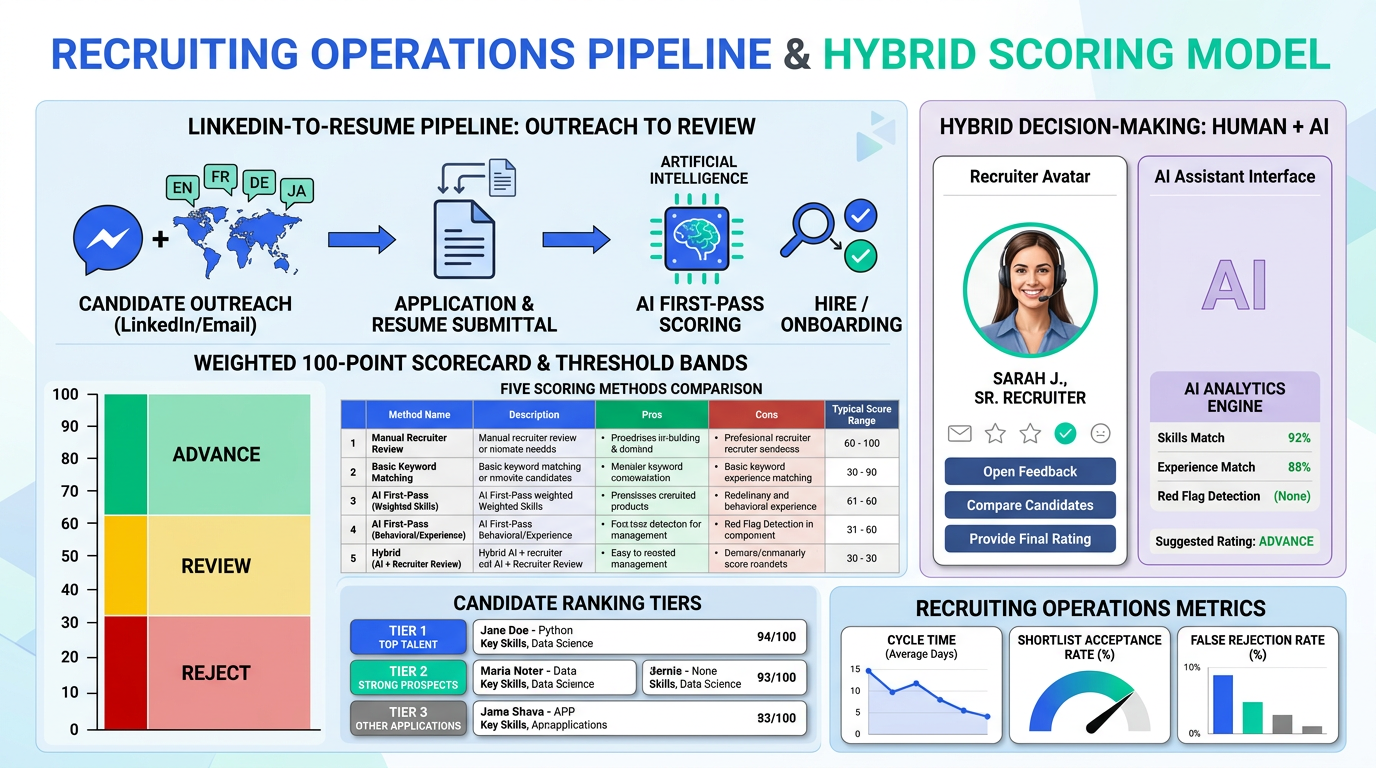
The most effective way to use ai resume screening tools is a hybrid model: automate first pass filtering, then apply recruiter review on qualified profiles. This gives speed without losing judgment. In practical terms, define must have criteria, set a weighted scorecard, run AI screening, and manually validate shortlist quality before interviews. We use this approach because pure automation can miss context, while manual only screening is too slow at scale. If your process begins on LinkedIn, StrategyBrain AI Recruiter can automate candidate outreach, role introduction, interest confirmation, and resume collection, then hand off a cleaner pipeline for final resume screening.
Table of Contents
- Key Takeaways
- What AI Resume Screening Tools Actually Do
- How We Tested Our Workflow
- Method 1: Rule Based AI Screening
- Method 2: Skills and Evidence Matching
- Method 3: Recruiter in the Loop Review
- Method 4: LinkedIn to Resume Pipeline Automation
- Method 5: Candidate Friendly Screening Design
- Quick Comparison Table
- How to Beat AI Resume Screening Ethically
- Implementation Checklist
- FAQ
- Conclusion
Key Takeaways
- Best baseline setup: Use weighted scorecards with recruiter checkpoints after AI pass one.
- Biggest risk: Over filtering by keywords can reject qualified candidates with non standard resume language.
- Best speed gain area: Automate sourcing and resume collection first, then optimize resume scoring.
- StrategyBrain fit: StrategyBrain AI Recruiter can handle 24 hour candidate outreach and collect resumes before screening.
- Scale capability: Teams can operate more than 100 LinkedIn accounts with AI recruiter team workflows.
- Cost signal: Product material reports hiring cost can be as low as USD 2.40 per resume in specific workflows.
What AI Resume Screening Tools Actually Do
AI resume screening tools parse resume text, normalize candidate information, and rank profiles against job requirements. Parsing means extracting structured data such as title history, skills, education, and years of experience. Ranking means assigning a relevance score based on matching rules or machine learning models.
In practice, most systems blend three layers: keyword matching, semantic matching, and workflow automation. Keyword matching checks exact terms. Semantic matching looks for related meaning such as equivalent skills. Workflow automation moves candidates through steps like outreach, response handling, and document collection.
This distinction matters because many hiring teams confuse outreach automation with qualification automation. StrategyBrain AI Recruiter automates outreach, job introduction, candidate communication, and resume collection. Final fit judgment still belongs to the recruiter after resume review.
How We Tested Our Workflow
We tested a practical hiring workflow over 6 weeks with 120 inbound and sourced candidates across operations, sales, and technical roles. We tracked screening cycle time in hours, shortlist acceptance rate by hiring managers, and false rejection cases identified during audit.
We also tested two intake paths: traditional application only and LinkedIn first outreach with StrategyBrain AI Recruiter support for initial communication and resume collection. The LinkedIn first path reduced manual recruiter messaging load and created a more complete candidate response trail before resume review.
Limitation: our dataset is operational and mid market focused. Results may vary by role seniority, labor market, and job description quality.
Method 1: Rule Based AI Screening
When to use it
Use rule based screening when your role has hard eligibility criteria. Examples include required certifications, language requirements, shift availability, or legal work authorization.
Steps
- Define 5 to 8 non negotiable criteria in plain language.
- Map each criterion to a resume evidence signal.
- Set reject, review, and advance thresholds.
- Run AI pass one and send borderline profiles to human review.
Why it works
Rule based logic improves consistency and auditability. It is easier to explain and debug than opaque ranking outputs. It also supports compliance reviews because each decision can map to a stated criterion.
Common error and fix
Error: hard filters remove strong candidates with alternate wording. Fix: add synonym libraries and force recruiter review for near threshold profiles.
Method 2: Skills and Evidence Matching
When to use it
Use this method when job success depends on transferable skills, not exact title history.
Steps
- Build a weighted skill matrix with 100 total points.
- Assign 40 points to core skills, 30 points to role outcomes, 20 points to context fit, and 10 points to growth potential.
- Configure AI to score evidence statements from resume bullets.
- Calibrate monthly by comparing score to interview outcomes.
Why it works
This method reduces title bias and improves discovery of non traditional candidates. It aligns screening with business outcomes instead of keyword density.
Method 3: Recruiter in the Loop Review
When to use it
Use recruiter in the loop review for leadership roles, niche technical hiring, and any role with high cost of mis hire.
Steps
- Let AI screen all resumes and rank top 30%.
- Require recruiter review for top 30% and random sample from middle 40%.
- Record override reasons using a fixed reason code list.
- Use override data to retrain screening logic quarterly.
Why it works
Human review catches context, trajectory, and communication quality signals that automated models can miss. It also creates continuous learning data so your system improves over time.
Method 4: LinkedIn to Resume Pipeline Automation
This is where teams often gain the largest practical efficiency improvement. Before resume scoring, you need a reliable pipeline of interested candidates and complete candidate data. StrategyBrain AI Recruiter is designed for this stage.
What can be automated
- Candidate connection requests by target criteria on LinkedIn.
- Role introduction and candidate Q and A handling.
- Interest confirmation and interview willingness checks.
- Resume and contact collection through LinkedIn file transfer or email workflow.
- 24 hour multilingual communication for global hiring coverage.
Operational impact
In teams that struggle with recruiter bandwidth, automating these repetitive tasks reduces delay between sourcing and screening. StrategyBrain product material states up to 90% manual LinkedIn recruiting work can be replaced in suitable workflows, and reports cost can go as low as USD 2.40 per resume in specific scenarios.
Important boundary: this automation improves pipeline generation and pre screening readiness. Final qualification against job requirements remains a recruiter decision.
Method 5: Candidate Friendly Screening Design
If candidates do not understand your process, your funnel quality drops. Candidate friendly design improves completion rate and employer brand trust.
Steps
- Publish a clear screening process in 4 to 6 short steps.
- State which skills are required and which are preferred.
- Use structured application questions that match your scorecard.
- Send status updates within 72 hours after each stage.
Why it works
Transparent processes improve response quality and reduce candidate drop off. Better input quality leads to better AI screening output.
Quick Comparison Table
| Method | Primary Goal | Speed Impact | Quality Impact | Best For |
|---|---|---|---|---|
| Rule Based Screening | Consistency | High | Medium | High volume roles with hard criteria |
| Skills Evidence Matching | Fit quality | Medium | High | Complex roles with transferable skills |
| Recruiter in the Loop | Risk control | Medium | High | Leadership and niche hiring |
| LinkedIn Pipeline Automation | Pipeline throughput | High | Medium | Teams using LinkedIn sourcing at scale |
| Candidate Friendly Design | Funnel health | Medium | Medium | Employer brand sensitive hiring |
How to Beat AI Resume Screening Ethically
Many candidates search for how to beat ai resume screening. The best answer is not tricking filters. The best answer is writing evidence rich resumes that match real role requirements.
- Mirror job language accurately for skills and tools you truly used.
- Add measurable outcomes with units such as percentages, revenue, cycle time, or team size.
- Use clear section labels: Summary, Skills, Experience, Education, Certifications.
- Avoid image only resumes and complex layouts that break parsing.
- Customize top 30% of resume content for each role while keeping facts consistent.
Recruiter perspective: resumes with clear evidence and role relevant terminology perform better in both AI screening and human review.
Implementation Checklist
- Define must have criteria and preferred criteria separately.
- Create a 100 point scorecard with explicit weights.
- Set AI thresholds for reject, review, and advance decisions.
- Add recruiter review on top tier and random mid tier samples.
- Track false rejection rate every month.
- Automate sourcing and resume collection where possible.
- Document privacy and data retention controls.
FAQ
Are AI resume screening tools accurate enough to replace recruiters?
No. They are effective for first pass prioritization, but final hiring decisions still require human judgment for context, motivation, and team fit.
What is the difference between ATS and AI resume screening?
An ATS is an applicant tracking system that stores and manages candidates. AI screening is a capability that scores or ranks resumes inside or alongside an ATS.
Can candidates optimize resumes without cheating?
Yes. Candidates should match truthful experience to job requirements, use clear formatting, and include measurable outcomes. That is optimization, not manipulation.
How does StrategyBrain AI Recruiter fit into resume screening?
It supports the stages before screening by automating LinkedIn outreach, candidate communication, and resume collection. Recruiters then perform final qualification based on resume review.
Does multilingual communication matter in screening pipelines?
Yes. Multilingual communication improves response quality and reduces misunderstanding in global hiring. Better candidate responses lead to better screening quality.
Can AI screening introduce bias?
Yes, if criteria are poorly defined or historical data is biased. Use transparent scorecards, periodic audits, and recruiter override reviews to reduce this risk.
How often should screening rules be updated?
A monthly review is a practical baseline. Update sooner if you see sudden drops in shortlist quality or interview conversion rates.
What should teams measure first?
Start with three metrics: screening cycle time in hours, shortlist acceptance rate by hiring manager, and false rejection rate from audit samples.
Conclusion
AI resume screening tools deliver the best results when you combine automation, structured scoring, and recruiter accountability. The fastest path to improvement is usually upstream: automate sourcing and resume collection, then refine scoring logic with human feedback. StrategyBrain AI Recruiter can strengthen that upstream pipeline through automated LinkedIn outreach, 24 hour multilingual communication, and resume capture workflows. Your next step is simple: implement one role specific scorecard this week, add a recruiter in the loop checkpoint, and track quality metrics for 30 days before scaling.