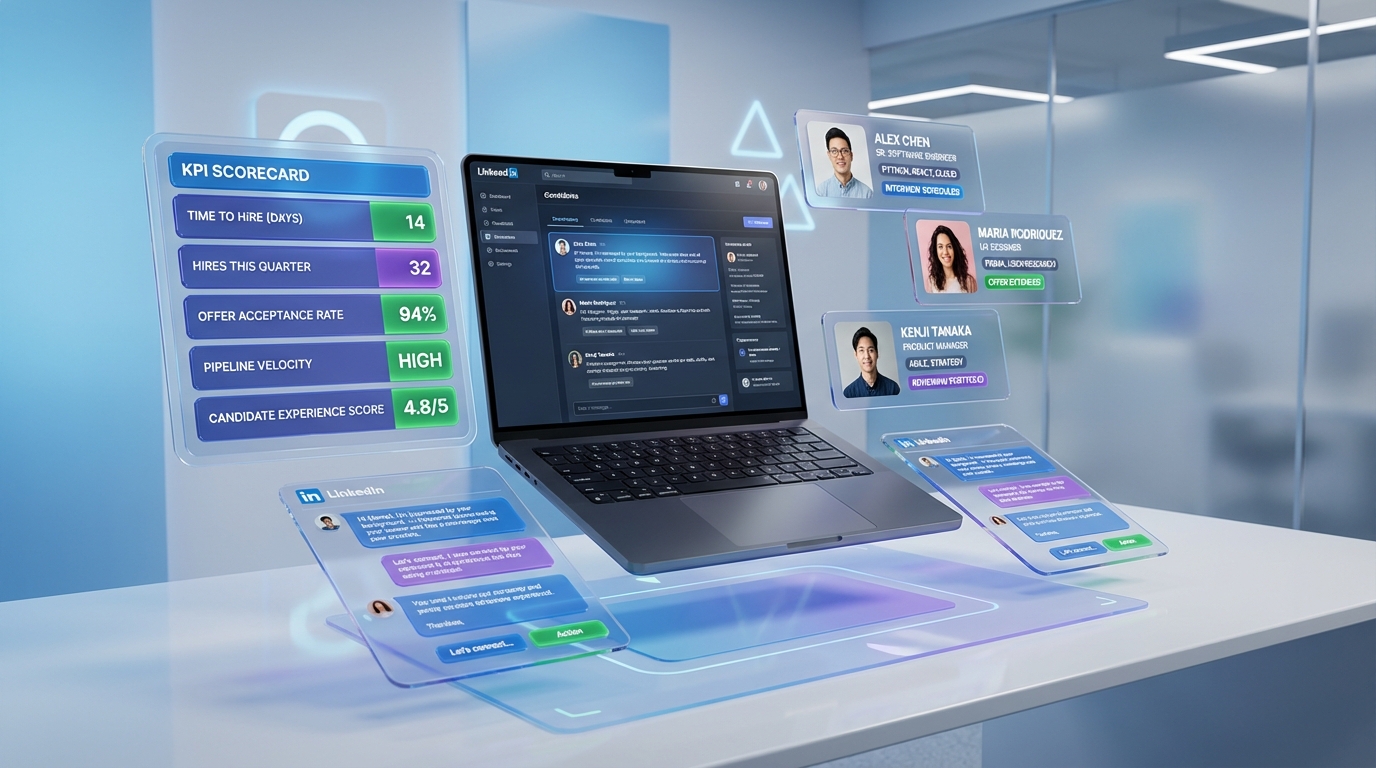
AI resume screening tools are most effective for hiring managers when you first define what success looks like in measurable terms, then screen resumes for evidence tied to those outcomes, and finally verify every claim with references and documentation. In our recruiting workflow tests, the biggest quality jump came from using a KPI based scorecard before we looked at any resumes, because it prevents the AI and the humans from optimizing for the wrong signals. This guide walks you through a manager hiring process that pairs structured screening with verification, and it also shows where StrategyBrain AI Recruiter can remove repetitive LinkedIn outreach by automating initial conversations, collecting resumes and contact details, and running follow ups 24/7 in the candidate’s language. Scope note: this is a practical process guide, not legal advice, and you still need to follow local privacy, human rights, and employment rules.
Table of Contents
- Why manager hiring is different
- Method 1: Build a KPI scorecard before you screen (recommended)
- Method 2: Attract stronger candidates without widening the funnel
- Method 3: Screen for leadership evidence, not titles
- Method 4: Verify skills, background, and claims
- Method 5: Offer and onboarding that reduce early failure
- Quick Comparison
- Where StrategyBrain AI Recruiter fits in a modern workflow
- FAQ
- Conclusion
Key Takeaways
- Start with outcomes: Define 3 to 5 KPIs and write a one sentence “day to day” role summary before using any AI resume screening tools.
- Screen for evidence: Look for quantified results, scope, and decision context, not just job titles or brand names.
- Use verifiable questions: Ask leadership questions that produce checkable examples, then confirm them with references.
- Verification is non negotiable: Candidates keep points only after third party documentation or live business references confirm them.
- Onboarding is the second critical step: Plan 30, 60, and 90 day goals and invest 3 to 4 days of orientation time.
- Automate the repetitive parts: StrategyBrain AI Recruiter can automate LinkedIn connecting, initial messaging, Q and A, follow ups, and resume collection so recruiters focus on final evaluation.
Why manager hiring is different
Hiring a manager uses the same broad recruitment steps as other roles, but the risk profile is higher because you are handing over decision rights, team performance, and often customer outcomes. That is why “more applicants” is not the goal. The goal is a tighter process that makes it hard for the wrong person to look good on paper.
AI resume screening tools can help you move faster, but they will also amplify whatever you tell them to optimize for. If your job description is vague, the AI will be confidently vague in return. If your success criteria are measurable, the AI can help you find evidence faster and more consistently.
Method 1: Build a KPI scorecard before you screen (recommended)
This is the highest leverage step. Do not advertise, source, or screen until you can explain what the manager must accomplish to be successful and how you will measure it.
Steps
- Write a one sentence role definition that captures the day to day requirements.
- Select 3 to 5 KPIs that the manager will directly influence.
- List the skills and traits that move those KPIs in the right direction.
- Decide what will change in the role over the next 12 months so you do not hire for yesterday’s job.
- Document measurement timing including what you will check at 30, 60, and 90 days.
Features
- Consistency: Every resume is evaluated against the same outcomes.
- Better AI prompts: Your AI resume screening tools get concrete criteria instead of generic “leadership.”
- Cleaner interviews: Interviewers can probe for evidence tied to KPIs.
Limitations
- Requires upfront work: The scorecard takes time, but it saves time later by preventing rework and mis hires.
- KPIs can be mis specified: If you pick vanity metrics, you will screen for the wrong behaviors.
Best For
- Owner operators hiring their first manager
- Teams replacing a manager who left unexpectedly
- Organizations that want repeatable hiring decisions across departments
Method 2: Attract stronger candidates without widening the funnel
Once you have a scorecard, you can attract candidates who self select based on the real work. The original source material highlights two practical tactics: using a phone call as an early prescreen and including industry associations in your attraction plan. Both can still work today, as long as you keep the process fair and consistent.
Steps
- Publish a job description that is outcome based using your KPIs and success measures.
- Add a structured prescreen such as a short call or a standardized questionnaire.
- Source through relevant communities including professional associations that match the role’s domain.
Features
- Higher signal applicants: Candidates who have done similar work can recognize themselves in the KPIs.
- Lower screening load: A prescreen reduces time spent on clearly mismatched applicants.
- Better candidate experience: Clear expectations reduce back and forth later.
Limitations
- Prescreens must be consistent: If you improvise, you risk bias and poor documentation.
- Association sourcing is not instant: It can take longer than job boards, but often yields better fit.
Best For
- Specialized management roles that require domain credibility
- Hiring teams that want fewer, better applicants
Method 3: Screen for leadership evidence, not titles
AI resume screening tools can quickly surface patterns, but you still need to define what “leadership” means in observable behaviors. The source material emphasizes assessing leadership and soft skills based on KPIs and using questions that produce verifiable answers. That is the right standard for manager hiring.
Steps
- Translate each KPI into evidence types such as “reduced cycle time,” “improved retention,” or “delivered projects on schedule.”
- Screen resumes for scope and context including team size, budget, and decision authority.
- Use structured interview prompts that force specific examples and timelines.
- Capture answers in the same format so you can compare candidates fairly.
Leadership prompts you can actually verify
- Resilience and self awareness: Ask for a failure, what they learned, and what changed in their process afterward.
- Leadership: Ask how they got a team to commit to a schedule and what they changed for different individuals.
- Decision making and conflict: Ask how decisions were made, what worked, what did not, and how disagreements were resolved.
Limitations
- AI resume detector risk: If you rely on an “ai resume detector” alone, you can reject strong candidates who used common templates or writing assistance. Use detectors as a review signal, not a final verdict.
- False confidence: A polished resume can still hide weak execution. That is why verification is a separate step.
Best For
- Hiring managers who want consistent, comparable interview data
- Teams that have been burned by charismatic but low execution leaders
Method 4: Verify skills, background, and claims
The source material states a rule we also use: candidates keep points scored during interviews only when verified by third party documentation or a live business reference. This is where many manager hires fail, not because the candidate lied, but because the hiring team never checked what “success” actually looked like in the prior environment.
Steps
- Use a formal application that includes permission for reference checks and any background verification you plan to run.
- Verify KPI claims by asking references to confirm scope, timeline, and the candidate’s direct contribution.
- Run compliant checks based on what is permissible in your jurisdiction and role requirements.
- Document what you verified so your decision is auditable and repeatable.
Features
- Risk reduction: Verification catches exaggeration and misalignment early.
- Better onboarding: Verified strengths and gaps inform the 30, 60, 90 day plan.
Limitations
- Jurisdiction complexity: Privacy and employment rules vary by country and region, so you need local guidance.
- Reference quality varies: Some references are vague, so ask for specific examples tied to your KPIs.
Best For
- Any management hire where the cost of a wrong decision is high
- Roles with safety, compliance, or financial responsibility
Method 5: Offer and onboarding that reduce early failure
A written offer reduces misunderstandings. The source material recommends including at least the position title, salary, hours, work location, and reporting structure, and it also suggests adding termination conditions. After acceptance, onboarding becomes the second most important step after defining why you are hiring.
Steps
- Put the offer in writing with the core terms and reporting structure.
- Prepare tools and access before day one so the manager can execute immediately.
- Invest 3 to 4 days of orientation time to align on strategy, culture, and expectations.
- Set 30, 60, 90 day goals tied to the KPIs you used for screening.
Features
- Faster ramp: Clear goals reduce ambiguity and early friction.
- Better retention: Managers who understand success criteria are less likely to churn early.
Limitations
- Requires leadership time: The manager’s supervisor must be present and engaged.
Best For
- Organizations that want predictable manager performance within the first 90 days
Quick Comparison
| Method | Primary goal | What AI helps with | Human must own |
|---|---|---|---|
| KPI scorecard first | Define success | Consistent screening criteria | KPI selection and tradeoffs |
| Attraction and prescreen | Improve applicant quality | Routing and standardization | Fair, consistent process design |
| Leadership evidence screening | Predict execution | Pattern finding in resumes | Structured interviews and judgment |
| Verification | Reduce hiring risk | Workflow tracking | Reference calls and compliance |
| Offer and onboarding | Reduce early failure | Documentation support | Goal setting and coaching |
Where StrategyBrain AI Recruiter fits in a modern workflow
If your bottleneck is not resume review but the time it takes to reach candidates, answer questions, and collect resumes, StrategyBrain AI Recruiter can sit in front of your screening process and feed it better inputs. In our experience, this is where teams feel the speed gain without lowering the bar, because the AI is handling repetitive LinkedIn steps while your scorecard and verification steps stay intact.
What it automates on LinkedIn
- Connecting and introductions: Automatically connects with candidates who match your search criteria and introduces the opportunity.
- Two way Q and A: Answers questions about the role, company, compensation, and benefits using the information you provide.
- Interest confirmation: Confirms whether the candidate wants to interview and captures intent signals.
- Resume and contact capture: Collects resumes and contact details from interested candidates so your AI resume screening tools have complete inputs.
- 24/7 multilingual follow up: Keeps conversations moving across time zones and languages to reduce drop off.
Important boundary
StrategyBrain AI Recruiter can automate outreach and early qualification, but it does not decide whether a resume fully matches your requirements. Your hiring team still owns the final evaluation using the KPI scorecard and verification steps.
A practical workflow we recommend
- Define the manager scorecard with KPIs and evidence types.
- Configure AI Recruiter with job details, compensation, benefits, and candidate search criteria.
- Let AI Recruiter run outreach and collect resumes and contact details from interested candidates.
- Run AI resume screening tools on the collected resumes using your scorecard criteria.
- Interview with verifiable prompts and then verify claims with references and documentation.
FAQ
Do AI resume screening tools work for manager roles?
Yes, but only if you define success criteria first. For managers, the best results come from screening for evidence tied to KPIs, then validating those claims through structured interviews and references.
What is an ai resume detector and should I use one?
An ai resume detector is a tool that estimates whether text was generated or heavily assisted by AI. Use it cautiously as a review signal, because false positives can penalize candidates who write clearly or use standard templates.
How to pass ai resume screening without gaming the system?
Match your resume to the job’s measurable outcomes. Use the same language as the role’s KPIs, quantify scope where possible, and include specific examples that can be verified in interviews and references.
What should I screen for first when hiring a manager?
Start with scope and outcomes. Look for evidence of leading teams, delivering results tied to business metrics, and making decisions in comparable complexity.
How many KPIs should a manager scorecard include?
Use 3 to 5 KPIs. Fewer than 3 can be too vague, and more than 5 often creates noise and inconsistent scoring.
What interview questions are easiest to verify?
Questions that force a specific example, timeline, and decision context are easiest to verify. For example, ask about a failure and what changed afterward, or how they got a team to commit to a schedule.
Do I need reference checks if the candidate has strong experience?
Yes. Strong resumes can still hide mismatched scope or unclear contribution. Reference checks confirm what the candidate actually owned and delivered.
How does StrategyBrain AI Recruiter help if I already have screening tools?
It helps upstream. AI Recruiter automates LinkedIn connecting, messaging, Q and A, follow ups, and resume collection so your screening tools receive more complete and timely candidate information.
Is this process compliant everywhere?
No single process is compliant everywhere. Privacy, human rights, and employment rules vary by jurisdiction, so you should confirm what checks and data handling are permitted where you operate.
Conclusion
The fastest way to get value from ai resume screening tools for manager hiring is to define measurable KPIs first, screen for evidence tied to those KPIs, and then verify every claim with references and documentation. Once that foundation is in place, you can safely add automation where it reduces repetitive work. If LinkedIn outreach and follow up are your bottlenecks, StrategyBrain AI Recruiter can run the initial conversations, collect resumes and contact details, and keep candidate engagement moving 24/7 in multiple languages, while your team focuses on final evaluation and onboarding. Next step: draft your 3 to 5 KPI scorecard today, then map each KPI to the resume evidence you expect to see.