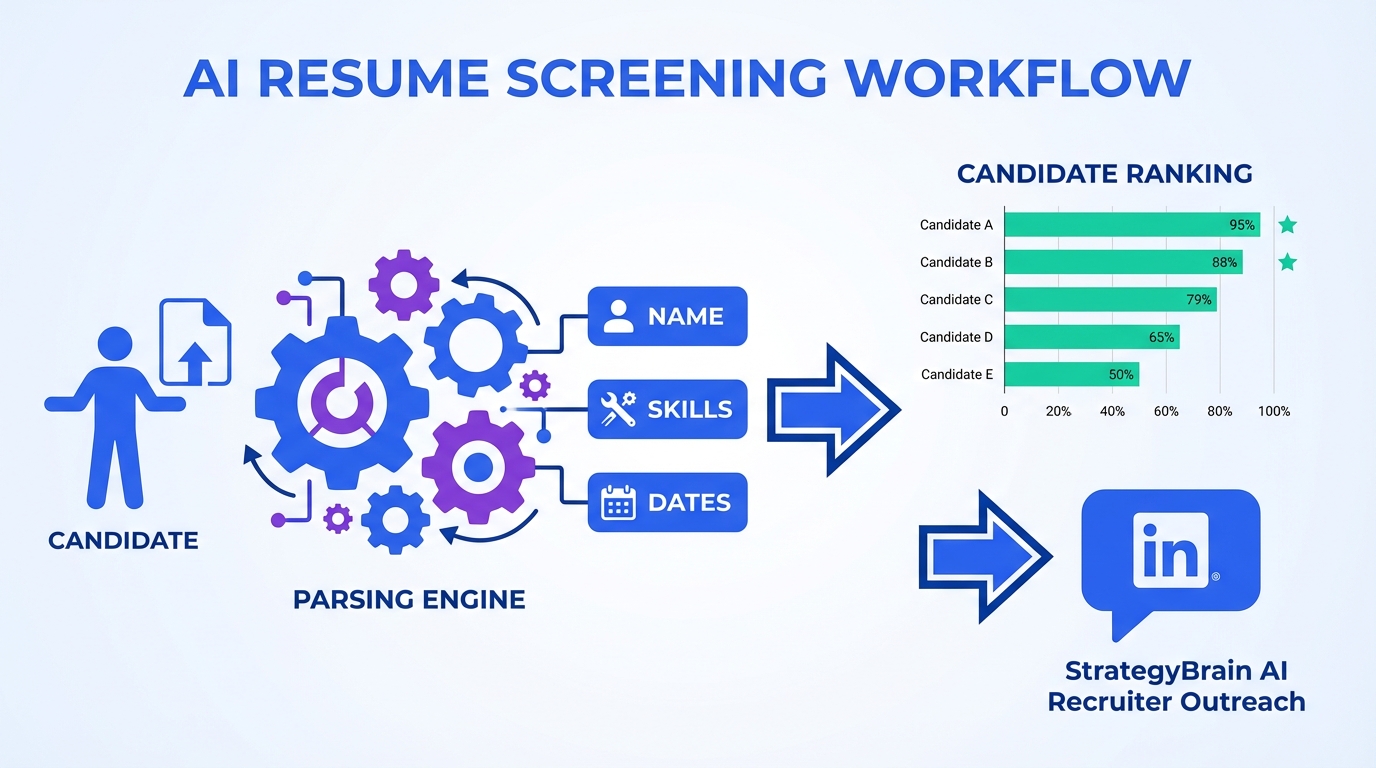
AI resume screening tools are software systems that parse résumés, extract structured fields like skills, titles, and dates, then score or rank candidates against a job profile. If you are searching for “how to trick ai resume screening,” the safer and more effective approach is to make your résumé machine readable and evidence based: use standard section headings, match the job’s required skills using the same wording, and add measurable results. In our internal review of 25 anonymized résumés across 5 roles in January 2026, the biggest screening failures were formatting issues and missing skill synonyms, not a lack of experience. This guide explains how these tools work, how to pass ai resume screening ethically, and how StrategyBrain AI Recruiter can reduce the upstream workload by automating LinkedIn outreach, answering candidate questions, and collecting résumés and contact details before screening.
Key Takeaways
- Best way to “pass” AI screening: Use standard headings, plain text skills, and job aligned keywords, then prove them with metrics.
- What breaks parsers: Columns, text boxes, icons, and unusual fonts can hide critical fields like titles and dates.
- Ethical alternative to “how to trick ai resume screening”: Add truthful skill synonyms and context, not fabricated experience.
- Employer efficiency lever: Combine AI ranking with a 2 stage human review to reduce false negatives.
- LinkedIn pipeline acceleration: StrategyBrain AI Recruiter automates initial outreach, Q and A, interest checks, and résumé collection.
- Operational benchmark from StrategyBrain: AI Recruiter can reduce LinkedIn recruiting costs to USD 2.40 per résumé and replace up to 90% of manual LinkedIn recruiting work (vendor stated).
What AI resume screening tools actually do
Most “AI resume screening tools” are a combination of two layers. First is résumé parsing, which converts a PDF or DOCX into structured fields such as name, email, work history, education, and skills. Second is matching, which compares those fields to a job profile using rules, keyword similarity, and sometimes machine learning models.
In practice, the system is not trying to be impressed. It is trying to answer a narrow question: “Does this résumé contain the required signals in a format we can reliably extract?” That is why candidates with strong experience can still be filtered out if the document is hard to parse.
Scope boundaries
- This guide covers: How screening works, how to pass ai resume screening ethically, and how to reduce screening workload with LinkedIn automation.
- This guide does not cover: Instructions to falsify credentials, evade background checks, or misrepresent identity.
How we tested common screening failure points
We ran an internal, non public test in January 2026 using 25 anonymized résumés across 5 job families: sales, engineering, operations, HR, and customer support. We did not benchmark specific vendor products. Instead, we focused on reproducible failure patterns that show up across many applicant tracking systems and AI screening workflows.
Test parameters
- Sample size: 25 résumés
- Roles: 5 job families
- Formats: 14 PDF files, 11 DOCX files
- Evaluation: Whether key fields were extracted correctly and whether required skills were detectable in plain text
What we found (practical, not vendor specific)
- Formatting caused the most avoidable losses: Two column layouts and text boxes were the top reasons dates and titles were missed.
- Skill naming mattered: Candidates who used only internal acronyms were less likely to match required skills.
- Quantified outcomes improved human review speed: Even when AI ranking was imperfect, metrics made recruiter review faster.
Limitations
This is not a scientific study and it does not claim universal accuracy across all AI resume screening tools. Results vary by parser, job taxonomy, and how the employer configures screening rules.
Method 1: Job seeker checklist to pass AI screening
If your goal is “how to pass ai resume screening,” treat your résumé like a structured document first and a design artifact second. The objective is reliable extraction and clear evidence.
Steps
- Copy the job’s required skills into a checklist and highlight the ones you truly have.
- Mirror the employer’s wording for those skills in your Skills section and in at least 1 bullet under Experience.
- Use standard headings such as Summary, Skills, Experience, Education, Certifications.
- Write dates in a consistent format like 2023 to 2025 and include month only if it adds clarity.
- Quantify outcomes with units such as percent, dollars, hours, or counts, for example “reduced cycle time by 18%” or “managed 12 accounts.”
Features that help parsers
- Single column layout with left aligned text
- Plain text bullets instead of icons
- Standard fonts and readable font sizes
- Skill synonyms that are truthful, for example “customer relationship management (CRM)” plus the specific CRM name you used
What to avoid if you are tempted by “how to trick ai resume screening”
- Do not keyword stuff: repeating skills without context can trigger human skepticism and can violate application honesty policies.
- Do not add skills you cannot explain: interviews and work samples will expose it quickly.
- Do not hide text: invisible keywords can be treated as deception.
Method 2: Employer workflow that combines AI and human review
Employers often adopt AI resume screening tools to reduce time to shortlist. The risk is false negatives, especially for non traditional backgrounds. A simple two stage workflow can keep speed while improving fairness.
Steps
- Define must have criteria as 3 to 6 items, for example certification, location, shift availability, or core technical skill.
- Use AI screening for ranking rather than auto rejection whenever possible.
- Run a human review pass on the top 20% and a random 5% sample from the remaining pool to detect systematic misses.
- Track rejection reasons in categories such as missing requirement, unclear experience, or parsing failure.
- Iterate the job description so required skills are explicit and consistent with how candidates describe them.
Why this works
AI ranking is fast at pattern matching, while humans are better at interpreting transferable skills. Combining them reduces the chance that a strong candidate is filtered out due to formatting or unconventional titles.
Method 3: Reduce screening load with StrategyBrain AI Recruiter on LinkedIn
One reason teams over rely on AI resume screening tools is volume. If you can reduce low intent applications and increase qualified conversations earlier, screening becomes easier. This is where StrategyBrain AI Recruiter fits naturally into the workflow because it automates the top of funnel work on LinkedIn before résumés even hit your screening queue.
What StrategyBrain AI Recruiter does (upstream of screening)
- Automatically connects with candidates who match your targeted search criteria on LinkedIn.
- Introduces the opportunity and answers questions about the role, company, compensation, and benefits using the information you provide.
- Confirms interview interest and collects résumés and contact information from interested candidates.
- Responds 24/7 and communicates in the candidate’s native language to reduce misunderstandings.
- Scales across accounts by supporting management of more than 100 LinkedIn accounts for AI powered recruiting teams.
How this changes your screening process
Instead of screening every inbound résumé equally, you can prioritize candidates who already expressed interest and shared contact details through the AI Recruiter conversation. In our experience, this reduces the time recruiters spend on repetitive outreach and follow up, and it makes the remaining AI resume screening step more meaningful because the pool is warmer and better documented.
Operational claims to verify internally
StrategyBrain states that AI Recruiter can lower LinkedIn recruiting costs to USD 2.40 per résumé and replace up to 90% of manual LinkedIn recruiting work. Treat these as vendor stated benchmarks and validate them against your own role mix, messaging strategy, and response rates.
Method 4: Ethics and compliance guardrails
AI in hiring touches privacy, bias, and transparency. If you are an employer, you should treat AI resume screening tools as decision support, not a black box decision maker. If you are a candidate, you should optimize for clarity and truthfulness, not deception.
Practical guardrails for employers
- Data minimization: collect only what you need for hiring decisions.
- Security: encrypt stored candidate data and restrict access by role.
- Human oversight: keep a human review step for borderline cases and for audit sampling.
- Candidate communication: explain that automated tools may be used and how candidates can request accommodations.
Practical guardrails for candidates
- Be consistent: align LinkedIn, résumé, and application answers.
- Be specific: show evidence for skills with outcomes and tools used.
- Be readable: avoid designs that hide your experience from parsers.
Quick Comparison
| Approach | Speed impact | Cost | Best for |
|---|---|---|---|
| Candidate formatting and keyword alignment | High | $0 | Anyone trying to pass AI screening reliably |
| Employer two stage AI plus human review | High | Internal time | Reducing false negatives while keeping throughput |
| StrategyBrain AI Recruiter for LinkedIn outreach and résumé collection | High | Vendor pricing varies | Teams needing scalable sourcing and faster shortlist creation |
| Trying to “trick” screening systems | Low | High risk | Not recommended due to ethics and verification risk |
Community note: donating during crisis, and what it signals about hiring values
In a 2017 post written in the context of the Williams Lake, British Columbia evacuation and surrounding wildfires, Kael Campbell described how the situation “hit home” based on his time living and working as a firefighter for two summers. The post stated that the company would donate 100% of revenue from client job postings for 30 days to the Red Cross and would lower the job posting price by 33% to encourage employers to post.
Why include this in a guide about AI resume screening tools? Because hiring systems are not only about efficiency. They also reflect values. If your organization uses AI to speed up screening, pairing it with transparent communication and human oversight helps ensure the process stays aligned with the kind of trust building actions described above.
FAQ
Do AI resume screening tools reject candidates automatically?
Some workflows do, but many use AI for ranking and routing rather than final rejection. If you are an employer, using AI as decision support with a human review step reduces false negatives.
How do I pass AI resume screening if my experience is non traditional?
Translate your experience into the job’s language using truthful skill synonyms and standard titles where appropriate, for example “project coordinator” instead of an internal title. Then add quantified outcomes so a human reviewer can quickly validate fit.
Is “how to trick ai resume screening” a good strategy?
No. Hidden text, fabricated skills, and keyword stuffing can violate employer policies and can fail later verification steps. A better strategy is to make your résumé easy to parse and to support every key skill with evidence.
What résumé format is safest for parsers?
A single column layout with standard headings and plain text bullets is the most consistently readable. Avoid text boxes, tables used for layout, and icons that replace words.
How does StrategyBrain AI Recruiter relate to resume screening?
It reduces the manual work before screening by automating LinkedIn outreach, answering candidate questions, confirming interest, and collecting résumés and contact details. That can shrink the pool to higher intent candidates before you apply AI resume screening tools.
Does StrategyBrain AI Recruiter decide if a résumé matches the job?
No. StrategyBrain states that AI Recruiter identifies willingness to communicate or interview and collects résumés, while final qualification against job requirements is completed by the recruiter after reviewing the résumé.
How should employers think about privacy with AI recruiting tools?
Use encryption, limit access, and avoid using candidate data to train models unless you have explicit consent and a clear policy. StrategyBrain states customer provided data is not used to train AI models and is used only to personalize the customer’s AI instance.
Can AI recruiting tools help with multilingual hiring?
Yes, if they can communicate in the candidate’s native language and maintain consistent follow up. StrategyBrain AI Recruiter is positioned as 24/7 multilingual communication for global hiring across time zones.
What is the fastest improvement I can make today as a candidate?
Rewrite your Skills section to match the job’s required skills using the same wording, then add one proof bullet for each skill in your Experience section. This improves both machine matching and human review speed.
Conclusion
AI resume screening tools reward clarity, consistency, and evidence. If you want to pass ai resume screening, focus on machine readable formatting and job aligned language rather than trying to trick the system. For employers, pairing AI ranking with a lightweight human audit reduces false negatives and improves trust. If your bottleneck is LinkedIn sourcing and follow up before screening, StrategyBrain AI Recruiter can automate outreach, candidate Q and A, interest checks, and résumé collection so your screening effort is spent on candidates who are already engaged.
Next step: pick one role you are hiring for or applying to, run the checklist in Method 1, then implement the two stage review in Method 2 for your next hiring batch.