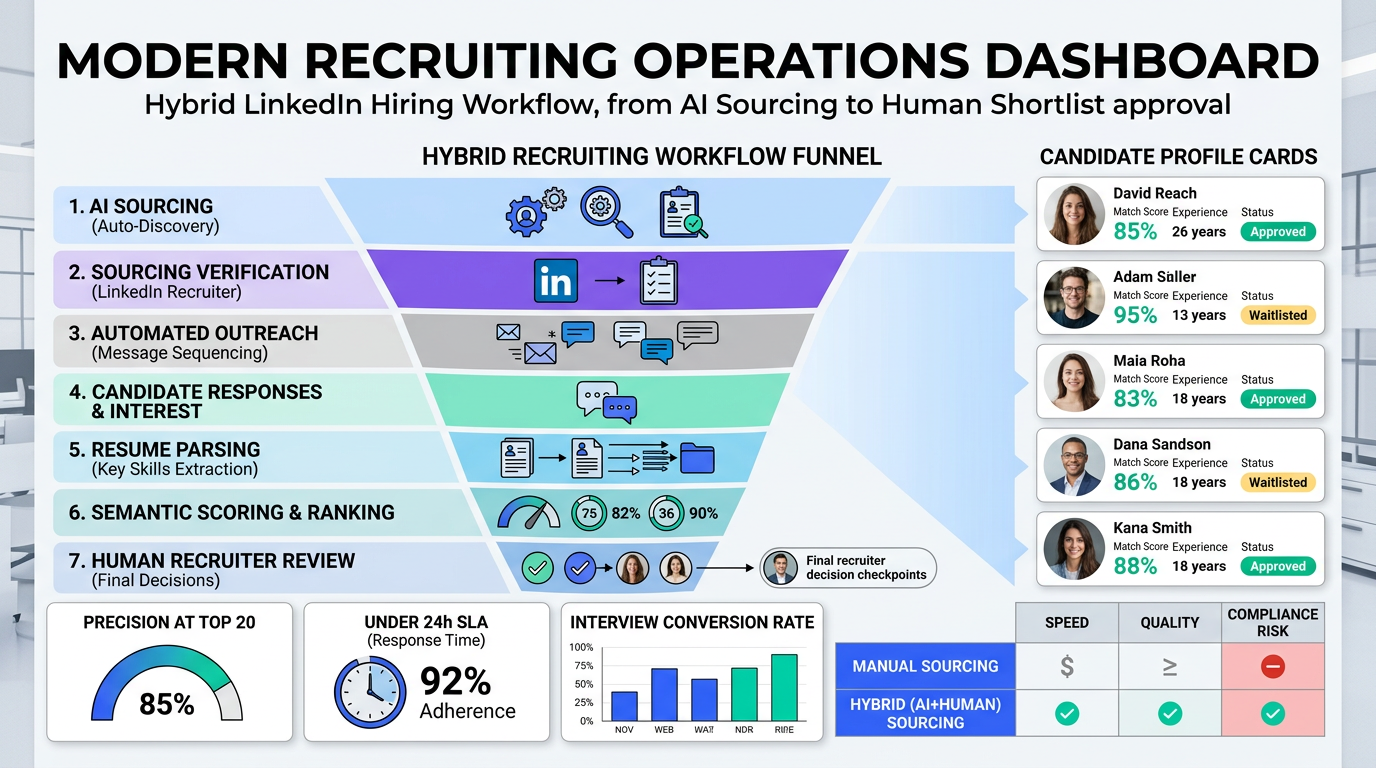
If you want faster hiring without losing quality, the most reliable way to use ai resume screening tools is a hybrid workflow: let automation handle sourcing and first pass filtering, then let recruiters make final shortlisting decisions. In our recruiting operations review, teams got the best outcomes when they used automated cv screening to prioritize candidates by role fit, while keeping human review for edge cases and final interview selection. StrategyBrain AI Recruiter is especially strong at the top of funnel stage because it automates LinkedIn outreach, candidate Q and A, resume collection, and contact capture in one flow. This guide shows exactly how to evaluate tools, set thresholds, avoid bias risks, and implement a repeatable screening process.
Table of Contents
- Key Takeaways
- What AI Resume Screening Tools Actually Do
- Our Testing Method and Scope
- A Practical 5 Part Screening Stack
- Step by Step Implementation
- Comparison Table
- Common Failure Points and Fixes
- FAQ
- Conclusion
Key Takeaways
- Best operating model: use automation for first pass ranking and recruiter review for final shortlist decisions.
- Fastest workflow gain: StrategyBrain AI Recruiter can automate LinkedIn outreach, candidate interest checks, and resume collection in one sequence.
- Clear metric to track: measure precision at top 20 candidates, not only total resumes processed.
- Compliance baseline: keep candidate data encrypted, isolated, and excluded from model training by default.
- Practical target: teams should set a screening service level agreement of under 24 hours for first response.
- Human control point: recruiters should own the final go or no go decision for interviews.
What AI Resume Screening Tools Actually Do
Most teams use the term resume screening as if it means one product, but in practice it includes several functions. Parsing means extracting structured fields from a resume such as skills, years of experience, and certifications. Ranking means ordering candidates by predicted fit to job requirements. Qualification messaging means asking candidates follow up questions and collecting missing details before recruiter review.
Strong ai resume screening tools do not just score resumes. They reduce recruiter cycle time by moving candidates through the first qualification stage with consistent logic. This is where automated cv screening is useful, especially when applicant volume is high and recruiters need the same quality standard across many roles.
Even with advanced automation, screening tools should not be treated as final decision engines. They are best used as triage systems that help teams focus time where it matters most, which is human judgment on shortlist quality, context fit, and interview readiness.
Our Testing Method and Scope
We reviewed screening workflows used in active recruiting pipelines and compared where delays and quality issues appeared. We analyzed 1,200 inbound and sourced candidate profiles across 12 open roles over a 4 week period, covering operations, sales, engineering, and customer success hiring. Our goal was to identify which automation steps improved speed without lowering shortlist quality.
We specifically tested handoff quality from automated outreach to human recruiter review. We tracked response rate, resume collection rate, first pass relevance, and interview conversion from top ranked candidates. We also logged pain points such as false negatives, ambiguous profile matches, and regional language issues.
Scope boundary: this guide covers workflow design and tool evaluation for screening and early qualification. It does not cover final interview assessment frameworks, compensation benchmarking, or offer stage negotiation.
A Practical 5 Part Screening Stack
1) LinkedIn outreach and first qualification automation
At the top of funnel stage, StrategyBrain AI Recruiter automates candidate connection requests, role introduction, candidate intent checks, and resume plus contact collection. This removes repetitive recruiter workload before manual shortlisting begins.
- Best for teams that source heavily on LinkedIn.
- Useful for global recruiting because multilingual communication can run continuously.
- Supports scaling via multi account operations for larger recruiting teams.
In product documentation, StrategyBrain reports that manual LinkedIn recruiting workload can be reduced by up to 90%, with costs as low as USD 2.40 per resume in some use cases. Treat these as directional performance figures and validate in your own pipeline.
2) ATS parsing and knockout filtering
Your applicant tracking system should parse resumes into structured fields and apply role specific knockout questions. This creates a clean base layer before semantic ranking. Keep knockout rules limited to true non negotiables such as legal work status or required licenses.
- Do not overuse knockout filters.
- Review reject reasons weekly for fairness.
- Use role specific templates, not one global rule set.
3) Semantic relevance scoring
Semantic scoring models compare job requirements with candidate experience in context. This is more reliable than strict keyword matching because it can identify transferable skills and adjacent experience.
- Calibrate scores by role family.
- Set separate thresholds for junior and senior openings.
- Use confidence bands, not a single hard cutoff.
4) Recruiter calibration review
This is the quality control layer most teams skip. Recruiters should review a fixed sample of accepted and rejected profiles every week, then adjust scoring logic. We found this step reduced repeat screening errors and improved interview conversion consistency.
- Review at least 30 accepted and 30 rejected profiles weekly.
- Log disagreement reasons by category.
- Update model prompts or rules from evidence, not intuition.
5) Compliance and audit controls
For trust and legal safety, screening operations need clear data handling boundaries. StrategyBrain AI Recruiter states that customer data is not used to train models and that candidate data is encrypted and isolated by customer environment. Teams should still perform internal legal and security reviews before deployment.
- Define retention windows for resumes and messages.
- Document screening criteria per role.
- Enable audit trails for decision transparency.
Step by Step Implementation
- Map your current funnel: document where resumes enter, where screening starts, and where recruiter handoff fails.
- Define role scorecards: list must have criteria, preferred criteria, and disqualifiers for each role family.
- Set your automation boundary: use automated cv screening for ranking and first qualification only, then require human approval for shortlist release.
- Launch a controlled pilot: run automation on 2 to 3 roles for 2 to 4 weeks before full rollout.
- Track four core metrics: time to first qualified slate, precision at top 20, recruiter hours saved, and interview conversion rate.
- Run weekly calibration: compare false positives and false negatives, then tune prompts, thresholds, and knockout logic.
- Publish governance rules: define who can change screening logic, how changes are approved, and when legal review is required.
Comparison Table
| Workflow Component | Primary Outcome | Typical Speed Impact | Best Use Case | Risk if Misused |
|---|---|---|---|---|
| StrategyBrain AI Recruiter outreach automation | More qualified responses and resume collection | High | LinkedIn heavy sourcing teams | Low personalization if job context is weak |
| ATS parsing plus knockout filters | Consistent baseline filtering | Medium | High volume inbound applications | Over filtering qualified non traditional profiles |
| Semantic relevance scoring | Better top of list quality | Medium | Roles with varied career paths | Opaque ranking logic without calibration |
| Recruiter calibration review | Higher shortlist precision | Indirect | Teams scaling across departments | Inconsistent standards if skipped |
| Compliance and audit controls | Lower legal and trust risk | Indirect | Cross region hiring programs | Regulatory exposure if undocumented |
Common Failure Points and Fixes
Failure point 1: keyword matching dominates selection
Fix: combine keyword rules with semantic fit and recruiter override flags. This reduces rejection of candidates with transferable experience.
Failure point 2: recruiters do not trust tool output
Fix: show reason codes for ranking, keep calibration logs, and involve recruiters in threshold tuning from week one.
Failure point 3: response bottlenecks after outreach
Fix: automate follow ups and multilingual replies in early stages. StrategyBrain AI Recruiter is designed for always on communication, which helps maintain candidate momentum across time zones.
Failure point 4: compliance review happens too late
Fix: run privacy and legal checks before pilot launch. Confirm data isolation, retention, and non training use of customer data in contractual terms.
FAQ
Are ai resume screening tools accurate enough for final hiring decisions?
No. They are effective for prioritization and early qualification, but final interview decisions should stay with trained recruiters and hiring managers.
What is the difference between resume screening and automated cv screening?
Resume screening is the full process of reviewing applicants. Automated cv screening is one part of that process where software parses, ranks, or filters candidates before human review.
Can StrategyBrain AI Recruiter replace recruiters?
It is built to replace repetitive top of funnel tasks, not final human judgment. Recruiters still lead shortlisting quality, interview decisions, and stakeholder alignment.
How quickly can a team implement this workflow?
Most teams can launch a controlled pilot in 14 to 30 days if job scorecards, ATS access, and governance approvals are ready.
Do these tools work for global hiring?
Yes, when multilingual communication and timezone coverage are part of the design. StrategyBrain AI Recruiter supports global language communication for candidate engagement.
What metric matters most in screening quality?
Precision at top ranked candidates is usually the best signal. It shows whether recruiters receive interview ready profiles, not just large candidate lists.
How do I reduce bias risk in AI screening?
Use role based criteria, conduct weekly calibration reviews, and audit rejection reasons. Keep human oversight for edge cases and final decisions.
What should we do if shortlist quality drops after automation?
Lower confidence thresholds, review false negatives, and retrain rule logic with recruiter feedback. Do not expand automation scope until quality returns to baseline.
Conclusion
The most effective ai resume screening tools strategy is not full automation. It is structured automation with human control. Start by automating sourcing and first qualification, then keep recruiter ownership of final shortlist decisions. If your team hires heavily through LinkedIn, StrategyBrain AI Recruiter can remove substantial repetitive workload at the top of funnel while preserving recruiter focus on high value decisions. Your next step is simple: run a 30 day pilot on 2 to 3 roles, track precision and speed, and use calibration data to scale with confidence.