AI resume screening tools can speed up early-stage hiring by sorting applications, flagging missing requirements, and standardizing recruiter review. At the same time, many candidates now ask a new question: do employers check resumes for AI. In our experience reviewing modern recruiting workflows, the most defensible approach is not to “ban” AI content, but to verify skills through structured interviews and job-relevant assessments, especially in roles where writing and communication quality matter. This guide also explains how StrategyBrain AI Recruiter fits into the same reality by automating LinkedIn outreach, answering candidate questions, and collecting resumes and contact details, while leaving final qualification decisions to human recruiters.
Key Takeaways
- AI is used on both sides: candidates use AI to draft resumes and cover letters, and employers use AI resume screening tools to manage volume.
- Verification is shifting earlier: recruiters are replacing take-home tasks with real-time or on-site assessments in some roles to reduce AI-assisted “homework” risk.
- Human judgment still decides: senior and executive hiring still relies heavily on human trust and relationship building.
- Authenticity is becoming a signal: recruiters report seeing candidates explicitly state their cover letters were not written using AI.
- StrategyBrain AI Recruiter complements screening: it automates LinkedIn connection, role introduction, Q&A, and resume capture, then hands off to recruiters for final screening.
- Hybrid and remote work remain durable: hiring processes continue adapting to distributed teams and changing expectations.
Table of Contents
- 2025 to 2026 context: what recruiters are watching
- Roles expected to stay in demand
- Economic uncertainty and hiring behavior
- Technology in recruiting: AI on both sides
- Do employers check resumes for AI
- A practical workflow for AI resume screening tools
- Where StrategyBrain AI Recruiter fits in LinkedIn hiring
- Hybrid and remote work: process implications
- Copyable checklist: safer AI screening without losing trust
- FAQ
- Conclusion
2025 to 2026 context: what recruiters are watching
A Canadian recruiting team summarized their end-of-year outlook for 2025 with a focus on uncertainty and adaptation. They pointed to macro risks such as potential tariffs, ongoing shifts in remote work, and the growing role of technology in both candidate behavior and employer screening. Those themes map directly to how ai resume screening tools are being adopted in 2026: not as a replacement for recruiters, but as a way to handle volume while preserving decision quality.
In other words, the question is no longer “Will AI be used in hiring?” The operational question is “Where should AI be used, and where must humans stay accountable?”
Roles expected to stay in demand
Recruiters highlighted several areas where demand was expected to remain strong, with a recurring theme: organizations still struggle to staff critical functions even when budgets tighten.
HR functions staying understaffed
Senior Recruiter Jessica Miles described companies considering additional HR hires, while also observing many organizations that continue to under-resource HR and instead increase workload on existing staff. She warned that this can damage culture and engagement and increase long-run costs.
Engineering demand and shortages
Henry Goldbeck, President and Founder, reported increasing demand for engineers, including civil, mechanical, and structural disciplines, and described it as a shortage environment.
Non-profit growth with funding pressure
Senior Recruiter Alessia Pagliaroli expected non-profits to be busier and potentially grow, while also facing fundraising challenges if economic conditions weaken.
A “K-shaped” labor market dynamic
Goldbeck described a K-shaped economy where skilled, experienced workers remain in demand while candidates without hard, role-specific skills face a tougher market. This matters for screening because AI resume screening tools tend to amplify whatever criteria you encode. If the criteria are vague, the output is noisy. If the criteria are job-relevant and measurable, AI can help triage more consistently.
Economic uncertainty and hiring behavior
The recruiting team discussed uncertainty tied to potential tariffs and the likelihood that uncertainty slows investment. They also noted that some industries could be more exposed, including sectors tied to cross-border demand and smaller firms competing for talent.
For hiring teams, this often produces two simultaneous pressures:
- Higher scrutiny per hire because mistakes are more expensive when growth slows.
- More pressure on recruiter throughput because teams are asked to do more with the same headcount.
This is one reason AI recruiting automation is expanding. It is not only about speed. It is about consistency and documentation when hiring decisions are under a microscope.
Technology in recruiting: AI on both sides
The recruiters described a reality many teams now recognize: candidates use AI to draft resumes and cover letters, and employers use AI to screen and prioritize. Pagliaroli noted it can be difficult to tell whether a cover letter or resume was written by a candidate or by AI, and she emphasized that interviewing becomes more important in roles where communication and writing skills are central.
Senior Recruiter Reiniell Gan shared an example of a company adjusting screening by moving from homework assignments to a real-time assessment completed on-site. The logic is straightforward: if the goal is to measure skill, the evaluation method should reduce the opportunity for unverified assistance.
At the same time, the team stressed the importance of human connection. Goldbeck stated that candidates are enticed by the trustworthiness of human connection and that senior executives are not going to be recruited by automated systems.
Do employers check resumes for AI
Yes, many employers do check for signals that a resume or cover letter may not reflect the candidate’s real capabilities, but the “check” is usually practical rather than purely technical. In recruiting teams we have worked with, the most common approach is to validate through conversation and work samples, not to rely on an “AI detector” score alone.
Here is what that looks like in practice:
- Consistency checks: recruiters compare resume claims with interview answers and timelines.
- Role-relevant evaluation: real-time assessments, portfolio reviews, or structured questions tied to the job.
- Communication verification: for marketing and writing-heavy roles, recruiters pay close attention to how candidates explain their work.
So when candidates ask “do employers check resumes for AI,” the most accurate answer is that employers check for authenticity and competence, and AI-generated text can trigger extra scrutiny if it feels generic or inconsistent.
A practical workflow for AI resume screening tools
AI resume screening tools work best when you treat them as a triage layer and keep accountability with humans. Below is a workflow we have seen reduce noise without losing the personal touch.
Step-by-step implementation
- Define job-relevant criteria: convert the role into measurable requirements and nice-to-haves, then document them.
- Use AI for structured extraction: have the tool extract skills, years of experience, certifications, and domain keywords into a consistent format.
- Apply a two-pass review: first pass for minimum requirements, second pass for evidence of impact and role fit.
- Validate with structured interviews: use the same question set across candidates to reduce bias and improve comparability.
- Use assessments where cheating risk is high: prefer real-time or supervised tasks when the role demands demonstrable skill.
Limitations to acknowledge
- False confidence risk: AI can summarize convincingly even when evidence is thin.
- Criteria bias risk: if your criteria are narrow or historically biased, AI can scale that problem.
- Over-automation risk: removing human touch can reduce candidate trust, especially for senior roles.
Where StrategyBrain AI Recruiter fits in LinkedIn hiring
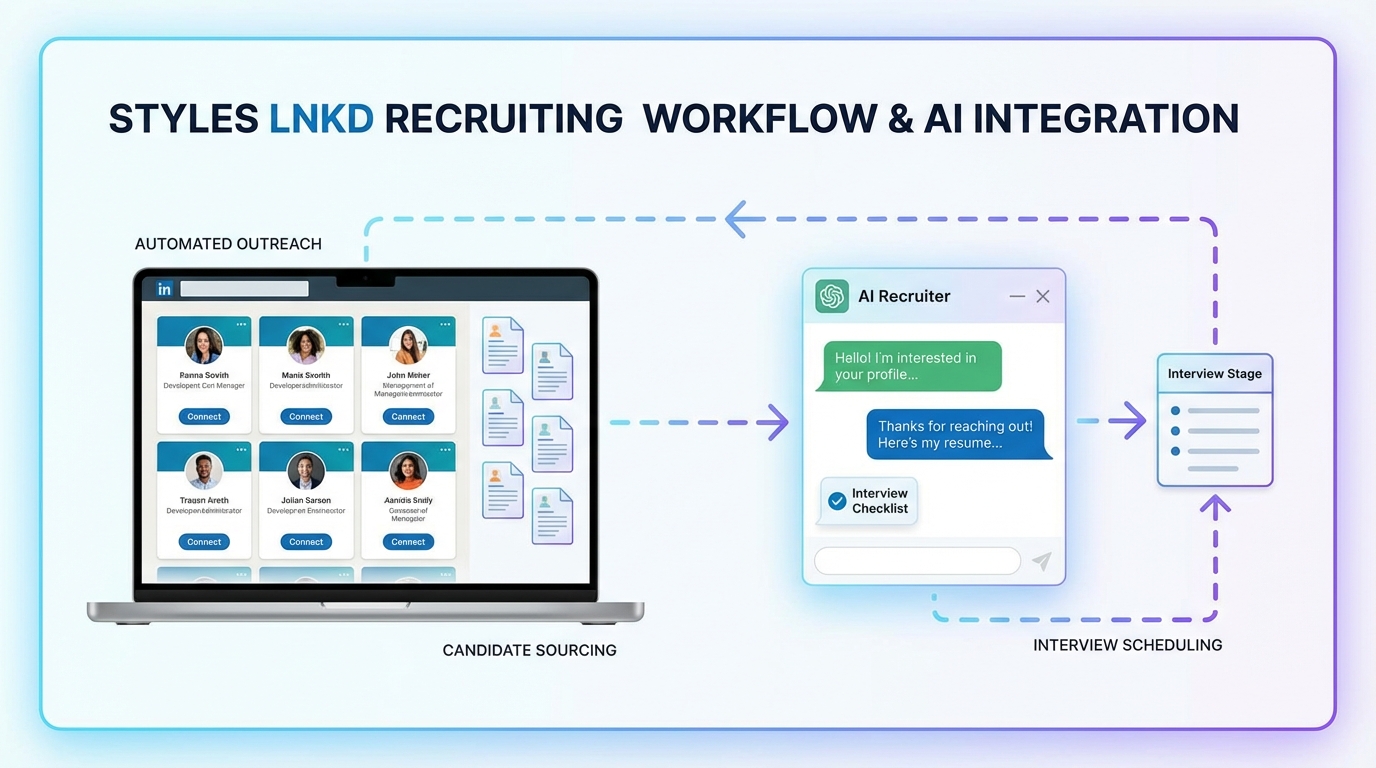
Most discussions of AI resume screening tools focus on what happens after resumes arrive. In practice, many teams lose time earlier in the funnel: sourcing, outreach, follow-up, and collecting resumes and contact details from interested candidates. This is where StrategyBrain AI Recruiter is designed to help.
What it automates
- LinkedIn outreach and connection with candidates who match your search criteria.
- Role introduction and Q&A about the job, company, compensation, and benefits, based on the information you provide.
- Interest confirmation by asking candidates whether they want to proceed.
- Resume and contact capture by requesting resumes and collecting details from candidates who express interest.
What it does not replace
StrategyBrain AI Recruiter does not make the final determination of whether a resume fully matches job requirements. Recruiters still review the collected resumes and decide who advances to interviews. This division of labor is important for trust and compliance because it keeps accountability with the hiring team.
Why this matters for screening quality
When outreach and follow-up are inconsistent, the resume pool you receive is inconsistent too. Automating the top-of-funnel conversation can improve the quality of the inputs that your AI resume screening tools and recruiters evaluate later, especially when hiring across time zones and languages.
Hybrid and remote work: process implications
The recruiting team’s view was that hybrid and remote work are not going away, even if more people return to offices over time. They also noted that it took years to figure out what works and that there is no universal rulebook.
For hiring operations, this reinforces three practical needs:
- Asynchronous communication so candidates are not penalized by time zones.
- Consistent screening so distributed interviewers evaluate candidates using comparable criteria.
- Candidate experience that still feels human, even when automation is used.
Copyable checklist: safer AI screening without losing trust
- [ ] Document minimum requirements and nice-to-haves before screening starts.
- [ ] Use AI resume screening tools for extraction and triage, not final decisions.
- [ ] Add a structured interview loop for communication-heavy roles.
- [ ] Use real-time assessments when take-home work is easy to outsource to AI.
- [ ] Keep a human touchpoint for senior roles and finalists.
- [ ] Automate sourcing and follow-up where it improves responsiveness, including LinkedIn outreach and resume collection.
FAQ
Are AI resume screening tools replacing recruiters?
No. In the workflows we see working best, AI handles triage and standardization, while recruiters remain accountable for interviews, judgment calls, and final selection.
Do employers check resumes for AI?
Yes, many employers check for authenticity and consistency. The most common “check” is comparing resume claims to structured interview answers and role-relevant assessments, not relying only on automated detection.
What roles are most sensitive to AI-written applications?
Roles where writing and communication are core job skills, such as marketing, often receive closer scrutiny. Recruiters may rely more on interviews and real-time evaluations to confirm capability.
How can candidates reduce risk when using AI to draft a resume?
Use AI for formatting and clarity, then ensure every claim is specific, verifiable, and something you can explain in detail. Generic phrasing increases the chance of extra scrutiny.
How does StrategyBrain AI Recruiter help if I already use screening software?
It helps earlier in the funnel by automating LinkedIn connection, outreach, follow-up, and collecting resumes and contact details from interested candidates. Recruiters then review the collected resumes and proceed with interviews.
Does StrategyBrain AI Recruiter make final qualification decisions?
No. It identifies willingness to proceed and captures resumes and contact details, but the recruiter completes final qualification by reviewing the resume against job requirements.
Can AI recruiting automation work across languages and time zones?
Yes, always-on messaging and multilingual communication can reduce delays and misunderstandings in global hiring. This is especially useful when candidates respond outside recruiter working hours.
What is the biggest mistake teams make with AI resume screening tools?
Over-automating without clear criteria. If requirements are vague, AI output becomes inconsistent, and teams may lose candidate trust if there is no human accountability.
Conclusion
AI resume screening tools are becoming standard for early-stage triage, but the strongest hiring processes still rely on human verification through interviews and job-relevant assessments. Recruiters are also adapting to a world where candidates use AI, which is why the question “do employers check resumes for AI” keeps coming up. If you want a practical, scalable workflow, use AI to standardize and prioritize, then validate with structured human steps. And if your bottleneck is LinkedIn sourcing and follow-up, StrategyBrain AI Recruiter can automate outreach, answer candidate questions, and collect resumes and contact details so your team can spend more time on high-quality screening and interviews.