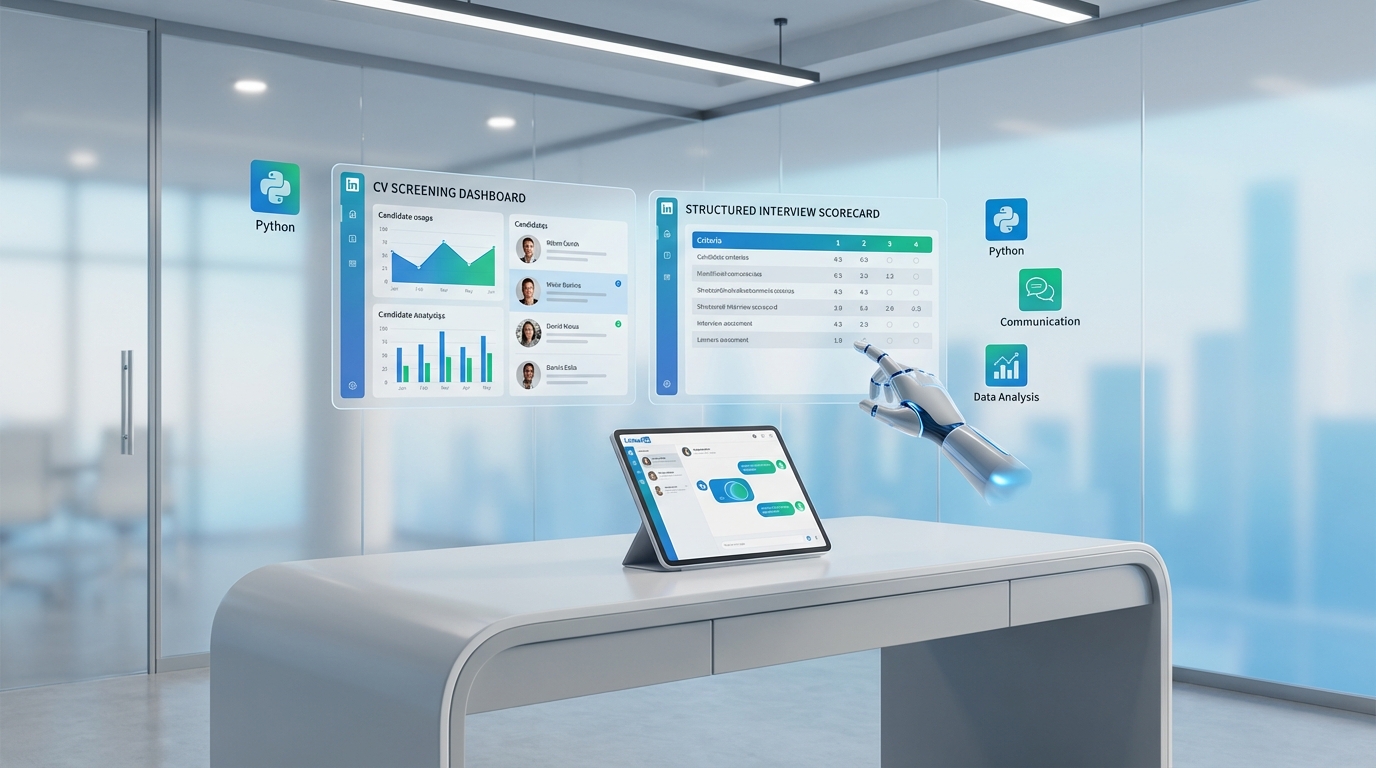
To use ai resume screening tools well, you need two layers of screening: first, cv screening software to confirm skills match from evidence in the résumé, and second, a structured interview to assess retention risk factors like goals, culture fit, decision making, and compensation expectations. In our hiring workflows, the biggest retention mistakes happen when teams rely on gut feel after a fast résumé pass. The fix is simple: define what “good” looks like in the job description, screen for proof, then interview for long term alignment. If you also recruit on LinkedIn, StrategyBrain AI Recruiter can automate initial outreach, answer candidate questions, and collect résumés and contact details so recruiters can focus their time on the retention interview that actually prevents churn.
Key Takeaways
- Retention starts at screening: Bad hiring decisions are cited as a major driver of turnover, so your screening process must test retention risk, not only skills. (Source: Harvard Business Review, accessed 2026-02-28)
- Use evidence based screening: Convert job requirements into “must show proof” résumé signals so your cv screening software can rank consistently.
- Standardize the interview: Ask the same retention questions across candidates to reduce bias and improve comparability.
- Make résumés AI readable: Require clean formatting so parsing and scoring are accurate, especially when candidates upload files through LinkedIn.
- Automate the busywork: StrategyBrain AI Recruiter can automate LinkedIn outreach and résumé collection so recruiters spend time on retention interviews.
- Be transparent about pay: Compensation misalignment is a predictable churn trigger, so clarify expectations before final rounds.
What AI resume screening tools can and cannot do
AI resume screening tools are systems that parse résumés, extract structured fields, and score candidates against criteria. In practice, most teams use them to reduce manual reading time and to enforce consistency across large applicant pools.
However, résumé screening is not the same as retention screening. A résumé can show skills and experience, but it rarely proves whether someone will stay, thrive in your culture, or remain motivated under your compensation structure. That is why the interview must be designed to test retention risk explicitly.
Scope boundaries for this guide
- Covered: How to combine cv screening software with a retention focused interview, plus copyable questions and scorecards.
- Not covered: Legal advice, jurisdiction specific compliance requirements, or vendor specific feature claims for third party tools.
Step 1: Write a job description that AI can screen
Poor skills match is a leading cause of unsuccessful hires. The fastest way to improve screening accuracy is to make the job description measurable. When requirements are vague, ai resume screening tools can only guess, and recruiters end up overriding scores with intuition.
Steps
- List 5 to 8 job critical outcomes that the person must deliver in the first 90 days.
- Translate each outcome into evidence you can see on a résumé, such as tools used, scope, and results.
- Define minimum thresholds for education and role specific experience so screening is consistent.
- Validate with current performers by asking people who do the job what “good” looks like in real work.
Interview prompts that connect to screening
- How many years of education and experience do you have?
- How many years of experience do you have that is specific to the job needs?
- What is one of your greatest achievements in the job function we are hiring for?
Limitations
Even with a strong job description, screening scores can be distorted by résumé formatting. That is why you should set an “ai readable resume” standard for applicants and for any files collected through LinkedIn.
Step 2: Screen for culture and collaboration signals
Many candidates fail not because they cannot do the work, but because they do not fit the organization’s expectations for communication, leadership, and collaboration. This is often described as a cultural misfit. Your screening process should flag areas to probe, not auto reject based on personality assumptions.
What to screen for before the interview
- Team context: Evidence of cross functional work, mentoring, or stakeholder management.
- Communication artifacts: Presentations, documentation, customer facing work, or training experience.
- Stability signals: Tenure patterns and role changes that require clarification in the interview.
How to validate in the interview
Use behavioral questions to test judgment and accountability. Thoughtful responses often reveal whether a candidate reacts emotionally or uses good judgment and takes responsibility.
- Talk about a quick decision you had to make at work. Why did you choose that option, and what was the result?
- Tell me about a time you made a mistake at work. What did you do to rectify it?
Step 3: Interview for care and diligence, not gut feel
Retention improves when hiring decisions are made through a comprehensive plan, not a gut feeling. In our experience, the easiest way to operationalize this is a scorecard with a small set of retention dimensions that every interviewer uses.
Steps
- Pick 4 retention dimensions: goals, genuineness, resolve, and emotional maturity.
- Ask the same core questions for each dimension across all candidates.
- Score immediately after the interview using defined anchors, such as 1 to 5 with written criteria.
- Debrief with evidence by citing specific answers, not impressions.
Retention question bank
Goals
- Describe your preferred work environment.
- What do you see yourself doing 10 years from now? Why?
- Where are you planning to be 2 years from now? Why?
Genuineness
- Have you ever had to alter your behavior for work reasons? Why?
- How would your current supervisor and coworkers describe you?
- Do you receive the respect you deserve in your current position? Why or why not?
Resolve
- How do you meet obstacles in your life? Give me an example.
- Tell me how you resolved a complicated problem at work. How did you decide what steps needed to be taken?
Emotional maturity
- In your last position, what was your greatest accomplishment?
- What was your most significant failure?
Limitations
- A scorecard improves consistency, but it does not eliminate bias unless interviewers are trained on scoring anchors.
- Retention questions should not be used to discriminate. Keep questions job relevant and consistent.
Step 4: Handle compensation early to reduce flight risk
In a candidate shortage, employees can be lured away by attractive compensation packages. Understanding motivations helps you predict whether someone is likely to leave when a higher paid opportunity appears. Money motivation is not inherently negative, but misalignment is a predictable churn driver.
Steps
- Ask motivation questions in an early screen so you do not waste late stage interview time.
- Confirm total compensation expectations including benefits, vacation, and extras that matter to the candidate.
- Explain retention incentives if available, such as long term incentives, during the process.
Questions to gauge financial motivations
- What prompted you to look into other job opportunities?
- What are the top 3 requirements for your ideal role?
How StrategyBrain AI Recruiter fits into the workflow
Most teams think of ai resume screening tools as something that happens after applications arrive. In LinkedIn heavy hiring, the bottleneck often happens earlier: outreach, follow up, answering candidate questions, and collecting résumés and contact details. That is where StrategyBrain AI Recruiter fits naturally into a retention focused process.
Where it helps before CV screening
- Automated LinkedIn outreach: It connects with candidates who match your search criteria and introduces the role.
- Always on messaging: It responds 24/7 and can communicate in the candidate’s native language to reduce misunderstandings.
- Résumé and contact capture: When a candidate is interested, it requests the résumé and captures contact details shared in messages.
How it supports, not replaces, qualification
AI Recruiter can identify willingness to communicate or interview, but it does not decide whether the résumé fully matches job requirements. Recruiters still do the final qualification by reviewing the résumé and applying the scorecard. This division of labor is useful because it keeps the AI focused on speed and consistency while humans own the hiring decision.
Security and privacy notes
- Customer provided data is not used to train AI models.
- Candidate information is encrypted and isolated per customer environment.
- LinkedIn account credentials are encrypted and used only with explicit authorization.
Quick Comparison
| Method | Primary goal | What it screens | Best for |
|---|---|---|---|
| CV screening software | Consistency at scale | Skills and experience evidence | High volume applicant review |
| Retention interview scorecard | Reduce turnover risk | Goals, culture alignment, judgment, maturity | Finalist evaluation and debrief |
| StrategyBrain AI Recruiter | Automate LinkedIn pipeline work | Interest, responsiveness, résumé collection | Outbound LinkedIn recruiting and follow up |
Templates you can copy
AI readable resume checklist for candidates
- Use standard section headings: Summary, Experience, Education, Skills.
- Avoid tables, text boxes, and multi column layouts that break parsing.
- Write dates in a consistent format, such as YYYY-MM or Month YYYY.
- List tools and technologies in a dedicated Skills section.
- Include measurable outcomes with units, such as revenue, time saved, or volume handled.
Retention interview mini scorecard
| Dimension | What “strong” sounds like | Red flags to probe |
|---|---|---|
| Goals | Clear 2 year plan tied to role growth | Vague direction or frequent pivots without rationale |
| Genuineness | Specific examples, consistent self awareness | Blames others, avoids accountability |
| Resolve | Structured problem solving and follow through | Impulsive decisions, no learning loop |
| Emotional maturity | Owns failures and explains corrective actions | Cannot discuss mistakes or growth areas |
FAQ
Do ai resume screening tools predict employee retention?
No. They can help you screen for skills and experience evidence, but retention is better assessed through structured interviews and consistent scorecards that test goals, culture alignment, and motivations.
What is an ai readable resume?
An ai readable resume is a résumé formatted so parsing systems can reliably extract fields like job titles, dates, skills, and employers. Avoiding tables, text boxes, and multi column layouts usually improves parsing accuracy.
How do I reduce bias when using cv screening software?
Use job relevant criteria, define thresholds in advance, and validate scores with structured interviews. Also audit outcomes by checking whether screened out candidates share patterns unrelated to job performance.
What questions help screen for retention risk in an interview?
Ask about preferred work environment, 2 year and 10 year goals, how they handle obstacles, and how they corrected a mistake at work. These questions reveal alignment and accountability when scored consistently.
How should compensation be discussed to prevent early turnover?
Confirm expectations early and discuss total compensation, including benefits and vacation. Misalignment is a predictable churn trigger, so clarity reduces late stage surprises.
How does StrategyBrain AI Recruiter relate to ai resume screening tools?
AI Recruiter supports the stage before résumé screening by automating LinkedIn outreach, follow up, and résumé collection. Recruiters then apply their cv screening software and retention interview scorecard to make the final decision.
Does AI Recruiter decide if a candidate is qualified?
No. It identifies willingness to communicate or interview and collects résumés and contact details. Recruiters still review the résumé and determine fit against job requirements.
How is candidate data protected in AI Recruiter?
Candidate information is encrypted and isolated per customer environment, and customer provided data is not used to train AI models. LinkedIn credentials are encrypted and used only with explicit authorization.
Conclusion
The best use of ai resume screening tools is not to replace judgment, but to make judgment consistent. Start with a measurable job description, use cv screening software to screen for evidence, then run a retention focused interview with a scorecard that tests goals, culture alignment, diligence, and compensation fit. If LinkedIn is a major sourcing channel, use StrategyBrain AI Recruiter to automate outreach and résumé collection so your team can spend its limited time on the interview work that actually reduces turnover. Next step: copy the scorecard above and run it in your next 5 interviews, then compare debrief quality and hiring confidence.