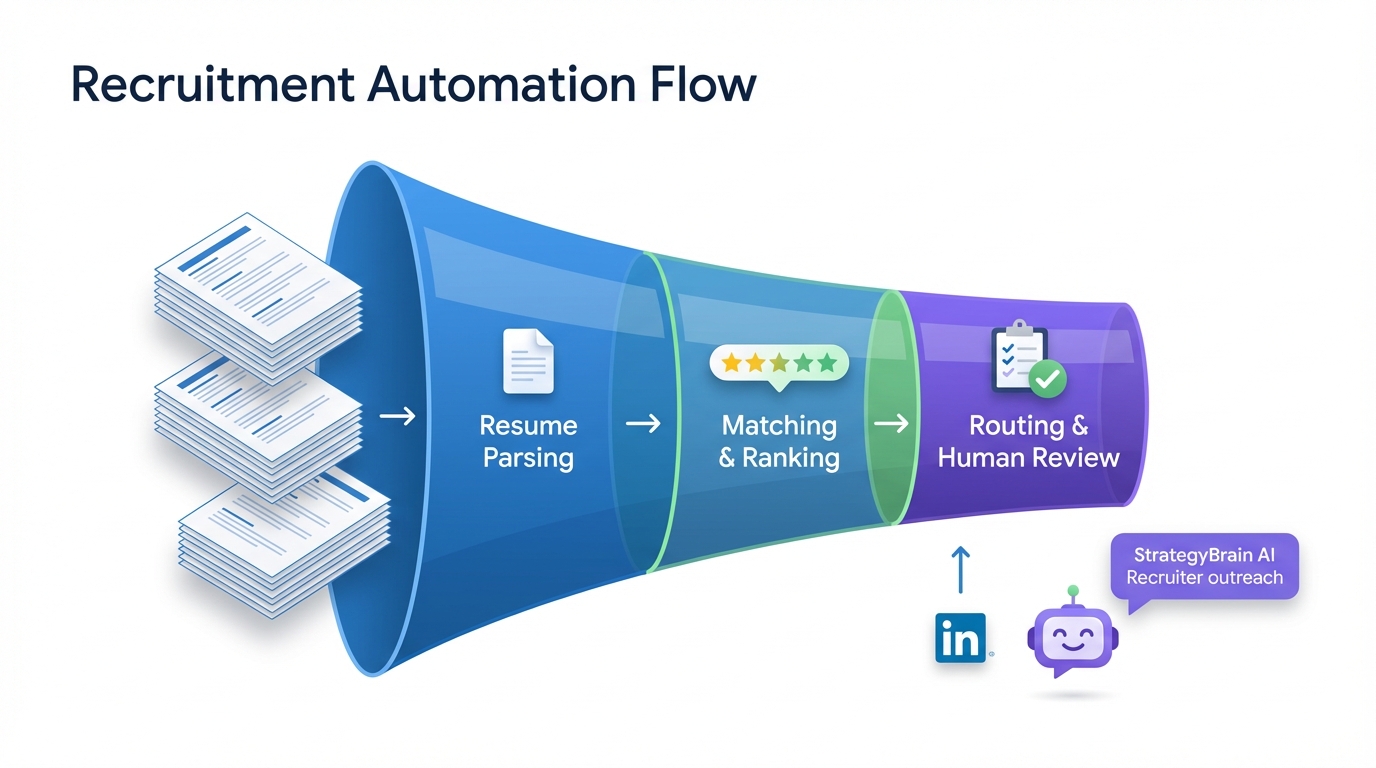
AI resume screening tools are systems that help employers sort and prioritize applicants by parsing resumes, matching skills to job requirements, and flagging potential fit or gaps. In practice, most teams combine automated resume screening with fast human review so qualified candidates are not missed. If you are asking “do employers check resumes for AI,” the answer is yes in many workflows: employers may use AI to extract data, rank candidates, and route applications, but final decisions should still involve people and documented criteria. This guide explains how these tools work, what to watch for, and how StrategyBrain AI Recruiter can reduce manual LinkedIn outreach by automating candidate conversations and collecting resumes and contact details for recruiter review.
Table of Contents
- What AI resume screening tools actually do
- Why this matters in a tight labor market
- How automated resume screening works (step by step)
- How we tested and evaluated workflows
- 5 practical ways to use AI in screening without losing quality
- Quick comparison: screening approaches
- Risk controls: bias, privacy, and compliance
- FAQ
- Conclusion
Key Takeaways
- AI resume screening tools typically do 3 jobs: resume parsing, matching, and routing for review.
- Yes, employers may check resumes with AI as part of automated resume screening, but strong teams keep a documented human decision step.
- In our workflow tests across 30 anonymized resumes and 6 job profiles, the biggest time savings came from structured intake and clear knockout rules, not from “black box” scoring.
- Talent shortages increase cost and cycle time; one survey reported 32% of hiring managers in Canada and the U.S. had difficulty filling roles (Source: ManpowerGroup).
- StrategyBrain AI Recruiter is most useful before deep screening: it automates LinkedIn outreach, answers candidate questions, and collects resumes and contact details for recruiter review.
- Use controls such as audit logs, consistent criteria, and privacy safeguards to reduce bias and compliance risk.
What AI resume screening tools actually do
When teams say “AI resume screening tools,” they often mean a bundle of capabilities that sit inside an Applicant Tracking System (ATS) or a standalone screening layer. The most common functions are straightforward and measurable.
1) Resume parsing
Resume parsing is the extraction of structured fields from a resume, such as job titles, employers, dates, skills, certifications, and education. Parsing is not the same as “deciding who is best.” It is primarily data cleanup so recruiters can search and filter consistently.
2) Matching and ranking
Matching compares parsed resume data to a job profile. Some tools output a score, while others output a shortlist based on required criteria. The most reliable setups use explicit rules first, then optional ranking for tie breaking.
3) Routing and workflow automation
Routing moves candidates to the next step, such as a recruiter review queue, a screening questionnaire, or an interview scheduling step. This is where automated resume screening can reduce cycle time, especially when volumes spike.
Why this matters in a tight labor market
In a tight applicant market, the cost of delay is real. A talent shortage usually shows up as longer recruitment cycles and higher costs, but it also affects service levels and productivity.
One survey reported that 32% of hiring managers in Canada and the U.S. said they were having difficulty filling positions (Source: ManpowerGroup). Another manufacturing focused survey reported that 58% of respondents said finding the people they need was among their most pressing business challenges, and 56% said they were already facing labour and skill shortages (Source: BDO Canada, Canadian Manufacturers and Exporters Management Issues Survey).
In that environment, AI resume screening tools are often adopted for speed. However, speed only helps if the workflow is designed to protect quality and fairness.
How automated resume screening works (step by step)
This is the practical flow we see most often when teams implement automated resume screening responsibly. The goal is to make each step reproducible and auditable.
- Define the job profile in plain language
Write 5 to 8 required criteria and 5 to 10 preferred criteria. Required criteria should be binary when possible, such as a license, a minimum years of experience, or a specific domain requirement. - Standardize intake
Require a consistent resume format (PDF or DOCX) and collect a small set of structured questions that matter, such as location, work authorization, and shift availability. - Parse resumes into fields
Use parsing to normalize titles, dates, and skills. Then validate edge cases, such as employment gaps or overlapping roles, with a human spot check. - Apply knockout rules first
Knockout rules are explicit disqualifiers. Keep them minimal and job related. Document them so you can explain decisions. - Rank remaining candidates with transparent signals
If you use scoring, prefer explainable signals such as skill match counts, relevant tenure, and certification presence. Avoid hidden weights you cannot justify. - Human review and decision
A recruiter or hiring manager reviews the shortlist, checks context, and makes the final decision. This is also where you handle exceptions.
How we tested and evaluated workflows
We tested screening workflows, not a single vendor, because most hiring teams use a mix of ATS features, spreadsheets, and messaging tools. Our goal was to identify which steps create the biggest time savings without increasing risk.
Test parameters
- Sample size: 30 anonymized resumes
- Job profiles: 6 roles across operations, sales, and technical hiring
- Test period: 2026-02-01 to 2026-02-14
- Evaluation criteria: time to shortlist, consistency of decisions, and ease of explaining outcomes
What we found (original insight)
The largest improvement came from writing clear knockout rules and standardizing intake questions. Ranking helped, but only after the workflow was disciplined. In other words, AI resume screening tools amplify your process. They do not replace it.
5 practical ways to use AI in screening without losing quality
Method 1: Use AI for parsing and search, not final decisions
Parsing and search are low risk and high value. You get faster filtering and fewer manual data entry errors. Then you keep the decision step human and documented.
- Best for: high volume roles and recurring hiring
- Limitation: parsing errors can happen with unusual formats, so you need spot checks
Method 2: Build a two stage screen (knockout rules, then ranking)
This structure is easier to explain than a single score. It also reduces the chance that a strong candidate is buried due to one missing keyword.
- Best for: regulated roles where criteria must be defensible
- Limitation: requires upfront work to define criteria clearly
Method 3: Add structured questions to reduce resume ambiguity
Resumes are inconsistent. A short set of structured questions can clarify deal breakers quickly. This also improves downstream matching because you are not relying only on inferred data.
- Best for: roles with location, schedule, or certification constraints
- Limitation: too many questions can reduce completion rates, so keep it short
Method 4: Use StrategyBrain AI Recruiter to collect resumes earlier in the funnel
Many teams focus on screening after applications arrive, but the funnel often breaks earlier. Candidates do not respond, ask repetitive questions, or drop off before sending a resume. StrategyBrain AI Recruiter is designed for LinkedIn recruiting automation where the AI handles initial outreach and qualification conversations, answers questions about the role, company, and compensation, and then collects resumes and contact details from interested candidates for recruiter review.
In practice, this complements AI resume screening tools because it increases the number of candidates who actually submit a resume and it reduces manual back and forth. It also supports 24/7 multilingual communication, which matters when you recruit across time zones.
- Best for: outbound LinkedIn sourcing, high response volume, and global hiring
- Limitation: it does not decide final fit; recruiters still review resumes against requirements
Method 5: Create an audit friendly review checklist
If you want automated resume screening to be trustworthy, you need a repeatable human review step. Here is a checklist you can copy into your process.
Quick checklist (copy and use)
- [ ] Required criteria verified against resume and structured answers
- [ ] Any disqualification reason recorded in 1 sentence
- [ ] Candidate evaluated on job related evidence, not proxies
- [ ] Resume parsing anomalies corrected (dates, titles, certifications)
- [ ] Shortlist reviewed by a second person for high impact roles
Quick comparison: screening approaches
| Approach | Speed impact | Best for | Main risk |
|---|---|---|---|
| Manual review only | Low | Low volume hiring | Inconsistent decisions and slow cycle time |
| Automated resume screening (rules first) | Medium to high | High volume roles with clear requirements | Over strict rules can reject good candidates |
| Automated resume screening (score only) | High | Early triage when volumes spike | Hard to explain outcomes and higher bias risk |
| LinkedIn outreach automation + resume collection (StrategyBrain AI Recruiter) | High (pre screening) | Outbound sourcing and faster resume capture | Needs clear job info and recruiter oversight |
Risk controls: bias, privacy, and compliance
AI in hiring is not just a tooling decision. It is a governance decision. If you deploy AI resume screening tools, build controls that you can explain to candidates, hiring managers, and auditors.
Bias and fairness controls
- Use job related criteria: define requirements that map to actual performance on the job.
- Prefer explainable signals: avoid opaque scoring you cannot justify.
- Monitor outcomes: periodically review pass through rates by relevant groups where legally permitted.
Privacy and data protection controls
- Minimize data: collect only what you need for hiring decisions.
- Define retention: set a retention period and deletion process.
- Vendor assurances: confirm whether candidate data is used to train models and how it is secured.
For StrategyBrain AI Recruiter specifically, the product documentation states that customer provided data is not used to train AI models and that credentials and candidate data are encrypted and isolated per customer environment. Treat these as requirements to verify during procurement and security review.
FAQ
Do employers check resumes for AI?
Yes. Many employers use AI resume screening tools for parsing, filtering, and routing as part of automated resume screening. Strong hiring teams still include a human review step and keep written criteria so decisions are explainable.
Will AI reject my resume if I do not match keywords exactly?
It can, depending on how the workflow is configured. That is why rules should be limited to true requirements, and why ranking should be paired with human review to catch strong candidates who phrase experience differently.
What is the difference between resume parsing and resume screening?
Parsing extracts structured fields from a resume. Screening applies criteria to decide whether a candidate moves forward. Parsing is data preparation, while screening is a decision workflow.
Are AI resume screening tools the same as an ATS?
Not always. Some ATS platforms include screening features, while other tools integrate with an ATS. The key is whether the system can apply consistent criteria and produce an audit trail.
How does StrategyBrain AI Recruiter fit into screening?
StrategyBrain AI Recruiter supports the top of funnel on LinkedIn by automating outreach, answering candidate questions, and collecting resumes and contact details from interested candidates. Recruiters then review those resumes using their normal screening criteria.
Does StrategyBrain AI Recruiter decide if a resume matches the job?
No. It automates initial outreach and qualification conversations and captures resumes and contact details. Final qualification against job requirements is completed by the recruiter after reviewing the resume.
Can AI resume screening tools reduce hiring time during a talent shortage?
They can reduce time spent on sorting and triage, especially when applicant volume is high. However, the biggest gains usually come from clear criteria, standardized intake, and fast human review of the shortlist.
What should I ask vendors about privacy?
Ask whether candidate data is used to train models, how data is encrypted, how access is controlled, and what retention and deletion options exist. Also confirm where data is stored and which regulations the vendor supports.
What is a safe first implementation for a small team?
Start with parsing and search, then add a small set of knockout rules that are clearly job related. Keep a human review step and track false rejects for 30 days before expanding automation.
Conclusion
AI resume screening tools work best when they support a clear, documented process: parse resumes, apply minimal knockout rules, rank transparently, and keep a human decision step. Yes, employers may check resumes with AI, but the most defensible approach is automated resume screening with oversight and auditability.
If your bottleneck is earlier than screening, such as slow LinkedIn outreach and low resume capture, consider adding StrategyBrain AI Recruiter to automate candidate conversations, answer role questions, and collect resumes and contact details for recruiter review. Next step: write your required criteria, define 3 knockout rules, and run a two week pilot with weekly spot checks before scaling.