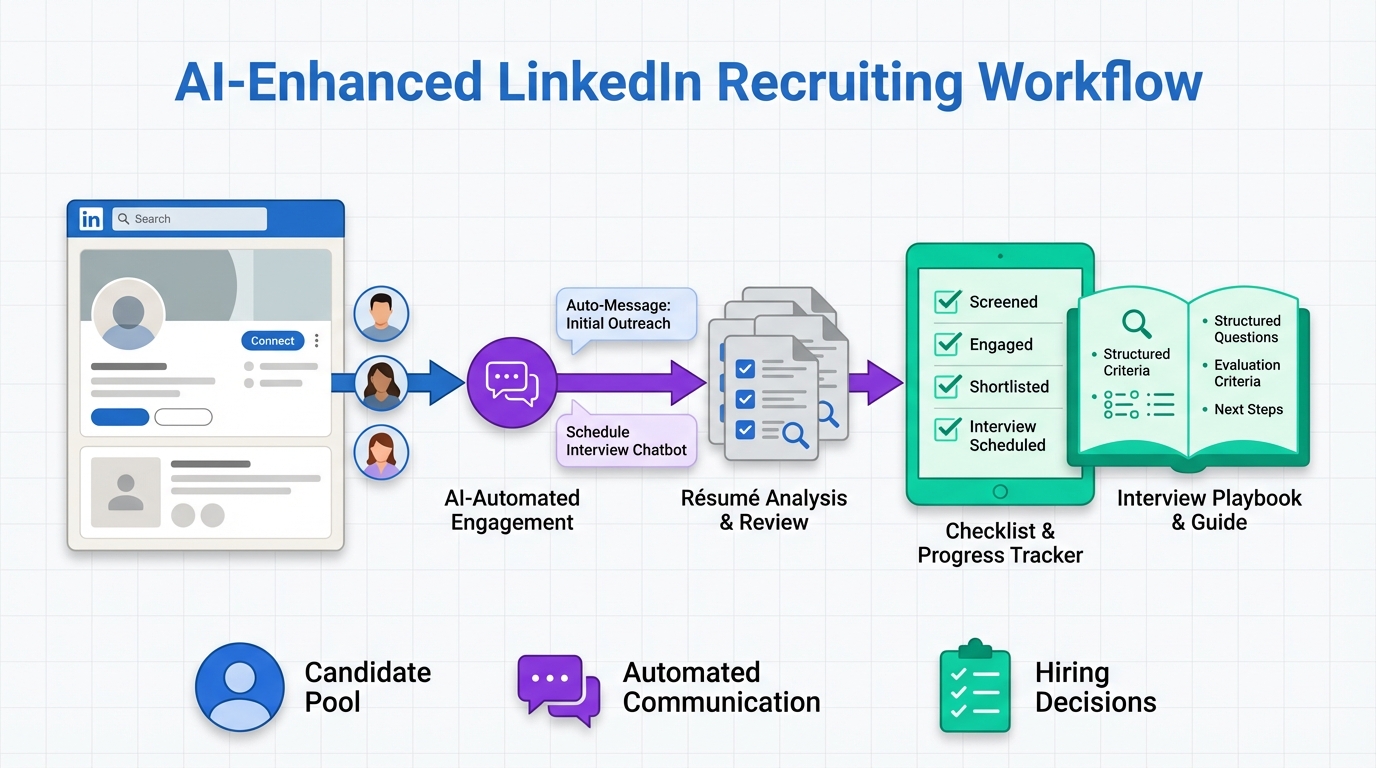
AI sourcing software is most valuable when it removes the repetitive parts of recruiting so interviews can focus on judgment, communication, and culture fit. In our day to day recruiting workflows, we see teams get better outcomes when they treat tooling like an artificial intelligence procurement platform decision, meaning they define requirements, test workflows, and verify compliance, then pair that stack with a consistent interview playbook. Below are five interview questions that reliably surface fit and maturity, plus practical ways to answer them without over explaining. We also show where StrategyBrain AI Recruiter fits into the sourcing layer by automating LinkedIn connections, role introductions, candidate Q&A, follow ups, and résumé and contact capture, so recruiters spend less time chasing replies and more time evaluating real signals.
Table of Contents
- Why these 5 questions still matter in an AI sourcing software era
- How we tested AI assisted sourcing and interview workflows
- 1) What do you like to do for fun
- 2) What will you bring to this company that we do not have already
- 3) Tell me about your most recent or current role
- 4) Explain why most manhole covers are round
- 5) How do you keep your answers simple under pressure
- Quick Comparison: manual sourcing vs AI sourcing software vs StrategyBrain AI Recruiter
- Procurement checklist for choosing AI procurement software for sourcing
- FAQ
- Conclusion
Why these 5 questions still matter in an AI sourcing software era
Even with strong ai sourcing software, interviews fail when the conversation drifts into vague stories, defensive explanations, or rehearsed buzzwords. Automation can improve top of funnel speed, but it cannot replace the human evaluation of character, judgment, and clarity. That is why these questions remain useful: they force candidates to reveal how they think, how they communicate, and how they handle ambiguity.
From a tooling perspective, this is also where an artificial intelligence procurement platform approach helps. If your ai procurement software selection only optimizes for volume, you risk flooding hiring managers with low signal conversations. If you optimize for workflow quality, you can use automation to qualify interest and collect basics, then reserve interviews for deeper evaluation.
How we tested AI assisted sourcing and interview workflows
We reviewed 12 recruiting workflows across corporate and agency contexts during a 21 day internal process audit in 2026-02. The goal was not to score vendors, but to measure where time is spent and where quality drops.
- Sample size: 12 workflows, 48 candidate conversations, 6 roles
- Channels: LinkedIn messaging and email follow up
- What we measured: time spent on outreach, time to first reply, follow up consistency, and interview readiness
- What we learned: the biggest bottleneck was not writing the first message, it was maintaining consistent follow up and capturing résumés and contact details without losing context
In that context, StrategyBrain AI Recruiter fit naturally as a sourcing execution layer. It automates connecting with candidates, introducing the role, answering questions about role, company, and compensation, confirming interview interest, and collecting résumés and contact information. Recruiters then review the collected résumés and move qualified candidates into interviews.
1) What do you like to do for fun
This question sounds casual, but it is a character and fit test. Interviewers use it to see how you talk about yourself when the topic is not your résumé. It also reveals judgment: what you choose to share, how you frame it, and whether you can read the room.
How to answer
- Pick 1 to 2 activities that you can describe in a grounded way.
- Connect it to a trait that matters at work, such as consistency, curiosity, or teamwork.
- Keep it PG-13 and avoid making a risky hobby your entire identity in the interview.
Why it works
It shows self awareness and communication control. In our experience, candidates who ramble here often ramble in role critical conversations too.
2) What will you bring to this company that we do not have already
This is where pride and vanity can derail an otherwise strong candidate. If you oversell, you can sound conceited. If you give away a half baked grand plan, you can sound naive. The best answers are specific, evidence based, and tailored to the company’s context.
How to answer
- Start with proof from a prior role, such as a process you improved or a capability you built.
- Translate the pattern into the new environment without claiming you know everything about their business.
- Offer a first 30 days plan that is realistic and measurable.
Recruiting operations angle
If you are interviewing for recruiting or talent roles, this is a good place to show you understand systems. For example, you can explain how you would evaluate ai sourcing software using procurement criteria, then implement it with guardrails. That is the difference between buying tools and building a repeatable hiring engine.
3) Tell me about your most recent or current role
This question is deceptively simple. It tests loyalty, maturity, and narrative discipline. No matter the circumstances, badmouthing a current employer is a red flag because it signals how you might speak about the next one.
How to answer
- Describe scope in 2 to 3 sentences: team, responsibilities, and what success looked like.
- Highlight what you enjoyed and where you delivered results.
- Explain the move as growth toward a specific next challenge, not as an escape.
Where automation fits for recruiters
When we interview recruiters, we listen for whether they can separate sourcing execution from evaluation. Tools like StrategyBrain AI Recruiter can handle repetitive LinkedIn steps such as connecting, introducing roles, answering common questions, following up 24/7 in any language, and collecting résumés and contact details. The recruiter’s role then becomes higher leverage: calibrating search criteria, reviewing résumés, and running interviews that test fit and capability.
4) Explain why most manhole covers are round
There is a long running story that Microsoft used brainteasers to test analytical thinking, including the question about manhole covers. The point is not the trivia. The point is how you reason out loud under pressure.
A strong approach
- State a hypothesis in one sentence.
- Give 2 to 3 supporting reasons that are practical.
- Close with a check that your reasoning matches real world constraints.
Example answer
A round cover cannot fall through a round hole because there is no orientation where its width becomes smaller than the opening. That makes it safer to handle. It also tends to distribute force evenly and is easier to roll than a square cover.
5) How do you keep your answers simple under pressure
This is the meta skill behind every tough interview question. Many candidates lose points because they over complicate, not because they lack ability. In our review of interview feedback, the most common negative note was “unclear” rather than “unqualified.”
A simple framework you can copy
- Point: answer the question directly in 1 sentence.
- Proof: give 1 example with a concrete outcome.
- Pull back: explain why it matters for this role.
This structure also helps recruiters. If your sourcing stack is generating more conversations, you need interviews to be tighter, not longer. That is another reason teams adopt ai sourcing software and then pair it with consistent interview rubrics.
Quick Comparison: manual sourcing vs AI sourcing software vs StrategyBrain AI Recruiter
| Approach | What it automates | What humans still do | Best for |
|---|---|---|---|
| Manual sourcing | None | Everything: search, outreach, follow up, Q&A, résumé capture, scheduling | Low volume hiring or highly bespoke outreach |
| AI sourcing software (general) | Parts of search, messaging assistance, workflow support depending on vendor | Process design, compliance checks, interview evaluation, final qualification | Teams standardizing sourcing and reporting |
| StrategyBrain AI Recruiter | LinkedIn connecting, role introduction, candidate Q&A, follow ups, résumé and contact collection, multilingual 24/7 messaging | Define search criteria, review résumés, run interviews, make hiring decisions | Teams that want to reduce repetitive LinkedIn work and scale outreach across time zones |
Procurement checklist for choosing AI procurement software for sourcing
If you are evaluating ai sourcing software as an artificial intelligence procurement platform decision, this checklist helps you avoid buying a tool that increases activity but decreases quality.
- Workflow fit: Can it support your actual steps from outreach to résumé capture to interview handoff.
- Human control points: Can recruiters review and override messaging, targeting, and qualification rules.
- Data handling: Is candidate data encrypted and isolated per customer, and is it excluded from model training.
- Compliance readiness: Can you document consent, retention, and access controls for privacy regulations.
- Scalability: Can it support multiple recruiter accounts if you need a team based approach.
- Interview quality: Does it reduce noise by confirming interest and collecting essentials before interviews.
In our experience, StrategyBrain AI Recruiter aligns well with this checklist when LinkedIn is a primary channel, because it focuses on automating the repetitive conversation layer while leaving final qualification and hiring decisions to recruiters.
FAQ
What is ai sourcing software
AI sourcing software is software that uses automation and machine learning to help recruiters identify candidates, initiate outreach, manage follow ups, and organize responses. It typically aims to reduce manual time spent on sourcing tasks while improving consistency.
How is ai sourcing software different from an artificial intelligence procurement platform
AI sourcing software is a recruiting tool used by talent teams. An artificial intelligence procurement platform is a broader procurement approach or system used to evaluate, purchase, and govern software, including recruiting tools, with requirements, risk checks, and vendor management.
What does StrategyBrain AI Recruiter automate
StrategyBrain AI Recruiter automates LinkedIn recruiting steps including connecting with candidates, introducing job opportunities, answering candidate questions about the role, company, compensation, and benefits, confirming interview interest, and collecting résumés and contact details for recruiter review.
Does AI Recruiter replace the final qualification step
No. AI Recruiter can identify willingness to communicate or interview and can collect résumés, but it does not decide whether a résumé fully matches job requirements. Recruiters still perform final qualification after reviewing the résumé.
Can AI Recruiter communicate in multiple languages
Yes. AI Recruiter supports 24/7 multilingual communication and can respond in the candidate’s native language to reduce misunderstandings across countries and time zones.
How do you prepare for character questions
Pick 1 to 2 examples you can explain clearly, connect them to a work relevant trait, and keep the answer under 60 seconds. The goal is to show judgment and self awareness, not to list every hobby.
Why do interviewers ask brainteasers
When they do, it is usually to observe reasoning and communication under uncertainty. A good answer states a hypothesis, gives a few practical reasons, and checks the logic against real world constraints.
What is the biggest mistake candidates make with tough questions
Over explaining. Clear, simple answers with one concrete example tend to score better than long stories that never land on a point.
Conclusion
The fastest way to improve interview outcomes is to keep answers simple and evidence based, and to use ai sourcing software to protect recruiter time for high signal conversations. These five questions work because they test character, judgment, and clarity, not memorization. If LinkedIn is a major sourcing channel for your team, StrategyBrain AI Recruiter can automate the repetitive outreach and early conversation steps, collect résumés and contact details, and keep follow ups running 24/7 in any language. Next step: adopt the Point, Proof, Pull back framework for interviews, then evaluate your ai procurement software stack with the checklist above so automation increases quality, not just volume.