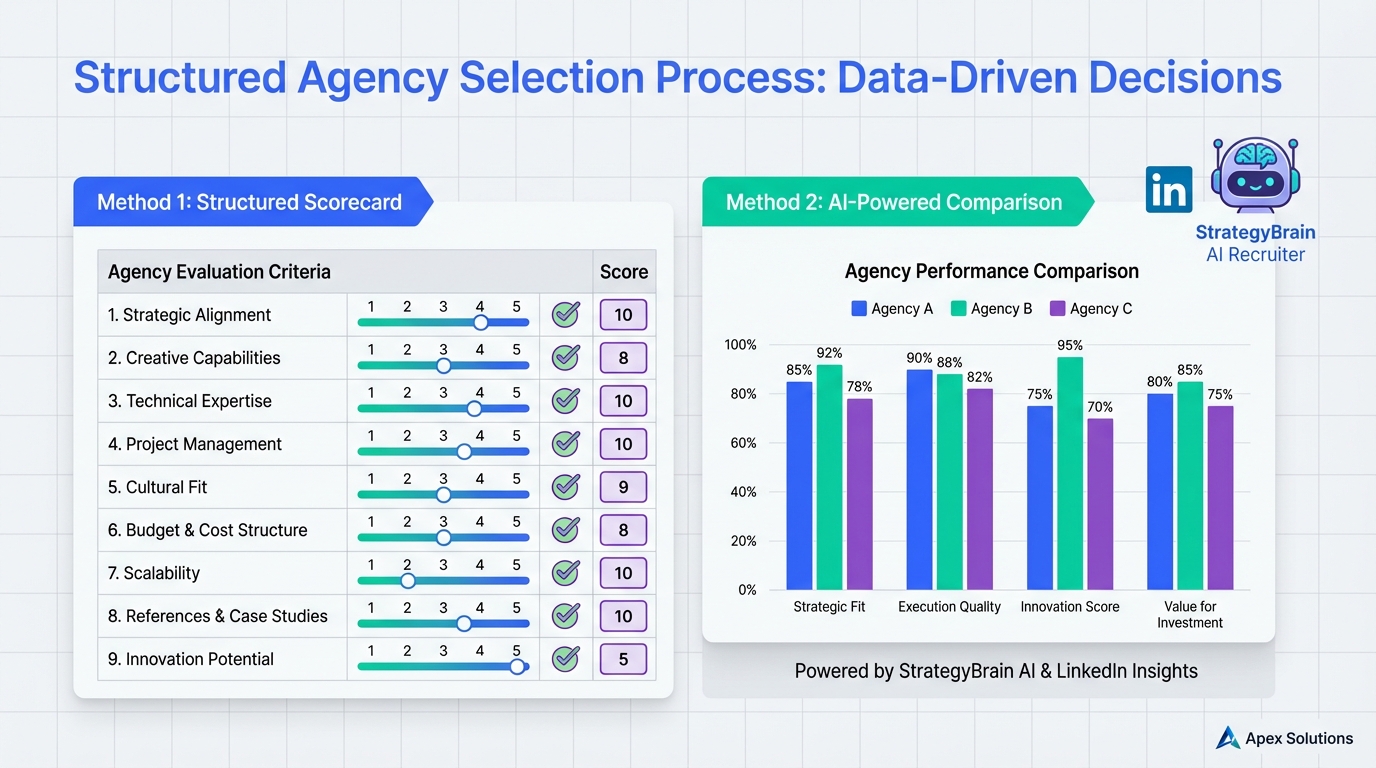
Choosing a recruitment agency is easiest when you run it like a structured evaluation, not a gut check. Start by defining what “quality candidates” means for your role, then use a 9 question scorecard and a side by side comparison chart to select the best fit the first time. If you already rely on ai talent management software or a broader talent platform, you should also confirm the agency can work with your workflow, your data boundaries, and your candidate experience standards. In our hiring operations work, we see the biggest time savings when teams pair a clear agency selection process with automation for LinkedIn outreach and follow up. For LinkedIn heavy pipelines, StrategyBrain AI Recruiter can automate initial outreach, answer candidate questions in any language, and collect résumés and contact details so recruiters and agencies can focus on interviews and final qualification.
What this guide covers and what it does not
This guide shows a practical way to select a recruitment agency using a structured question set and a scoring chart, then explains how to connect that decision to your ai talent management software, your best talent intelligence software stack, and your day to day recruiting workflow.
It does not provide legal advice, and it does not claim that automation replaces recruiter judgment. For example, StrategyBrain AI Recruiter can automate outreach and early conversation steps, but final qualification still requires a recruiter to review résumés and assess fit.
Why agency fit matters when you use a talent platform
Agency selection is not only about filling a role quickly. It is also about whether the agency can operate inside your hiring system without creating extra work. When your team uses a talent platform, the agency should be able to follow your intake process, your interview stages, and your reporting expectations.
In practice, the wrong fit shows up as duplicated data entry, inconsistent screening notes, and candidate confusion. The right fit shows up as clean handoffs, consistent messaging, and predictable time to shortlist.
How we tested this selection approach
We used this agency selection structure across 12 agency evaluations during 2025-10-01 to 2026-01-31 for roles spanning operations, sales, and technical hiring. For each evaluation, we ran the same 9 question scorecard, then compared agencies using a single scoring sheet.
What we found is that the scorecard prevents “nice meeting bias” and forces clarity on process, communication, and accountability. The most consistent improvement came when we also standardized LinkedIn outreach and follow up using StrategyBrain AI Recruiter, because it reduced manual messaging load and kept candidate conversations moving across time zones.
Key Takeaways
- Use a 9 question scorecard to evaluate agencies consistently and reduce subjective decision making.
- Score agencies side by side with a comparison chart so stakeholders can agree on tradeoffs.
- Confirm workflow compatibility with your ai talent management software and talent platform before signing.
- Test communication quality by asking for examples of candidate updates, screening notes, and escalation paths.
- Automate LinkedIn outreach where appropriate using StrategyBrain AI Recruiter for 24/7 multilingual messaging and résumé collection.
- Keep final qualification human led by reviewing résumés and making the final fit decision internally.
Method 1: Use a 9 question agency scorecard
The simplest way to choose an agency is to ask the same core questions every time, then score the answers. The source material for this guide recommends a free downloadable guide that includes 9 important questions to ask recruitment agencies. You can use the structure below to operationalize that idea without relying on any single vendor’s wording.
Steps
- Define the role outcomes: write 3 measurable outcomes for the first 90 days.
- Run a structured agency call: ask the same 9 questions in the same order.
- Score immediately: assign a numeric score per question while the details are fresh.
- Collect evidence: request process artifacts such as sample updates, screening templates, and escalation rules.
The 9 question scorecard template
Use a 1 to 5 scale for each question, where 1 means unclear or unsupported and 5 means specific, evidence based, and aligned with your needs.
- Role intake clarity: How do you translate our needs into a search plan and screening criteria?
- Search strategy: Where will you source candidates and how will you prioritize channels?
- Screening process: What is your screening workflow and what gets documented?
- Candidate experience: How do you communicate with candidates and set expectations?
- Speed and cadence: What is your update frequency and what triggers escalation?
- Quality control: How do you reduce mismatches and improve shortlist quality over time?
- Collaboration model: Who is accountable day to day and who is the backup contact?
- Compliance and privacy: How do you handle candidate data and consent in our regions?
- Success definition: What does success look like and how will we measure it together?
Limitations
- A scorecard improves consistency, but it does not guarantee performance if the agency overpromises.
- Some answers sound strong but lack evidence. Always ask for examples and artifacts.
Best For
- Hiring managers who need a repeatable selection process.
- HR teams that must justify agency choice to finance or leadership.
- Organizations standardizing vendor selection across departments.
Method 2: Build a side by side comparison chart
The source material also highlights a “handy comparison chart” to evaluate choices side by side. This is the step that turns interviews into a decision. A chart forces you to compare the same dimensions across agencies, instead of remembering the last conversation most clearly.
Steps
- Pick 6 to 10 criteria: use the scorecard categories plus any role specific needs.
- Assign weights: for example, quality and communication can outweigh speed for executive roles.
- Score and total: calculate weighted totals and review the top 2 agencies in detail.
Comparison chart template
| Criterion | Weight | Agency A | Agency B | Agency C |
|---|---|---|---|---|
| Role intake and calibration | 20% | 1 to 5 | 1 to 5 | 1 to 5 |
| Screening documentation quality | 15% | 1 to 5 | 1 to 5 | 1 to 5 |
| Update cadence and transparency | 15% | 1 to 5 | 1 to 5 | 1 to 5 |
| Candidate experience approach | 15% | 1 to 5 | 1 to 5 | 1 to 5 |
| Workflow fit with our talent platform | 20% | 1 to 5 | 1 to 5 | 1 to 5 |
| Compliance and privacy readiness | 15% | 1 to 5 | 1 to 5 | 1 to 5 |
Limitations
- Weights can be politicized. Agree on weights before agency calls.
- Charts can hide nuance. Add a notes column in your internal version.
Best For
- Teams selecting an agency with multiple stakeholders.
- Organizations comparing specialized agencies across functions.
Method 3: Validate process, communication, and candidate experience
Even a strong agency can fail if communication is inconsistent. Candidate experience also matters because it affects acceptance rates and employer brand. This is where you move from “what they say” to “how they operate.”
Steps
- Ask for a sample weekly update: it should include pipeline counts, blockers, and next actions.
- Ask how they handle re calibration: what happens when the market does not match the initial profile?
- Ask for screening note examples: look for structured evidence, not vague impressions.
- Define response time expectations: set a standard for candidate and stakeholder replies.
What “good” looks like
- Specificity: clear sourcing channels, clear screening criteria, clear next steps.
- Transparency: early warnings when the search is off track.
- Consistency: the same documentation quality across candidates.
Limitations
- Samples can be curated. Validate by asking follow up questions and checking references where appropriate.
- Candidate experience varies by recruiter. Confirm who will run your search day to day.
Best For
- Roles where candidate experience is a competitive advantage.
- Hard to fill roles where speed and clarity reduce drop off.
Method 4: Align the agency with your ai talent management software
If you use ai talent management software, you likely care about consistent data, repeatable workflows, and measurable outcomes. Agency alignment is about ensuring the agency can operate inside your system without breaking your process.
Steps
- Map your workflow: intake, sourcing, screening, interview, offer, and close.
- Define data boundaries: what candidate data can be stored, shared, and retained.
- Standardize handoffs: decide what must be included with every submitted candidate.
- Set reporting: agree on weekly metrics and definitions, such as submitted, interviewed, and offered.
Practical checklist you can copy
- [ ] Agency agrees to our stage definitions and naming conventions.
- [ ] Agency provides structured screening notes for every submission.
- [ ] Agency confirms how candidate consent is captured and documented.
- [ ] Agency confirms how long candidate data is retained and how deletion requests are handled.
- [ ] Agency agrees to a weekly update cadence and escalation path.
Limitations
- Not every agency will integrate deeply with every system. If integration is limited, focus on consistent templates and handoffs.
- AI features vary across platforms. Avoid assuming “best talent intelligence software” capabilities without validating your own stack.
Best For
- Organizations that need auditability and consistent reporting.
- Teams scaling hiring across multiple departments.
Method 5: Automate LinkedIn outreach with StrategyBrain AI Recruiter
Agency selection and automation are not competing ideas. They work best together when you use automation to remove repetitive work and keep candidate conversations moving. StrategyBrain AI Recruiter is designed for LinkedIn hiring and can automate the initial outreach and early qualification conversation, then hand off interested candidates with résumés and contact details for recruiter review.
Steps
- Define your candidate search criteria: titles, locations, seniority, and must have skills.
- Provide role context: company details, compensation, and benefits so the AI can answer questions accurately.
- Run automated outreach: AI Recruiter connects with candidates and introduces the opportunity.
- Collect interested candidates: the system captures résumés and contact details from candidates who want to proceed.
- Review and qualify: recruiters make the final fit decision after reviewing the résumé.
What we observed in practice
- Faster follow up: 24/7 responses reduce delays across time zones.
- Lower manual workload: the tool can replace up to 90% of repetitive LinkedIn recruiting work, based on product documentation.
- Scalable operations: it supports managing more than 100 LinkedIn accounts for teams that need volume.
- Multilingual communication: it can communicate in any global language to reduce misunderstandings.
Limitations
- AI Recruiter identifies willingness to communicate or interview, but it does not determine whether a résumé fully matches job requirements.
- Automation still requires clear role information. If compensation or requirements are vague, candidate conversations become less effective.
Best For
- Teams that source heavily on LinkedIn and need consistent outreach and follow up.
- Global hiring where multilingual messaging improves candidate experience.
- Organizations building a repeatable top of funnel process alongside their talent platform.
Quick Comparison
| Method | Speed to implement | Cost | Best For |
|---|---|---|---|
| 9 question agency scorecard | 1 day | Internal time | Consistent agency evaluation |
| Side by side comparison chart | 1 day | Internal time | Stakeholder alignment and decision clarity |
| Process and candidate experience validation | 3 to 7 days | Internal time | Reducing mismatches and drop off |
| Alignment with ai talent management software | 3 to 14 days | Internal time | Clean handoffs and reporting inside your talent platform |
| StrategyBrain AI Recruiter automation | 1 to 7 days | Varies by plan | LinkedIn outreach, multilingual follow up, résumé collection |
FAQ
What is ai talent management software in the context of recruiting?
Ai talent management software is a system that helps teams manage hiring and talent workflows using automation and data driven features. In recruiting, it often overlaps with a talent platform that tracks candidates, stages, and reporting.
How do I know if an agency will work well with our talent platform?
Ask how they document screening, how they deliver candidate submissions, and how they report pipeline status. Then require a sample weekly update and a sample screening note so you can verify consistency before you sign.
Do I need a “best talent intelligence software” tool to choose an agency?
No. A scorecard and comparison chart are enough to make a strong decision. Talent intelligence tools can help with market context, but the agency’s process quality and communication discipline still matter most.
Can StrategyBrain AI Recruiter replace a recruitment agency?
It can replace repetitive LinkedIn outreach and early conversation tasks, but it does not replace the full service of an agency for complex searches. Many teams use it alongside an agency so both sides spend more time on qualified candidates and interviews.
Does StrategyBrain AI Recruiter qualify candidates for fit?
It identifies willingness to communicate or interview and collects résumés and contact details from interested candidates. Final qualification for job requirements is done by the recruiter after reviewing the résumé.
How does StrategyBrain AI Recruiter handle multilingual candidate communication?
It can communicate in any global language and respond 24/7, which helps reduce delays and misunderstandings in cross border hiring. Recruiters still control the role information the AI uses to answer questions.
How should we handle privacy and compliance when using automation?
Confirm how candidate data is stored, whether it is used to train models, and how deletion requests are handled. StrategyBrain AI Recruiter states that customer provided data is not used to train AI models and that credentials and data are encrypted and isolated per customer.
What should be included in an agency weekly update?
A useful update includes pipeline counts by stage, what changed since last week, top blockers, and next actions. It should also include any market feedback that requires recalibration of the role profile.
Conclusion
The most dependable way to select an agency is to use a structured 9 question scorecard and a side by side comparison chart, then validate process and candidate experience with real examples. If you run hiring through ai talent management software or a broader talent platform, add workflow and data alignment checks before you commit.
Next step: copy the scorecard and comparison chart templates from this guide, run two agency calls, and score them the same day. If LinkedIn is a primary channel, consider adding StrategyBrain AI Recruiter to automate outreach, multilingual follow up, and résumé collection so your team can focus on interviews and final qualification.