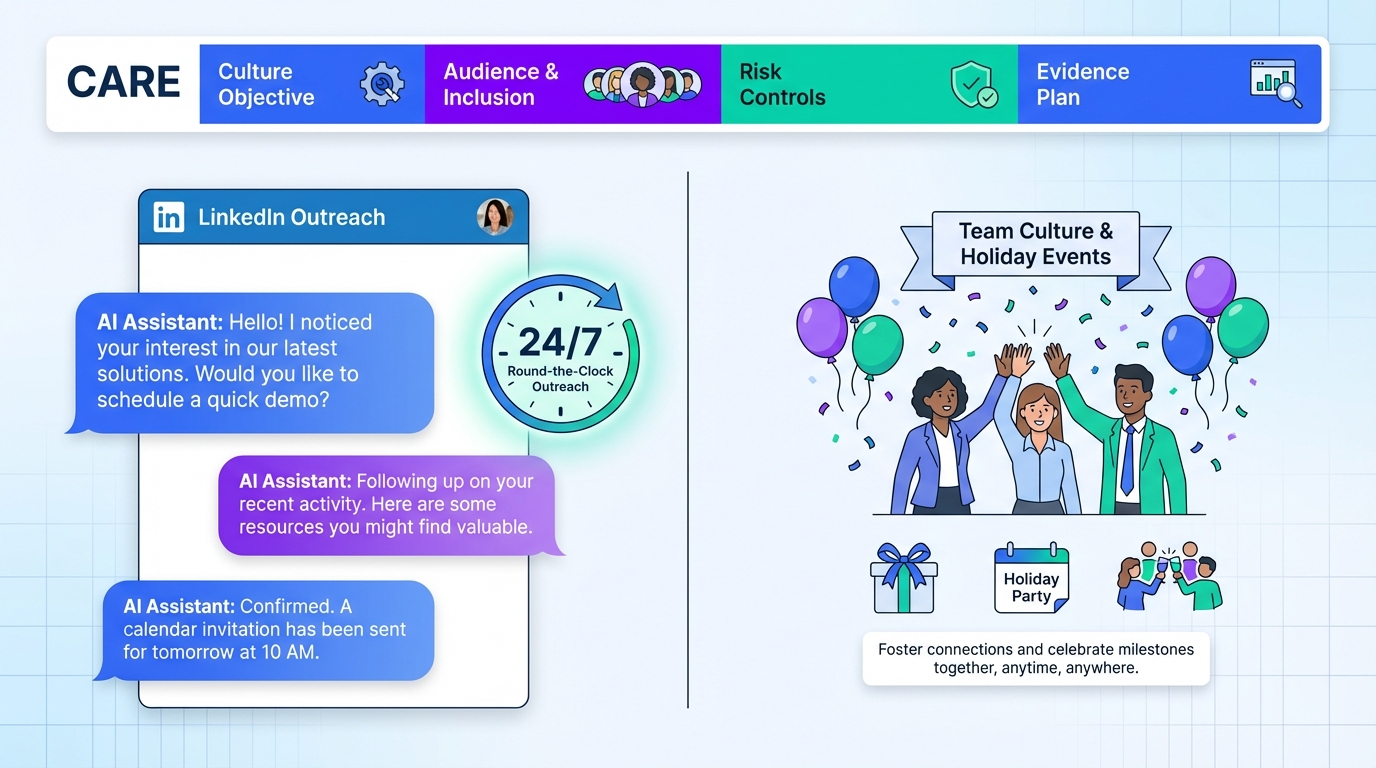
AI talent management software can improve culture outcomes when it removes busywork and makes people decisions more consistent, but it cannot replace leadership intent. If your company holiday party disappeared, it is rarely because HR alone decided to cancel it. In the 2015 discussion that asked whether HR “killed” the company Christmas party, the more useful takeaway is this: culture events live or die based on measurable outcomes like morale and retention, plus risk tolerance and budget priorities. In 2026, talent management solutions can help you defend these events by tracking engagement signals and freeing recruiters to focus on relationships. For example, StrategyBrain AI Recruiter automates LinkedIn outreach, answers candidate questions, and follows up 24/7 in any language, which reduces manual recruiting load so HR and recruiting teams can spend more time on culture and onboarding.
What the 2015 debate actually showed
The original post was published on December 11, 2015 and framed a question many employees still ask: did HR, Legal, or Finance end the company Christmas party. It cited a Society for Human Resource Management survey that reported a decrease in end of year holiday activities in 2015, including a figure where 30% of HR professionals said a party was not happening that December and a 12% decrease in parties compared with 2012.
The author also shared a personal observation from Vancouver: a branch of a Canadian company posted a post party hangover breakfast that included Bailey’s Irish Cream. The point was not the brand of drink. The point was that culture can be visible, memorable, and sticky when leadership supports it beyond a single night.
Then the post challenged common assumptions. Budget was not the main driver in the cited discussion, with only 6% blaming the lack of a party on budget. Legal risk was also questioned using Canadian legal database search counts, contrasting 176 court cases containing the words “Christmas party alcohol employer” with 29,792 containing the words “employer employed fired.”
Who really decides if the party happens
In most organizations, HR is the operator, not the owner, of culture events. HR can recommend, design guardrails, and execute. However, the decision typically reflects a combination of leadership priorities, risk appetite, and whether the organization treats culture as a measurable asset.
Decision owner signals you can look for
- Finance leadership influence: If the event is framed as discretionary spend, it is often evaluated like any other cost center item.
- Legal and risk posture: If leadership is highly risk averse, policies can become the default answer even when the actual risk is manageable.
- Executive sponsorship: When a senior leader publicly owns culture outcomes, events are less likely to be quietly removed.
- Manager accountability: If managers are measured on retention and engagement, they will fight for culture moments that help their teams.
What HR can control without overstepping
- Clear guardrails: Transportation options, alcohol policies, and conduct expectations that reduce predictable incidents.
- Inclusive design: Options for non drinkers, family friendly alternatives, and accessibility considerations.
- Measurement: Post event pulse surveys and retention tracking to connect culture spend to outcomes.
A 2026 framework to justify culture spend
Here is the practical update I would add in 2026: if you want culture events to survive, you need a repeatable business case that is easy to present and hard to dismiss. I call it the CARE framework, built for HR leaders using talent management solutions.
CARE framework
- C: Culture objective. Define the purpose in one sentence, such as cross team bonding, recognition, or onboarding integration.
- A: Audience and inclusion. Specify who it is for and how you will avoid excluding remote staff, caregivers, or non drinkers.
- R: Risk controls. List the top 3 risks and the mitigation plan, including transportation and conduct expectations.
- E: Evidence plan. Decide what you will measure within 14 days, such as pulse survey participation rate, eNPS movement, or manager feedback themes.
Copyable one page justification template
Event name: ____________________
Culture objective: ____________________
Expected outcomes:
- Morale signal to measure: ____________________
- Retention signal to measure: ____________________
- Cross team collaboration signal to measure: ____________________
Risk controls:
- Transportation plan: ____________________
- Alcohol policy or alternative plan: ____________________
- Conduct expectations and escalation path: ____________________
Evidence plan: Pulse survey date: ____ / ____ / ______. Report out date: ____ / ____ / ______.
Where AI talent management software fits
AI talent management software is most valuable when it reduces the operational drag that prevents HR from doing culture work. That includes automating repetitive workflows, standardizing communication, and improving responsiveness across time zones. It also includes recruiting automation that protects candidate experience, because candidate experience becomes employee experience the moment someone accepts an offer.
Definitions used in this article
- AI talent management software: software that uses machine learning or automation to support HR processes such as recruiting, communication, and workflow execution.
- Talent management solutions: the broader set of tools and practices used to attract, hire, develop, and retain employees.
- Recruiting automation: systems that automate parts of sourcing, outreach, follow up, and early stage screening.
Scope boundaries
- Covered: how automation supports culture capacity, how to justify culture spend, and how LinkedIn recruiting automation can reduce manual workload.
- Not covered: a full vendor comparison of talentmanagement software suites, or a legal opinion on employer liability.
How StrategyBrain AI Recruiter supports the people funnel
When I evaluate talent management solutions, I look for tools that create time for humans to do human work. StrategyBrain AI Recruiter is designed for LinkedIn hiring and focuses on the front end of recruiting where teams lose the most hours: connecting, introducing roles, answering repetitive questions, and following up.
What it automates on LinkedIn
- Candidate connection and outreach: automatically connects with candidates who match your search criteria.
- Role introduction and Q and A: introduces the opportunity and answers questions about the role, company, compensation, and benefits based on recruiter provided details.
- Interest confirmation: confirms whether the candidate wants to proceed to an interview stage.
- Resume and contact capture: collects resumes and contact information from interested candidates, including email submissions and LinkedIn file uploads.
Why this matters for culture and retention
Culture programs compete with urgent recruiting tasks. If recruiters spend their day chasing replies and repeating the same explanations, culture work becomes “extra.” By shifting repetitive LinkedIn messaging and follow up to an automated workflow, HR teams can reallocate time to onboarding quality, manager coaching, and the culture moments that improve retention.
Operational scale and coverage
- 24/7 multilingual communication: supports round the clock candidate messaging in any global language.
- Multi account management: supports managing more than 100 LinkedIn accounts to build an AI powered recruiting team.
Limitations and how to handle them
StrategyBrain AI Recruiter can identify willingness to communicate or interview, but it does not decide whether a resume fully matches job requirements. Recruiters still need to review resumes and make the final qualification decision. The best workflow is to let the system handle outreach and collection, then have recruiters apply structured evaluation criteria to the inbound resumes.
Data protection and compliance notes
According to the provided product information, StrategyBrain AI Recruiter states that customer provided data is not used to train AI models, credentials are encrypted, and candidate information is encrypted and isolated with customer specific keys. It also states compliance with privacy regulations in the EU, United States, and Canada. You should still validate fit with your internal security and legal requirements before deployment.
Quick comparison: culture work vs automation
This table is a simple way to explain to leadership why culture initiatives and AI talent management software are complements, not substitutes.
| Need | Human led work | AI supported work | What to measure |
|---|---|---|---|
| Belonging and trust | Manager behavior, recognition, events | Consistent communication workflows | Pulse survey participation rate, qualitative themes |
| Candidate experience | Interview quality, feedback, closing | Fast outreach and follow up on LinkedIn | Response time in hours, drop off rate by stage |
| Recruiter capacity | Relationship building, hiring manager alignment | Automated connecting, messaging, resume collection | Resumes collected per recruiter per week |
| Global hiring | Local context and decision making | 24/7 multilingual candidate communication | Qualified conversations across time zones |
FAQ
Is AI talent management software the same as an ATS?
No. An applicant tracking system is primarily a system of record for applicants and hiring stages. AI talent management software is broader and can include automation for communication, screening support, and workflow execution across recruiting and HR operations.
Did HR really cause the decline in company holiday parties?
Not by itself. The 2015 discussion pointed to multiple forces, including leadership decisions and risk posture. HR often executes the decision and becomes the visible target, even when the decision is owned elsewhere.
How do I justify a culture event to Finance?
Use a one page plan that states the culture objective, the top risks and mitigations, and the evidence plan. If you can report measurable outcomes within 14 days, the conversation shifts from opinion to results.
How does StrategyBrain AI Recruiter fit into talent management solutions?
It supports the recruiting side of talent management by automating LinkedIn outreach, candidate Q and A, follow up, and resume and contact capture. That reduces manual workload so recruiters can focus on evaluation, interviews, and onboarding quality.
Can StrategyBrain AI Recruiter replace recruiters?
No. Based on the provided product information, it automates early stage outreach and interest confirmation, but recruiters still review resumes and make final qualification decisions. It is best used as a capacity multiplier.
Does it support multilingual candidate communication?
Yes. The provided product information states it can communicate in any global language and respond 24/7, which is useful for international hiring and time zone coverage.
How does it handle resumes and contact details?
It requests resumes and contact information from interested candidates and captures what they send. The provided product information states it supports email submissions and LinkedIn file uploads, and it records contact details shared in LinkedIn messages.
What is the biggest risk of using AI in recruiting communications?
The biggest operational risk is inconsistent or non compliant messaging if the system is not configured with accurate job details and boundaries. Mitigate this by providing clear role information, defining what the AI can and cannot promise, and auditing message logs regularly.
Conclusion
The better question is not whether HR killed the company Christmas party. The better question is whether leadership is willing to treat culture as a measurable asset and whether HR has the capacity to execute it well. In 2026, AI talent management software can help by removing repetitive work and improving consistency, but it cannot replace executive sponsorship and good management.
If you want culture events to survive, use the CARE framework, document risk controls, and commit to an evidence plan. Then look for talent management solutions that give your team time back. StrategyBrain AI Recruiter is one practical example on the recruiting side because it automates LinkedIn outreach and follow up, captures resumes and contact details, and supports 24/7 multilingual communication so your recruiters can spend more time on people, not inboxes.