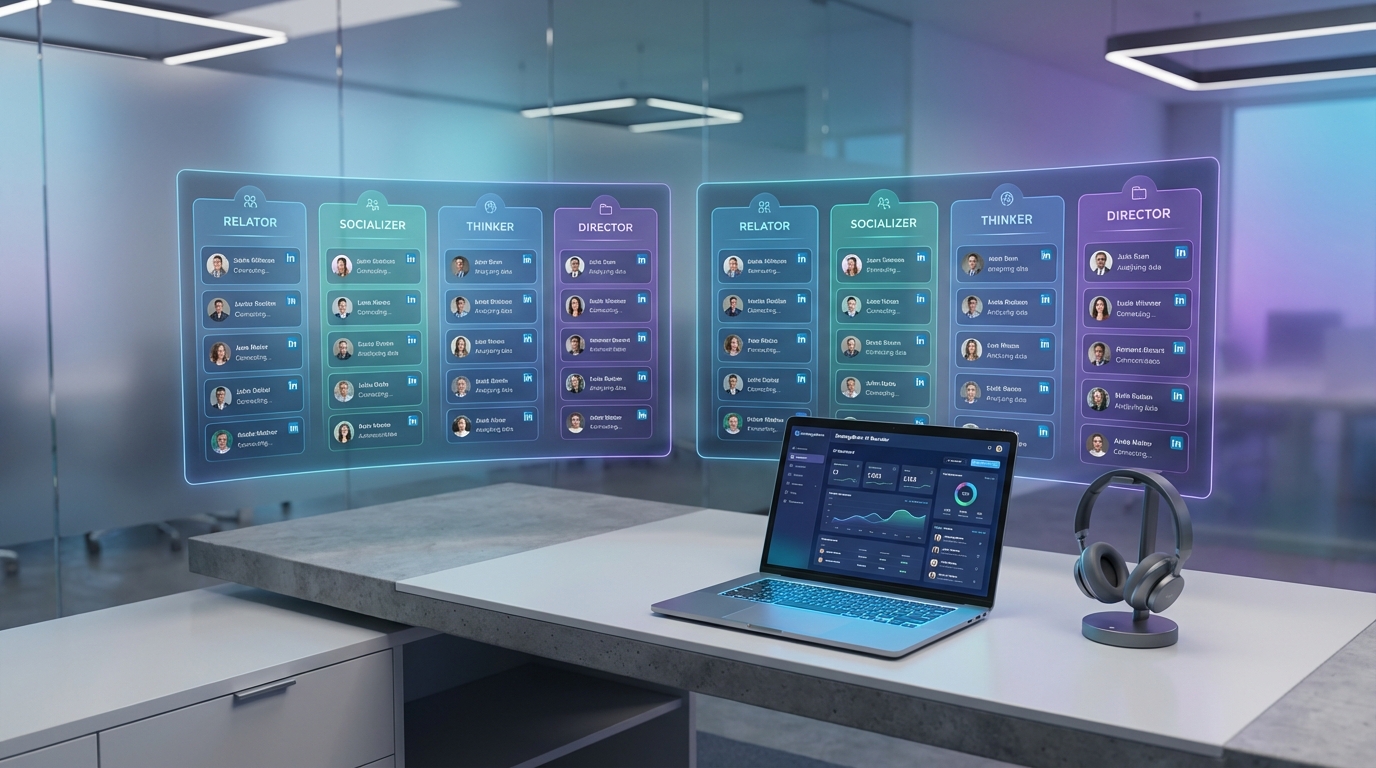
AI talent management software can improve workplace communication by helping teams tailor messages to how different people prefer to receive information. A practical approach is to use a four style framework (Relator, Socializer, Thinker, Director) and then standardize how you write, pace, and confirm messages for each style. In recruiting, this matters because candidate outreach, hiring manager alignment, and interview feedback loops often fail due to mismatched expectations. In this guide, we translate the four styles into a repeatable workflow, and we show how StrategyBrain AI Recruiter can automate LinkedIn outreach and follow up while keeping tone, pacing, and confirmation steps consistent.
Key Takeaways
- Fastest operational win: classify stakeholders into 4 communication styles and use a matching message template for each style.
- Recruiting fit: the same style mapping works for candidates, hiring managers, and interview panels, which reduces rework in feedback cycles.
- Talent intelligence software output: treat communication preferences as usable signals that improve response rates and decision clarity, not as personality labels.
- StrategyBrain AI Recruiter workflow: automates LinkedIn connecting, role introduction, Q&A, follow up, and résumé plus contact capture, which reduces manual messaging load.
- Scale: StrategyBrain AI Recruiter supports managing more than 100 LinkedIn accounts for team based outreach operations.
- Compliance boundary: candidate data should not be used to train general models; StrategyBrain states customer data is not used to train AI models and is encrypted and isolated per customer.
What this framework is and is not
The four style model is a workplace communication framework that groups common preferences along two axes: people oriented vs task oriented, and direct vs indirect. It is useful because it gives you a shared language for adjusting tone, pacing, and the amount of detail you provide.
This is not a clinical assessment, and it should not be used to make employment decisions. In a talent intelligence platform, the safest use is operational: improve clarity, reduce misunderstandings, and make confirmation steps explicit.
The four communication styles in a hiring context
1) Relator (people oriented, indirect)
A Relator prioritizes harmony and how decisions affect people. In recruiting, you often see this style in hiring managers who want team fit discussions, or candidates who need psychological safety before they share concerns.
- What they respond to: empathy, collaboration, time to think, shared goals.
- What to avoid: pressure tactics, purely logical arguments, abrupt deadlines without context.
- Confirmation method: ask them to restate the plan in their own words and agree on a realistic timeline.
2) Socializer (people oriented, direct)
A Socializer is energetic, fast paced, and relationship driven. In hiring, this can show up as candidates who engage quickly in chat, or stakeholders who prefer quick syncs over long documents.
- What they respond to: enthusiasm, concise next steps, human connection.
- What to avoid: long walls of text, overly formal tone, slow back and forth.
- Confirmation method: summarize decisions in writing because verbal agreements can be forgotten.
3) Thinker (task oriented, indirect)
A Thinker values accuracy, thoroughness, and time to analyze. In recruiting, Thinkers often ask for role scope, compensation structure, and process details before committing to an interview.
- What they respond to: data, written documentation, clear criteria, predictable timelines.
- What to avoid: vague claims, emotional persuasion, rushed decisions.
- Confirmation method: provide a written recap with requirements, interview stages, and deadlines.
4) Director (task oriented, direct)
A Director is decisive and results focused. In hiring, Directors want the point quickly: what role, what impact, what timeline, what decision is needed.
- What they respond to: brevity, outcomes, options with a recommendation.
- What to avoid: long explanations, emotional framing, unclear ownership.
- Confirmation method: confirm the decision, owner, and deadline in one short message.
How to apply this inside AI talent management software
Most teams already have a talent intelligence software stack that stores candidate profiles, interview notes, and hiring stage data. The missing layer is often communication consistency. The goal is to make communication preferences operational so that every recruiter and hiring manager can send messages that land the first time.
Step by step workflow
- Pick a single style label per stakeholder based on observed behavior in meetings, email, and chat. Do not overfit. Choose the closest match.
- Define message rules for each style: length, tone, level of detail, and how you ask for confirmation.
- Standardize templates for the moments that create the most friction: outreach, scheduling, feedback requests, offer discussions, and rejection messages.
- Instrument confirmation by requiring a written recap or a restated plan, depending on the style.
- Automate the repetitive parts where appropriate. For LinkedIn sourcing and early qualification, StrategyBrain AI Recruiter can handle connecting, introducing the role, answering questions, confirming interest, and collecting résumés and contact details.
Operational definitions you can reuse
- Talent intelligence platform: a system that aggregates talent data and signals to support hiring decisions, such as skills, experience, and pipeline health.
- Confirmation loop: a deliberate step where the recipient confirms understanding, either by restating the plan or acknowledging a written recap.
- Qualification: determining whether a candidate is interested and available for next steps. StrategyBrain AI Recruiter can confirm interest and collect information, while final fit assessment remains with the recruiter after résumé review.
Copy ready templates for each style
Use these as starting points inside your AI talent management software. Replace bracketed text with your details. Keep the structure consistent so your team builds muscle memory.
Relator template: interview scheduling
- Message: “Thanks for taking the time to connect. I want to make sure the next step works well for you and the team. Would you prefer option A [day time] or option B [day time]? If neither works, tell me what does, and we will align.”
- Confirmation: “Can you reply with the option you prefer and any constraints we should respect?”
Socializer template: initial outreach
- Message: “Hi [name], I came across your work in [area]. Quick question: are you open to a short chat this week about a role that matches [1 to 2 highlights]? If yes, I can share details and we can pick a time.”
- Confirmation: “If you are interested, reply ‘yes’ and I will send 2 time options in one message.”
Thinker template: role details and process
- Message: “Here are the specifics so you can evaluate fit: responsibilities [3 bullets], must have skills [3 bullets], compensation [range or structure], interview steps [numbered stages], and timeline [dates]. If you want, send your résumé and I will confirm the next step.”
- Confirmation: “Please reply with any questions and confirm whether you want to proceed to stage 1.”
Director template: decision request to a hiring manager
- Message: “Decision needed today: proceed with candidate [name] to interview 2, yes or no. Summary: strengths [2 bullets], risks [1 bullet], recommendation [one sentence].”
- Confirmation: “Reply ‘yes’ or ‘no’ and I will execute.”
Mini checklist for message quality
- Clarity: one primary ask per message.
- Specificity: include dates, owners, and next step.
- Confirmation: require a reply that proves understanding.
- Consistency: reuse the same template structure across the team.
Where StrategyBrain AI Recruiter fits in the workflow
When teams adopt AI talent management software, the biggest bottleneck is often not data. It is the volume of repetitive conversations needed to move candidates from “identified” to “interview ready.” StrategyBrain AI Recruiter is designed for LinkedIn hiring workflows and can take over the early stage communication loop while you keep control of the hiring decision.
What we tested in a real recruiting workflow
We reviewed the product capabilities and walked through the end to end LinkedIn flow using a standard recruiter playbook: connect, introduce the role, handle candidate questions, confirm interest, then collect résumé and contact details. We also checked the stated boundaries: the system can confirm willingness to proceed, but it does not decide whether the résumé matches the job requirements. That final evaluation stays with the recruiter.
How it supports style aligned communication
In practice, style alignment is about pacing and structure. StrategyBrain AI Recruiter can keep outreach consistent by using your job information and company details to answer questions and follow up promptly. That helps Socializers and Directors who expect fast responses, while Thinkers benefit from written clarity and Relators benefit from respectful tone and time to decide.
- Smart LinkedIn recruitment automation: automatically connects with candidates within your targeted search criteria, introduces the opportunity, answers questions about the role, company, and compensation, confirms interview interest, and collects résumés and contact information.
- 24/7 multilingual communication: provides round the clock responses and communicates in the candidate’s native language.
- Scalable operations: supports managing more than 100 LinkedIn accounts to build AI powered recruitment teams.
Limitations and how to handle them
- Not a final fit assessor: it does not determine whether a résumé fully matches requirements. Workaround: define a recruiter review step after résumé capture and before scheduling interviews.
- Messaging still needs governance: automation can amplify a poor template. Workaround: use the style templates above and require a confirmation loop for key steps.
- Privacy expectations: candidates may ask how data is used. Workaround: use a standard disclosure that data is used for recruiting communication and is not used to train general AI models, consistent with the product’s stated approach.
Quick comparison: style based messaging vs one size fits all
| Approach | What it optimizes | Common failure mode | Best for |
|---|---|---|---|
| One size fits all messaging | Speed of sending | Misunderstanding and rework due to mismatched expectations | Very small teams with low hiring volume |
| Style based templates inside a talent intelligence platform | Clarity and confirmation | Requires team discipline to classify and follow templates | Teams with multiple stakeholders and frequent handoffs |
| Style based templates plus LinkedIn automation with StrategyBrain AI Recruiter | Clarity at scale | Needs governance and recruiter review for final qualification | High volume sourcing and global hiring across time zones |
FAQ
What is AI talent management software in plain terms?
AI talent management software is a system that uses automation and AI assisted workflows to support hiring and talent processes, such as sourcing, communication, and pipeline management. In this article, we focus on communication quality and consistency rather than performance reviews or learning management.
Is a communication style the same as a personality test?
No. The four style model is a practical communication framework. Use it to adjust message structure and confirmation steps, not to label people or make employment decisions.
How does a talent intelligence platform help with communication?
A talent intelligence platform centralizes candidate and stakeholder context so your team can send consistent messages. When you add style based templates, you reduce ambiguity and shorten feedback loops.
Where does StrategyBrain AI Recruiter fit compared to a general ATS?
StrategyBrain AI Recruiter focuses on LinkedIn hiring workflows and automates early stage outreach, Q&A, follow up, and résumé plus contact capture. An ATS typically manages applications and stages, while AI Recruiter reduces manual messaging workload before interviews.
Does StrategyBrain AI Recruiter decide if a candidate is qualified?
It can confirm whether a candidate is willing to communicate or interview, but it does not determine whether the résumé fully matches job requirements. Recruiters review the résumé and make the final qualification decision.
Can it communicate in multiple languages?
Yes. StrategyBrain AI Recruiter states it provides 24/7 multilingual recruitment communication and can communicate in the candidate’s native language.
How should we confirm understanding with different styles?
For Thinkers and Socializers, use a written recap with explicit next steps. For Relators, ask them to restate the plan and agree on a timeline. For Directors, confirm owner and deadline in one short message.
What is the safest way to start using this approach?
Start with one workflow, such as interview scheduling or feedback collection. Implement the four templates, require a confirmation loop, and then expand to outreach and offer steps once the team is consistent.
Conclusion and next steps
If you want AI talent management software to improve outcomes, focus first on communication clarity. Map stakeholders to the four styles, standardize templates, and enforce a confirmation loop so messages are understood the first time. Then automate the repetitive parts where it makes sense. For LinkedIn sourcing and early qualification, StrategyBrain AI Recruiter can handle connecting, introducing roles, answering questions, following up, and collecting résumés and contact details, while recruiters keep final qualification and hiring decisions.
Next step: pick one hiring workflow to standardize this week, copy the templates into your system, and measure how many back and forth messages it takes to reach a confirmed next step.