AI talent management software helps teams run more consistent interviews by turning “good habits” into a repeatable process that candidates experience the same way every time. The core best practices are simple and still decisive in 2026: arrive 10 minutes early, dress professionally, handle small details, greet with a firm handshake, keep your phone away, use confident body language, bring multiple resume copies, answer with concrete results, explain job changes honestly, and show you understand the market, company, and role. In this guide, we translate those fundamentals into a structured workflow you can run inside talent management software, and we show where StrategyBrain AI Recruiter fits naturally by automating early LinkedIn outreach and pre qualification so interviews focus on fit and evidence.
Key Takeaways
- Consistency wins: Use one interview checklist for every candidate to reduce bias and missed signals.
- 10 minute arrival rule: Aim to arrive 10 minutes early to avoid a negative first impression.
- Evidence over stories: Give succinct answers that include specific outcomes and examples.
- Professional signals matter: Dress professionally, manage scent and grooming, and keep your phone out of sight.
- Honesty with control: Explain departures truthfully without emotional or overly negative framing.
- AI can protect interview time: StrategyBrain AI Recruiter can handle initial LinkedIn messaging and interest checks so recruiters spend interviews on deeper evaluation.
Why these basics still decide outcomes
We reviewed the original recruiter cheat sheet source content and then pressure tested it against how interviews actually run when teams use talent management software. The conclusion was straightforward: the “small” behaviors are not small because they shape trust, clarity, and signal quality. Even with AI assisted recruiting, the interview is still a high stakes human evaluation moment, and the basics reduce noise so the interviewer can focus on evidence.
This article covers interview behavior and interview operations. It does not cover compensation negotiation tactics, role specific technical assessments, or legal advice for regulated hiring.
Interview best practices checklist
1) Arrive 10 minutes early
Arriving late creates an immediate negative impression. Arriving drastically early can create awkwardness for reception and the interviewer. The practical target is 10 minutes early, which gives you buffer time without forcing the organization to host you prematurely.
2) Dress professionally, even for a recruiter interview
Treat interviews with recruiters the same way you would treat interviews with an employer. Recruiters represent multiple potential employers, so professional presentation is part of demonstrating judgment. Even if the eventual job has a casual dress code, your interview standard should remain professional.
3) Handle small details that affect polish
Small details can distract interviewers and reduce perceived professionalism. The original guidance emphasized avoiding overpowering scents, using a breath mint, and ensuring clothing is fresh and free of unpleasant odors. If possible, freshen up shortly before the interview.
4) Stand up and offer a firm handshake
Standing when the interviewer enters and offering a firm handshake is a simple, widely recognized signal of respect and confidence. The goal is a professional greeting that feels steady and intentional.
5) Switch off and put away your phone
Do not check your phone during an interview and do not place it on the table. Switch it off and keep it out of sight before you enter the building. This protects attention and signals respect for the interviewer’s time.
6) Use confident, trustworthy body language
Interviewers look for nonverbal cues that project confidence and honesty. The original content also called out smiling as a practical behavior that communicates comfort and approachability. The goal is calm presence rather than forced performance.
7) Bring the right materials
Come prepared with multiple printed copies of your resume and any relevant work samples or portfolio items. For example, a sales professional might bring evidence of a campaign they worked on. Preparation reduces friction and makes it easier for interviewers to evaluate you fairly.
8) Answer succinctly and include concrete results
Organize your thoughts and provide a clear, relevant answer. Avoid rambling and veering off topic. When possible, include achievements and examples from previous roles so the interviewer can evaluate impact, not just intent.
9) Be honest about leaving roles, without emotional spillover
If you were fired, say so and move on. Being let go can happen for many reasons and is not always a deal breaker. Honesty matters because inconsistencies can do more damage than a truthful explanation. At the same time, avoid overly negative commentary about past employers.
10) Demonstrate understanding of the market, company, and role
Do your homework on the role and the industry context. Understanding how you can bring value, and asking appropriate questions, creates a strong impression. Interviews are not one way. Prepare questions to evaluate whether the role is the right fit for your career path.
How to operationalize in talent management software
Many teams buy talentmanagement software and still run interviews inconsistently because the process is not encoded into the workflow. Below is a practical way to translate the checklist into a system that scales.
Step by step: turn best practices into a repeatable workflow
- Create a single interview scorecard that includes preparation, communication clarity, evidence of results, and role specific competencies.
- Attach the checklist to every interview stage so interviewers see the same reminders and evaluation fields each time.
- Standardize candidate instructions such as arrival timing, what to bring, and how the interview will be structured.
- Require evidence fields in the scorecard so “good communicator” becomes “gave one example with measurable outcome.”
- Run a short calibration after the first 3 interviews for a role to align on what “strong” looks like.
What to measure inside AI talent management software
- Interview completion rate: percentage of scheduled interviews that occur as planned.
- Time to decision: days from first interview to final decision.
- Candidate drop off points: stage where candidates most often disengage.
- Scorecard completeness: percentage of interviews with all required fields filled.
These metrics do not replace judgment. They help you detect process breakdowns early.
Where StrategyBrain AI Recruiter fits in an AI enabled workflow
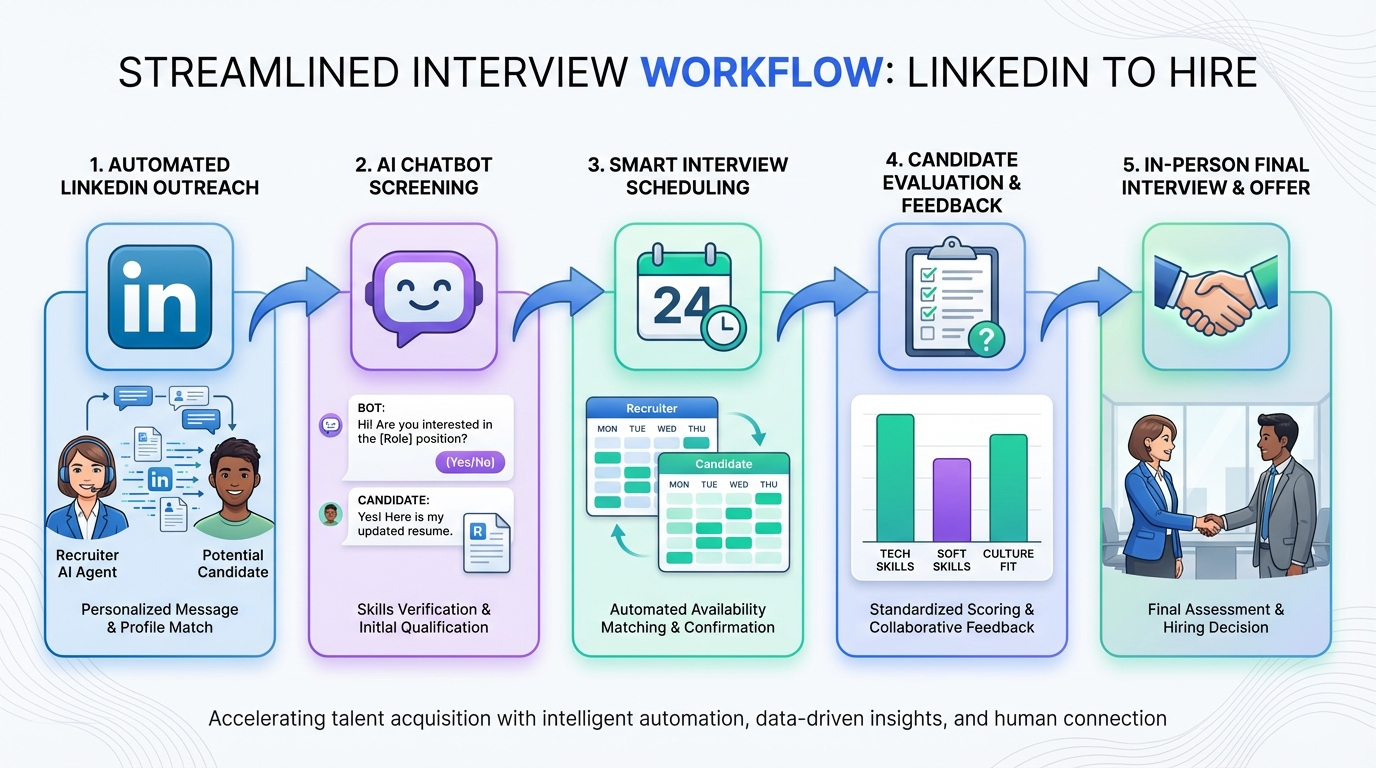
In our experience, the biggest interview quality problem is not the interview itself. It is that recruiters arrive at the interview with uneven information because early outreach and qualification were rushed. StrategyBrain AI Recruiter is designed to reduce that variability by automating the repetitive LinkedIn steps that happen before the interview.
What it automates before the interview
- LinkedIn candidate outreach: automatically connects with candidates that match your search criteria.
- Role introduction and Q&A: introduces the opportunity and answers questions about the role, company, compensation, and benefits based on the information you provide.
- Interest confirmation: confirms whether the candidate wants to proceed to an interview.
- Resume and contact collection: collects resumes and contact details from interested candidates.
Why this improves interview quality, not just speed
When early messaging is consistent, interviewers can spend more time on evidence and fit. That aligns directly with the best practices above, especially succinct answers with concrete results and demonstrating understanding of the role. It also reduces the temptation to use interview time for basic screening questions that could have been handled earlier.
Operational notes and limitations
- Qualification boundary: AI Recruiter can identify willingness to communicate or interview, but it does not decide whether a resume fully matches job requirements. Recruiters still make the final qualification decision.
- Always on communication: it supports 24/7 multilingual candidate messaging, which is useful for global hiring across time zones.
- Scale model: it supports managing more than 100 LinkedIn accounts for organizations building AI powered recruiting teams.
Security and privacy posture (as described by the product)
- Data usage: customer provided data is not used to train AI models.
- Credential handling: LinkedIn account credentials are encrypted and stored independently per user with explicit authorization.
- Data protection: the product states compliance with privacy regulations in the EU, United States, and Canada.
Common failure modes and fixes
Failure mode: candidates ramble and interviews run long
Fix: ask for one example with a result, then follow with one clarifying question. Capture the result in the scorecard as a measurable outcome.
Failure mode: interviewers disagree because criteria are vague
Fix: define 3 to 5 role critical competencies and require evidence fields for each. Use the same scorecard in your talent management software for every interviewer.
Failure mode: interview time is spent on basic screening
Fix: move screening earlier. For LinkedIn sourced candidates, an AI recruiter workflow can confirm interest, answer common questions, and collect resumes before scheduling interviews.
Failure mode: candidate experience feels inconsistent
Fix: standardize instructions and expectations. The same arrival guidance, what to bring, and interview format should be sent to every candidate.
FAQ
What is AI talent management software?
AI talent management software is talent management software that uses machine learning or automation to support hiring and talent processes such as sourcing, screening, interview coordination, and evaluation. In practice, the value comes from consistent workflows and better data capture, not from replacing human judgment.
How early should a candidate arrive for an interview?
A practical target is 10 minutes early. It reduces the risk of being late without creating the awkwardness of arriving far too early.
Should candidates dress professionally for a recruiter interview?
Yes. A recruiter represents multiple employers, so professional dress signals judgment and respect even if the eventual role has a more casual dress code.
What should candidates bring to an interview?
Bring multiple printed copies of your resume and any relevant work samples or portfolio items. This supports clearer evaluation and reduces friction if multiple interviewers are involved.
How do I answer interview questions without rambling?
Give a succinct answer and include one concrete example with a result. Then stop and let the interviewer ask follow up questions.
How should candidates explain being fired or laid off?
Be honest and brief, then move on. Avoid emotional framing and avoid overly negative commentary about past employers.
How does StrategyBrain AI Recruiter support LinkedIn recruiting?
It automates early LinkedIn outreach by connecting with candidates, introducing the role, answering common questions, confirming interview interest, and collecting resumes and contact details. Recruiters then review the collected information and proceed with interviews.
Does StrategyBrain AI Recruiter replace recruiter judgment?
No. It can confirm willingness to communicate or interview, but it does not determine whether a resume fully matches job requirements. Recruiters still make the final qualification decision.
Conclusion
The fastest way to improve interview outcomes is to standardize the basics and enforce them through your process. AI talent management software helps when it turns preparation, evidence capture, and evaluation into a repeatable workflow. If your bottleneck is early LinkedIn outreach and inconsistent pre screening, StrategyBrain AI Recruiter can automate the initial conversations and resume collection so interviews focus on fit, results, and role understanding. Next step: copy the checklist above into your scorecard, require evidence fields, and run a calibration after the first 3 interviews for the role.