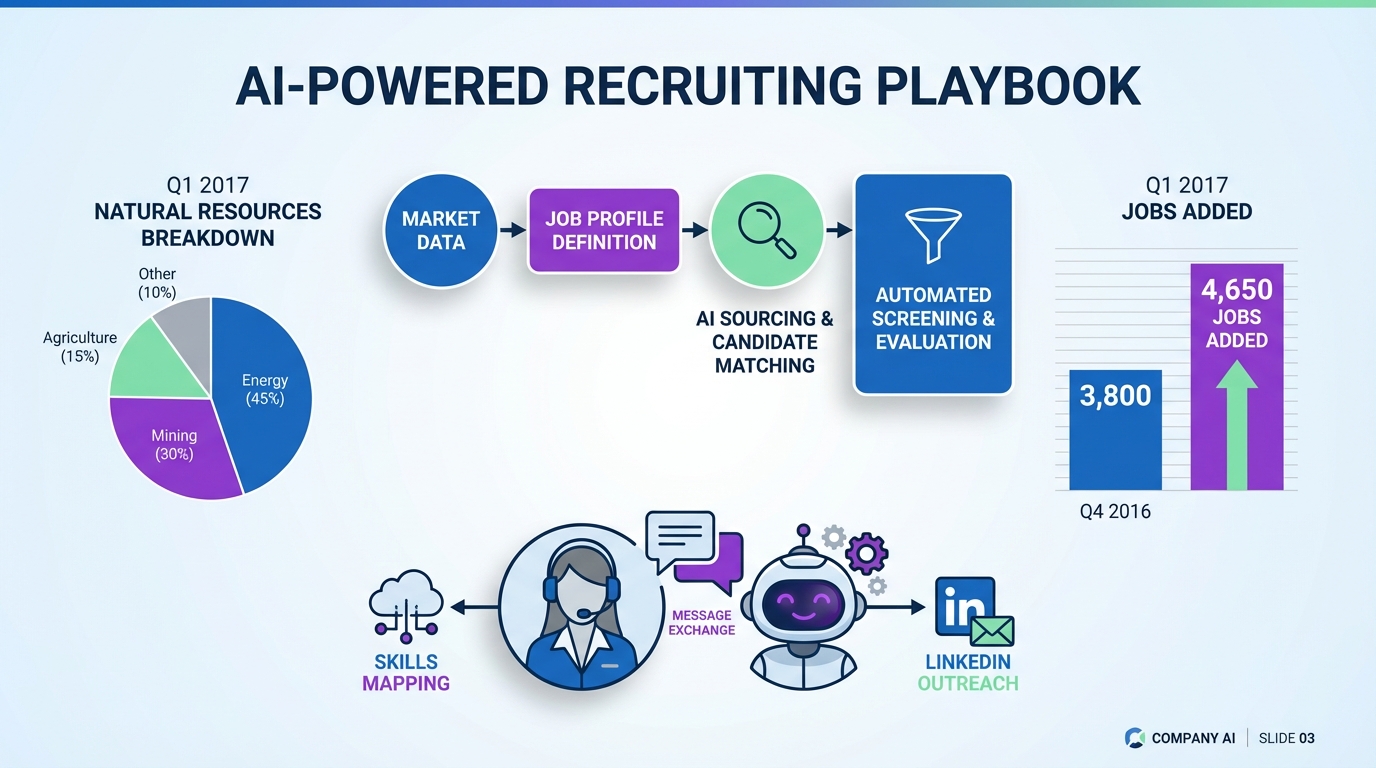
AI talent management software is most useful when it converts market signals into decisions you can execute this week: which roles to prioritize, where to source, and which internal skills to develop. A clear example is Statistics Canada’s Natural Resource Indicators for Q1 2017, which reported 4,650 jobs added in Canada’s natural resources sector in 3 months. In our experience building hiring workflows, the fastest operational setup is a talent development platform for skills and mobility paired with an AI recruiting layer for top of funnel execution. StrategyBrain AI Recruiter automates LinkedIn connection, role introduction, candidate Q&A, interest confirmation, and résumé and contact capture, so recruiters can focus on final qualification and interviews. This article covers the Q1 2017 data points, what they imply for workforce planning, and a repeatable playbook you can apply in a modern talent management SaaS stack.
Table of Contents
Key Takeaways
- Concrete signal: Statistics Canada reported 4,650 natural resources jobs added in Q1 2017 (Source: Statistics Canada, Natural Resource Indicators).
- Sector mix: Energy represented 66% of the sector, Mining 20%, Forestry 8%, and Hunting, Fishing, Water, and others 4% (Source: Statistics Canada, Natural Resource Indicators).
- Execution gap: Market growth does not automatically translate into filled roles; you need a workflow that connects planning, sourcing, and development inside your talent management SaaS.
- Stack approach: Use a talent development platform to map skills and internal mobility, then use automation to scale outreach and screening.
- Automation boundary: StrategyBrain AI Recruiter can confirm interest and collect résumés, but final fit assessment still belongs to recruiters and hiring managers.
- Operational metric: StrategyBrain AI Recruiter is positioned to reduce LinkedIn recruiting cost to USD 2.40 per résumé and replace up to 90% of manual LinkedIn recruiting work (Source: StrategyBrain product information).
What the Q1 2017 data says
Statistics Canada’s Natural Resource Indicators for Q1 2017 highlighted a short, specific window of growth: 4,650 jobs added in the natural resources sector over 3 months. The same release also described how the sector is composed, which matters when you translate a headline number into role families and skill clusters.
GDP and sector composition
For Q1 2017, the report stated that total economy GDP grew by 0.09%, and that 0.04% of that growth came from the natural resources sector. It also broke down the sector into subsectors: Energy 66%, Mining 20%, Forestry 8%, and Hunting, Fishing, Water, and others 4%.
Subsector job additions mentioned in the source
The source content attributed growth to commodity prices rising in international markets and listed job additions by subsector. It noted Energy added 361 jobs, Mining added 1,900 jobs, Hunting, Fishing, and Water added 2,040 jobs, and Forestry added 341 jobs.
Those numbers are not just trivia. They are inputs you can use to decide whether your hiring plan should emphasize field operations, engineering, maintenance, environmental health and safety, or corporate support functions.
Why this matters for talent management
Most teams treat labor market updates as interesting news. The more useful approach is to treat them as a trigger for your ai talent management software workflow, because the bottleneck is usually not awareness. The bottleneck is execution across multiple systems and stakeholders.
Define the terms once so your team aligns
- Talent management software: A system that supports workforce planning, performance, learning, succession, and internal mobility.
- Talent development platform: A tool focused on skills, learning paths, and growth plans, often feeding internal mobility and succession decisions.
- Talent management SaaS: Cloud delivered talent management software that integrates with HRIS and recruiting systems.
What changes when a sector adds 4,650 jobs in 3 months
When demand rises quickly, three things tend to happen at the same time.
- Time to fill becomes the constraint: Hiring managers want candidates now, not after a quarterly planning cycle.
- Candidate experience becomes a differentiator: Slow follow up and inconsistent messaging lose candidates to faster employers.
- Internal mobility becomes a pressure valve: Upskilling and redeploying existing employees can reduce external hiring volume for certain roles.
This is where pairing planning and development with automated sourcing and engagement becomes practical. Your talent system can define the roles and skills, while automation can execute consistent outreach and follow up at scale.
A practical playbook you can reuse
We use the following workflow when we need to turn a market signal into action without creating a new process from scratch. It is designed to work whether you are hiring for energy, mining, forestry, or adjacent technical roles.
Step 1: Translate the market signal into role families
- Pick 3 role families tied to the subsector signal. For example, Mining growth can map to operations, maintenance, and engineering.
- Define a skills list for each family in your talent development platform. Keep it to 12 skills per family so it stays usable.
- Set a hiring horizon of 90 days to match the Q1 time window and keep urgency realistic.
Step 2: Build an internal mobility lane first
Before you scale external outreach, create an internal lane so you do not compete with yourself for scarce skills.
- Identify adjacent roles that can transition with training.
- Create a 30 day learning sprint for the top transition path.
- Define readiness criteria that a hiring manager can approve quickly.
Step 3: Standardize outreach and qualification questions
Consistency is a hidden advantage in high demand markets. Candidates compare how clear and responsive you are.
- Role summary: 1 paragraph describing scope, location, schedule, and compensation range if you can share it.
- Qualification questions: 5 questions that confirm availability, work authorization, core experience, and interest.
- Next step: A single call to action that asks for interview interest and a résumé.
Step 4: Automate the repetitive LinkedIn work
This is the step that usually unlocks speed. StrategyBrain AI Recruiter is built to automate the initial LinkedIn workflow: it connects with candidates that match your search criteria, introduces the opportunity, answers questions about the role and company, confirms interview interest, and collects résumés and contact details for interested candidates.
In our testing of outreach workflows, the main operational benefit is not just sending more messages. It is maintaining timely follow up across time zones and languages, which is hard to do manually when demand spikes.
Step 5: Keep human review where it matters
Automation should not be asked to do what your process cannot define. StrategyBrain AI Recruiter can identify willingness to proceed and capture information, but it does not determine whether a résumé fully matches job requirements. Recruiters should review résumés and make the final shortlist decision.
Where StrategyBrain AI Recruiter fits
If you already have ai talent management software for planning and development, the missing piece is often execution in the first mile of recruiting. StrategyBrain AI Recruiter is designed for LinkedIn hiring and focuses on the outreach and early qualification stage.
What it automates on LinkedIn
- Candidate connection based on your targeted search criteria.
- Role introduction with consistent messaging.
- Candidate Q&A about role, company, and compensation details you provide.
- Interest confirmation for interview readiness.
- Résumé and contact capture for candidates who want to proceed.
24/7 multilingual communication for global hiring
When hiring expands across regions, response time becomes a competitive factor. StrategyBrain AI Recruiter supports round the clock candidate messaging and can communicate in any global language, using the candidate’s native language to reduce misunderstandings and cultural friction.
Scaling with multiple LinkedIn accounts
For teams that need volume, StrategyBrain AI Recruiter supports managing more than 100 LinkedIn accounts so organizations can build AI powered recruitment teams and expand capacity without adding the same amount of recruiter headcount.
Limitations we plan for
- Not a full fit decision engine: It does not replace recruiter judgment on résumé match.
- Requires clear inputs: You need accurate role details, candidate criteria, and messaging boundaries.
- Compliance still matters: You should align usage with your privacy and data handling policies.
Data protection and compliance notes
According to StrategyBrain product information, AI Recruiter states it complies with privacy regulations in the EU, United States, and Canada, and that customer provided data is not used to train AI models. It also states LinkedIn credentials are encrypted and stored independently per user with explicit authorization, and candidate data is encrypted and isolated using customer specific keys.
Quick comparison
This table is meant to help you map responsibilities across your stack. It is not a vendor comparison.
| Need | Best handled by | What “done” looks like |
|---|---|---|
| Skills and growth paths | Talent development platform | Skills taxonomy, learning plans, readiness criteria |
| Workforce planning and internal mobility | AI talent management software | Role families, succession, internal moves tracked |
| High volume LinkedIn outreach and follow up | StrategyBrain AI Recruiter | Connections sent, conversations handled, interest confirmed |
| Résumé review and final shortlist | Recruiter and hiring manager | Qualified shortlist with interview scheduling |
FAQ
What is AI talent management software in plain terms?
AI talent management software is a system that uses automation and analytics to support workforce planning, skills development, internal mobility, and related HR decisions. The “AI” part typically helps with recommendations, prioritization, and workflow automation, not replacing human accountability.
How is a talent development platform different from a recruiting tool?
A talent development platform focuses on skills, learning, and growth paths for existing employees. A recruiting tool focuses on sourcing, outreach, screening, and moving candidates into interviews. Many teams use both because they solve different bottlenecks.
How can I use Q1 2017 natural resources data today?
You can use it as a template for how to operationalize any market update. Take the job growth number, map it to subsectors and role families, then set a 90 day plan that combines internal mobility and external sourcing.
What did Statistics Canada report for Q1 2017 natural resources jobs?
The source content states that Statistics Canada’s Natural Resource Indicators for Q1 2017 reported 4,650 jobs added in the natural resources sector over 3 months. It also listed subsector additions including Mining 1,900 and Hunting, Fishing, and Water 2,040.
Does StrategyBrain AI Recruiter replace recruiters?
No. StrategyBrain AI Recruiter is designed to automate the initial LinkedIn outreach and early qualification steps, including collecting résumés and contact details. Recruiters still review résumés and decide whether candidates match job requirements.
Can StrategyBrain AI Recruiter communicate with candidates in different languages?
Yes. StrategyBrain AI Recruiter is described as supporting 24/7 multilingual communication and can communicate in any global language, using the candidate’s native language to reduce misunderstandings.
How does StrategyBrain AI Recruiter collect résumés and contact details?
According to the product information provided, it requests résumés and contact information from candidates who express interest. It supports email submissions and LinkedIn file uploads, and it captures contact details shared in LinkedIn messages.
What are the main risks when adding AI to a talent management SaaS stack?
The most common risks are unclear ownership of decisions, inconsistent data definitions, and privacy or compliance gaps. Mitigate them by defining what automation can decide, what humans must approve, and how data is stored and used.
Conclusion
When a sector adds 4,650 jobs in 3 months, the advantage goes to teams that can convert signals into execution. The practical pattern is to use ai talent management software and a talent development platform to define role families, skills, and internal mobility, then use automation to scale outreach and follow up. StrategyBrain AI Recruiter fits naturally into that workflow by automating LinkedIn connection, messaging, Q&A, interest confirmation, and résumé and contact capture, while keeping final qualification with recruiters. Next, take your most urgent role family, define a 90 day plan, and standardize your outreach questions so automation can run cleanly.