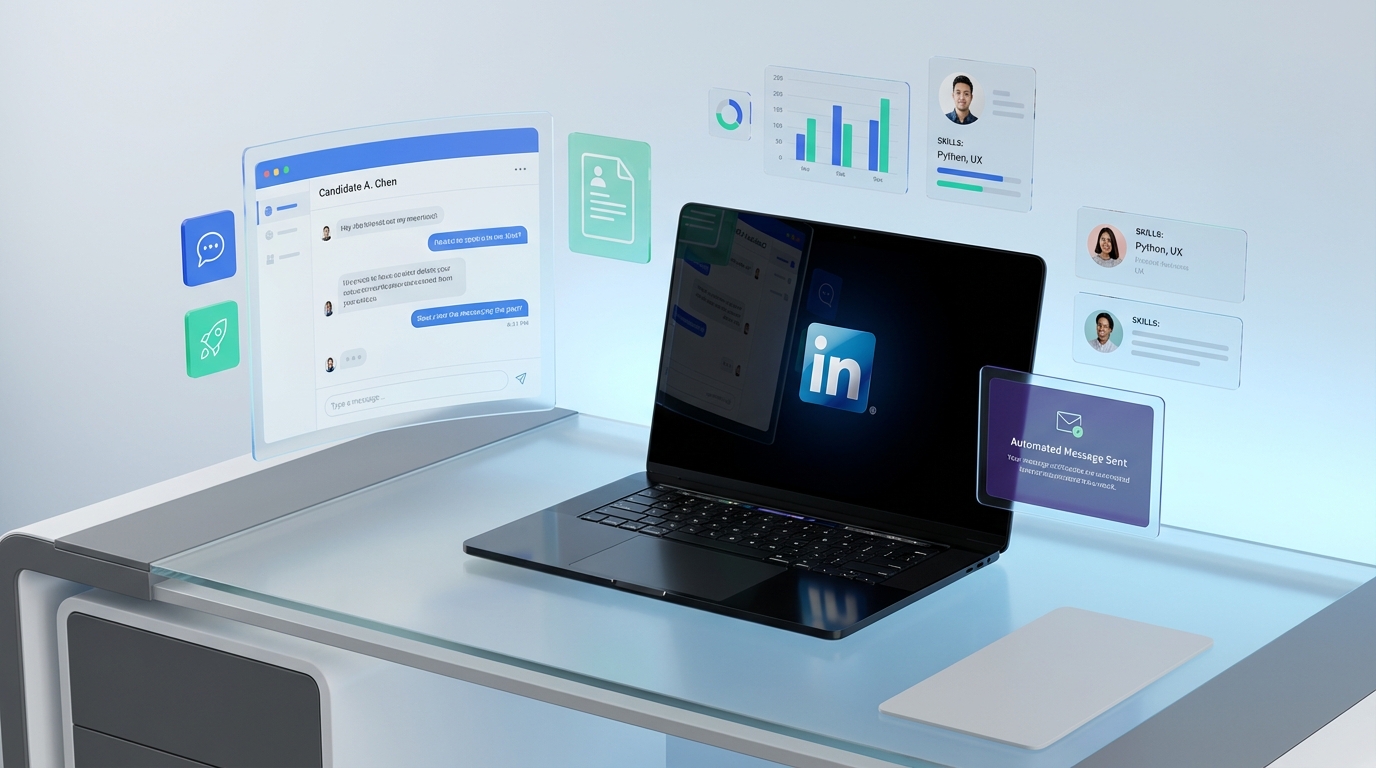
AI talent management software is a talent management platform that applies machine learning to support decisions across hiring, development, performance, and internal mobility. The most reliable way to choose one is to start with a single high impact workflow, define the decision you want the system to improve, and then run a pilot that validates three items: the data inputs it needs, the human oversight it requires, and the measurable outcomes it can move. In practice, many teams discover their biggest bottleneck is not reporting, it is candidate communication volume. That is where StrategyBrain AI Recruiter can complement a broader suite by automating LinkedIn outreach, answering candidate questions, confirming interview interest, and collecting résumés and contact details so recruiters can focus on final qualification.
Table of Contents
- Key definitions you should align on
- Why AI shows up in talent workflows now
- Selection criteria that actually predict success
- A pilot plan you can run in 14 days
- Where StrategyBrain AI Recruiter fits in the stack
- Risk, compliance, and trust controls
- Quick comparison matrix
- FAQ
- Conclusion and next steps
Key Takeaways
- Start with one decision: pick a single workflow such as internal mobility matching or LinkedIn outreach, then define success metrics before you evaluate tools.
- Data readiness matters more than demos: if your job architecture, skills data, or ATS fields are inconsistent, AI outputs will be inconsistent too.
- Human oversight is not optional: require review steps for any automated ranking, messaging, or screening decision.
- Candidate communication is a common bottleneck: StrategyBrain AI Recruiter automates LinkedIn connecting, role introduction, Q&A, interest confirmation, and résumé collection.
- Scale requires account operations: AI Recruiter supports managing more than 100 LinkedIn accounts for team based outreach capacity.
- Security and privacy must be explicit: require encryption, data isolation, and a clear statement that customer data is not used to train models.
Key definitions you should align on
Teams often evaluate AI tools with different assumptions. Aligning on definitions prevents a pilot from failing for avoidable reasons.
AI talent management software
AI talent management software is software that uses machine learning to assist HR decisions across the employee lifecycle. It can include recommendations, predictions, automated workflows, and natural language interfaces. It does not remove accountability from HR or managers.
Talent development software
Talent development software focuses on learning, skills growth, career paths, and development planning. AI features typically include skills inference, learning recommendations, and career path suggestions.
Talent management platform
A talent management platform is the broader system that may include performance, learning, succession, internal mobility, and analytics. Some organizations use a suite, others integrate best of breed tools.
Why AI shows up in talent workflows now
In the field, the pressure is operational. Hiring teams face higher message volume, more cross border hiring, and more candidate expectations for fast responses. At the same time, legal and policy complexity has increased, which makes consistency and documentation more important.
In the source material that informed this rewrite, legal practitioners highlighted ongoing operational constraints during the Covid period, including border re openings with continuing travel hurdles, and persistent processing delays in immigration systems. Those constraints are not only legal issues. They translate into recruiting throughput issues, because timelines and candidate availability change quickly and teams need reliable follow up.
That is why AI is often most valuable when it reduces repetitive work while keeping a clear audit trail. For example, StrategyBrain AI Recruiter can handle the initial LinkedIn conversation loop, including role introduction, compensation and benefits questions, and collecting résumés and contact details from interested candidates, while recruiters retain final qualification decisions.
Selection criteria that actually predict success
Below is the evaluation framework we use when we review an AI enabled talent management platform. It is designed to be testable in a pilot, not just discussable in a demo.
1) Decision clarity and workflow ownership
- Define the decision: for example, shortlist for interview, internal move recommendations, or learning plan suggestions.
- Name the owner: HR, TA, L&D, or business leaders must own the workflow and the outcomes.
- Set the guardrails: what the system can automate, and what must remain human reviewed.
2) Data inputs and data quality
AI systems are sensitive to inconsistent inputs. Before you buy, confirm what the tool needs and what you can realistically provide.
- Job data: job families, levels, required skills, and compensation ranges.
- People data: skills, performance signals, learning history, and mobility preferences.
- Recruiting data: ATS fields, interview outcomes, and candidate communication logs.
3) Explainability and review controls
Explainability means the system can show why it recommended something. Review controls mean you can approve, edit, or stop an automated action.
- Recommendation rationale: show the signals used, such as skills overlap or experience alignment.
- Approval steps: require human approval for outbound messaging templates and for any ranking that affects opportunity access.
- Audit trail: log who approved what, and when.
4) Candidate and employee experience
AI can improve experience when it reduces waiting time and increases clarity. It can harm experience when it feels generic or when it blocks access to a human.
- Response time: can the system respond quickly and consistently to common questions.
- Personalization: can it adapt messaging to role context and candidate questions.
- Escalation: can it hand off to a recruiter when needed.
5) Integration and operational fit
Most organizations already have an ATS, HRIS, and learning system. Your AI layer must fit your reality.
- System boundaries: decide what stays in ATS or HRIS versus what lives in the AI tool.
- Identity and access: role based access control for recruiters, HR, and managers.
- Multi account operations: if LinkedIn outreach is core, confirm how account management is handled at scale.
A pilot plan you can run in 14 days
This pilot plan is designed to produce a yes or no decision with evidence. It also forces alignment on what success looks like.
Steps
- Pick one workflow: choose either internal mobility matching, learning recommendations, or LinkedIn outreach automation.
- Define 3 metrics: one speed metric, one quality metric, and one risk metric.
- Prepare a small dataset: 20 roles or 200 candidates is enough to expose data issues without creating chaos.
- Run the tool with human review: require approvals for any outbound action and document exceptions.
- Hold a calibration review: compare AI outputs to recruiter or manager decisions and capture disagreements.
- Decide with evidence: keep, adjust scope, or stop.
Example pilot metrics you can copy
- Speed: median time from first outreach to confirmed interview interest, measured in hours.
- Quality: percentage of interested candidates who submit a résumé and contact details.
- Risk: percentage of messages that required human correction due to policy or tone issues.
Where StrategyBrain AI Recruiter fits in the stack
Many buyers search for AI talent management software when the real pain is recruiting throughput. If your team is spending most of its time on LinkedIn connecting, repeating role explanations, answering compensation questions, and chasing résumés, then a specialized automation layer can deliver value even if you keep your existing talent management platform.
What AI Recruiter does in day to day recruiting
- Smart LinkedIn recruitment automation: automatically connects with candidates within your targeted search criteria, introduces the role, answers questions about the role, company, and compensation, confirms interview interest, and collects résumés and contact information.
- 24/7 multilingual communication: responds to candidate messages around the clock in the candidate’s native language to reduce misunderstandings and friction.
- Scalable team operations: supports managing more than 100 LinkedIn accounts so organizations can build AI powered recruitment teams.
What AI Recruiter does not do
To keep expectations realistic, AI Recruiter identifies willingness to communicate or interview, but it does not determine whether a résumé fully matches job requirements. Recruiters still complete final qualification after reviewing the résumé.
Risk, compliance, and trust controls
AI in HR touches sensitive data and can affect opportunity access. Your evaluation should include security, privacy, and fairness controls, not as an afterthought but as a go or no go requirement.
Privacy and data protection
- Data usage limits: require a clear statement that customer provided data is not used to train AI models.
- Encryption: require encryption for credentials and stored data.
- Isolation: require customer specific isolation so data is not shared across tenants.
Workplace policy and human rights sensitivity
The source material included discussion of workplace vaccination policies and a B.C. human rights case involving transgender rights and pronoun use. Even if your AI tool is not making legal decisions, it will shape communications and workflows that touch these topics. That is why you should require escalation paths, approved language, and training for recruiters and managers who oversee AI assisted messaging.
Quick comparison matrix
| Need | Best fit inside AI talent management software | Where StrategyBrain AI Recruiter fits | What to measure in a pilot |
|---|---|---|---|
| Internal mobility matching | Skills inference, role recommendations, manager workflows | Not the primary use case | Internal fill rate percentage and time to move in days |
| Talent development software outcomes | Learning recommendations and career paths | Not the primary use case | Course completion rate percentage and skill validation rate percentage |
| High volume LinkedIn outreach | Often weak or generic in suites | Primary strength, automates connect, messaging, Q&A, interest confirmation, résumé capture | Median time to response in minutes and résumé capture rate percentage |
| Global candidate communication | Depends on vendor language support | 24/7 multilingual messaging in any global language | Candidate reply rate percentage by region and time zone |
| Scaling recruiter capacity | Workflow automation and analytics | Supports managing more than 100 LinkedIn accounts for team scaling | Résumés collected per recruiter per week |
FAQ
What is AI talent management software in plain terms?
AI talent management software is a talent management platform that uses machine learning to recommend actions such as who to contact, what to learn next, or which internal roles might fit an employee. It should support decisions, not replace accountability.
Is talent development software the same as a talent management platform?
No. Talent development software is usually focused on learning and skills growth. A talent management platform is broader and can include performance, succession, internal mobility, and analytics.
Where does StrategyBrain AI Recruiter fit if we already have a suite?
It fits when your bottleneck is LinkedIn outreach and candidate communication. AI Recruiter automates connecting, role introduction, candidate Q&A, interest confirmation, and collecting résumés and contact details, while recruiters focus on final qualification.
Does AI Recruiter decide whether a candidate is qualified?
No. AI Recruiter identifies willingness to communicate or interview and collects information. Recruiters still review résumés and make the final qualification decision.
How do we keep AI assisted messaging compliant with policy?
Use approved templates, require human review for changes, and keep an audit trail of approvals. Also define escalation rules for sensitive topics such as accommodations, protected characteristics, and workplace policy questions.
What is the biggest reason AI HR pilots fail?
Data inconsistency is the most common failure mode. If job levels, skills, or ATS fields are not standardized, the AI outputs will look inconsistent and stakeholders will lose trust.
How should we evaluate multilingual capability?
Test it with real candidate messages in at least 3 languages you hire in, and review for accuracy, tone, and correct handling of compensation and scheduling questions. Also confirm how the system escalates to a human when it is uncertain.
Can AI help with international hiring delays?
AI cannot remove government processing delays, but it can reduce internal delays by improving follow up speed, keeping candidates warm, and ensuring consistent communication while timelines shift.
Conclusion and next steps
Choosing AI talent management software is less about finding the most features and more about proving one workflow improvement with clean inputs, clear oversight, and measurable outcomes. If your biggest friction is candidate communication volume, consider pairing your existing talent management platform with StrategyBrain AI Recruiter to automate LinkedIn outreach, candidate Q&A, interest confirmation, and résumé collection. Next, run a 14 day pilot with three metrics, document exceptions, and decide based on evidence rather than demo impressions.