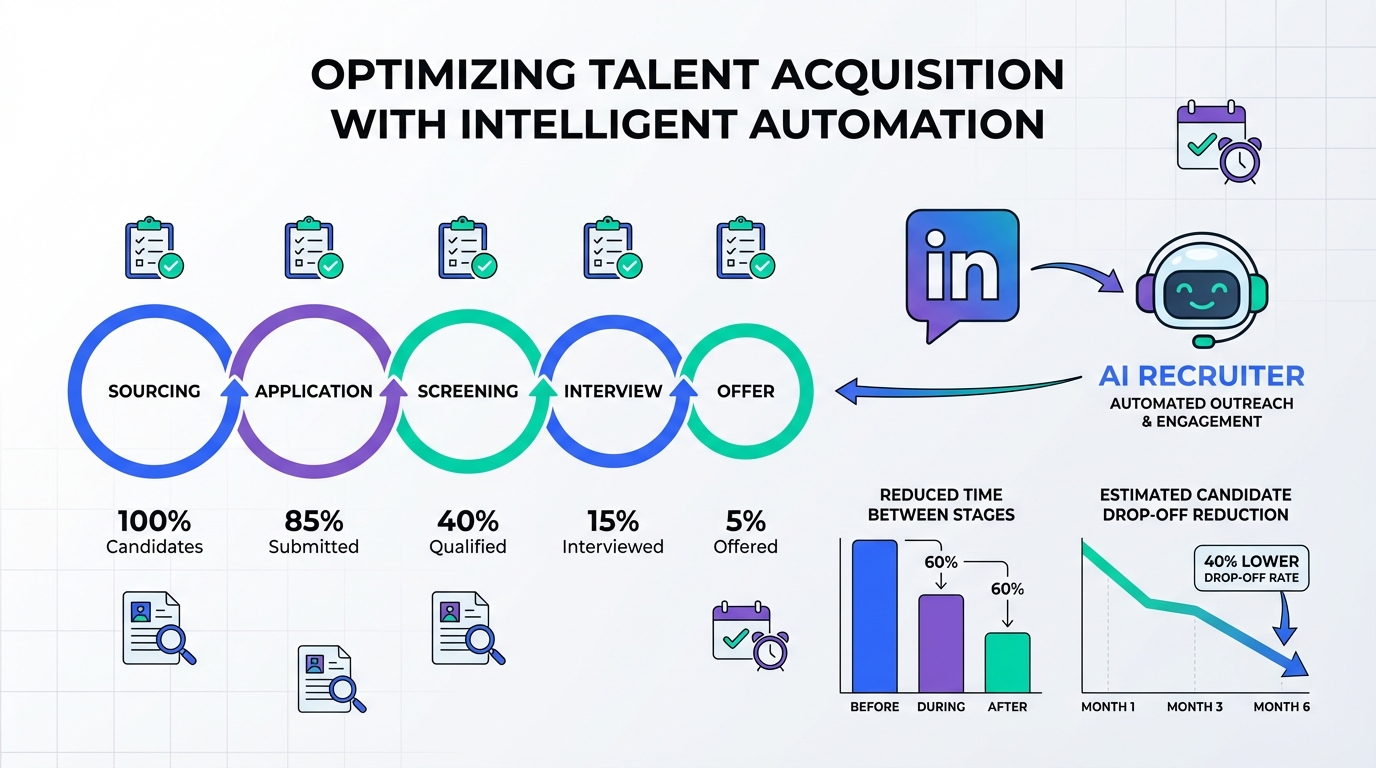
An applicant tracking system for recruiters works best when it does two things reliably: it keeps hiring decisions consistent across the team, and it removes manual busywork that slows candidates down. In our recruiting operations work, the biggest gains came from standardizing stages and scorecards inside the ATS, then automating the “in between” steps like outreach follow ups, Q and A, and collecting résumés and contact details. This guide breaks down the most practical applicant tracking system benefits and a 1 week setup plan. It also explains how StrategyBrain AI Recruiter can plug the biggest gap most ATS workflows still have by running LinkedIn outreach and qualification conversations 24 hours a day in any language, then handing recruiters the résumé and contact details for final review.
Key Takeaways
- Core ATS benefit for recruiters: consistent stages and scorecards reduce decision drift across interviewers.
- Speed benefit: automation of reminders, scheduling triggers, and status updates reduces time lost between stages.
- Quality benefit: structured feedback improves signal quality compared with free form notes.
- Candidate experience benefit: predictable communication reduces drop off, especially in competitive roles.
- Where ATS often falls short: sourcing and early LinkedIn conversations still consume large blocks of recruiter time.
- How StrategyBrain AI Recruiter complements an ATS: it automates LinkedIn connecting, role introduction, Q and A, interest confirmation, and résumé and contact capture, then routes qualified interest back to recruiters.
What an applicant tracking system means for recruiters
An applicant tracking system, often shortened to ATS, is the system of record for recruiting. It stores candidate profiles, tracks pipeline stages, and captures evaluation data such as interview feedback and scorecards. For recruiters, the ATS is less about “having software” and more about enforcing a repeatable workflow that hiring managers can trust.
In day to day recruiting, the ATS becomes the place where three things must stay aligned: the job requirements, the evaluation criteria, and the communication timeline. When those drift, teams start arguing about what “qualified” means, candidates wait too long, and the process becomes inconsistent.
Scope note: This article focuses on recruiter workflow and adoption. It does not review specific ATS vendors or pricing, and it does not provide legal advice for compliance requirements.
A reverse mentorship lesson that applies to ATS adoption
One of the most useful ways to think about ATS adoption is through the lens of reverse mentorship. Reverse mentorship is a two way learning relationship where younger and older generations teach each other skills. In the workplace, it is often described as a way to share technology fluency in one direction and business judgment in the other.
That framing matters because ATS rollouts fail when they are treated as a top down enforcement tool. The better approach is mutual learning. Recruiters and coordinators who live in the system every day can teach practical shortcuts and workflow hygiene. Meanwhile, experienced hiring leaders can teach what “good” looks like in decision making, calibration, and risk management. When both sides teach and learn, the ATS becomes a shared operating system instead of a compliance chore.
It also helps to remember that it is not all about tech. Different generations often have different expectations about work, communication, and work life balance. A well configured ATS can reduce friction by making expectations explicit. For example, stage definitions and service level targets clarify what “fast” means, and structured feedback clarifies what “strong candidate” means.
Applicant tracking system benefits recruiters can measure
1) Consistency in evaluation
The most defensible ATS benefit is consistency. When every candidate moves through the same stages and is assessed with the same scorecard, the team reduces decision drift. That is especially important when multiple interviewers participate and when hiring managers change their mind mid process.
- What to measure: scorecard completion rate per stage, and the percentage of candidates with structured feedback before a decision.
- What usually breaks: free form notes that never get entered, or stages that mean different things to different people.
2) Faster movement between stages
Recruiting speed is often lost between stages, not during interviews. An ATS helps recruiters reduce that dead time by triggering reminders, standardizing handoffs, and making ownership visible. This is one of the most practical ats benefits because it is operational, not theoretical.
- What to measure: median time in stage for each pipeline step.
- What usually breaks: unclear ownership for scheduling, and missing templates for candidate updates.
3) Better candidate communication
Candidate experience improves when communication is predictable. An ATS supports this with templates, scheduled updates, and a single place to see what was sent and when. Even when the message is “we are still in process,” consistency reduces anxiety and drop off.
This is also where many recruiters feel the gap between what the ATS can store and what the market demands. Candidates expect fast replies, and they ask detailed questions about role scope, company context, compensation, and benefits. If your team is hiring across time zones, response expectations become even harder to meet.
4) Cleaner collaboration across generations and roles
In teams with multiple generations and specialties, the ATS becomes a shared language. Reverse mentorship works better when the system supports it. Junior recruiters can share tech savvy workflow improvements, and senior leaders can share decision frameworks, but both need a common structure to collaborate.
- What to measure: hiring manager response time to feedback requests, and the percentage of interviews with completed feedback within 24 hours.
- What usually breaks: feedback requested in chat tools with no audit trail, or interviewers who do not know where to enter feedback.
5) A more scalable sourcing to screening funnel when paired with automation
An ATS alone does not source candidates. It tracks them once they are in your process. Recruiters still spend significant time on LinkedIn connecting, introducing roles, answering questions, following up, and collecting résumés. This is where pairing an ATS with automation can create a step change in throughput.
StrategyBrain AI Recruiter is designed for that front end of the funnel on LinkedIn. It can automatically connect with candidates that match your search criteria, introduce the opportunity, learn about the candidate’s situation, answer questions about the role, company, compensation, and benefits, confirm interview interest, and collect résumés and contact information from interested candidates. It also supports 24 hour multilingual communication, which helps when candidates reply outside your working hours.
Important boundary: AI Recruiter can confirm interest and collect information, but it does not decide whether a résumé fully matches your requirements. Recruiters still do the final qualification after reviewing the résumé, which keeps accountability where it belongs.
How to set up an ATS in 1 week
This plan assumes you already have an ATS selected. The goal is to get to a stable, repeatable workflow quickly, then iterate. We have used this approach to avoid the common trap of over customizing before the team has agreed on basics.
Day 1: Define stages and exit criteria
- List your pipeline stages such as Applied, Recruiter Screen, Hiring Manager Screen, Interview, Offer, Hired, Rejected.
- Write exit criteria for each stage in one sentence. Example: “Recruiter Screen exit means the candidate confirmed interest, compensation range alignment, and availability.”
- Assign ownership for each stage so handoffs are explicit.
Day 2: Build scorecards and structured feedback
- Create a scorecard with 4 to 6 competencies tied to the job requirements.
- Standardize rating definitions so “Strong Yes” means the same thing across interviewers.
- Make feedback required before moving a candidate forward, if your ATS supports it.
Day 3: Create communication templates and service levels
- Write templates for application received, next steps, scheduling, rejection, and “still in process.”
- Set service levels such as “candidate receives an update within 48 hours after each interview.”
- Define escalation for stalled stages, such as an automatic reminder after 24 hours.
Day 4: Configure intake and job kickoff
- Standardize the intake form so every requisition includes must haves, nice to haves, compensation, benefits, and interview plan.
- Align on what “qualified” means using examples of past hires and near misses.
- Document the sourcing channels you will use for the role.
Day 5: Pilot with one role and run a calibration
- Run one live role through the workflow end to end.
- Hold a 30 minute calibration with recruiters and hiring managers to review what worked and what did not.
- Adjust stage definitions and templates based on real friction points.
Day 6 and Day 7: Add automation where it actually saves recruiter time
Once the ATS workflow is stable, add automation to the highest volume, lowest judgment tasks. For many recruiting teams, that is the LinkedIn outreach and early qualification conversation. If you use StrategyBrain AI Recruiter, the practical setup is to provide the LinkedIn account and the job information the AI needs, including company details, compensation, benefits, and candidate search criteria. The AI can then run the initial outreach and follow up, and capture résumés and contact details from interested candidates for recruiter review.
If you are hiring globally, the multilingual capability matters. Candidates can respond in their native language, and the AI can keep the conversation moving while your team is offline. That reduces drop off and keeps your ATS pipeline fed with candidates who have already confirmed interest.
Quick checklist for recruiters
- Stages have written exit criteria and an owner.
- Scorecards are required before advancing candidates.
- Templates exist for every major candidate update.
- Time in stage is tracked weekly.
- LinkedIn outreach and follow up has a defined process, whether human run or automated.
Where StrategyBrain AI Recruiter fits in the recruiter workflow
Think of your ATS as the system that governs decisions and documentation. Think of StrategyBrain AI Recruiter as the system that keeps the top of funnel moving on LinkedIn. When you combine them, recruiters can spend more time on judgment work such as final qualification, stakeholder alignment, and closing.
What we found works best in practice
- Use the ATS to define the process including stages, scorecards, and communication standards.
- Use AI Recruiter to execute the repetitive front end including connecting, introducing the role, answering common questions, confirming interest, and collecting résumés and contact details.
- Keep final qualification with recruiters because résumé fit and hiring tradeoffs require context and accountability.
Limitations and honest cautions
- An ATS will not fix unclear requirements. If the intake is vague, the pipeline will be noisy.
- Automation needs guardrails. Your messaging must reflect your employer brand and comply with your policies.
- AI Recruiter does not replace recruiter judgment. It reduces manual LinkedIn work and improves responsiveness, but recruiters still decide who advances.
Quick comparison: ATS only vs ATS plus AI Recruiter
| Workflow area | ATS only | ATS plus StrategyBrain AI Recruiter |
|---|---|---|
| Pipeline tracking and compliance record | Strong | Strong |
| Structured evaluation and scorecards | Strong | Strong |
| LinkedIn connecting and initial outreach | Typically manual | Automated connecting and outreach based on recruiter provided criteria |
| Candidate Q and A about role and compensation | Typically manual | Automated responses using recruiter provided job details |
| Follow up and responsiveness outside business hours | Depends on recruiter availability | 24 hour messaging support |
| Résumé and contact detail capture | Manual requests and tracking | Automated collection from interested candidates |
FAQ
What is the biggest benefit of an applicant tracking system for recruiters?
The biggest benefit is consistency. A well configured ATS standardizes stages, scorecards, and communication so recruiters and hiring managers make decisions using the same criteria and the same process.
Which ATS benefits show up fastest after implementation?
Speed improvements usually show up first. When stage ownership, templates, and reminders are in place, candidates move between steps with less waiting and fewer missed handoffs.
Does an ATS replace LinkedIn recruiting work?
No. An ATS tracks candidates once they are in your process, but it does not run LinkedIn outreach conversations for you. Many teams still spend significant time connecting, following up, and answering early questions.
How does StrategyBrain AI Recruiter work with an ATS?
StrategyBrain AI Recruiter automates the LinkedIn front end: connecting with candidates, introducing the role, answering questions about the role and compensation, confirming interest, and collecting résumés and contact details. Recruiters then review the collected information and move qualified candidates through the ATS stages.
Can AI Recruiter decide whether a candidate is qualified?
AI Recruiter can confirm interest and collect information, but it does not determine whether a résumé fully matches the job requirements. Recruiters still do final qualification after reviewing the résumé.
How does reverse mentorship relate to ATS adoption?
Reverse mentorship encourages mutual learning. Junior team members often share practical technology workflows, while senior leaders share decision frameworks and business context. An ATS becomes more effective when it supports that two way learning instead of being treated as a top down enforcement tool.
What should recruiters configure first in a new ATS?
Start with stages and exit criteria, then scorecards, then communication templates. Those three elements create a repeatable workflow that you can measure and improve.
Is multilingual candidate communication important for ATS outcomes?
It can be, especially for global hiring. Faster, clearer communication reduces drop off and keeps candidates moving. StrategyBrain AI Recruiter supports multilingual messaging so candidates can communicate in their native language.
Conclusion and next steps
An applicant tracking system for recruiters delivers the most value when it standardizes decisions and removes delays between stages. The most reliable applicant tracking system benefits come from clear stage definitions, structured scorecards, and consistent communication. If your bottleneck is still LinkedIn outreach and early qualification, pairing your ATS with StrategyBrain AI Recruiter can reduce repetitive work by automating connecting, messaging, follow ups, and résumé and contact capture while keeping final qualification with recruiters.
Next steps: pick one live role, implement the 1 week setup plan, and track time in stage for 2 weeks. If sourcing and follow up are your biggest time sink, pilot AI Recruiter on a single LinkedIn account first, then expand once your messaging and handoffs feel stable.