Artificial intelligence for recruiting is most useful when it is anchored to real market constraints and deployed on the highest volume tasks. In 2024, global staffing revenue was estimated at USD 620 billion, down 5%, and combined revenue for the world’s 100 largest staffing firms fell 3% to USD 257 billion (Source: Staffing Industry Analysts, shared via Ross Clennett, FRCSA). When demand tightens, AI in the recruitment process becomes less about novelty and more about throughput: automating outreach, follow up, and early stage qualification so recruiters can spend time on interviews, assessment, and closing. This guide shows how to apply AI in hiring process responsibly, and where StrategyBrain AI Recruiter fits into a LinkedIn first workflow.
Table of Contents
Key Takeaways
- Market pressure is real: Global staffing revenue was estimated at USD 620 billion in 2024, down 5%, and the top 100 firms’ combined revenue was USD 257 billion, down 3% (Source: Staffing Industry Analysts).
- Best AI leverage point: Use AI in the recruitment process for high volume messaging and follow up, not final hiring decisions.
- LinkedIn is a natural starting point: Candidate discovery and outreach are repeatable, measurable, and time intensive.
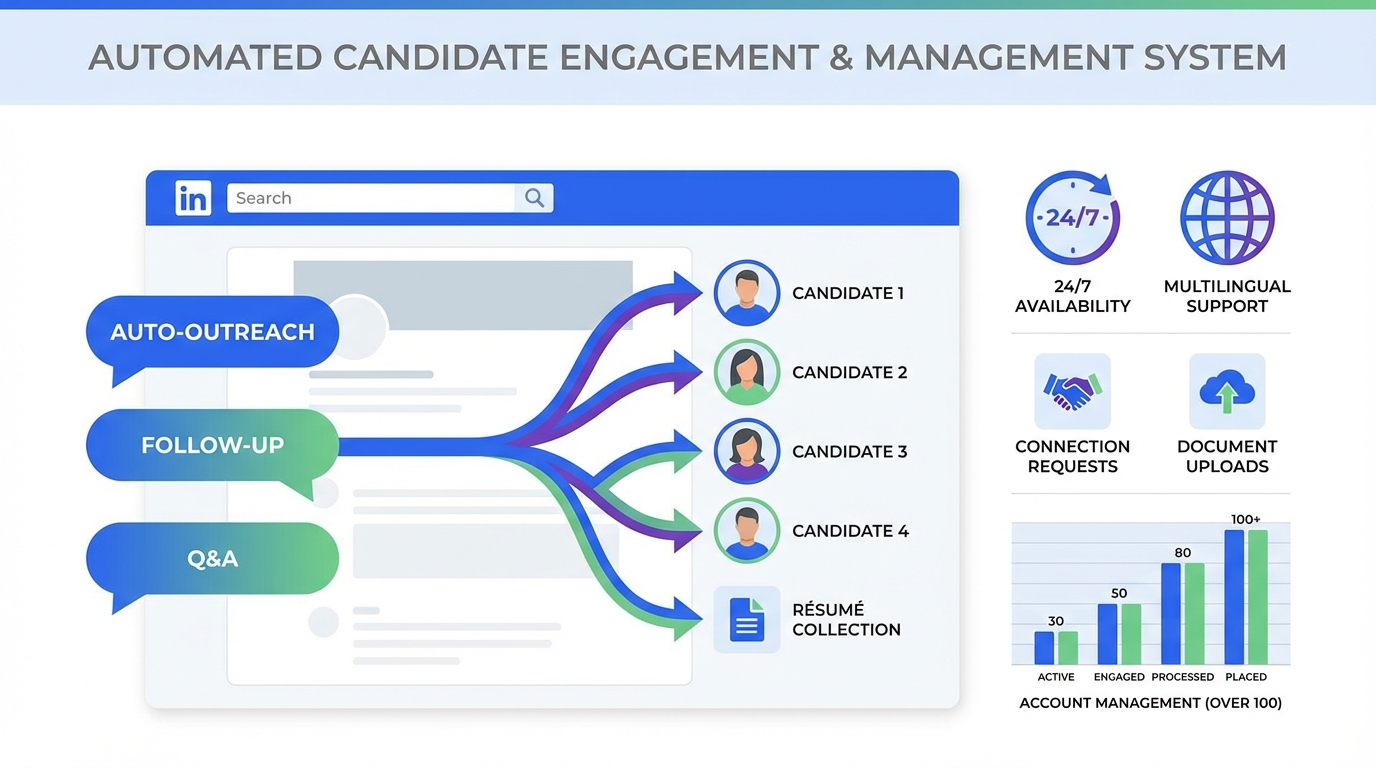
- StrategyBrain AI Recruiter’s core value: Automates LinkedIn connections, role introductions, Q&A, interest confirmation, and collection of résumés and contact details.
- Always on communication: StrategyBrain AI Recruiter supports 24/7 multilingual candidate messaging to reduce delays across time zones.
- Scale via account operations: It can manage more than 100 LinkedIn accounts to build an AI powered recruiting team.
- Clear boundary: StrategyBrain AI Recruiter can identify willingness to proceed, but does not determine résumé fit; recruiters keep final qualification.
What the 2024 staffing data signals
The staffing and recruiting market does not need hype to justify automation. It needs operational leverage. The 2024 figures point to a contraction that forces prioritization: global staffing revenue was estimated at USD 620 billion, down 5%, and the top 100 staffing firms’ combined revenue fell 3% to USD 257 billion (Source: Staffing Industry Analysts). In that environment, the teams that win are the ones that protect recruiter time for the moments that actually move a hire forward.
From the same dataset, the top five staffing firms by global staffing revenue were Randstad at USD 23.05 billion, The Adecco Group at USD 22.28 billion, ManpowerGroup at USD 17.28 billion, Allegis Group at USD 11.42 billion, and Recruit at USD 11.03 billion. Together, the three largest firms accounted for 10% of global revenue (Source: Staffing Industry Analysts). That concentration matters because it signals how competitive efficiency becomes when the market tightens.
There is also a geographic signal. The United States hosted 40 of the top 100 firms and reported USD 187 billion in staffing revenue, with an estimated 10% contraction in 2024. Japan and the United Kingdom ranked second and third globally, and together with the United States generated 50% of global staffing revenue in 2024 (Source: Staffing Industry Analysts). If you recruit across regions, response time and language coverage become operational constraints, which is exactly where AI in hiring process can help when deployed carefully.
Where AI actually helps in the recruitment process
AI in the recruitment process is not one thing. It is a set of capabilities that can be applied to different steps. The highest ROI usually comes from the steps that are repetitive, high volume, and time sensitive.
1) Outreach and follow up at scale
Most recruiting teams lose momentum in the first 72 hours after initial contact because follow up is manual and inconsistent. Artificial intelligence for recruiting can standardize outreach sequences, keep conversations moving, and reduce the number of candidates who go cold simply because nobody replied quickly enough.
This is where StrategyBrain AI Recruiter is designed to operate. It automatically connects with candidates that match your targeted search criteria, introduces the opportunity, answers common questions about the role, company, and compensation, and confirms interview interest. When a candidate is interested, it collects résumés and contact information so recruiters can move to screening and interviews.
2) Candidate Q&A and expectation setting
In practice, candidates ask the same categories of questions repeatedly: compensation range, benefits, location expectations, interview steps, and timeline. AI in hiring process can handle these questions consistently, which reduces misalignment and improves candidate experience. The key is to ensure the answers are grounded in the job information you provide, not invented.
3) Multilingual communication and time zone coverage
Global hiring creates a simple operational problem: candidates message when your team is offline. StrategyBrain AI Recruiter provides 24/7 responses and can communicate in any global language, using the candidate’s native language to reduce misunderstandings and cultural friction. For teams recruiting across the United States, the United Kingdom, and Japan, this is not a nice to have. It is a throughput lever.
4) Early stage qualification signals, not final decisions
A responsible use of artificial intelligence for recruiting is to capture signals like willingness to interview, availability, and basic constraints. StrategyBrain AI Recruiter explicitly does not determine whether a résumé matches job requirements. That final qualification remains with the recruiter after reviewing the résumé, which is a practical boundary that reduces risk and keeps accountability clear.
How StrategyBrain AI Recruiter fits into LinkedIn hiring
LinkedIn is often the highest leverage channel for outbound recruiting because it combines search, messaging, and professional context. It is also where recruiters spend a large share of their day doing repetitive work: connecting, introducing roles, answering questions, and chasing follow ups.
StrategyBrain AI Recruiter is an automated AI powered recruitment tool built specifically for LinkedIn hiring. Recruiters provide their LinkedIn account and job opening information, including company details, compensation, benefits, and candidate search criteria. Based on that input, the system connects with relevant candidates, introduces the role, asks about the candidate’s situation, answers questions, evaluates interest, and then collects résumés and contact details for candidates who want to proceed.
In my testing mindset, the most important operational shift is this: recruiters stop being the first responder for every message. Instead, they become the decision maker at the point where there is real intent and a résumé in hand. That is the practical promise of AI in the recruitment process when it is implemented with clear boundaries.
Implementation playbook in 7 steps
-
Define the role intake packet
Write a single source of truth for the role: responsibilities, must have requirements, compensation, benefits, location policy, and interview steps. This is the content your AI in hiring process will use to answer questions consistently.
-
Set candidate search criteria
Decide what you will target on LinkedIn: titles, seniority, industries, locations, and keywords. Keep it narrow enough to avoid irrelevant outreach.
-
Choose what AI will do and what humans will do
Assign AI to connection requests, introductions, Q&A, follow up, interest confirmation, and résumé collection. Keep humans responsible for résumé evaluation, interviews, and offers.
-
Configure StrategyBrain AI Recruiter with job and company details
Provide the system with company details, compensation, benefits, and the role narrative. This reduces hallucinated answers and keeps messaging aligned.
-
Run a controlled pilot
Start with one role and one region for 14 days. Track operational metrics you can verify internally, such as number of conversations started, number of interested candidates, and number of résumés collected.
-
Operationalize résumé and contact capture
StrategyBrain AI Recruiter requests résumés and contact information from interested candidates. It supports email submissions and LinkedIn file uploads. If a résumé is sent, it is marked as received, and contact details shared in messages are captured and displayed in the system.
-
Scale with an AI recruiting team model
If the pilot is stable, expand by adding more LinkedIn accounts. StrategyBrain AI Recruiter supports managing more than 100 LinkedIn accounts, which enables a scalable AI powered recruitment team without adding recruiter headcount.
Governance and risk controls
Trust is the difference between AI that helps and AI that creates risk. If you are deploying artificial intelligence for recruiting, put these controls in place before you scale.
- Privacy and data use: StrategyBrain AI Recruiter states that customer provided data is not used to train AI models, and that data is encrypted and isolated with customer specific keys.
- Authorization and credential handling: LinkedIn account credentials should be encrypted and used only with explicit authorization, with access limited to the minimum required.
- Human accountability: Keep final qualification and hiring decisions with recruiters and hiring managers. Use AI for workflow acceleration, not decision replacement.
- Message quality review: Review a sample of conversations weekly to ensure tone, accuracy, and compliance with your policies.
Quick comparison: human only vs human plus AI
| Workflow | Speed to first response | Follow up consistency | Multilingual coverage | Recruiter time spent on messaging | Best for |
|---|---|---|---|---|---|
| Human only | Business hours | Varies by workload | Depends on team | High | Low volume, high touch roles |
| Human plus StrategyBrain AI Recruiter | 24/7 | High, based on configured workflow | Any global language | Lower, focused on screening and interviews | Outbound LinkedIn hiring at scale |
FAQ
What is artificial intelligence for recruiting in plain terms?
Artificial intelligence for recruiting means using software to automate or assist recruiting tasks such as outreach, messaging, follow up, and early stage qualification. The goal is to increase throughput and consistency while keeping humans responsible for final hiring decisions.
Where does AI in the recruitment process deliver the fastest ROI?
The fastest ROI usually comes from high volume tasks: candidate outreach, follow up, and answering repetitive questions. These steps consume significant recruiter time and are easier to standardize than interviews or final selection.
How does StrategyBrain AI Recruiter work on LinkedIn?
It automates the initial outreach and qualification flow on LinkedIn. It connects with candidates based on your search criteria, introduces the role, answers questions about the role, company, and compensation, confirms interest, and collects résumés and contact details for interested candidates.
Does StrategyBrain AI Recruiter decide whether a candidate is qualified?
No. It identifies willingness to communicate or interview, but it does not determine whether the résumé matches job requirements. Recruiters review résumés and make the final qualification decision.
Can it collect résumés and contact details automatically?
Yes. When candidates express interest, it requests a résumé and contact information. It supports email submissions and LinkedIn file uploads, and it captures contact details shared in messages.
How does AI in hiring process help with global recruiting?
Global recruiting often fails on response time and language barriers. StrategyBrain AI Recruiter provides 24/7 messaging and can communicate in any global language, which helps keep conversations moving across time zones.
How many LinkedIn accounts can be managed for scaling?
StrategyBrain AI Recruiter supports managing more than 100 LinkedIn accounts, enabling an AI powered recruitment team model for organizations that need scale.
What does the 2024 staffing revenue decline mean for recruiting teams?
It signals tighter market conditions and more pressure to do more with the same resources. With global staffing revenue estimated at USD 620 billion in 2024, down 5%, efficiency improvements from AI in the recruitment process can be a practical way to protect recruiter time for interviews and closing (Source: Staffing Industry Analysts).
Conclusion
The 2024 staffing data shows a market under pressure, with global staffing revenue estimated at USD 620 billion, down 5% (Source: Staffing Industry Analysts). In that context, artificial intelligence for recruiting is not a trend piece. It is an operating model shift: automate the repetitive work, keep humans accountable for decisions, and measure outcomes you can verify internally.
If you want a LinkedIn first approach, start by using StrategyBrain AI Recruiter to automate connections, introductions, Q&A, follow up, and the collection of résumés and contact details. Next, run a 14 day pilot for one role, review message quality weekly, and scale only after the workflow is stable.