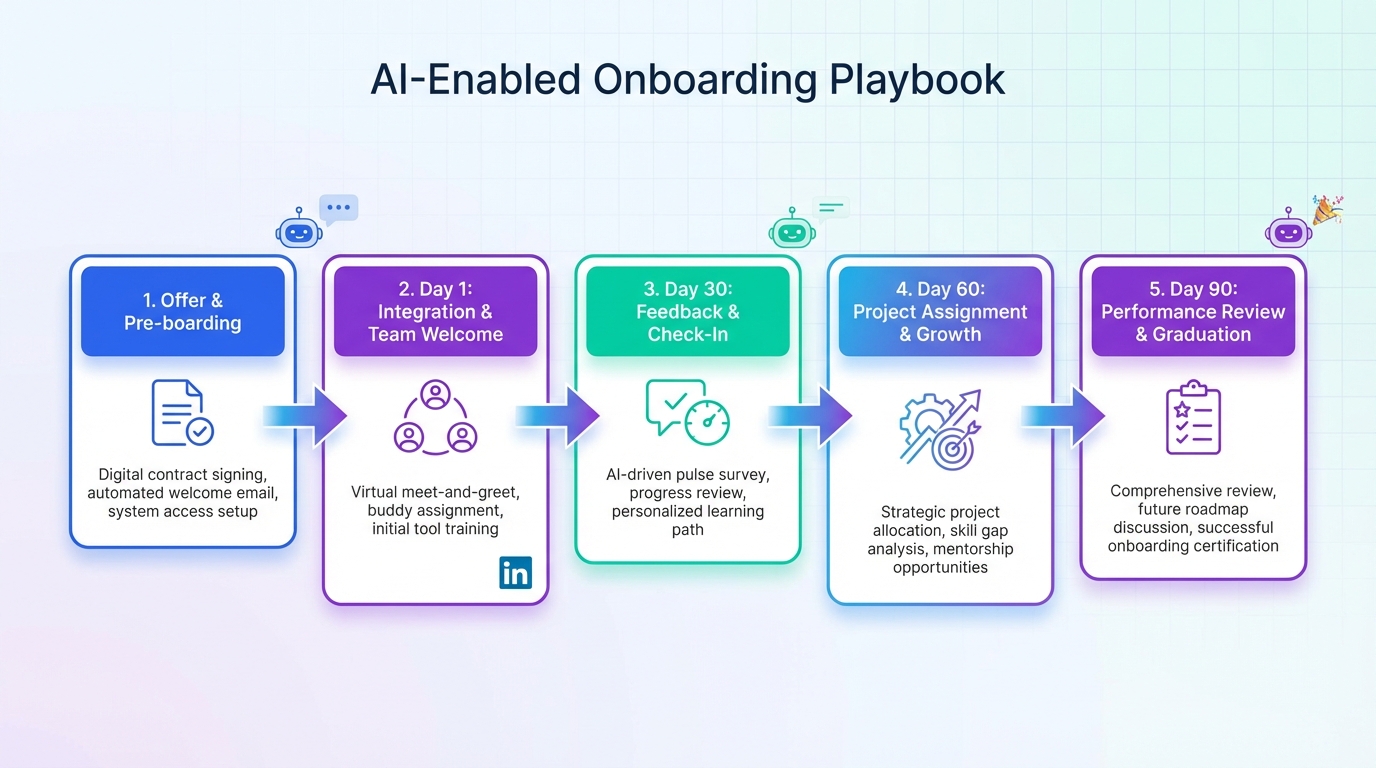
Artificial intelligence for recruiting works best when it supports a disciplined onboarding plan rather than replacing it. The most reliable pattern we see is simple: document what “good” looks like for the first 90 days, assign shared ownership across the team, and use automation to keep communication and follow up consistent from offer acceptance through the first weeks on the job. In this guide, we adapt HR Consultant Judy Slutsky’s six onboarding strategies into an AI ready workflow, and we show where StrategyBrain AI Recruiter fits naturally, especially for LinkedIn based hiring where it can automate candidate outreach, answer role and compensation questions, confirm interview interest, and collect résumés and contact details before day one.
Key Takeaways
- Start with a written onboarding document that maps skills and outcomes for the first 90 days, then review at the 3 month mark.
- Make onboarding a team responsibility so culture, tools, and best practices are taught by the right people, not only the manager.
- Use new hire experience as input by collecting structured feedback and turning it into process improvements.
- Assign defined project work early to accelerate communication, accountability, and integration, especially for remote teams.
- Hire and support natural learners by setting expectations for questions, shadowing, and proactive development.
- Invest in external development with deliverables so training outcomes connect to the job and can be applied internally.
- Where AI helps most is consistency and speed in repetitive recruiting tasks, for example StrategyBrain AI Recruiter’s automated LinkedIn messaging and follow up.
Why onboarding is part of artificial intelligence ai in recruitment
Many teams talk about the ai market in recruitment industry as if it ends when the offer is signed. In reality, the recruiting experience continues into onboarding. Candidates remember whether communication stayed clear after acceptance, whether expectations were consistent, and whether the first weeks felt organized.
That is where artificial intelligence for recruiting can add real value. Not by inventing culture, but by reducing the operational gaps that cause confusion. For example, StrategyBrain AI Recruiter can keep LinkedIn conversations responsive across time zones, follow up automatically, and capture résumés and contact details from interested candidates so the handoff into onboarding starts with complete information.
Scope note: This article focuses on onboarding strategy and where AI can support it. It does not cover legal onboarding requirements, payroll setup, or jurisdiction specific compliance checklists.
Strategy 1: Use an onboarding document as the guiding plan
Judy Slutsky’s first recommendation is to stop improvising. Before day one, create a written onboarding document that includes responsibilities, skills, and competencies from the job description, then order learning logically so foundational skills come first.
How to implement it
- Write a 90 day onboarding document with role outcomes, key relationships, and required tools.
- Sequence skills so the first weeks focus on prerequisites for later work.
- Schedule a 3 month review to confirm which skills were gained and what needs reinforcement.
Where AI fits naturally
Artificial intelligence for recruiting can reduce the “handoff loss” between recruiting and onboarding. In LinkedIn heavy workflows, StrategyBrain AI Recruiter can handle the repetitive pre start communication that often falls through, such as answering role, company, benefits, and compensation questions, and confirming next steps. That consistency makes the onboarding document easier to execute because fewer details are missing when the person starts.
Limitations to watch
- AI does not define success for the role. Your team still must write clear outcomes and expectations.
- Over documentation can slow action. Keep the plan usable, not perfect.
Strategy 2: Treat onboarding as shared ownership
Slutsky emphasizes that onboarding should not sit on one manager’s shoulders. One person cannot teach everything a new employee needs, and relying on one or two people can distort the culture and best practices the new hire experiences.
How to implement it
- Assign onboarding owners for culture, tools, process, and role specific training.
- Create a simple handoff map that shows who meets the new hire in week 1, week 2, and week 4.
- Use a shared tracker so tasks are visible and not dependent on memory.
Where AI fits naturally
In artificial intelligence ai in recruitment, the biggest operational win is often coordination. StrategyBrain AI Recruiter supports scale by enabling teams to manage more than 100 LinkedIn accounts, which matters when multiple recruiters or regions are involved. When recruiting is distributed, consistent messaging and follow up reduces confusion for candidates and makes internal ownership clearer.
Limitations to watch
- Shared ownership needs a single coordinator to prevent diffusion of responsibility.
- Automation can hide gaps if nobody reviews what candidates are actually experiencing.
Strategy 3: Listen and capture new hire experience
Onboarding is not only teaching. Slutsky notes that new employees bring perspectives from different professional backgrounds, and it is a mistake not to listen. When people can share and participate in decisions, they feel valued, which supports engagement.
How to implement it
- Run a week 2 feedback check focused on clarity, tools, and blockers.
- Run a week 6 feedback check focused on role expectations and collaboration.
- Convert feedback into changes by assigning an owner and a due date for each improvement.
Unique framework we use: the 3 Signal Onboarding Review
When we review onboarding programs, we score feedback into three signals so it becomes actionable rather than anecdotal.
- Clarity signal: the new hire can explain priorities, success metrics, and who decides what.
- Connection signal: the new hire has working relationships across the team, not only with the manager.
- Confidence signal: the new hire can complete real work with predictable support and feedback.
Where AI fits naturally
Artificial intelligence for recruiting can preserve context from the recruiting stage so onboarding starts with fewer assumptions. StrategyBrain AI Recruiter captures conversation history, résumés, and contact details from interested candidates. That reduces the common problem where the hiring team forgets what the candidate cared about most, such as compensation questions or role scope concerns, and then repeats the same conversations after day one.
Strategy 4: Put new hires on defined project work early
Slutsky recommends getting new hires involved quickly through defined project work. The goal is to create communication and accountability early, which speeds integration. This is especially valuable for remote teams where informal learning is limited.
How to implement it
- Pick one scoped project that can be completed in 10 business days.
- Define deliverables in writing, including what “done” means.
- Schedule two checkpoints so the new hire gets feedback before the final output.
Where AI fits naturally
In the ai market in recruitment industry, speed is often discussed as time to hire. Onboarding speed matters too. When recruiting communication is handled consistently, the new hire arrives with fewer unresolved questions. StrategyBrain AI Recruiter’s 24/7 multilingual communication can reduce delays for global hires who need answers outside local business hours, which helps them start project work sooner.
Limitations to watch
- Do not confuse “busy work” with integration. The project must connect to real team outcomes.
- Remote onboarding needs explicit communication norms so collaboration does not depend on informal cues.
Strategy 5: Hire and enable natural learners
Even with a formal onboarding plan, attitudes shape outcomes. Slutsky highlights the importance of hiring lifelong learners who ask questions, research, analyze, and proactively shadow others.
How to implement it
- Screen for learning behavior by asking for examples of self directed skill building.
- Set expectations that questions and shadowing are part of the job in the first month.
- Provide a learning path that includes internal experts and external resources.
Where AI fits naturally
Artificial intelligence ai in recruitment can improve candidate experience before the hire, which influences who accepts and how prepared they feel. StrategyBrain AI Recruiter can introduce job opportunities, answer questions about the role, company, and compensation, and confirm interview interest. That reduces friction for candidates who need clarity to make a decision, and it supports stronger alignment before onboarding begins.
Strategy 6: Make external development measurable
External training can be valuable, but Slutsky warns it becomes wasteful when it cannot be applied internally. The fix is to define deliverables and outcomes, then tie the curriculum back to the job.
How to implement it
- Choose training with a clear output such as a playbook, a process change, or a measurable skill.
- Define deliverables before the training starts.
- Schedule an internal share back within 10 business days of completion.
Where AI fits naturally
When teams adopt artificial intelligence for recruiting, training often includes new tools and new workflows. StrategyBrain AI Recruiter is most effective when recruiters define what the AI should communicate about the company, benefits, and compensation, then review outcomes. That makes AI adoption itself a measurable development initiative rather than a vague “innovation” project.
Quick Comparison: Manual onboarding vs AI supported onboarding
| Area | Manual only | AI supported approach | Practical outcome |
|---|---|---|---|
| Pre start communication | Depends on recruiter availability | Automated responses and follow up with human review | Fewer unanswered questions on day one |
| Consistency of messaging | Varies by recruiter and time zone | Standardized role and company explanations | Less confusion across candidates and hires |
| Global hiring communication | Limited to working hours and languages | 24/7 multilingual candidate messaging | Faster decisions and smoother starts |
| Scaling LinkedIn outreach | Linear with recruiter time | AI assisted outreach across many accounts | More capacity without adding headcount |
| Handoff completeness | Notes and files can be scattered | Captured résumés and contact details with conversation context | Cleaner transition into onboarding |
Important: AI supported does not mean hands off. It means repetitive tasks are automated so humans can focus on judgment, relationship building, and final qualification.
Copyable checklist: AI ready onboarding in 30 minutes
- Create a 90 day onboarding document with week 1, week 4, and day 90 outcomes.
- Assign owners for culture, tools, process, and role training.
- Schedule a 3 month review meeting before the new hire starts.
- Define one 10 business day project with written deliverables.
- Add two feedback checkpoints, week 2 and week 6.
- Standardize pre start candidate communication so role scope, benefits, and compensation questions are answered consistently.
- If you recruit on LinkedIn, configure StrategyBrain AI Recruiter to automate outreach, follow up, and résumé and contact collection for interested candidates.
FAQ
What does “artificial intelligence for recruiting” mean in day to day work?
It usually means using AI to automate repetitive recruiting tasks such as outreach, candidate messaging, and follow up, while keeping human decision making for evaluation and final selection. In LinkedIn workflows, it can also mean automating initial conversations that confirm interest and collect résumés and contact details.
Does AI replace recruiters during onboarding?
No. AI can support consistency and speed, but onboarding still requires human leadership, coaching, and cultural integration. The best results come from using AI to reduce administrative load so managers and recruiters can spend more time on high value conversations.
How does StrategyBrain AI Recruiter help with LinkedIn recruiting specifically?
StrategyBrain AI Recruiter automates LinkedIn recruiting tasks by connecting with candidates that match your criteria, introducing the opportunity, answering questions about the role, company, and compensation, confirming interview interest, and collecting résumés and contact information from interested candidates.
Can StrategyBrain AI Recruiter qualify candidates for job fit?
It can identify willingness to communicate or interview, and it can collect the information needed for screening. Final qualification for job requirements still needs a recruiter or hiring manager reviewing the résumé and assessing fit.
How should teams measure onboarding success when using AI?
Use measurable checkpoints such as completion of week 1 setup tasks, delivery of a defined project within 10 business days, and a structured 90 day review. Pair that with feedback signals for clarity, connection, and confidence so you can improve the process over time.
Is multilingual candidate communication actually important?
Yes for global hiring. Misunderstandings and delays often come from language and time zone gaps. Always on multilingual messaging can reduce friction and keep candidates engaged through the offer to start transition.
How many LinkedIn accounts can an AI recruiting team manage?
StrategyBrain AI Recruiter supports managing more than 100 LinkedIn accounts, which enables organizations to build AI powered recruitment teams and expand outreach capacity across roles, regions, or business units.
What about privacy and compliance when using AI in recruitment?
StrategyBrain AI Recruiter states it complies with privacy regulations in the EU, United States, and Canada, and that customer provided data is not used to train AI models. You should still review your internal policies and ensure candidates receive appropriate notices for your jurisdiction.
Conclusion
A strong onboarding program is still built on fundamentals: a written plan, shared ownership, early project work, and feedback loops that turn new hire experience into improvements. Artificial intelligence for recruiting becomes valuable when it reinforces those fundamentals by making communication and follow up consistent, especially in LinkedIn driven hiring where manual outreach can consume most of a recruiter’s week.
Next steps: start by writing your 90 day onboarding document and assigning owners. Then identify the repetitive communication points that cause delays after offer acceptance. If LinkedIn is a primary channel, consider using StrategyBrain AI Recruiter to automate outreach, answer candidate questions, confirm interest, and collect résumés and contact details so your onboarding starts with complete context.