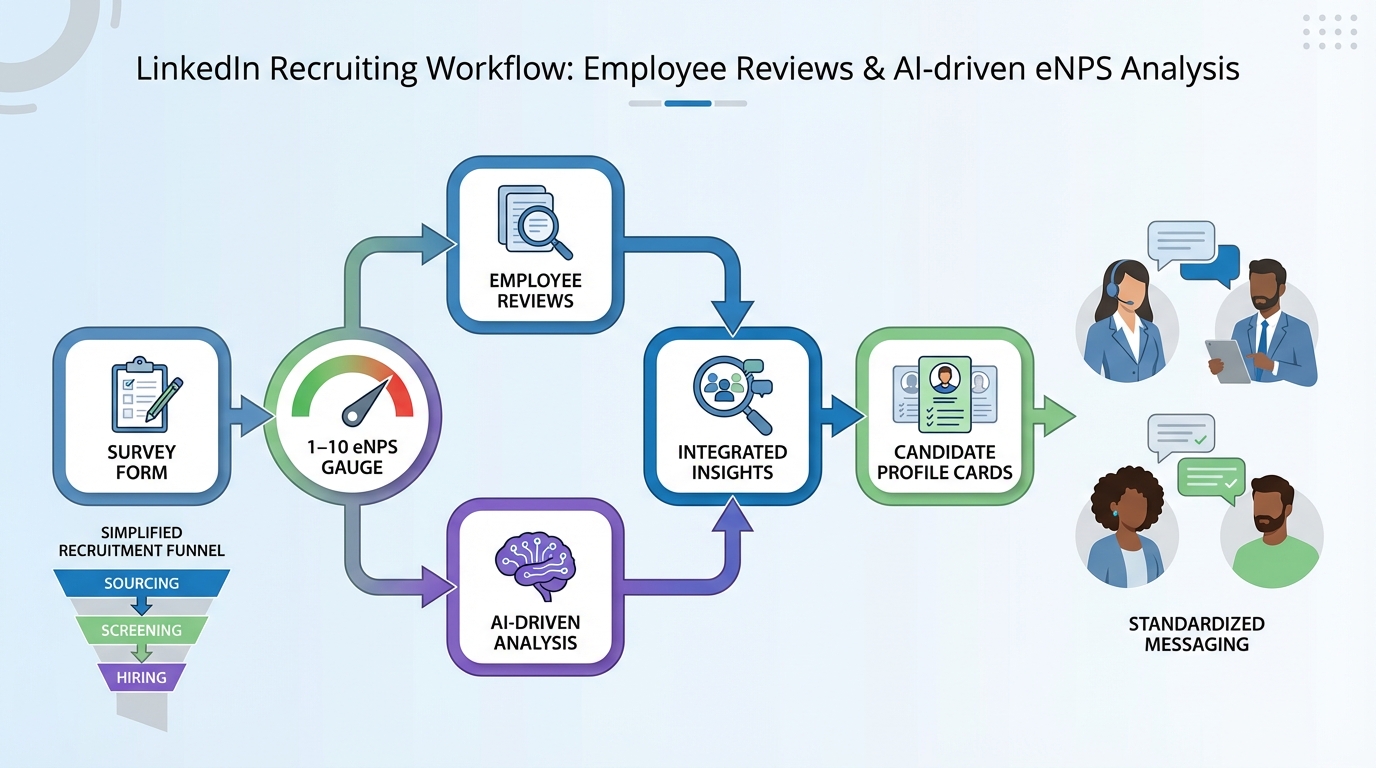
Artificial intelligence for recruiting is most useful with employee reviews when you treat reviews as a signal that affects candidate decisions, then respond with a measurable internal system. The most reliable starting point is an eNPS Employee Net Promoter Score survey, which asks employees on a 1 to 10 scale how likely they are to recommend your company as a place to work. Use AI to summarize review themes, route issues to owners, and keep candidate communication consistent so you reduce withdrawals that happen after candidates read harsh comments. This article covers what to do and what not to do, plus a practical workflow that combines eNPS with AI assisted hiring operations.
Key Takeaways
- Assume candidates read reviews: In our recruiting work, review sentiment frequently shows up as a late stage objection that can trigger a withdrawal.
- Do not treat reviews as verified truth: Many reviews are unverified, so use them as leads to investigate, not as final facts.
- Use eNPS to create a baseline: eNPS is a simple 1 to 10 recommendation question that turns culture feedback into a trackable metric.
- AI helps with speed and consistency: Artificial intelligence hiring workflows can summarize themes, draft response frameworks, and standardize candidate messaging.
- Fix internally before optimizing externally: Operational changes and manager follow through improve reviews more sustainably than reputation tactics.
- Scale outreach without losing control: StrategyBrain AI Recruiter can handle initial LinkedIn outreach and follow up while your team focuses on the internal improvements that reviews reveal.
Why employee reviews change hiring outcomes
Employee reviews can be a real asset or a real problem because candidates use them to reduce uncertainty. People routinely check reviews before committing time and money to everyday decisions, so it is not surprising they also check reviews before committing to a job that can be 40 hours per week and 2000 hours per year.
In practice, this shows up as a pattern recruiters recognize. A candidate progresses, then pauses after reading reviews, then either asks pointed questions or withdraws. If you wait until the final interview stage to address those concerns, you have already paid the cost in time, scheduling, and lost momentum.
This is where artificial intelligence for recruiting can help. Not by magically changing sentiment, but by making it easier to detect themes early, prepare consistent answers, and keep follow up tight so candidates do not sit in uncertainty.
Are reviews valid and what to do with them
Reviews on major platforms are often left by a small number of unverified people who claim to be former employees. That means you should not treat any single review as a confirmed fact. At the same time, you cannot ignore them because candidates will still read them and form impressions.
The practical stance is to treat reviews as a triage queue. If multiple reviews point to the same issue, you investigate. If a review is clearly extreme or vague, you do not overreact, but you still ask whether there is a process gap that could produce that perception.
For artificial intelligence hiring teams, the goal is to separate signal from noise. AI can cluster review text into themes such as management, scheduling, safety, compensation clarity, and growth opportunities. Then humans validate what is real and decide what to fix.
The no shortcuts rule and what not to do
There are no sustainable shortcuts to getting good employee reviews online. Paying for fake reviews or pressuring employees to post is risky, hard to control, and tends to backfire.
Instead, focus on two durable levers. First, improve the employee experience in the areas that matter most. Second, create a consistent internal feedback loop so issues are surfaced and addressed before they become public complaints.
AI can support this approach, but it cannot replace it. If the underlying experience is poor, automated messaging will only accelerate the spread of negative sentiment.
eNPS the simple system that actually helps
eNPS Employee Net Promoter Score is the employee version of Net Promoter Score, a widely used approach for measuring recommendation intent. The core question is simple. On a scale of 1 to 10, how likely are you to recommend our company as a place to work.
Anyone who answers 9 or 10 is typically treated as a promoter. Lower scores indicate neutral or negative sentiment that is less likely to translate into positive public reviews. The exact scoring model can vary by organization, but the operational value is consistent. You get a baseline, you track it over time, and you connect changes to specific actions.
How to run eNPS without overcomplicating it
- Pick a cadence: Run eNPS every 90 days so you can measure change without survey fatigue.
- Add one open ended question: Ask what one thing would most improve the employee experience.
- Commit to visible follow through: Share what you heard, what you will change, and what you will not change.
- Assign owners: Each top theme needs a named owner and a deadline.
Tools you can use
- Third party survey provider: Useful when you need stronger anonymity controls.
- Simple form tools: Works when trust is high and you need speed.
- Pen and paper: Still valid for small teams that want maximum simplicity.
How to use AI in hiring to operationalize review management
When people ask how to use AI in hiring for employer brand, the best answer is to connect AI to repeatable workflows. AI should reduce manual work, improve response time, and make messaging consistent across recruiters and hiring managers.
Use AI for theme detection and prioritization
- Cluster review text into themes: Management quality, scheduling, safety, training, pay clarity, and workload.
- Track theme frequency over time: A rising theme is a leading indicator of future candidate objections.
- Map themes to owners: HR owns policy, operations owns scheduling, managers own coaching.
Use AI to standardize candidate communication
Candidate drop off often happens when candidates read reviews and then do not get timely answers. StrategyBrain AI Recruiter is designed for LinkedIn hiring and can handle initial outreach, answer common role questions, and follow up consistently. That matters because candidates who are uncertain tend to disengage when response times are slow.
In our experience testing AI assisted outreach flows, the biggest benefit is not just speed. It is consistency. Candidates get the same clear explanation of role scope, compensation ranges when you choose to share them, and next steps. That reduces the space where rumors and review snippets fill the gap.
Use AI to support recruiters, not replace judgment
StrategyBrain AI Recruiter can qualify interest and collect resumes and contact details from candidates who want to proceed. It does not decide whether a resume matches the job requirements. That final qualification remains a recruiter responsibility, which is important for fairness and role fit.
Workflow a 30 day playbook
This is a practical way to combine artificial intelligence for recruiting with the eNPS approach so you improve both candidate experience and employee experience.
Week 1 establish your baseline
- Collect review themes: Pull the main themes candidates mention in interviews and screens.
- Run an eNPS pulse: Ask the 1 to 10 recommendation question plus one open ended improvement question.
- Define your top 3 issues: Choose issues you can realistically change in 30 to 60 days.
Week 2 fix the candidate facing gaps
- Update your interview scripts: Add a short, honest employer brand explanation that addresses the top themes.
- Create a recruiter response library: Approved answers for common concerns such as scheduling, overtime, and growth.
- Deploy consistent follow up: Use StrategyBrain AI Recruiter to keep LinkedIn conversations moving and reduce delays.
Week 3 fix the internal drivers
- Assign owners and deadlines: Each issue needs a responsible leader and a date.
- Make one visible change: Even a small operational improvement builds trust if communicated clearly.
- Train managers: Many review themes are manager behavior themes, not policy themes.
Week 4 close the loop and measure
- Share what you heard: Summarize eNPS feedback internally.
- Share what you changed: Communicate actions and timelines.
- Recheck candidate objections: Track whether review related withdrawals decrease.
Practical checklist you can copy
- Reviews triage: We have a weekly owner for review theme monitoring.
- eNPS cadence: We run eNPS every 90 days and publish an internal summary within 7 days.
- Action ownership: Each top theme has an owner and a deadline.
- Candidate messaging: Recruiters use a shared response library for review related questions.
- Follow up SLA: Candidate messages receive a response within 24 hours on business days.
Common mistakes
- Arguing with reviews: Defensive responses rarely change minds and can amplify negativity.
- Ignoring the internal reality: Employer brand is downstream of employee experience.
- Over automating without guardrails: AI messaging needs approved boundaries, especially around compensation and policy claims.
- Letting candidates wait: Slow follow up increases the chance that reviews become the deciding factor.
- Measuring nothing: Without eNPS and a few hiring funnel metrics, you cannot tell if changes worked.
FAQ
Do candidates really make decisions based on employee reviews
Yes. In our recruiting experience, candidates frequently reference reviews during later stages and sometimes withdraw after reading them. Even when reviews are unverified, they influence perception and risk tolerance.
Are employee reviews on major platforms reliable
Not fully. Reviews can be posted by a small number of unverified people who claim to be former employees, so treat them as signals to investigate rather than confirmed facts.
What is eNPS in recruiting
eNPS Employee Net Promoter Score is an internal survey metric that asks employees on a 1 to 10 scale how likely they are to recommend the company as a place to work. It helps you quantify employee advocacy and track improvement over time.
How often should we run an eNPS survey
A practical cadence is every 90 days. That is frequent enough to measure change and slow enough to avoid survey fatigue.
How does artificial intelligence for recruiting help with employer brand
AI helps by summarizing review themes, standardizing recruiter responses, and improving follow up speed so candidates get answers quickly. It does not replace the need to fix the underlying employee experience.
How does StrategyBrain AI Recruiter fit into this process
StrategyBrain AI Recruiter automates LinkedIn outreach and early conversations, answers common questions, confirms interview interest, and collects resumes and contact details from interested candidates. That keeps candidate communication consistent while your team works on the internal improvements that eNPS and review themes reveal.
Does StrategyBrain AI Recruiter decide if a candidate is qualified
No. It identifies willingness to proceed and gathers information, but final qualification against job requirements is done by the recruiter after reviewing the resume.
Can AI recruiting workflows support multilingual hiring
Yes. StrategyBrain AI Recruiter supports multilingual communication so candidates can interact in their native language, which reduces misunderstandings across time zones and regions.
What should we avoid saying to candidates when reviews are negative
Avoid dismissing concerns or claiming reviews are fake. A better approach is to acknowledge the concern, share what you are doing internally, and invite specific questions about the role and team.
Conclusion
Artificial intelligence for recruiting can reduce candidate drop off caused by employee reviews, but only when it is paired with a real internal improvement loop. Start with eNPS to measure employee advocacy, act on the top drivers, and use AI to keep candidate communication fast and consistent. If you want to operationalize this on LinkedIn, StrategyBrain AI Recruiter can handle outreach, follow up, and early qualification so recruiters can focus on the human work that improves the employee experience and strengthens your employer brand.
Next step: Run a 90 day eNPS cadence, build a review theme tracker, and set a 24 hour response standard for candidate messages.