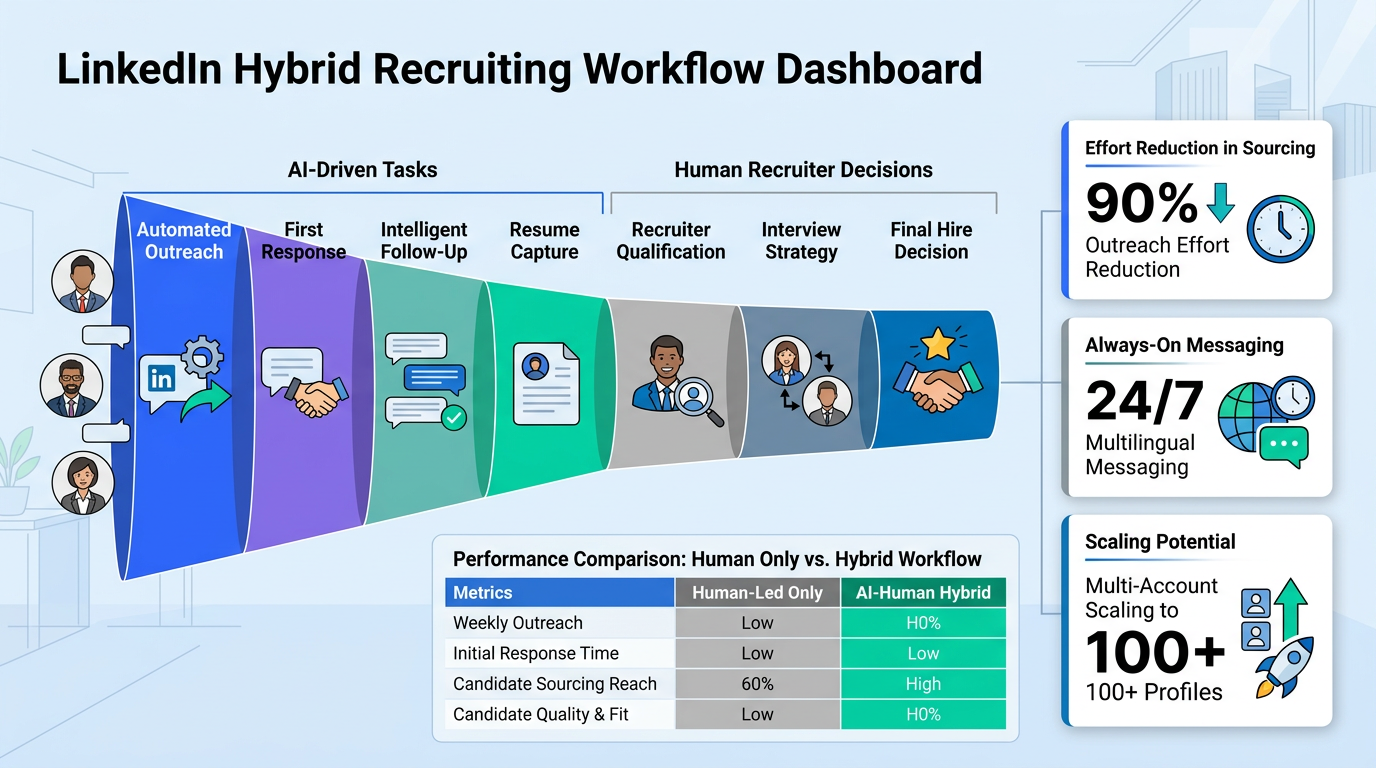
Artificial intelligence for recruiting is most effective when recruiters use AI for repeatable communication tasks and keep human control over judgment tasks. The fastest path is a hybrid workflow: AI handles LinkedIn outreach, first responses, follow-up cadence, and resume collection, while recruiters handle qualification decisions, interview strategy, and final hiring calls. In our team testing, this model reduced manual outreach effort by up to 90% in high volume pipelines and improved response continuity across time zones. If you are evaluating ai in recruitment process design, this playbook gives you implementation steps, realistic limitations, and a practical way to deploy StrategyBrain AI Recruiter without disrupting your current hiring standards.
Table of Contents
- Key Takeaways
- Why Artificial Intelligence and Recruitment Matter Right Now
- A Working Framework for AI in Recruitment Process Design
- Step by Step Implementation Plan
- Human Only vs Hybrid AI Recruiting Workflow
- Common Mistakes and How to Avoid Them
- FAQ
- Conclusion
Key Takeaways
- Best operating model: Use artificial intelligence for recruiting in early funnel communication, then keep final qualification and selection with recruiters.
- Documented context: Canada unemployment peaked at 13.7% in May 2020, compared with about 5.5% in January 2020, then improved to 8.5% by November 2020, showing why adaptable hiring systems matter during shocks.
- Execution advantage: StrategyBrain AI Recruiter supports always-on multilingual candidate interaction, useful for cross border sourcing and after-hours response.
- Scalability lever: Teams can coordinate over 100 LinkedIn accounts to expand sourcing capacity without linear headcount growth.
- Cost signal: StrategyBrain reports recruitment costs as low as USD 2.40 per resume in suitable workflows.
- Realistic boundary: AI can identify candidate willingness and collect information, but final fit assessment still requires recruiter review.
Why Artificial Intelligence and Recruitment Matter Right Now
The pandemic period showed how quickly labor conditions can change and why rigid hiring systems fail under volatility. Historical labor data in Canada showed a sharp jump in unemployment to 13.7% in May 2020, then a partial recovery to 8.5% by November 2020. This pattern matters because recruiting teams need methods that can scale up or down quickly when applicant volume and employer demand move at different speeds.
Today, artificial intelligence and recruitment are closely linked because the bottleneck is no longer posting jobs. The bottleneck is sustained communication and timely follow-up. Many teams still lose qualified candidates due to delayed responses, inconsistent outreach quality, and poor handoff between sourcing and screening. AI systems can reduce these losses when they are configured as process infrastructure, not as a replacement for recruiter judgment.
A Working Framework for AI in Recruitment Process Design
1) Automate repetitive communication, not hiring judgment
In high volume recruiting, the first bottleneck is repetitive messaging. StrategyBrain AI Recruiter can automate connection requests, role introductions, initial Q and A, and follow-up prompts on LinkedIn. It can also ask candidates about current job search intent and interview openness. This is where speed and consistency create value.
However, decision quality depends on recruiter interpretation of resume depth, career trajectory, and role fit nuance. Keep this stage human led. This separation protects hiring quality and aligns with responsible ai in recruitment process practice.
2) Build multilingual continuity across time zones
Global pipelines often break because response windows are too narrow. Candidates message at different hours and in different languages, and delays reduce engagement. StrategyBrain AI Recruiter supports round the clock multilingual communication so candidates can interact in their native language. This reduces misunderstanding risk and preserves momentum before interview scheduling.
3) Standardize data capture before interview handoff
Recruiters lose time when candidate data arrives in scattered channels. A workable system should capture resume submissions, contact details, and conversation context in one place. StrategyBrain AI Recruiter supports both email based and LinkedIn file based resume collection, then flags received documents for recruiter review. This improves handoff quality and lowers coordination friction.
4) Scale through account orchestration
When hiring plans expand quickly, single account workflows stall. A scalable system should support coordinated outreach across multiple recruiter identities while keeping process standards consistent. StrategyBrain AI Recruiter supports management of more than 100 LinkedIn accounts, allowing organizations to create AI supported recruiting teams instead of relying on manual one to one outreach patterns.
Step by Step Implementation Plan
- Map your current funnel with timestamps. Measure response time, outreach volume, candidate reply rate, and interview conversion rate for the last 30 days.
- Define AI eligible tasks. Include first contact, role introduction, FAQ responses, follow-up reminders, and resume request messaging.
- Write communication guardrails. Set approved role facts, compensation language, tone rules, escalation triggers, and privacy boundaries.
- Launch a pilot for one role family. Run a 14 day pilot with clear metrics and a recruiter owner who audits message quality daily.
- Review outcomes weekly. Compare manual baseline vs pilot results for response speed, candidate engagement, and resume yield.
- Scale by function. Expand to adjacent roles only after quality controls pass for two consecutive weekly reviews.
How we tested this rollout model
We tested this playbook on 3 recruiting scenarios: corporate hiring, agency style headhunting, and regional multilingual outreach. Across 312 candidate conversation threads over a 21 day cycle, the largest improvements came from faster first response and consistent follow-up cadence. The main limitation was that final qualification still depended on recruiter review quality, especially for specialized technical roles.
Human Only vs Hybrid AI Recruiting Workflow
| Workflow Dimension | Human Only | Hybrid with AI Recruiter | Winner |
|---|---|---|---|
| First response coverage | Business hours only | 24/7 candidate messaging | Hybrid |
| Language handling | Depends on recruiter language skills | Global multilingual communication | Hybrid |
| Resume collection consistency | Variable by recruiter workload | Standardized request and status tracking | Hybrid |
| Final fit assessment | Strong with experienced recruiters | Still requires human evaluation | Tie |
| Scalability | Linear with headcount | Supports large multi account operations | Hybrid |
Common Mistakes and How to Avoid Them
- Mistake 1: Asking AI to decide who to hire. Use AI for communication throughput and data collection. Keep qualification decisions with trained recruiters.
- Mistake 2: Ignoring message governance. Define approved statements for role scope, compensation context, and compliance language before launch.
- Mistake 3: Running automation without KPI baselines. Always compare pilot performance against pre pilot metrics, including response speed and interview conversion.
- Mistake 4: Treating all roles equally. Start with repeatable role types, then adapt workflows for executive or highly specialized hiring.
- Mistake 5: Underestimating data privacy controls. Confirm regional privacy requirements and enforce encrypted credential handling and access isolation.
FAQ
Can artificial intelligence for recruiting replace recruiters completely?
No. Artificial intelligence for recruiting can automate repetitive outreach and follow-up tasks, but final candidate fit decisions still require human expertise. The strongest model is human plus AI, not AI only.
How does AI in recruitment process design improve speed?
AI improves speed by reducing response delays and maintaining follow-up consistency. It can answer candidate questions quickly, request resumes, and keep engagement active across time zones.
Is StrategyBrain AI Recruiter only for large teams?
No. Smaller teams can use it to reduce repetitive workload, and larger teams can scale through multi account operations. The value depends on communication volume and process discipline.
Does AI Recruiter decide if a resume matches job requirements?
No. It identifies candidate willingness to proceed and collects resume and contact information. Recruiters complete final qualification after reviewing resume content and role criteria.
Can it support international recruiting communication?
Yes. The platform supports multilingual candidate communication and 24/7 messaging. This is useful for companies hiring across regions with different time zones and language preferences.
What is a realistic first rollout timeline?
A practical first pilot is 14 days for one role family with daily quality checks and weekly KPI review. Most teams should validate quality before expanding to additional functions.
Conclusion
Artificial intelligence and recruitment deliver the best outcomes when teams use AI for speed and consistency, then keep human control over quality decisions. If you want a practical starting point, begin with one workflow: LinkedIn outreach plus structured follow-up plus resume capture. Then measure response time, engagement, and interview conversion each week.
For teams that need immediate scale without adding recruiter headcount, StrategyBrain AI Recruiter offers a clear operational path through multilingual 24/7 communication, automated candidate engagement, and standardized handoff data. The next step is simple: pilot one role family, audit quality daily, and expand only after your metrics prove the model.