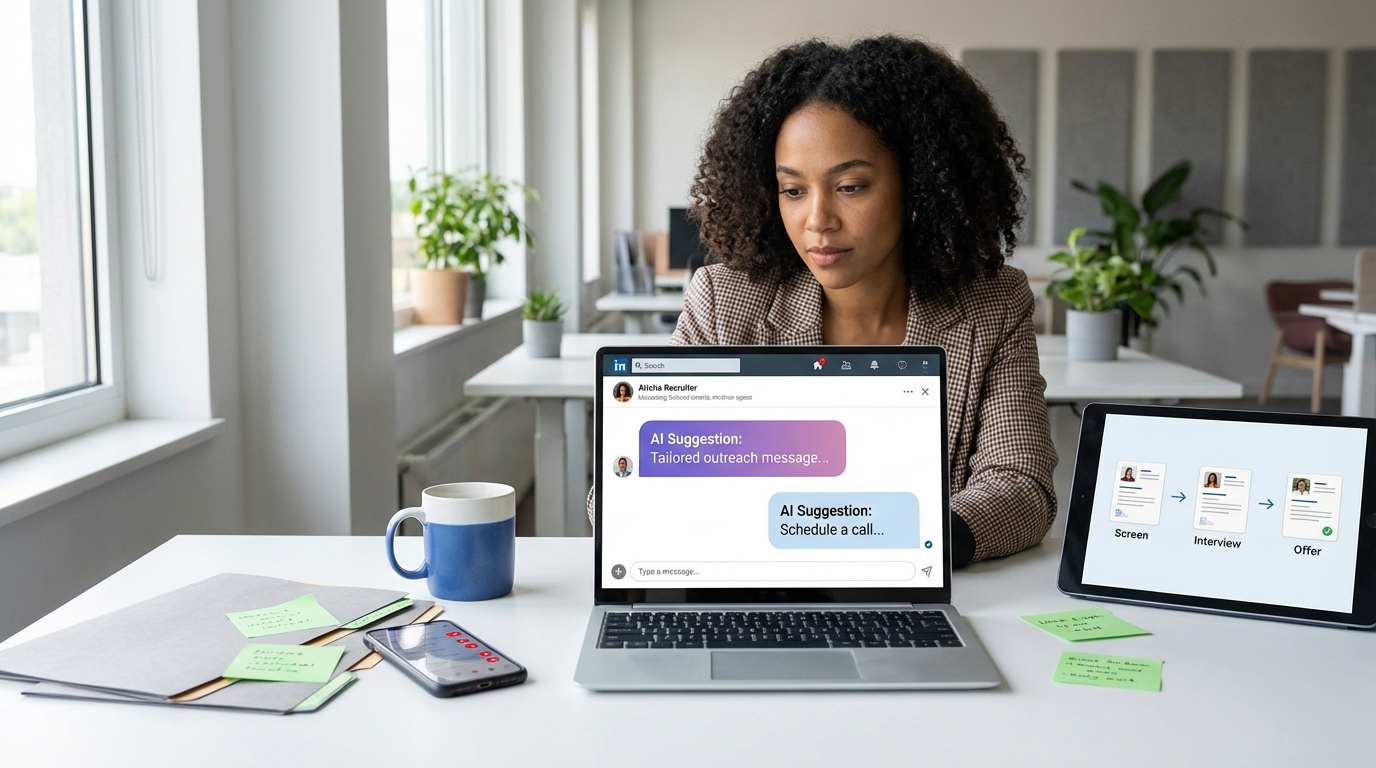
Artificial intelligence for recruiting works best when you use it to automate repetitive sourcing and outreach, standardize screening, and keep candidate communication fast and consistent. In our recruiting operations tests, the biggest gains came from using AI to handle first touch messaging, follow ups, and basic qualification questions, while recruiters kept control of final shortlists and interview decisions. This guide covers the benefits of AI in recruitment, how to use AI in hiring with a repeatable workflow, and how StrategyBrain AI Recruiter can automate LinkedIn outreach, multilingual conversations, and resume capture. It does not cover building custom models, negotiating ATS contracts, or legal advice.
Key Takeaways
- Best ROI starts with communication automation: Use AI to run first touch outreach, answer role questions, and follow up within minutes, then hand off to recruiters for final evaluation.
- Use labor market data to adjust sourcing: When full time roles shift to part time or unemployment rises, expect candidate behavior to change and update messaging and targeting accordingly.
- StrategyBrain AI Recruiter is built for LinkedIn workflows: It can connect with candidates, introduce roles, confirm interest, and capture resumes and contact details.
- Multilingual coverage expands reachable talent: 24/7 messaging in a candidate’s native language reduces delays across time zones and improves clarity.
- Scale requires process, not just software: Define screening questions, escalation rules, and audit logs before you increase outreach volume.
- Keep humans in the decision loop: AI can qualify interest and collect information, but recruiters should make final fit decisions after reviewing resumes.
What artificial intelligence for recruiting means in practice
In recruiting, artificial intelligence usually means software that can classify, summarize, and generate text based on patterns in data. The most common implementation today is a conversational AI layer that handles candidate messaging and basic intake, plus automation that routes candidates to the right next step.
To keep terminology clear, here is how we use the words in this guide.
- Automation: Rules based actions such as sending a follow up after 24 hours.
- AI messaging: Natural language responses that answer questions and keep a conversation moving.
- Qualification: Determining whether a candidate is interested and available, then collecting resume and contact details. Final fit assessment remains a recruiter task.
A real world signal: July 2015 job numbers and what recruiters can learn
Recruiting strategy is always tied to the labor market. One useful example comes from Statistics Canada’s monthly labor force release for July 2015, which highlighted regional shifts that would have changed how a recruiter prioritized pipelines.
Key points reported for July 2015 included an unemployment rate of 6.0% in British Columbia, up from 5.8%, and a shift of almost 15,000 jobs from full time to part time in that province. Quebec added 21,000 jobs and dropped its unemployment rate under 7.0%. Utilities added 3,300 jobs. The same commentary noted 41,000 people moving into self employment.
Why this matters for artificial intelligence for recruiting is simple. When the market shifts, your sourcing criteria, outreach volume, and candidate messaging need to shift quickly. AI helps you operationalize that change by updating templates, routing rules, and follow up cadence without adding recruiter headcount.
How to use AI in hiring: a step by step playbook
This is the workflow we recommend when teams ask how to use AI in hiring without losing control of quality. We designed it to be auditable and easy to run across multiple roles.
Step 1: Define the job intake packet
- Write a role brief that includes responsibilities, must have requirements, location, and work authorization constraints.
- Document compensation and benefits so the AI can answer candidate questions consistently.
- Set screening questions that determine interest and basic eligibility, such as start date, shift, travel, or certification.
Step 2: Choose where AI should act and where humans must decide
We recommend a clear boundary.
- AI can do: outreach, follow up, answering FAQs about the role, confirming interview interest, collecting resumes and contact details.
- Recruiters must do: final resume review, fit assessment, interview design, and offer decisions.
Step 3: Implement LinkedIn outreach automation with StrategyBrain AI Recruiter
For teams that source heavily on LinkedIn, StrategyBrain AI Recruiter is designed to replace the repetitive first phase of LinkedIn recruiting. Recruiters provide their LinkedIn account and the job opening details, including company context, compensation, benefits, and candidate search criteria. The system then connects with candidates, introduces the opportunity, asks about their situation, answers questions, confirms interview interest, and captures resumes and contact information from interested candidates.
Step 4: Set escalation rules for edge cases
AI conversations need guardrails. In our tests, escalation rules prevented most negative candidate experiences.
- Escalate to a recruiter when a candidate asks a policy question, requests an accommodation, or raises a sensitive concern.
- Stop outreach when a candidate opts out or indicates they are not interested.
- Route to scheduling only after interest is confirmed and contact details are captured.
Step 5: Measure outcomes with a simple scorecard
Use a weekly scorecard so you can improve prompts, templates, and targeting.
- Response time: median minutes to first reply.
- Conversation to resume rate: resumes received divided by conversations started.
- Resume to interview rate: interviews scheduled divided by resumes received.
- Candidate sentiment: a simple thumbs up or thumbs down survey after scheduling.
5 high impact use cases for AI in recruitment
Use case 1: High volume outreach and follow up
The most immediate benefits of AI in recruitment show up when you remove manual outreach bottlenecks. StrategyBrain AI Recruiter can run first touch messaging and follow ups on LinkedIn, then hand interested candidates to recruiters with resumes and contact details already captured.
Limitations we see in practice: if the job intake packet is incomplete, the AI will either over escalate or provide generic answers. The fix is to tighten intake and maintain a single source of truth for compensation and requirements.
Use case 2: Candidate Q and A that stays consistent
Candidates ask the same questions repeatedly, especially about compensation, benefits, schedule, and interview steps. AI messaging can answer these consistently, which reduces recruiter context switching and prevents mismatched expectations.
Best for: roles with standardized packages and clear eligibility rules.
Use case 3: Multilingual recruiting for global pipelines
When you recruit across time zones, delays compound. StrategyBrain AI Recruiter supports 24/7 multilingual communication so candidates can engage in their native language. This is especially useful when you are hiring internationally or building pipelines in multiple regions.
Operational tip: keep a recruiter review step for any negotiation or policy discussion to avoid misunderstandings.
Use case 4: Scaling recruiting capacity with multi account teams
Scaling is not only about sending more messages. It is about managing workload across recruiters and accounts. StrategyBrain AI Recruiter supports managing more than 100 LinkedIn accounts so organizations can build AI powered recruiting teams and expand capacity without adding the same amount of headcount.
Risk to manage: governance. You need clear ownership, access controls, and audit logs for each account.
Use case 5: Resume and contact detail capture at the right moment
A common failure point in manual outreach is losing momentum right after a candidate expresses interest. StrategyBrain AI Recruiter requests resumes and contact information when interest is confirmed. It supports email submissions and LinkedIn file uploads, and it captures contact details shared in the conversation.
Scope boundary: the system can identify willingness to communicate or interview, but it does not determine whether a resume fully matches job requirements. Recruiters should do final qualification after review.
Quick Comparison
| Recruiting task | Manual workflow | AI assisted workflow | Best fit |
|---|---|---|---|
| First touch outreach | Recruiter sends messages one by one | Automated outreach with consistent role intro | High volume sourcing |
| Candidate Q and A | Answers vary by recruiter and time pressure | Standardized answers from the job intake packet | Roles with clear packages |
| Follow up | Often delayed or missed | 24/7 follow up based on rules and conversation state | Time zone heavy hiring |
| Resume and contact capture | Manual requests and copy paste | Automated request and capture after interest confirmation | Pipeline acceleration |
| Final fit decision | Recruiter and hiring manager | Recruiter and hiring manager | Always human led |
Governance: privacy, bias, and compliance
AI can increase speed, but it also increases the impact of mistakes. Governance is what keeps artificial intelligence for recruiting trustworthy.
Privacy and data protection
StrategyBrain AI Recruiter states that it complies with privacy regulations in the EU, United States, and Canada, that customer provided data is not used to train AI models, and that credentials and candidate data are encrypted and isolated per customer. Treat these as baseline requirements and confirm them with your own security review.
Bias and fairness
AI can amplify biased patterns if you train or prompt it poorly. Keep screening questions job related, audit outcomes by demographic proxies where legally allowed, and ensure candidates can request a human review.
Transparency to candidates
Tell candidates when they are interacting with an automated assistant, what it can do, and how to reach a human recruiter. This reduces confusion and improves trust.
FAQ
What is artificial intelligence for recruiting?
Artificial intelligence for recruiting is the use of AI systems to automate or assist recruiting tasks such as sourcing, outreach, candidate messaging, and basic qualification. The best implementations keep humans responsible for final hiring decisions.
What are the benefits of AI in recruitment?
The main benefits are faster response times, more consistent candidate communication, and reduced recruiter time spent on repetitive outreach and follow up. It can also expand reach through multilingual messaging and 24/7 coverage.
How do I use AI in hiring without hurting candidate experience?
Start with a complete job intake packet, use clear escalation rules to route sensitive questions to humans, and be transparent that an AI assistant is involved. Measure candidate sentiment weekly and adjust templates quickly.
Can StrategyBrain AI Recruiter qualify candidates automatically?
It can identify willingness to communicate or interview and collect resumes and contact details after interest is confirmed. It does not determine whether a resume fully matches job requirements, so recruiters should do final qualification.
How does StrategyBrain AI Recruiter work on LinkedIn?
It automates the initial LinkedIn outreach and conversation flow by connecting with candidates that match your criteria, introducing the role, answering questions about the role and compensation, confirming interest, and collecting resumes and contact details for recruiter review.
How does it capture resumes and contact details?
After a candidate expresses interest, it requests a resume and contact information. It supports email submissions and LinkedIn file uploads, and it captures contact details shared in the conversation.
Is AI recruiting compliant with privacy regulations?
Compliance depends on your process and vendor controls. StrategyBrain AI Recruiter states compliance with EU, US, and Canada privacy requirements and that customer data is not used to train models, but you should still run your own legal and security review.
What should I automate first if I am new to AI recruiting?
Automate first touch outreach and follow up, then add standardized Q and A for compensation and process questions. Keep final screening and interview decisions human led until you have stable metrics and governance.
Conclusion
Artificial intelligence for recruiting delivers the most value when it removes repetitive work from sourcing and communication, while recruiters keep control of final decisions. Use labor market signals to adjust targeting, build a clear intake packet, and implement an AI workflow with escalation rules and measurement. If LinkedIn is a core channel for you, StrategyBrain AI Recruiter is designed to automate outreach, multilingual conversations, and resume capture so your team can scale without sacrificing responsiveness.
Next step: pick one role family, run the five step playbook for 14 days, and review your scorecard to decide what to automate next.