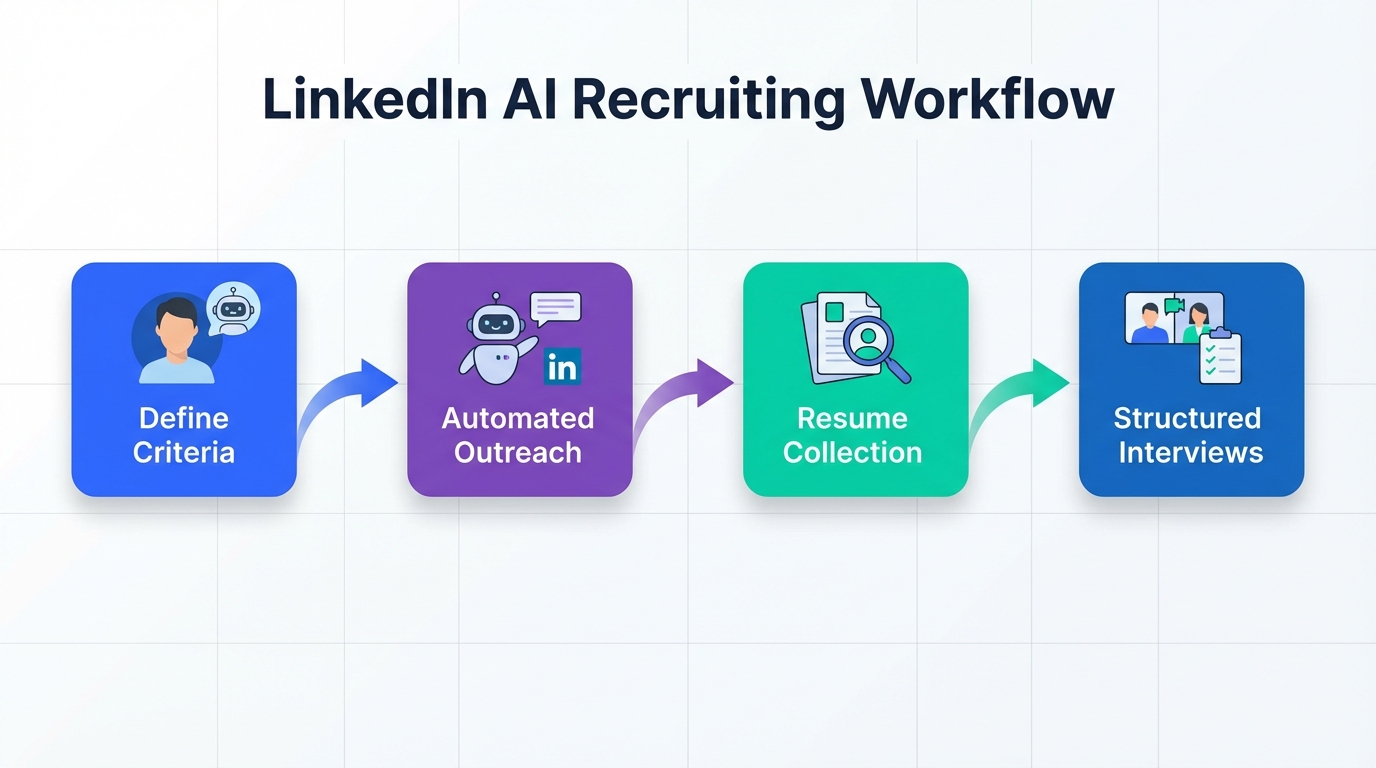
Artificial intelligence for recruiting is most effective when it helps you resist snap judgments, document evidence, and run a consistent process from first message to interview. The practical approach is simple: define job relevant criteria before you look at resumes, use structured questions to test those criteria, and use AI to automate repetitive steps like LinkedIn outreach, candidate Q and A, follow up, and resume collection. In this guide, I translate a classic hiring pitfall, the fundamental attribution bias, into an AI ready workflow, and I show where StrategyBrain AI Recruiter fits naturally for scalable LinkedIn recruiting without turning hiring decisions into a black box.
What the fundamental attribution bias looks like in hiring
One of the most expensive mistakes in recruiting is assuming a candidate’s choices reflect a personal flaw, instead of considering situational factors. In behavioral science this pattern is called the fundamental attribution error, which is the tendency to over emphasize personality based explanations for someone else’s behavior while under weighting external circumstances.
In hiring, it often shows up as a fast narrative you tell yourself while scanning a resume. For example, you see a recent step down in title or compensation and you are tempted to discard the resume. The bias is not that you notice the change. The bias is that you treat it as proof of capability or motivation without checking context.
How it harms hiring decisions
- Resume review becomes a thin slice judgment where one data point dominates the decision.
- Interviews become confirmation seeking because the interviewer tries to validate the first impression.
- Teams learn the wrong lessons when they blame individuals instead of diagnosing process and context.
A leader’s job is to describe reality without blame
A useful leadership standard is to focus on accurate description rather than blame. When you build a culture that interrogates reality, you reduce the chance that one person’s first impression becomes the team’s final decision. That is exactly where artificial intelligence AI in recruitment can help, not by replacing judgment, but by enforcing consistency and documentation.
What AI should and should not do in recruitment
To use AI responsibly, you need clear scope boundaries. AI is strong at repetition, speed, and consistency. Humans are responsible for final hiring decisions, legal compliance, and nuanced evaluation.
Good uses of AI in hiring
- Standardizing early stage communication so every candidate gets timely, consistent information.
- Automating follow up so interested candidates do not drop due to slow response times.
- Collecting structured signals such as availability, location constraints, compensation expectations, and interview interest.
- Reducing administrative load so recruiters spend more time on calibrated evaluation.
What AI should not do
- Make the final selection decision without human review and documented reasoning.
- Invent facts about a candidate or role. Any AI output must be traceable to inputs.
- Replace structured interviews. AI can support structure, but it cannot substitute for it.
A bias resistant AI recruiting workflow you can copy
This is the workflow I recommend when teams ask how to use AI in hiring without amplifying bias. It is designed to counter the fundamental attribution bias by forcing context checks and evidence based evaluation.
Step 1: Define evaluation criteria before you review candidates
- Write 5 to 7 job relevant criteria that map to outcomes, not pedigree.
- Define evidence for each criterion such as portfolio artifacts, quantified results, or specific examples.
- Set disqualifiers explicitly so you do not create new ones mid process.
Step 2: Convert criteria into structured interview questions
Use structured interviews so every candidate is evaluated on the same dimensions. A practical format is the STAR method, which stands for Situation, Task, Action, Result. It helps candidates explain context, which is the antidote to attribution bias.
- Situation: What was happening and what constraints existed.
- Task: What you were responsible for.
- Action: What you did and why.
- Result: What changed, ideally with measurable outcomes.
Step 3: Use AI to standardize outreach and capture intent signals
Early stage messaging is where inconsistency and delay quietly destroy pipelines. This is also where StrategyBrain AI Recruiter fits naturally because it automates the repetitive LinkedIn steps that humans often rush through.
- Provide the role brief including company details, compensation, benefits, and candidate search criteria.
- Let AI handle initial outreach and answer common questions about the role and employer.
- Capture intent by confirming whether the candidate is open to interviews and what conditions matter.
Step 4: Collect resumes and contact details only after interest is confirmed
When candidates express interest, you want a clean handoff. StrategyBrain AI Recruiter is designed to request resumes and capture contact details during the conversation, including email submissions and LinkedIn file uploads. Recruiters then review the received resumes and proceed with human screening and interviews.
Step 5: Document decisions to prevent post hoc storytelling
Attribution bias often appears after the fact, when teams justify a decision with a story that was not written down at the time. Require a short decision note for each stage.
- Resume stage: Which criteria were met, which were unclear, and what context questions remain.
- Interview stage: Evidence for each criterion, plus any risks and mitigations.
- Final stage: Why this candidate is the best match for the defined outcomes.
LinkedIn recruiting: where StrategyBrain AI Recruiter saves the most time
LinkedIn is a high leverage channel, but it is also where recruiters lose hours to repetitive messaging, follow up, and scheduling friction. StrategyBrain AI Recruiter focuses on the front half of the funnel, where speed and consistency matter most.
What it automates on LinkedIn
- Connecting with candidates who match your targeted search criteria.
- Introducing the opportunity and handling common role and compensation questions.
- Following up 24/7 so candidates in different time zones do not go cold.
- Multilingual communication in the candidate’s native language to reduce misunderstandings.
- Collecting resumes and contact details from interested candidates for recruiter review.
What stays with the recruiter
StrategyBrain AI Recruiter can identify willingness to communicate or interview, but it does not decide whether a resume fully matches job requirements. That final qualification step remains a human responsibility, which is a healthy boundary for trustworthy artificial intelligence for recruiting.
Scaling with multiple accounts
For teams that recruit at volume, the platform supports managing more than 100 LinkedIn accounts to build an AI powered recruiting team. The operational implication is that you can expand outreach capacity without adding the same amount of recruiter headcount, while still keeping human review for final selection.
Quick checklist for recruiters and hiring managers
- Criteria first: Write 5 to 7 job relevant criteria before reviewing resumes.
- Context questions: For any resume anomaly, write 1 clarifying question instead of assuming a cause.
- Structured interviews: Use the same questions for every candidate and score against criteria.
- AI for consistency: Use AI to standardize outreach, follow up, and information sharing.
- Human for decisions: Keep final qualification and selection with documented reasoning.
- Candidate experience: Respond quickly and clearly, including across time zones and languages.
- Audit trail: Store conversation history and stage decisions for later review.
Quick comparison: manual vs AI assisted recruiting
| Area | Manual process | AI assisted process | What improves |
|---|---|---|---|
| Initial outreach | Inconsistent messaging and timing | Standardized messaging aligned to role brief | Consistency and speed |
| Follow up | Often delayed due to workload | Always on follow up and responses | Pipeline conversion |
| Global hiring | Limited by recruiter time zone and language | Multilingual communication across time zones | International reach |
| Resume collection | Manual chasing and tracking | Automated request and capture after interest | Operational efficiency |
| Final qualification | Human review | Human review | Maintains accountability |
FAQ
Does artificial intelligence for recruiting reduce bias automatically?
No. AI can reduce bias only when it is used to enforce structure, consistency, and documentation. If you automate an unstructured process, you can scale the same bias faster.
What is the fundamental attribution bias in recruitment?
It is the tendency to explain a candidate’s choices as a personal flaw while ignoring situational factors. In practice, it shows up when a recruiter discards a resume based on one data point without asking for context.
How do I use AI in hiring without losing human judgment?
Assign AI to repetitive tasks such as outreach, Q and A, follow up, and information capture. Keep humans responsible for structured interviews, scoring against criteria, and final selection decisions with written justification.
Can StrategyBrain AI Recruiter qualify candidates for fit?
It can confirm willingness to communicate or interview and collect resumes and contact details from interested candidates. It does not determine whether a resume fully matches job requirements, so recruiters still perform final qualification.
How does StrategyBrain AI Recruiter work on LinkedIn?
Recruiters provide their LinkedIn account and role information such as company details, compensation, benefits, and candidate search criteria. The AI then connects with relevant candidates, introduces the role, answers questions, confirms interest, and collects resumes and contact information for recruiter review.
Can it communicate with candidates in different languages?
Yes. It supports multilingual communication and can respond around the clock, which helps when candidates are in different countries and time zones.
How does it handle resumes and contact details?
When a candidate is interested, it requests a resume and captures contact details shared in the conversation. It supports email submissions and LinkedIn file uploads, and it marks resumes as received when they arrive.
What about privacy and compliance?
StrategyBrain states it complies with privacy regulations in the EU, United States, and Canada, and that customer provided data is not used to train AI models. For your own program, you should still involve legal and security teams to validate requirements for your jurisdiction and data flows.
What is a practical first step if my team is new to AI recruiting?
Start by standardizing your evaluation criteria and interview questions, then add AI to the front of the funnel for consistent outreach and follow up. This sequence prevents you from scaling an inconsistent process.
Conclusion and next steps
Artificial intelligence for recruiting delivers the best outcomes when it helps humans describe reality more accurately and with less blame. If you want to reduce the fundamental attribution bias, start with criteria first evaluation, structured interviews, and documented decisions. Then use AI to automate the repetitive LinkedIn work that creates delays and inconsistency, including outreach, candidate Q and A, follow up, and resume collection. Next step: pick one role, run the workflow for 14 days, and review where candidates drop off and where decisions lack evidence. That is the fastest way to make artificial intelligence AI in recruitment both effective and trustworthy.