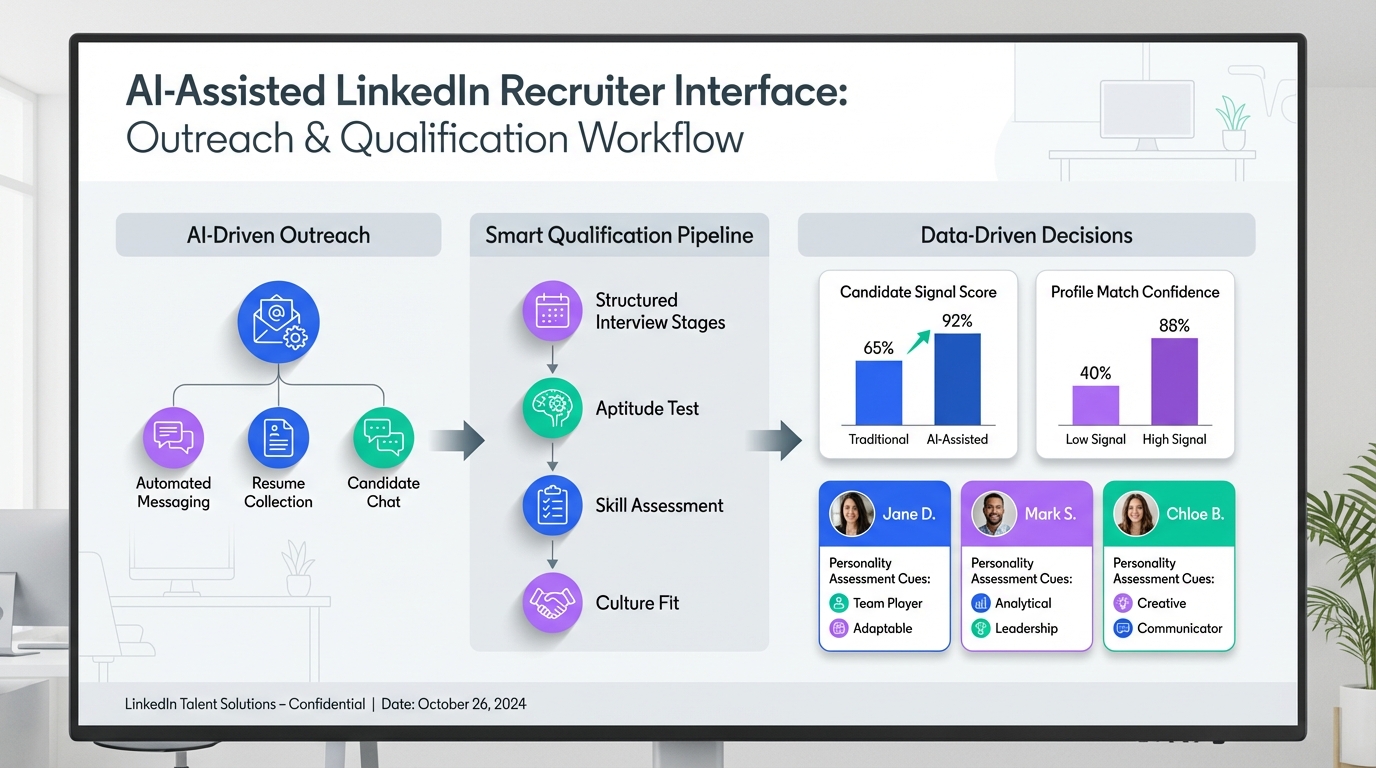
Artificial intelligence for recruiting is most useful when it strengthens, not replaces, human judgment. In our day to day recruiting work, we have found that AI adds the most value when it standardizes repetitive steps such as outreach, follow up, and basic qualification, while aptitude and personality assessments remain a small but sometimes revealing input when they are validated, consistently administered, and interpreted carefully. The practical rule is simple. Use AI in the recruitment process to improve speed and consistency, but avoid turning any single test score into a pass or fail gate, especially in tight labor markets where experienced candidates can underperform on tests due to stress or time away from school.
Table of Contents
- What aptitude testing can and cannot tell you
- Where AI fits in the recruitment process
- A practical framework: the three layers of evidence
- Method 1: Structured interviews as the backbone
- Method 2: Aptitude and personality assessments as a signal, not a gate
- Method 3: AI driven outreach and qualification on LinkedIn
- Method 4: Reference checking and work sample validation
- Quick comparison
- Implementation checklist
- FAQ
- Conclusion
What aptitude testing can and cannot tell you
Aptitude testing is any standardized assessment intended to measure a candidate’s ability in a specific domain such as math, reasoning, or job relevant problem solving. In the real world, it can be helpful for uncovering gaps that do not show up in a conversational interview. In our experience implementing pre employment assessments over many years, the value is usually in the exceptions. A test can reveal a mismatch between what a candidate claims and what they can actually do, or it can highlight a working style that matters for a specific role.
However, the same tool can backfire if it is treated as a universal filter. A stressed candidate, or someone who has been out of school for years, can score lower than a recent graduate even when the experienced candidate is the better hire. That is why we treat test results as a discussion prompt, not a final verdict.
When aptitude testing tends to help
- To confirm a critical baseline skill that the job truly requires, such as math for certain operational roles.
- To surface inconsistencies between a resume claim and demonstrated ability.
- To add structure when interviewers struggle to evaluate the same competency consistently.
When aptitude testing tends to hurt
- When used as pass or fail without considering experience, context, and job relevance.
- When administration is inconsistent across candidates, which makes comparisons unreliable.
- When the test is not validated against performance outcomes for your own workforce.
Where AI fits in the recruitment process
AI in the recruitment process is best used for high volume, repeatable tasks where consistency matters and humans burn time. That includes outreach, follow up, answering common candidate questions, and collecting resumes and contact details. This is also where artificial intelligence AI in recruitment can reduce time to first response, which is often the difference between engaging a candidate and losing them to a faster competitor.
One practical example is StrategyBrain AI Recruiter, which is designed for LinkedIn hiring workflows. It can automatically connect with candidates that match your search criteria, introduce the role, answer questions about the job, company, compensation, and benefits, confirm interview interest, and collect resumes and contact information from interested candidates. Recruiters then focus on reviewing the collected resumes and running interviews, rather than spending hours on repetitive messaging.
A practical framework: the three layers of evidence
To make assessments and AI work together, we use a simple evidence stack. It keeps the process fair, fast, and defensible.
- Conversation evidence from structured interviews and role specific questions.
- Demonstration evidence from work samples, practical tasks, or job relevant exercises.
- Signal evidence from assessments such as aptitude or personality tests, used to guide follow up questions.
AI supports all three layers by improving consistency and documentation, but it should not be the final decision maker. This is especially important for privacy, compliance, and candidate trust.
Method 1: Structured interviews as the backbone
Structured interviews mean every candidate is asked the same core questions, scored against the same rubric, and evaluated on job relevant competencies. This reduces noise and makes it easier to compare candidates fairly.
Steps
- Define 5 competencies that predict success for the role, such as safety mindset, troubleshooting, stakeholder communication, or planning.
- Write 2 questions per competency and define what a strong answer includes.
- Score immediately after the interview using a 1 to 5 scale with written notes.
- Use AI for consistency by standardizing templates for notes and follow up questions, while keeping the final evaluation human led.
Limitations
- Interviewers still need training to avoid bias and to score consistently.
- Some candidates interview well but do not perform well, which is why work samples matter.
Method 2: Aptitude and personality assessments as a signal, not a gate
If you use assessments, the key is standardization and validation. Standardization means the same instructions, timing, and scoring method for every candidate. Validation means you can explain how the assessment relates to performance in your environment, not just in theory.
Steps
- Choose what you are measuring and tie it to a job requirement, such as numerical reasoning for estimating or planning.
- Standardize administration so every candidate has the same conditions.
- Set interpretation rules that trigger follow up questions, not automatic rejection.
- Compare against top performers by building a representative internal sample over time.
What we learned the hard way
In our own hiring, a simple math test helped us identify candidates who misrepresented credentials. At the same time, we have also seen strong professionals struggle with testing conditions. That is why we avoid using a single cutoff score as the deciding factor.
Limitations
- Assessments require investment to validate and maintain.
- Over reliance can remove experienced candidates who are not strong test takers.
Method 3: AI driven outreach and qualification on LinkedIn
This is where artificial intelligence for recruiting can create immediate operational leverage. LinkedIn outreach is repetitive, time sensitive, and easy to delay when recruiters are overloaded. StrategyBrain AI Recruiter is built to handle the initial outreach and qualification loop so humans can focus on interviews and final selection.
Steps
- Provide the LinkedIn account and role details including company context, compensation, benefits, and candidate search criteria.
- Let the AI run outreach and follow up by connecting with relevant candidates and introducing the opportunity.
- Use AI for candidate Q and A so candidates get timely answers about the role and employer.
- Collect resumes and contact details from interested candidates, then review and shortlist for interviews.
Features that matter in practice
- 24/7 responsiveness so candidates in different time zones are not waiting for replies.
- Multilingual communication so candidates can interact in their native language, reducing misunderstandings.
- Scalable account management for teams that need to coordinate outreach across many LinkedIn accounts.
Limitations and boundaries
- AI Recruiter does not decide final fit because it does not determine whether a resume fully matches job requirements. Recruiters still do that final qualification step.
- Governance is required to ensure messaging stays aligned with your employer brand and compliance requirements.
Method 4: Reference checking and work sample validation
When the market is competitive and vacancies can last months, it is tempting to shorten the process. The safer shortcut is not fewer steps, but better steps. Work samples and reference checks can validate what interviews and assessments suggest.
Steps
- Use a work sample that mirrors the job, such as a troubleshooting scenario, a planning exercise, or a short writing task.
- Score with a rubric so you can compare candidates consistently.
- Run reference checks focused on the same competencies you scored in interviews.
Quick comparison
| Method | Primary purpose | Best used as | Main risk if misused |
|---|---|---|---|
| Structured interviews | Consistent evaluation | Core decision input | Inconsistent scoring without training |
| Aptitude and personality assessments | Reveal hidden signals | Follow up prompt | False negatives when used as pass or fail |
| AI outreach and qualification | Speed and scale | Front end workflow automation | Brand and compliance issues without governance |
| Work samples and references | Performance validation | Final confirmation | Weak design that does not match the job |
Implementation checklist
This checklist is the fastest way we know to combine assessments with AI in a way that is practical and defensible.
- Define job critical competencies and write a scoring rubric before you interview.
- Use assessments only when job relevant and document why each test exists.
- Standardize test administration including timing, instructions, and scoring.
- Avoid pass or fail cutoffs unless you have validated the cutoff against performance outcomes.
- Automate outreach and follow up with StrategyBrain AI Recruiter to reduce manual LinkedIn workload.
- Keep humans in the final decision and use AI outputs as decision support.
- Document privacy and data handling and ensure candidate data is protected and not used to train models.
FAQ
Is artificial intelligence for recruiting a replacement for recruiters?
No. In our experience, AI is best used to automate repetitive steps such as outreach, follow up, and basic qualification. Recruiters still own role definition, interview judgment, and final selection.
Should aptitude tests be used as pass or fail?
Only in narrow cases where the skill is truly essential and the cutoff is validated. Otherwise, we recommend using test results to guide follow up questions, because strong candidates can underperform due to stress or time away from school.
What does AI Recruiter actually automate on LinkedIn?
StrategyBrain AI Recruiter can connect with candidates that match your criteria, introduce the opportunity, answer questions about the role and compensation, confirm interview interest, and collect resumes and contact details. Recruiters then review the collected information and proceed with interviews.
Does AI Recruiter decide whether a candidate is qualified?
No. AI Recruiter identifies willingness to communicate and interview, but it does not determine whether a resume fully matches job requirements. That final qualification step remains with the recruiter.
How do you keep AI messaging from hurting the employer brand?
Use approved role information, define boundaries for what the AI can promise, and review conversation logs regularly. Consistency improves when you standardize the job facts the AI uses to answer candidate questions.
Can AI help with global hiring?
Yes. Always on messaging and multilingual communication can reduce delays and misunderstandings across time zones. This is one of the clearest operational benefits of AI in the recruitment process.
What is the biggest mistake teams make with assessments?
They deploy tests without a standardized method of administration and scoring, then treat the results as definitive. Without validation against performance outcomes, the test can remove strong candidates for the wrong reasons.
How do you validate an assessment program?
Start by comparing results against a representative sample of top performers in your company, then refine how you interpret scores. Validation is an ongoing process, not a one time setup.
Conclusion
The most reliable hiring systems combine structured human judgment with carefully designed signals. Aptitude and personality assessments can be useful, but only when they are standardized, validated, and used as one input rather than a gate. Artificial intelligence for recruiting adds the most value when it removes repetitive work and improves responsiveness, especially in LinkedIn outreach. If you want a practical starting point, keep interviews structured, treat assessments as follow up prompts, and use StrategyBrain AI Recruiter to automate the front end of candidate engagement so your team can spend more time on evaluation and closing.