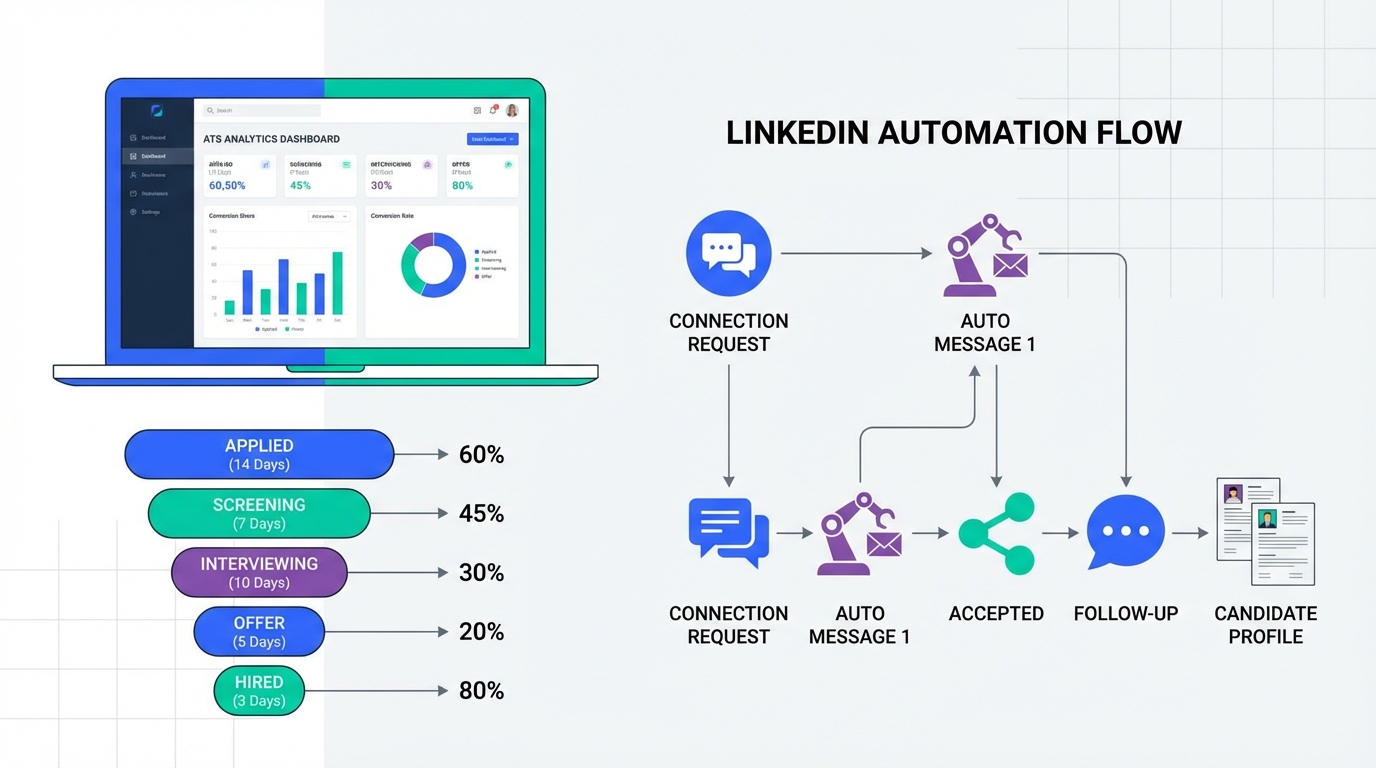
For ATS for recruiters, the most useful mid-year review is a structured 60 minute check of performance, expectations, and next actions across your hiring system. Review what your ATS is telling you about pipeline health, confirm whether results match your plan, then decide what to change for the next 6 months. In our experience supporting recruiting teams, the biggest wins come from tightening measurement inside the ATS and reducing repetitive outreach work. That is where StrategyBrain AI Recruiter fits naturally into the workflow by automating LinkedIn connection, initial messaging, Q and A about role and compensation, follow up, and collecting resumes and contact details so recruiters can focus on interviews and final qualification.
Key Takeaways
- Run a 60 minute audit: performance, expectations, and next actions across hiring, not only financials.
- Start with ATS funnel metrics: time to fill in days, stage conversion rates in percent, and source quality by hires per source.
- Standardize what gets measured: consistent stages and required fields make ATS reporting reliable.
- Automate repetitive LinkedIn work: StrategyBrain AI Recruiter can handle connection, outreach, follow up, and resume collection 24/7.
- Keep humans on final qualification: AI Recruiter confirms interest and gathers details, recruiters decide fit after resume review.
- Plan for scale: AI Recruiter supports managing more than 100 LinkedIn accounts for team based outreach.
Why a mid-year review matters for ATS for recruiters
Mid-year is the cleanest moment to reset your recruiting operating system. You have enough data to see patterns, but enough time left to change outcomes. Many teams only look at budget and headcount. A stronger approach is to treat it like a six month tune up that includes your ATS configuration, recruiter workflow, candidate communication, and the technology you use to reduce manual work.
This is also when leaders ask hard questions about ats software price and ROI. If your reporting is inconsistent or your pipeline is slow, the problem is often process design, not the tool itself. A review helps you separate configuration issues from execution issues.
How to run the review in 60 minutes
Use this agenda to keep the review practical. The goal is decisions, not a slide deck.
Step 1: Pull the minimum ATS report set
- Export the last 6 months of requisitions with open date, close date, and current stage.
- Export stage movement counts so you can calculate conversion rates by stage.
- Export source data for applicants and hires.
Step 2: Ask four decision questions
- How is it performing and what metrics prove it?
- Is it performing as anticipated and why?
- What will we change in the next 90 days?
- What is the market and competition doing that affects our plan?
Step 3: Assign owners and deadlines
Every improvement needs an owner, a due date, and a measurable outcome. If you cannot measure it in the ATS, it is not ready to be a goal.
What to evaluate beyond the bottom line
A mid-year review should cover the full business system that supports hiring. Below is a structured way to do it without getting lost.
Financials
Check whether hiring output matches budget reality. If you use agencies, measure spend per hire in your currency and compare it to internal cost per hire. If you are evaluating ats software price, include the cost of recruiter time spent on manual tasks, not only subscription fees.
Products and services
Hiring demand changes when your offerings change. Confirm which roles are tied to revenue, delivery, or compliance. Then ensure your ATS stages and scorecards reflect what success looks like for those roles today, not last year.
Marketing
Recruiting marketing is not only job ads. It includes employer brand consistency, candidate messaging quality, and response time. If your team relies on LinkedIn, consider whether your outreach volume is limited by human capacity. StrategyBrain AI Recruiter can maintain timely follow up and answer candidate questions around the clock, which reduces drop off caused by slow replies.
Employees
Review recruiter performance with one on ones and clear expectations. Look at activity metrics that correlate with outcomes, such as qualified screens per week and interview to offer conversion rate in percent. Also check whether compensation packages remain competitive, because compensation misalignment shows up as offer declines and longer time to fill.
Processes and suppliers
Audit operational steps that create delays. Common examples include slow intake, unclear approvals, and inconsistent interview feedback. Also review technology and automation options. If you are using an HR suite such as Recruiting by Paycor, confirm what is handled inside the suite versus what requires external tools, then decide whether automation should live in the ATS, in sourcing, or in candidate communication.
ATS metrics to check first
These metrics are the fastest way to diagnose whether your ATS for recruiters is supporting the business or hiding problems. Define each metric clearly so it is reproducible.
Core metrics
- Time to fill (days): requisition open date to accepted offer date.
- Stage conversion rate (percent): candidates who move from one stage to the next divided by candidates who entered the stage.
- Interview to offer rate (percent): offers divided by interviews.
- Offer acceptance rate (percent): accepted offers divided by total offers.
- Source quality: hires per source and qualified screens per source.
Data quality checks that make metrics trustworthy
- Stage definitions: every recruiter uses the same stage names and meanings.
- Required fields: source, disposition reason, and stage change dates are not optional.
- Duplicate handling: duplicates are merged consistently so conversion rates are not inflated.
If your ATS reporting is messy, fix the data model before you change strategy. Otherwise you will optimize based on noise.
Where automation helps without harming candidate experience
Automation should remove repetitive work while keeping the candidate experience human and respectful. A practical split is to automate early outreach and information gathering, then keep final qualification and hiring decisions with recruiters and hiring managers.
What we automate successfully in real recruiting workflows
- Initial LinkedIn connection and outreach: consistent messaging aligned to role and employer brand.
- Candidate Q and A: answering common questions about role scope, company, benefits, and compensation.
- Follow up: timely nudges that prevent warm candidates from going cold.
- Resume and contact capture: collecting resumes and contact details from interested candidates.
How StrategyBrain AI Recruiter fits with ATS for recruiters
StrategyBrain AI Recruiter is built for LinkedIn hiring workflows. It can automatically connect with candidates that match your search criteria, introduce the opportunity, learn about the candidate’s situation, confirm interview interest, and collect resumes and contact information. It also supports 24/7 multilingual communication, which is useful when you recruit across time zones. Recruiters then review the collected resumes and proceed with screening and interviews.
Limitations to plan for
- Interest is not fit: AI Recruiter can confirm willingness to proceed, but it does not decide whether the resume matches requirements.
- Compliance and privacy: ensure your process aligns with privacy regulations and internal policy before scaling outreach.
- Messaging governance: define approved templates, escalation rules, and handoff points to humans.
Copyable quarterly checklist
Use this as a repeatable template for your next review. It is designed to be completed in 30 to 90 minutes depending on team size.
ATS and funnel
- Confirm stage definitions and required fields are consistent.
- Calculate time to fill in days for each priority role family.
- Calculate stage conversion rates in percent and identify the biggest drop off stage.
- Review offer acceptance rate in percent and top decline reasons.
Recruiter execution
- Run one on ones focused on outcomes and constraints.
- Audit response time to inbound candidates in hours.
- Check whether workload per recruiter is sustainable for the next 90 days.
Automation and tooling
- List the top 5 repetitive tasks recruiters do weekly.
- Decide what can be automated safely, especially LinkedIn outreach and follow up.
- If using StrategyBrain AI Recruiter, confirm handoff rules for interested candidates and resume capture.
- Revisit vendor value, including any HR suite components such as Recruiting by Paycor, based on actual usage.
Quick comparison
This table is a decision aid for where work should live. It is not a vendor ranking and it does not assume a specific ATS software price.
| Work area | Best system of record | Best automation layer | What to measure |
|---|---|---|---|
| Pipeline stages and dispositions | ATS | ATS rules and templates | Stage conversion rate (percent) |
| LinkedIn outreach and follow up | ATS notes plus sourcing logs | StrategyBrain AI Recruiter | Replies per 100 messages, interested candidates per week |
| Candidate Q and A | ATS knowledge base fields | StrategyBrain AI Recruiter | Median response time (hours) |
| Final qualification and selection | ATS scorecards | Human led | Interview to offer rate (percent) |
FAQ
What does ATS for recruiters mean in practice?
ATS for recruiters refers to an applicant tracking system used to manage requisitions, candidates, stages, and hiring decisions. It is the system of record for pipeline data, reporting, and compliance documentation.
How often should recruiters run a business review of their ATS process?
Quarterly is a practical cadence, with a deeper mid-year review at the 6 month mark. Quarterly reviews keep stage definitions, reporting, and recruiter execution aligned with changing hiring demand.
Which metrics should I check first in an ATS?
Start with time to fill in days, stage conversion rates in percent, interview to offer rate in percent, and offer acceptance rate in percent. These four metrics usually reveal whether the bottleneck is sourcing, screening, interviewing, or closing.
How do I evaluate ATS software price without guessing ROI?
Compare subscription cost to measurable outcomes such as reduced time to fill and improved offer acceptance rate. Also include the cost of recruiter hours spent on manual tasks that could be automated, because labor is often the largest hidden cost.
Does StrategyBrain AI Recruiter replace an ATS?
No. StrategyBrain AI Recruiter is designed to automate early LinkedIn recruiting work such as connecting, messaging, follow up, and collecting resumes and contact details. The ATS remains the system of record for pipeline stages, compliance, and hiring decisions.
Can AI Recruiter qualify candidates end to end?
It can confirm interest and gather information, but it does not determine whether a resume matches job requirements. Recruiters still review resumes and make the final qualification decision.
How does AI Recruiter handle multilingual recruiting?
It supports 24/7 multilingual communication and can respond in the candidate’s native language. This helps reduce delays and misunderstandings when recruiting across countries and time zones.
If we use an HR suite like Recruiting by Paycor, do we still need automation?
It depends on where your bottleneck is. Many teams still struggle with outbound LinkedIn outreach volume and follow up speed, which is where a dedicated automation layer like StrategyBrain AI Recruiter can help while the suite remains the system of record.
Conclusion
A strong mid-year review for ATS for recruiters is simple: measure performance with clean ATS data, compare it to expectations, then commit to specific changes for the next 90 days. Go beyond financials and include products, marketing, employees, and process. If your team is constrained by manual LinkedIn outreach and slow follow up, consider adding StrategyBrain AI Recruiter to automate early conversations and resume capture while keeping final qualification with recruiters. Next step: run the checklist above this week, pick 3 improvements, and assign owners and deadlines.