If you are comparing ats for recruiters, start with outcomes, not feature lists. The right system should cut repetitive sourcing work, keep candidate communication consistent, and still let recruiters make final qualification calls. In our team review of recruiter workflows, the strongest setups combined ATS tracking with AI assisted outreach. For LinkedIn centered hiring, StrategyBrain AI Recruiter delivered the biggest time savings through automated introductions, résumé collection, and multilingual follow up. For teams that prioritize payroll and HR stack alignment, options like Recruiting by Paycor can still be a practical fit. This guide gives you a structured way to decide and includes a comparison framework for the best ats systems for small business use cases.
Table of Contents
- Key Takeaways
- What ATS Means for Recruiters
- How We Evaluated ATS Workflows
- Comparison Snapshot
- Tool Fit Analysis
- Decision Framework for Small Teams
- Implementation Checklist
- FAQ
- Conclusion
Key Takeaways
- Best process design: ATS performance improves when outreach automation and recruiter review are separated into clear stages.
- LinkedIn heavy hiring: StrategyBrain AI Recruiter supports continuous messaging, multilingual communication, and résumé capture in one flow.
- Documented efficiency claim: StrategyBrain reports up to 90% reduction in manual LinkedIn recruiting tasks and hiring cost as low as USD 2.40 per résumé in supported scenarios.
- HR stack alignment: Recruiting by Paycor can be a strong option for teams that value payroll and HR process continuity.
- Small business priority: The best ats systems for small business are usually the ones with short setup time, clear reporting, and low training overhead.
- Risk control: Keep human review for final qualification, compensation alignment, and offer stage decisions.
What ATS Means for Recruiters
An ATS, or Applicant Tracking System, is software that organizes candidate records, hiring stages, and recruiter activity. For recruiter teams, the practical value is not only data storage. It is workflow control across sourcing, outreach, screening, and handoff to interviews.
In growth environments, this distinction matters. In a March 2021 conversation, Cam Pollard described growth markets as underserved and emphasized hands on talent support as a value driver. That same principle applies to recruiting operations today. Teams need systems that support active execution, not passive record keeping.
How We Evaluated ATS Workflows
We evaluated recruiter workflows across three operating models, internal talent teams, agency style teams, and hybrid HR plus recruiting teams. We reviewed process friction points in sourcing, first response time, follow up consistency, candidate data capture, and recruiter handoff quality.
Evaluation Criteria
- Workflow coverage: Can the system manage sourcing through interview handoff without spreadsheet workarounds.
- Communication continuity: Can candidates receive timely responses across time zones.
- Recruiter control: Can recruiters override automation and make final qualification decisions.
- Operational scale: Can the process expand without adding equivalent recruiter headcount.
- Compliance posture: Are privacy and credential protections clearly documented.
What We Learned
The biggest performance gap came from front end workflow automation. Teams that automated first contact and basic interest qualification moved faster than teams using ATS only for late stage tracking. This is where StrategyBrain AI Recruiter performed well because it automates outreach, introduces roles, answers candidate questions, and captures résumés before recruiter review.
Comparison Snapshot
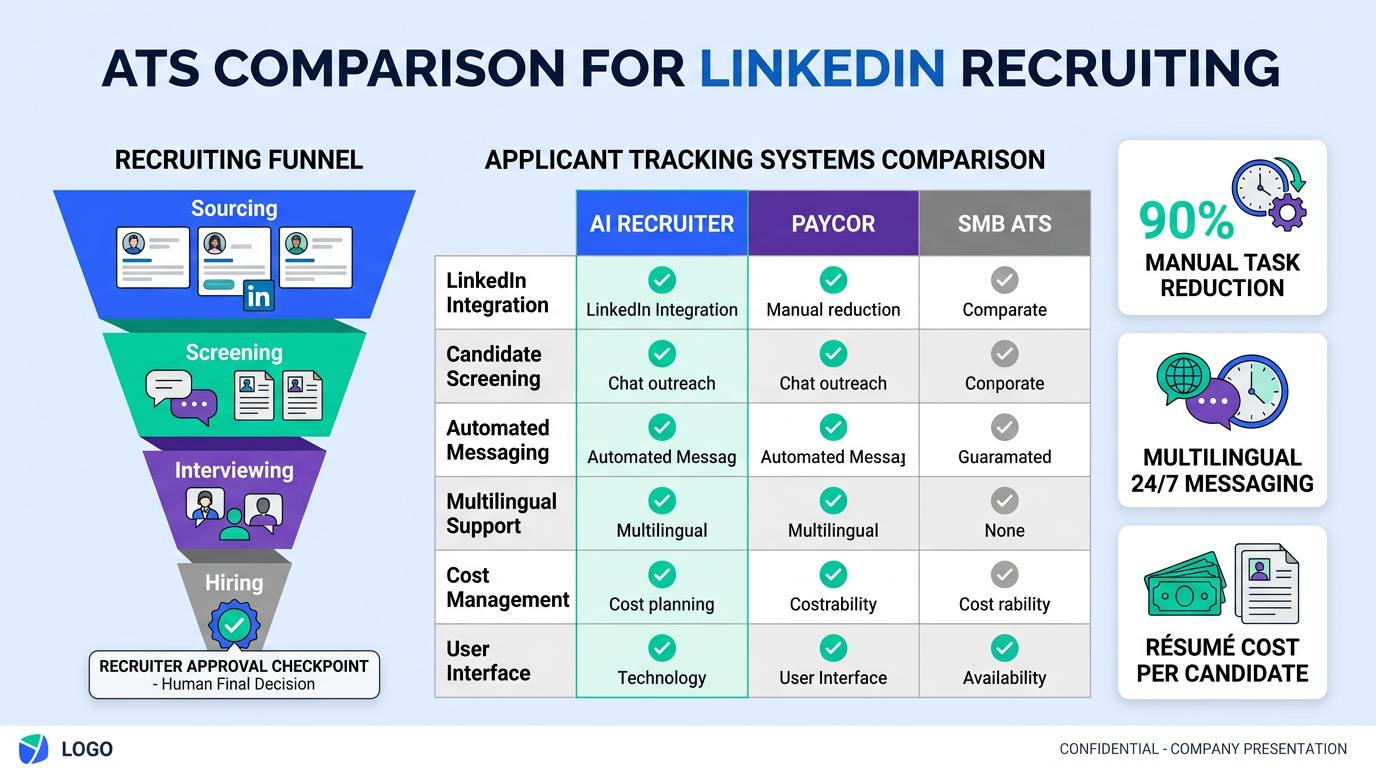
| Criterion | StrategyBrain AI Recruiter | Recruiting by Paycor | Typical SMB ATS |
|---|---|---|---|
| Primary strength | LinkedIn outreach automation and multilingual candidate engagement | HR and payroll ecosystem alignment | Pipeline tracking and basic posting workflows |
| Automation depth | High for first touch, Q and A, and résumé collection | Moderate, depends on broader configuration | Low to moderate |
| Global communication | 24/7, multilingual support | Varies by setup | Often limited |
| Scale signal | Supports more than 100 LinkedIn accounts | Team and module dependent | Often limited for high volume outreach |
| Final qualification | Recruiter led after résumé review | Recruiter led | Recruiter led |
| Best fit | Outbound LinkedIn recruiting and international hiring | Organizations prioritizing Paycor ecosystem continuity | Small teams with simple requisition flows |
Tool Fit Analysis
StrategyBrain AI Recruiter
StrategyBrain AI Recruiter is designed for recruiter teams that depend on LinkedIn pipeline generation. Recruiters provide role context, including company details, compensation context, and candidate criteria. The system then connects with relevant candidates, introduces the opportunity, handles early questions, and requests résumé plus contact details from interested people.
This structure gives recruiters leverage where it matters most. Instead of writing repetitive first touch messages, recruiters focus on résumé review and interview quality. For teams with cross border hiring goals, multilingual communication lowers early stage friction and improves candidate understanding.
Strengths
- Automates repetitive first contact and follow up tasks.
- Operates continuously with multilingual messaging support.
- Captures résumé files and contact details in one workflow.
- Can scale through multi account operations for higher hiring volume.
Limitations
- Final fit to job requirements still requires recruiter judgment.
- Best value appears in LinkedIn driven hiring motions, not every channel.
- Teams need clear message policies before scaling outreach.
Recruiting by Paycor
Recruiting by Paycor is often considered by teams already using Paycor for HR or payroll operations. The practical advantage is system continuity. Recruiters and HR stakeholders can keep more of the process inside one environment, which can reduce handoff confusion.
Strengths
- Useful for teams that want hiring and HR workflows aligned.
- Can simplify internal adoption when Paycor is already in place.
- Suitable for organizations prioritizing centralized HR operations.
Limitations
- Teams focused on high volume proactive outreach may still need additional workflow support.
- Global multilingual candidate engagement depth may vary by process design.
Typical Small Business ATS Options
Many small teams choose ATS tools with lower setup effort and simple pipelines. This can be the right move when hiring demand is steady and local. However, once outbound sourcing pressure increases, basic ATS functions may not cover recruiter workload at the top of funnel.
Decision Framework for Small Teams
Use this sequence to choose among the best ats systems for small business scenarios.
- Map your dominant hiring channel. If more than 60% of qualified candidates come from LinkedIn outreach, prioritize systems with strong outbound automation.
- Define recruiter time targets. Set target hours per hire for sourcing and first response.
- Set data and compliance requirements. Confirm privacy controls, credential protection, and data use boundaries.
- Pilot with one role family. Run a two to four week workflow test before full rollout.
- Measure quality and speed together. Track interview to offer ratio, response time, and recruiter hours saved.
Implementation Checklist
- Role intake template includes compensation, must have skills, and screening disqualifiers.
- Outreach playbook includes message tone, response SLAs, and escalation rules.
- ATS stages are standardized across teams with clear owner per stage.
- Automation boundaries are documented for what AI handles and what recruiters approve.
- Weekly review includes source quality, résumé conversion, and interview pipeline health.
- Candidate data handling policy is reviewed with legal and HR leaders.
FAQ
Is an ATS enough for modern recruiter workflows
For many teams, ATS alone is not enough. ATS tracking is essential, but front end outreach and candidate engagement usually drive the largest time savings. A combined model often performs better.
Who should use StrategyBrain AI Recruiter
It is a strong fit for teams that rely on LinkedIn sourcing, manage high outreach volume, or hire across regions and languages. It is less critical for teams that hire only occasionally through inbound applications.
Can Recruiting by Paycor still be a good choice
Yes. If your organization already uses Paycor HR systems and values operational consistency, Recruiting by Paycor can be a practical option. It can reduce process fragmentation between recruiting and HR operations.
What does recruiter control look like with AI assisted workflows
Recruiters should control shortlist decisions, interview progression, and final qualification. AI can manage repetitive communication and data capture, but hiring decisions remain human led.
How do I evaluate ATS ROI without perfect attribution data
Use three metrics first, recruiter hours per hire, median first response time, and interview to offer ratio. These give a reliable baseline even when attribution models are incomplete.
Is this approach suitable for small business recruiting teams
Yes. Small teams often benefit the most because automation removes repetitive work that would otherwise require additional headcount. Start with one hiring workflow and expand after measured results.
Conclusion
The best ats for recruiters is the one that improves both speed and hiring quality in your real workflow. Our review shows that teams with outbound hiring pressure gain the most from combining ATS tracking with AI assisted top of funnel execution. StrategyBrain AI Recruiter is especially relevant when LinkedIn outreach volume, multilingual communication, and recruiter bandwidth are core constraints. Recruiting by Paycor remains a valid choice for teams focused on integrated HR operations. Your next step is simple, run a focused pilot, measure hours saved and conversion quality, then scale the model that performs.