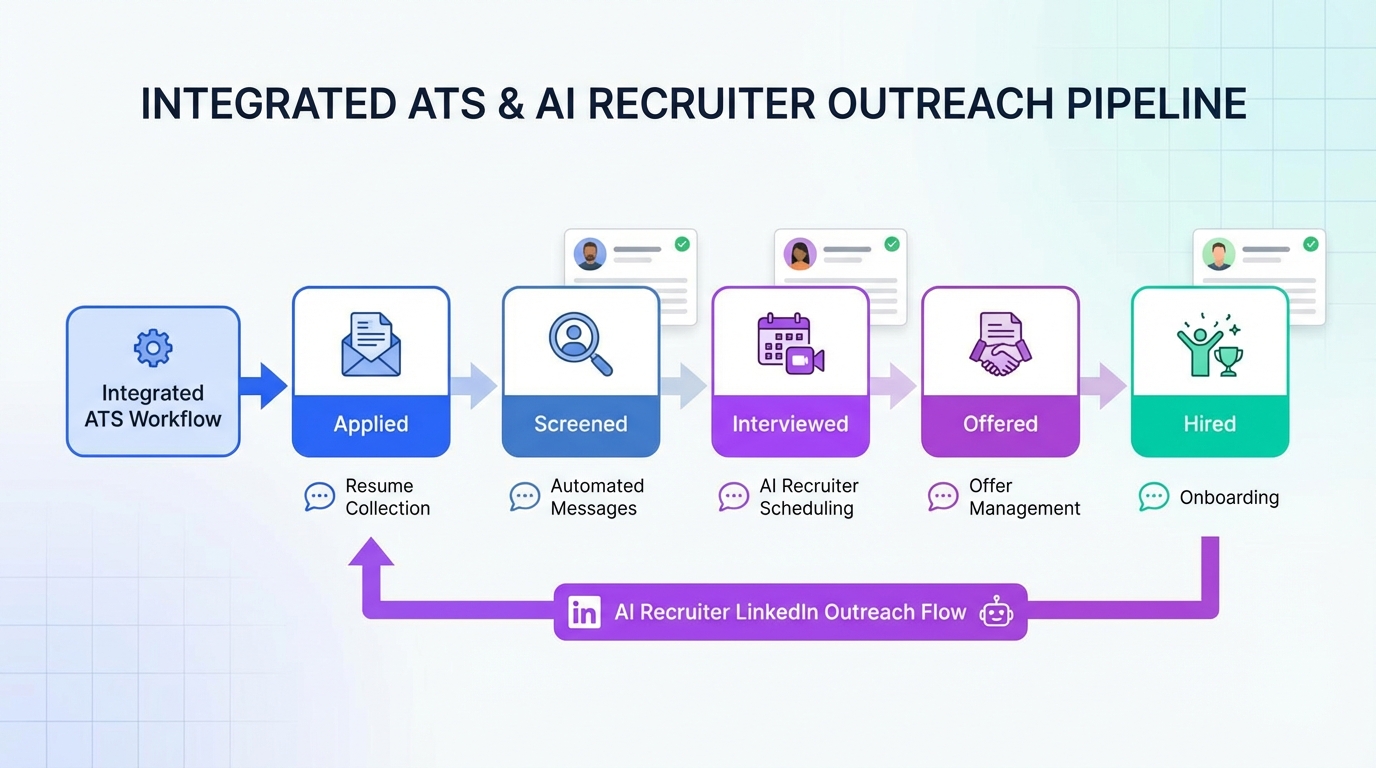
ATS for recruiters is the day to day use of an Applicant Tracking System, which is software that stores candidate applications, organizes pipeline stages, and documents decisions so hiring stays consistent and auditable. If you are asking what does ATS stand for, it stands for Applicant Tracking System. This guide explains how ATS hiring works in a modern workflow, what recruiters should optimize first, and how to pair an ATS with StrategyBrain AI Recruiter when your biggest constraint is LinkedIn outreach, candidate Q and A, follow up, and collecting resumes and contact details.
Table of Contents
Key Takeaways
- ATS for recruiters means running a standardized pipeline for applications, interviews, and decisions inside an Applicant Tracking System.
- ATS hiring is strongest for inbound applicants and compliance documentation, but it does not automatically solve outbound sourcing and follow up.
- StrategyBrain AI Recruiter automates LinkedIn connecting, role introduction, candidate Q and A, interest confirmation, and collecting resumes and contact details.
- 24/7 multilingual messaging helps reduce response delays across time zones and supports global hiring without adding recruiter headcount.
- Scale option: AI Recruiter can manage more than 100 LinkedIn accounts for teams that need high volume outreach capacity.
- Practical mindset: the Olympian style habits in this guide map to recruiter execution, especially consistency, feedback loops, and resilience.
What is ATS for recruiters
An Applicant Tracking System is a system of record for recruiting. It typically includes job requisitions, candidate profiles, resume storage, interview scheduling support, evaluation notes, and reporting. Recruiters use it to keep hiring structured, reduce manual coordination, and create a clear audit trail for decisions.
In recruiter terms, an ATS is not just a database. It is a workflow engine. It defines stages such as applied, screened, interviewed, offered, and hired, and it helps teams move candidates through those stages with consistent criteria.
What an ATS usually does well
- Centralizes candidate data so resumes, notes, and communications are not scattered across inboxes and spreadsheets.
- Standardizes pipeline stages so hiring managers and recruiters share the same definitions of progress.
- Supports compliance documentation by keeping records of decisions and communications.
What an ATS often does not solve by itself
- Outbound sourcing throughput, especially when you need high volume LinkedIn outreach and follow up.
- Real time candidate engagement when candidates ask detailed questions about role, company, benefits, and compensation.
- Time zone coverage if your team is not available to respond quickly.
How ATS hiring works end to end
Below is a practical ATS hiring flow that we see work across corporate recruiting and agency recruiting. The key is to keep each step measurable and to define what “done” means before moving to the next stage.
Step by step ATS workflow
- Intake and role definition: confirm must have skills, nice to have skills, compensation range, location rules, and interview plan.
- Job posting and inbound capture: publish the role and ensure every applicant lands in the ATS with a complete profile.
- Resume parsing and screening: use structured fields for skills and experience, then apply consistent screening questions.
- Shortlist and scheduling: move qualified candidates to a shortlist stage and schedule interviews with clear evaluation criteria.
- Interview feedback and decision: collect feedback in the ATS so decisions are documented and comparable.
- Offer and close: track offer status, acceptance, and start date, then close the requisition with final reporting.
Common failure points recruiters should watch
- Stage inflation: too many pipeline stages that do not change decisions, which slows down ATS hiring.
- Unclear screening criteria: recruiters and hiring managers interpret “qualified” differently, which creates rework.
- Slow candidate response loops: candidates drop when questions are not answered quickly, especially in competitive markets.
Recruiter playbook: 9 lessons inspired by Olympians
Olympic athletes are a useful metaphor for recruiting because both require repetition, resilience, and continuous improvement. The original “lessons from Olympians” framing was written for job seekers, but the same principles translate cleanly to recruiters running ATS hiring workflows and outbound sourcing.
1. Do not give up
Recruiting can be exhausting when roles stay open, candidates ghost, or hiring managers change requirements. The recruiter version of “do not give up” is to keep your pipeline moving every day, even after a rejection or a no show.
2. Find your passion
For job seekers, passion means choosing roles aligned with values. For recruiters, passion shows up as specialization. When you focus on a domain such as engineering, finance, or operations, your screening improves and your ATS notes become more predictive.
3. Set goals
Olympians break a big goal into milestones. Recruiters should do the same with ATS hiring. For example, define weekly targets for qualified screens completed, interviews scheduled, and offers progressed, then review the numbers in your ATS reporting.
4. Take pride in what you do
Job seekers are advised to dress well and proof applications. Recruiters should mirror that professionalism by keeping clean candidate records, writing clear outreach messages, and ensuring every stage change in the ATS has a reason.
5. Find a coach or mentor
Olympians credit coaches. Recruiters benefit from peer review too. Ask a senior recruiter to audit your screening rubric, your ATS stage definitions, and your candidate messaging templates.
6. You are not always going to win and that is ok
Not every search closes, and not every candidate accepts. A mature ATS hiring process treats losses as data. Track why candidates decline and why hiring managers reject, then adjust your intake and outreach.
7. Learn from every attempt
After each screen and interview loop, capture what worked and what did not in the ATS. Small improvements compound, especially when you hire for similar roles repeatedly.
8. Be confident
Confidence matters in candidate conversations. When candidates ask about compensation, benefits, or role scope, fast and clear answers build trust. This is also where automation can help, because delays often look like uncertainty.
9. Hard work is rewarded
Olympians train for results. Recruiters who consistently execute the basics, clean ATS data, disciplined follow up, and structured evaluation, usually outperform recruiters who rely on bursts of activity.
Where StrategyBrain AI Recruiter fits with an ATS
Many teams already have an ATS for recruiters, but still struggle with outbound sourcing and candidate engagement on LinkedIn. StrategyBrain AI Recruiter is designed for that gap. It automates the initial outreach and qualification conversation on LinkedIn, then hands interested candidates back to the recruiter with resumes and contact details collected.
What AI Recruiter automates on LinkedIn
- Automatic candidate connections based on your search criteria.
- Role introduction that explains the opportunity and checks fit at a high level.
- Candidate Q and A about the role, company, compensation, and benefits using the information you provide.
- Interest confirmation to identify who wants to proceed.
- Resume and contact collection for candidates who opt in to move forward.
How it changes the recruiter workflow
In a classic ATS hiring flow, recruiters spend a large share of time on repetitive messaging and follow up. With AI Recruiter handling the first touch and the back and forth, recruiters can focus on higher judgment work such as role intake, shortlist quality, interview calibration, and closing.
Scope boundaries and honest limitations
AI Recruiter can identify willingness to communicate or interview, but it does not decide whether a resume fully matches the job requirements. Recruiters still do the final qualification after reviewing the resume and notes.
Security and privacy posture to know
- Data usage: customer provided data is not used to train AI models.
- Credential handling: LinkedIn account credentials are encrypted and stored independently per user with explicit authorization.
- Compliance: the product states compliance with privacy regulations in the EU, United States, and Canada.
Quick comparison: ATS vs AI Recruiter vs both
| Need | ATS for recruiters | StrategyBrain AI Recruiter | Best setup |
|---|---|---|---|
| Track applicants and pipeline stages | Yes | No, not the primary purpose | ATS |
| Automate LinkedIn outreach and follow up | Not typically | Yes | Both |
| Answer candidate questions 24/7 in multiple languages | Not typically | Yes, multilingual support | Both |
| Collect resumes and contact details from interested candidates | Yes for inbound applicants | Yes for LinkedIn conversations | Both |
| Scale outreach across many LinkedIn accounts | No | Yes, supports more than 100 accounts | AI Recruiter plus ATS |
Implementation checklist
This is a copy ready checklist you can use to tighten your ATS hiring workflow and decide where automation belongs.
ATS workflow checklist
- Define pipeline stages with entry and exit criteria for each stage.
- Standardize screening questions and scorecards for the role family.
- Require a reason code for every rejection and every stage change.
- Set a response time target for candidate messages and stick to it.
- Review weekly ATS reports for bottlenecks and drop off points.
LinkedIn automation checklist with StrategyBrain AI Recruiter
- Provide role details including company context, compensation, and benefits so the AI can answer questions accurately.
- Define candidate search criteria clearly before launching outreach.
- Decide what counts as “interested” and what information must be collected before handoff.
- Set a handoff routine so resumes and contact details are reviewed daily by a recruiter.
- Document your privacy and consent language for resume and contact collection.
FAQ
What does ATS stand for in recruiting?
ATS stands for Applicant Tracking System. It is software recruiters use to manage applications, candidate records, and hiring pipeline stages.
Is ATS hiring only for large companies?
No. Small teams use ATS hiring to stay organized and consistent, especially when multiple stakeholders review candidates. The difference is usually how many integrations and reporting features they need.
Does an ATS automatically screen out candidates?
Some ATS platforms support screening questions and filters, but the system itself is mainly a workflow and record keeping tool. Recruiters still need clear criteria and structured evaluation to avoid inconsistent decisions.
What is the biggest mistake recruiters make with an ATS?
The most common mistake is treating the ATS like a storage bin instead of a process. When stage definitions are unclear and notes are inconsistent, reporting becomes unreliable and hiring slows down.
Where does StrategyBrain AI Recruiter fit if we already have an ATS?
StrategyBrain AI Recruiter fits upstream of the ATS when your bottleneck is LinkedIn outreach, follow up, and early qualification conversations. It can connect with candidates, introduce the role, answer questions, confirm interest, and collect resumes and contact details for recruiter review.
Can AI Recruiter replace recruiters?
No. AI Recruiter automates repetitive LinkedIn tasks and identifies willingness to proceed, but it does not determine full job fit from the resume. Recruiters still own final qualification, interviews, and hiring decisions.
How does AI Recruiter handle resumes and contact details?
When a candidate is interested, AI Recruiter requests a resume and contact information. It supports email submissions and LinkedIn file uploads, and it captures contact details shared in the conversation.
Is candidate data used to train AI models?
According to the product information provided, candidate and customer data is not used to train AI models. Data is used only to personalize communication for the customer’s AI instance.
How do I decide whether to improve my ATS process or add LinkedIn automation?
If you have many inbound applicants but poor pipeline visibility, start with ATS process improvements. If you have too few qualified conversations because outreach and follow up are slow, LinkedIn automation such as StrategyBrain AI Recruiter is usually the faster lever.
Conclusion
ATS for recruiters is fundamentally about running a consistent, documented hiring workflow inside an Applicant Tracking System. That structure is essential for ATS hiring, but it does not automatically fix outbound sourcing, candidate engagement, or follow up speed. If LinkedIn outreach is where your process breaks down, StrategyBrain AI Recruiter can automate connecting, role introduction, candidate Q and A, interest confirmation, and resume and contact collection, so recruiters can focus on final qualification and closing. Next step: audit your ATS stages this week, then decide whether your biggest constraint is pipeline clarity or candidate engagement speed on LinkedIn.