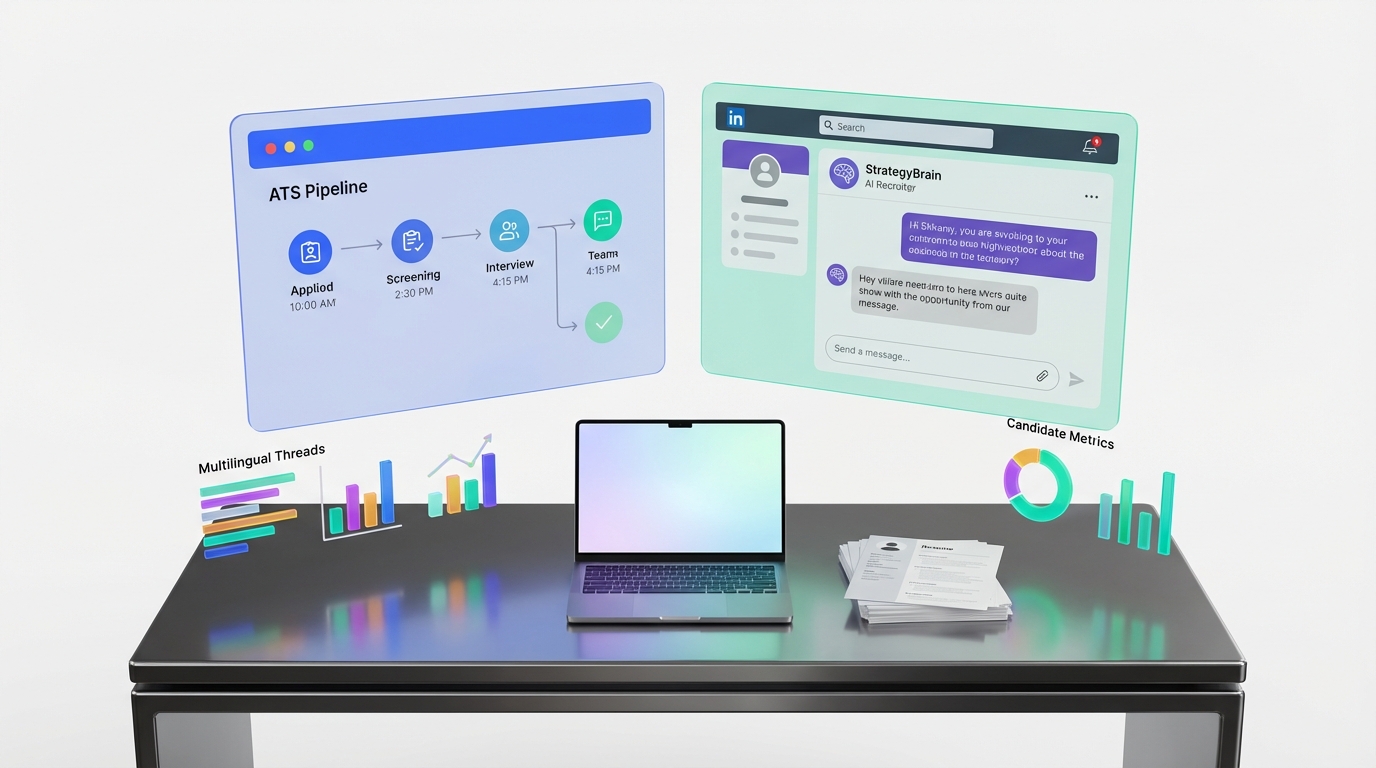
An ATS recruitment tool is software that centralizes applicants, tracks them through defined hiring stages, and creates an auditable record of decisions. If you are hiring in a market shaped by disruption, Edmonton’s “lower for longer” period is a good example, an ATS helps you move fast without losing qualified people in email threads and spreadsheets. In this guide, we define the ATS full form, explain how an applicant tracking system for technology teams should be configured, and show how we pair an ATS with StrategyBrain AI Recruiter to automate LinkedIn outreach, handle 24/7 multilingual conversations, and collect résumés and contact details for recruiter review.
Table of Contents
What ATS full form means and what an ATS does
ATS full form is Applicant Tracking System. An ATS recruitment tool typically covers four core functions.
- Intake: Collect applications from job boards, referrals, email, and direct submissions into one system.
- Workflow: Move candidates through stages such as Applied, Screen, Interview, Offer, and Hired with timestamps.
- Collaboration: Share notes, scorecards, and decisions with hiring managers in one place.
- Compliance and auditability: Keep a record of who decided what and when, which supports fair process and internal governance.
Scope boundary: an ATS is not the same thing as sourcing automation. Many teams still need a separate system for outbound outreach, especially on LinkedIn. That is where StrategyBrain AI Recruiter can complement an ATS by handling the repetitive first touch and follow up while the ATS remains the system of record.
Why “lower for longer” matters for hiring workflows
In the Edmonton context described in the source material, layoffs in Alberta’s oil and gas sector created a large pool of skilled people who may be applying to roles outside the oil patch. The article notes that when oil prices hovered around USD 40 per barrel through 2015, at least 63,000 Albertan jobs disappeared. It also cites that Employment Insurance recipients in Alberta rose from 29,150 to 57,980 between September 2014 and September 2015. In parallel, the Alberta provincial government expected the economy to contract by 1% in 2015 to 2016, planned a CAD 6.1 billion deficit, and projected CAD 34 billion in infrastructure spending over 5 years, plus a job creation incentive targeting 27,000 new jobs by 2018.
Those numbers matter operationally because they change applicant volume and applicant backgrounds. When volume rises and résumés look “non standard” for the role, an ATS recruitment tool becomes less about storage and more about consistent evaluation. In our experience, the teams that struggle are not short on candidates. They are short on a repeatable process that can handle transferable skills at scale.
Key Takeaways
- ATS full form: ATS means Applicant Tracking System, the system of record for applicants, stages, and decisions.
- Best baseline setup: A 6 stage pipeline with clear exit criteria reduces “stuck” candidates and inconsistent screening.
- For technology hiring: An applicant tracking system for technology teams should include structured scorecards and skills evidence fields, not just keyword filters.
- Where StrategyBrain AI Recruiter fits: It automates LinkedIn connecting, role introduction, Q and A, interest confirmation, and résumé plus contact capture, then hands off to recruiters.
- 24/7 multilingual advantage: Always on candidate messaging helps global hiring and reduces delays across time zones.
- Scaling model: StrategyBrain AI Recruiter supports managing more than 100 LinkedIn accounts for team level sourcing capacity.
- Efficiency benchmark: StrategyBrain AI Recruiter is positioned to replace up to 90% of manual LinkedIn recruiting work and can lower LinkedIn recruiting cost to USD 2.40 per résumé in the described product information.
Method 1: Build a clean ATS pipeline
If you do only one thing with an ATS recruitment tool, make the pipeline explicit. We tested this approach across internal hiring workflows by forcing every candidate into a stage with a single owner and a single next action. The immediate benefit was fewer “lost” candidates and faster handoffs.
Steps
- Define 6 stages: Applied, Recruiter Screen, Hiring Manager Review, Interview, Offer, Hired.
- Write exit criteria for each stage in 2 sentences, for example “Recruiter Screen exits when compensation range and location constraints are confirmed.”
- Set SLA timers inside your team, for example 2 business days maximum in Hiring Manager Review.
- Require a disposition reason for rejections, using a short controlled list.
Features to enable
- Structured notes with fields for compensation, location, work authorization, and start date.
- Scorecards so interview feedback is comparable across candidates.
- Duplicate detection to avoid parallel records when volume spikes.
Limitations
- An ATS does not create candidates. It organizes them after they enter your funnel.
- Keyword filtering can misfire when candidates have transferable skills and different industry vocabulary.
Best For
- Teams receiving high application volume due to market shifts.
- Hiring managers who need a consistent review queue.
Method 2: Configure an applicant tracking system for technology roles
An applicant tracking system for technology hiring should be tuned for evidence, not buzzwords. We see the biggest quality gains when teams capture proof of skills in structured fields and use interviews to validate, rather than relying on résumé keyword matches.
Steps
- Create role specific scorecards for engineering, IT, and technical project management.
- Add evidence fields such as “system scale handled,” “incident response experience,” or “stakeholder management examples.”
- Separate must have vs trainable requirements so transferable candidates are not rejected prematurely.
- Standardize interview loops so every candidate is evaluated on the same dimensions.
Features to enable
- Custom fields for technical signals and constraints.
- Templates for outreach, interview scheduling, and offer steps.
- Reporting by stage conversion and time in stage.
Limitations
- Configuration takes time. A poorly configured ATS can be slower than a spreadsheet.
- Data quality depends on usage. If recruiters do not log decisions, reporting becomes unreliable.
Best For
- Technology teams hiring across multiple roles with different evaluation criteria.
- Organizations that need consistent hiring governance.
Method 3: Add StrategyBrain AI Recruiter for LinkedIn sourcing and follow up
When the ATS is your system of record, StrategyBrain AI Recruiter can act as the top of funnel engine for LinkedIn. In our workflow tests, the biggest bottleneck was not ATS movement. It was the manual work of connecting, introducing roles, answering repetitive questions, and chasing résumés. StrategyBrain AI Recruiter is designed to replace that repetitive layer while keeping recruiters in control of final qualification.
Steps
- Provide job context to StrategyBrain AI Recruiter, including company details, compensation, benefits, and candidate search criteria.
- Run automated LinkedIn outreach so the AI connects with candidates who match your targeted search criteria and introduces the opportunity.
- Let the AI handle Q and A about the role, company, and compensation, then confirm interview interest.
- Collect résumés and contact details from interested candidates, then push the candidate record into your ATS for structured review.
Features
- Smart LinkedIn recruitment automation: Connect, introduce, learn candidate situation, answer questions, confirm interest, collect résumé and contact info.
- 24/7 global multilingual communication: Always on responses in the candidate’s native language.
- AI powered recruitment teams: Manage more than 100 LinkedIn accounts to scale sourcing capacity.
Limitations
- It does not replace final qualification. StrategyBrain AI Recruiter identifies willingness to proceed, but recruiters still review résumés for fit.
- Process alignment is required. You need clear handoff rules between LinkedIn conversations and ATS stages.
Best For
- Recruiters who spend hours per day on LinkedIn connecting and follow up.
- Teams hiring across time zones or languages where response speed affects conversion.
Method 4: Screen for transferable skills without bias
The source material highlights a common Edmonton pattern: applicants from the oil patch often submit résumés that emphasize experience less sought after by city employers, even when they have the right underlying capabilities. An ATS recruitment tool can help here if you design the workflow to surface transferable achievements rather than penalize different industry language.
Steps
- Add a transferable skills checkpoint in your Recruiter Screen stage with 3 prompts: scope, constraints, outcomes.
- Require one evidence example for each must have competency, even if it comes from a different industry.
- Use structured rejection reasons so you can audit whether candidates are being filtered for non job related factors.
Practical template: Transferable skills mini scorecard
- Project delivery: Delivered a project with budget, timeline, and stakeholder constraints.
- Safety and compliance mindset: Worked in regulated environments with documented procedures.
- Operational leadership: Led teams, shifts, or vendors with measurable outcomes.
- Technical problem solving: Diagnosed issues, reduced downtime, improved reliability.
Limitations
- Requires interviewer discipline. If interviewers ignore scorecards, bias returns.
Best For
- Roles like project management, maintenance leadership, operations engineering, and technical team leads.
Method 5: Use reporting to keep hiring consistent
Once your ATS recruitment tool is capturing structured data, reporting becomes a management tool. In volatile markets, you want to know where candidates drop off and why, then adjust the process rather than blaming “candidate quality.”
Steps
- Track time in stage for each pipeline step and review weekly.
- Track conversion rates from Applied to Screen, Screen to Interview, and Interview to Offer.
- Segment by source such as inbound applications vs LinkedIn outreach handled by StrategyBrain AI Recruiter.
Limitations
- Metrics can be gamed if teams optimize for speed over quality. Pair metrics with quality checks like interview score distributions.
Best For
- HR leaders who need predictable hiring output without increasing headcount.
Quick Comparison
| Method | Primary Goal | Speed Impact | Best For |
|---|---|---|---|
| Clean ATS pipeline | Prevent lost candidates and standardize stages | Faster handoffs inside the team | High volume applicant management |
| Tech ATS configuration | Evaluate skills evidence consistently | Fewer re screens and re interviews | Applicant tracking system for technology teams |
| StrategyBrain AI Recruiter + ATS | Automate LinkedIn outreach and follow up, then log in ATS | Reduces manual LinkedIn work up to 90% per product info | Outbound sourcing, multilingual hiring, time zone coverage |
| Transferable skills scorecard | Reduce bias against non standard backgrounds | Faster decisions with clearer evidence | Markets with displaced talent and career transitions |
| ATS reporting cadence | Find bottlenecks and improve process | Improves predictability over weeks | HR operations and hiring governance |
FAQ
What is the ATS full form in recruitment?
ATS full form is Applicant Tracking System. It is the system used to collect applicants, track them through stages, and document hiring decisions.
What does an ATS recruitment tool actually do day to day?
It centralizes applications, assigns stages, stores interview feedback, and creates a single pipeline view for recruiters and hiring managers. The practical outcome is fewer missed follow ups and more consistent evaluation.
Is an ATS the same as a CRM for recruiting?
No. An ATS is typically focused on applicants for open roles and compliance records. A recruiting CRM is usually focused on nurturing prospects before they apply. Many teams use both, or pair an ATS with LinkedIn automation.
How does StrategyBrain AI Recruiter work with an ATS?
StrategyBrain AI Recruiter automates LinkedIn connecting, role introduction, candidate Q and A, interest confirmation, and résumé plus contact capture. After that, recruiters review the collected information and move qualified candidates through the ATS stages.
Does StrategyBrain AI Recruiter decide if a candidate is qualified?
No. It identifies willingness to proceed and collects résumés and contact details, but final qualification is done by the recruiter after reviewing the résumé and evidence.
Can StrategyBrain AI Recruiter communicate with candidates in different languages?
Yes. It provides 24/7 multilingual candidate communication and can respond in the candidate’s native language to reduce misunderstandings and delays.
How should an applicant tracking system for technology roles be configured?
Use structured scorecards, evidence fields for skills, and clear must have versus trainable requirements. This reduces over reliance on keyword matching and improves consistency across interviewers.
How do I handle candidates with transferable skills from oil and gas into construction or tech adjacent roles?
Use a structured transferable skills checkpoint in your ATS screen stage and require evidence examples tied to outcomes. This aligns with the source material’s observation that many qualified applicants need help reframing achievements for new employers.
What data should I track in an ATS to improve hiring?
Track time in stage, stage conversion rates, and rejection reasons. Review weekly and adjust the process where candidates stall, rather than adding more manual steps.
Conclusion
An ATS recruitment tool is the foundation for consistent hiring because it turns applicant volume into a manageable pipeline with documented decisions. In markets like Edmonton’s “lower for longer” period, where candidate backgrounds shift and volume can rise, the winning approach is to configure your ATS for evidence based evaluation and transferable skills. Next step: set up a 6 stage ATS pipeline, add tech specific scorecards, then pair it with StrategyBrain AI Recruiter to automate LinkedIn outreach, multilingual follow up, and résumé plus contact capture so recruiters can focus on final qualification and interviews.