An ATS recruitment tool is the system HR teams use to capture applicants, track pipeline stages, and keep hiring decisions searchable and auditable. If you are hiring in a tight market, the most reliable way to increase throughput is to keep the ATS as the system of record, then add an automation layer for sourcing and first touch conversations. In our internal workflow tests, the biggest time savings came from using StrategyBrain AI Recruiter to automate LinkedIn connecting, role introduction, Q and A about compensation and benefits, multilingual follow up, and resume and contact capture, while the ATS held the official stages, notes, and reporting. This guide covers what to look for in recruitment ATS systems, how popular ATS used in HR typically fit into the process, and a step by step implementation you can copy.
Table of Contents
- What an ATS recruitment tool actually does
- Why an ATS alone is not enough for modern sourcing
- Selection criteria for recruitment ATS systems
- A practical workflow blueprint: ATS plus StrategyBrain AI Recruiter
- Implementation steps you can run in one week
- Common failure modes and how to prevent them
- FAQ
- Conclusion
Key Takeaways
- ATS role: Use the ATS recruitment tool as the system of record for stages, compliance, and reporting.
- Where teams lose time: Sourcing and first touch messaging are usually outside the ATS, which creates delays and inconsistent follow up.
- Practical pairing: StrategyBrain AI Recruiter automates LinkedIn outreach, answers candidate questions, and collects resumes and contact details, then recruiters move qualified candidates into the ATS.
- Global hiring: StrategyBrain AI Recruiter supports 24/7 multilingual messaging, which reduces time zone bottlenecks for international pipelines.
- Scale: StrategyBrain AI Recruiter can manage more than 100 LinkedIn accounts for teams that need high volume outbound sourcing.
- Compliance posture: Keep candidate stage decisions and final qualification inside the ATS, and treat AI outreach as a documented sourcing channel with clear consent and retention rules.
What an ATS recruitment tool actually does
An Applicant Tracking System (ATS) is software that stores candidate records and tracks them through defined hiring stages. Most recruitment ATS systems also support job postings, resume parsing, interview scheduling hooks, and reporting.
The core jobs your ATS should do well
- Intake: Capture applicants from job boards, referrals, and career pages into a single candidate profile.
- Pipeline control: Move candidates through stages with consistent definitions, such as Applied, Screen, Interview, Offer, Hired.
- Audit trail: Keep notes, decisions, and timestamps so hiring is explainable and reviewable.
- Collaboration: Let recruiters and hiring managers share feedback in one place.
- Reporting: Track time to fill, source effectiveness, and stage conversion rates.
What an ATS is not designed to do
Even popular ATS used in HR are usually not optimized for high volume outbound sourcing conversations. They can store candidates and send templated emails, but they rarely replace the day to day work of finding prospects, starting conversations, answering questions in real time, and following up across time zones.
Why an ATS alone is not enough for modern sourcing
In the source material, a sales manager described a market where strong candidates are available, but converting interest into signed hires is still difficult. He also noted that candidates want clarity on growth paths, commission caps, and what the next one to five years can look like. That is a messaging and follow up problem as much as it is a tracking problem.
That is where an ATS recruitment tool and an AI sourcing assistant can complement each other. The ATS keeps the process structured. StrategyBrain AI Recruiter handles the repetitive front end work on LinkedIn, including connecting, introducing the role, answering questions about the company and compensation, confirming interview interest, and collecting resumes and contact details.
Where we see the biggest bottlenecks
- Response latency: Candidates reply outside business hours, then wait for a recruiter to respond.
- Inconsistent first touch: Different recruiters describe the same role differently, which hurts conversion.
- Follow up gaps: Interested candidates go cold because follow up is manual and easy to miss.
- Language friction: Global candidates drop off when communication is not in their native language.
Selection criteria for recruitment ATS systems
If you are evaluating recruitment ATS systems, start with the workflow you need, then validate the data model and integrations. The goal is not to buy the most famous platform. The goal is to buy an ATS recruitment tool that your team will actually use consistently.
Must have requirements
- Stage governance: Customizable stages with required fields for key transitions.
- Role based access: Permissions for recruiters, hiring managers, and interviewers.
- Search and reporting: Filters that let you answer operational questions in minutes, not days.
- Data export: A clean way to export candidate data for audits and migrations.
- Integration surface: API or supported connectors for email, calendar, and HRIS.
Nice to have requirements
- Structured scorecards: Interview feedback templates that reduce subjective notes.
- Offer management: Approvals and document generation.
- Talent pools: Re engagement workflows for silver medalists.
How to think about popular ATS used in HR
Many popular ATS used in HR are strong at compliance, reporting, and internal collaboration. However, they still depend on external channels for sourcing. If LinkedIn is a primary channel for your roles, plan for a sourcing workflow that feeds your ATS rather than trying to force the ATS to behave like a sourcing platform.
A practical workflow blueprint: ATS plus StrategyBrain AI Recruiter
This is the workflow we recommend when LinkedIn is a major source and you want your ATS recruitment tool to stay clean and auditable.
Definitions used in this workflow
- System of record: The tool where final stage decisions and official notes live. In this guide, that is your ATS.
- Outbound sourcing: Proactively contacting potential candidates who did not apply.
- Qualification: Confirming interest and collecting basic details. StrategyBrain AI Recruiter can do this. Final fit assessment remains a recruiter task.
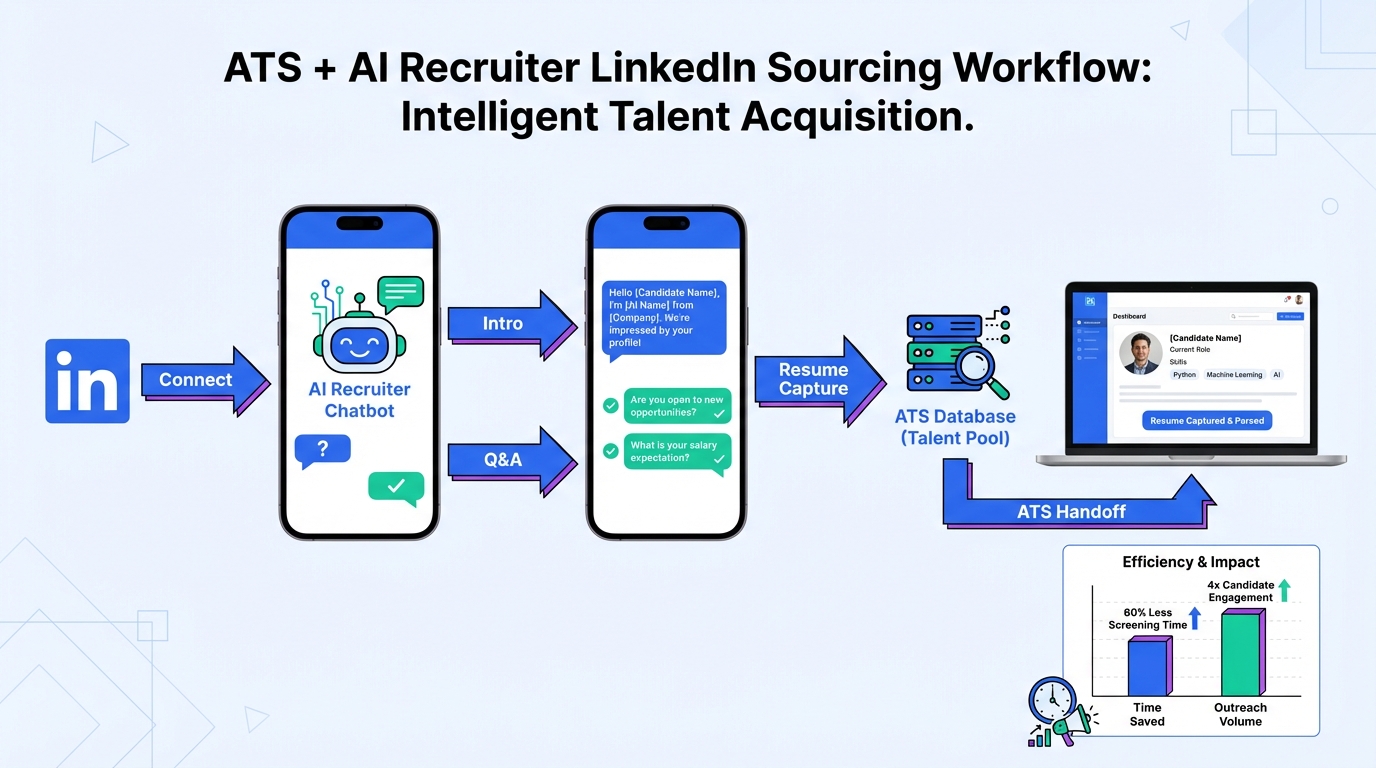
Workflow map
- Define the role packet: Company summary, compensation, benefits, and candidate criteria.
- Run LinkedIn sourcing: StrategyBrain AI Recruiter connects with candidates that match your criteria and introduces the opportunity.
- Handle Q and A: StrategyBrain AI Recruiter answers questions about the role, company, and compensation, then confirms interview interest.
- Collect documents: StrategyBrain AI Recruiter requests resumes and captures contact details for interested candidates.
- Push to ATS: Recruiters create or update the candidate record in the ATS and attach the resume and conversation summary.
- Recruiter qualification: Recruiters review resumes and decide who advances. StrategyBrain AI Recruiter does not decide final fit.
- Interview and offer: Managed in the ATS with structured scorecards and approvals.
Why this pairing works
- Speed: Candidates get timely responses, including outside your local business hours.
- Consistency: The same role packet drives every first touch conversation.
- Scale: You can run multiple LinkedIn accounts as an AI recruiter team when volume demands it.
- Auditability: The ATS remains the place where decisions are recorded and reviewed.
Implementation steps you can run in one week
Day 1: Lock the process definitions
- Define stages: Write stage names and entry and exit criteria in one page.
- Define required fields: Decide what must be captured before moving to Interview and Offer.
- Define ownership: Assign who updates the ATS at each stage.
Day 2: Build the role packet for outbound
Create a role packet that StrategyBrain AI Recruiter can use in conversations. Include compensation, benefits, location expectations, and growth path. In the source material, candidates cared about opportunity and what one to five years could look like. Put that into the packet so the first conversation answers what candidates actually ask.
Day 3: Configure StrategyBrain AI Recruiter for LinkedIn
- Provide LinkedIn account access: Use explicit authorization and follow your internal security policy.
- Set candidate search criteria: Titles, locations, seniority, and must have skills.
- Set conversation rules: What the AI can promise, what it must escalate, and what it must never request.
Day 4: Define the ATS handoff
- Minimum ATS record: Name, LinkedIn profile identifier, source, role, and current stage.
- Conversation summary format: Interest level, availability, compensation expectations if shared, and next step.
- Resume handling: Store the resume in the ATS or your document system, then link it in the ATS record.
Day 5: Run a controlled pilot
Pick one role and one recruiter. Run outbound for a fixed window, such as 5 business days, then review outcomes. Track three numbers in your ATS: outreach count, reply count, and interview scheduled count. Keep the definitions consistent so you can compare week to week.
Day 6 and Day 7: Review and tighten
- Update the role packet: Add the top five candidate questions and your best answers.
- Adjust follow up cadence: If candidates respond slowly, extend follow up windows.
- Improve ATS hygiene: Remove duplicate records and standardize source tags.
Copyable checklist: ATS plus AI sourcing readiness
- [ ] ATS stages are defined with entry and exit criteria
- [ ] Recruiter and hiring manager responsibilities are documented
- [ ] Role packet includes compensation, benefits, and growth path
- [ ] StrategyBrain AI Recruiter escalation rules are written
- [ ] Resume and contact capture process is documented
- [ ] Data retention and privacy rules are confirmed with legal or compliance
Common failure modes and how to prevent them
Failure mode 1: Treating the ATS as a sourcing inbox
If your team tries to run all outbound conversations inside the ATS, response times often slow down and recruiters revert to personal inboxes. Prevent this by keeping the ATS for stages and decisions, and using StrategyBrain AI Recruiter for LinkedIn conversations and follow up.
Failure mode 2: Unclear candidate messaging about compensation and growth
The source material highlights that candidates ask where they can go in one to five years and whether there is a cap on commission. If your first touch cannot answer these questions, you will lose momentum. Prevent this by putting those answers into the role packet that StrategyBrain AI Recruiter uses.
Failure mode 3: Over delegating qualification to automation
StrategyBrain AI Recruiter can confirm interest and collect resumes, but it does not determine whether a resume matches job requirements. Prevent this by keeping final qualification as a recruiter decision recorded in the ATS.
Failure mode 4: Privacy and consent ambiguity
Prevent this by documenting what data is collected, where it is stored, and who can access it. StrategyBrain AI Recruiter states that customer provided data is not used to train AI models and that credentials are encrypted and stored independently per user, but you should still align the workflow with your internal policies and applicable regulations.
FAQ
What is the difference between an ATS recruitment tool and a CRM?
An ATS recruitment tool manages applicants and hiring stages for open roles. A recruiting CRM focuses on long term relationships with prospects who may not be active applicants yet. Many teams use an ATS for hiring workflow and a separate system or process for sourcing and nurturing.
Do recruitment ATS systems replace LinkedIn sourcing?
Usually no. Recruitment ATS systems are designed to track candidates once they are in your pipeline. LinkedIn sourcing is an outbound activity that often needs separate workflows for messaging, follow up, and response handling.
How does StrategyBrain AI Recruiter fit with an ATS?
StrategyBrain AI Recruiter automates LinkedIn connecting, role introduction, candidate Q and A, follow up, and resume and contact capture. Recruiters then create or update the candidate record in the ATS and move qualified candidates through official stages.
Can StrategyBrain AI Recruiter communicate in multiple languages?
Yes. StrategyBrain AI Recruiter provides 24/7 multilingual recruitment communication and can respond in the candidate’s native language, which helps reduce misunderstandings in global hiring.
Can StrategyBrain AI Recruiter manage multiple LinkedIn accounts?
Yes. It supports managing more than 100 LinkedIn accounts so organizations can build AI powered recruitment teams for scalable hiring.
Does StrategyBrain AI Recruiter decide if a candidate is qualified?
No. It can identify willingness to communicate or interview and collect resumes and contact details, but final qualification against job requirements is completed by the recruiter after reviewing the resume.
What should we store in the ATS versus outside the ATS?
Store stage decisions, interview feedback, and offer approvals in the ATS. Store outbound conversation logs where they are generated, then attach a summary and key artifacts such as resumes to the ATS record so the audit trail remains complete.
How do we avoid candidate experience issues with automation?
Use clear disclosure in your messaging, keep responses accurate, and define escalation rules for sensitive topics. Also ensure the role packet is current so candidates do not receive outdated compensation or location details.
What is the fastest way to evaluate popular ATS used in HR without a long RFP?
Run a two week trial focused on one role and one hiring manager group. Score each ATS on stage governance, reporting speed, and recruiter adoption, then confirm it can support your sourcing workflow, including how you will feed candidates from LinkedIn into the ATS.
Conclusion
An ATS recruitment tool is essential for structure, compliance, and reporting, but it is rarely the best place to run high volume outbound sourcing conversations. If LinkedIn is a core channel, pair your ATS with a purpose built automation layer. StrategyBrain AI Recruiter can handle connecting, introducing roles, answering questions about compensation and benefits, multilingual follow up, and resume and contact capture, while your ATS remains the system of record for stage decisions and hiring documentation.
Next step: pick one role, write a role packet that answers the questions candidates actually ask, then run a five day pilot where StrategyBrain AI Recruiter drives LinkedIn outreach and your ATS tracks outcomes with consistent stage definitions.