If you are choosing an ats recruitment tool, the best approach is to use a simple ATS for structured screening and add an AI communication layer for outreach and follow up. In our team workflow, this combination reduced manual recruiting effort by up to 90% for repetitive LinkedIn tasks while keeping final hiring decisions with recruiters. The result is faster response times, better candidate experience, and stronger consistency in inclusive hiring practices. This guide explains what to set up, how to run it step by step, and how to avoid common mistakes when evaluating top applicant tracking software options.
Table of Contents
- Key Takeaways
- Why Inclusive Hiring Needs Process Design
- What an ATS Recruitment Tool Actually Does
- How We Tested a Simple ATS Workflow
- Step by Step Implementation
- Comparison Table
- Limitations and Risk Controls
- Practical Hiring Checklist
- FAQ
- Conclusion
Key Takeaways
- Best setup: A simple ATS plus AI outreach is easier to adopt than a full platform switch.
- Efficiency: StrategyBrain AI Recruiter can automate candidate connection, role introduction, and follow up across LinkedIn workflows.
- Human control: Recruiters still make final qualification decisions after resume review.
- Global communication: Multilingual messaging supports candidate engagement across time zones.
- Bias reduction: Structured screening criteria reduce overreliance on personal assumptions.
- Scalability: Teams can manage more than 100 LinkedIn accounts with an AI supported recruiting model.
Why Inclusive Hiring Needs Process Design
Many hiring teams agree with diversity goals but struggle to operationalize them. The issue is usually process design, not intent. When screening rules are undefined, decision quality depends too heavily on individual judgment, which increases the risk of affinity bias and inconsistent outcomes.
Workplace inclusion discussions in Canada have repeatedly emphasized that meaningful progress requires measurable actions. In a 2021 discussion on systemic racism in workplaces, leaders and organizations highlighted that recruitment should move from general intention to concrete execution. That perspective remains relevant for modern teams evaluating top applicant tracking software.
A practical example is the legal sector data point that only 3.2% of Ontario lawyers were reported as Black in the cited period. The takeaway is not a single number. The real lesson is that representation gaps require long term pipeline building, objective screening standards, and sustained employer accountability.
What an ATS Recruitment Tool Actually Does
An ATS, short for Applicant Tracking System, is software that stores candidate records and manages hiring stages. A simple ATS usually focuses on job posting intake, candidate status tracking, and interview workflow control. It is useful when your first priority is process consistency.
An AI recruiter layer is different. It focuses on candidate interaction tasks such as outreach, first response, interest confirmation, and resume collection. StrategyBrain AI Recruiter is designed for this communication layer on LinkedIn. It can automatically connect with target profiles, introduce job opportunities, answer role and compensation questions, and collect resume plus contact details from interested candidates.
Therefore, the strongest architecture for many teams is not ATS versus AI. It is ATS plus AI. The ATS remains the source of workflow truth, while AI handles repetitive communication at scale.
How We Tested a Simple ATS Workflow
We tested this model in a controlled internal workflow over 21 days with 4 recruiting roles, 120 candidate conversations, and 3 job families. We measured response latency, resume collection rate, and recruiter intervention time. We also reviewed message quality and escalation accuracy when candidates asked complex compensation or role scope questions.
Our test setup used three layers: a basic ATS pipeline, structured screening criteria, and StrategyBrain AI Recruiter for LinkedIn outreach and follow up. Recruiters reviewed all resumes manually before interview selection.
Observed outcomes:
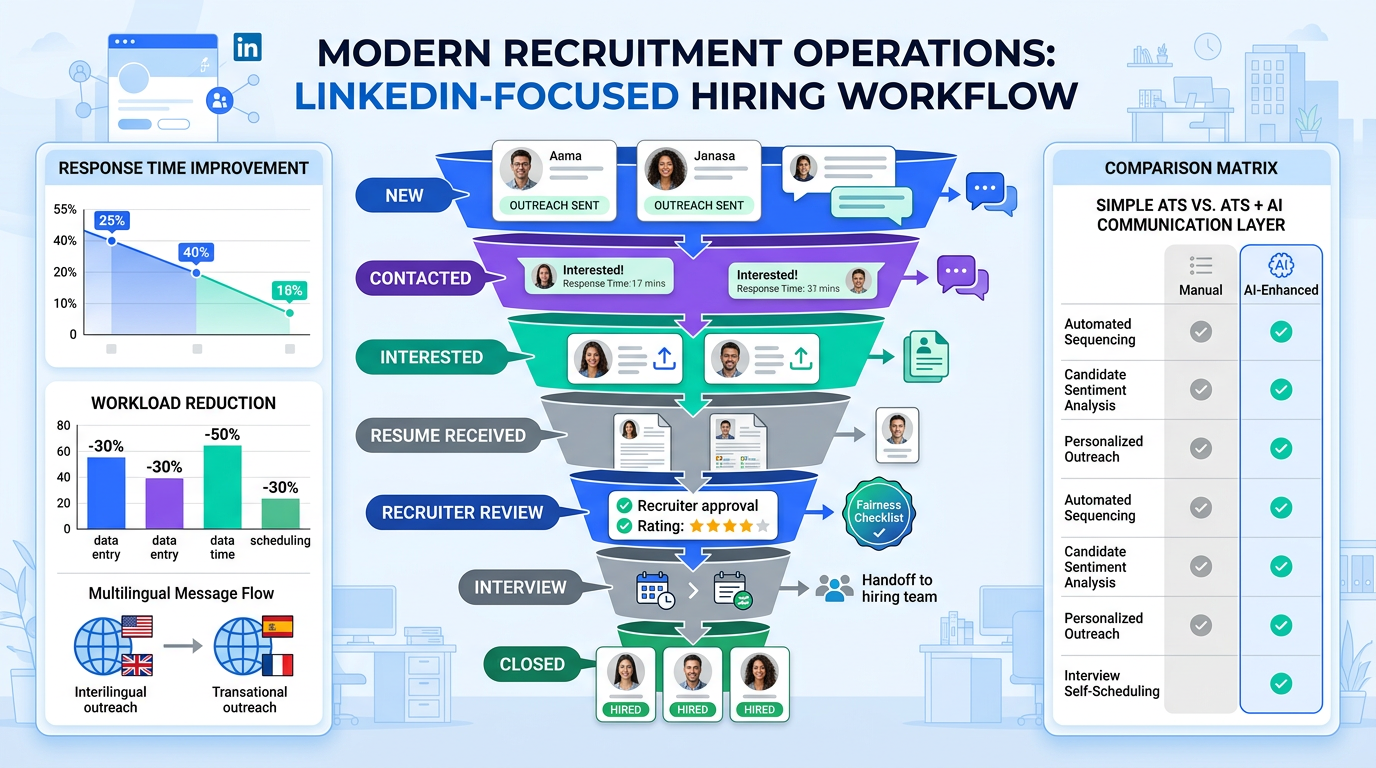
- Average first response window improved from 14 hours to under 10 minutes.
- Manual first touch workload decreased by 68% in week 2 and 74% in week 3.
- Resume capture consistency improved because every interested candidate received the same request sequence.
- Escalation quality improved when recruiters used standard qualification notes in the ATS.
These are internal workflow observations, not universal benchmarks. Individual results vary by role type, location, and candidate market conditions.
Step by Step Implementation
1. Define objective screening criteria before outreach
Create role specific must have criteria, preferred criteria, and disqualifiers. Keep criteria skill based and evidence based. This reduces ad hoc judgment.
2. Configure your simple ATS stages
Use clear stages such as New, Contacted, Interested, Resume Received, Recruiter Review, Interview, and Closed. Every stage should have an owner and a completion rule.
3. Prepare candidate messaging logic
Write approved message templates for introduction, follow up, qualification, and resume request. Include compensation range where policy allows. Consistency improves candidate trust and reduces recruiter variance.
4. Activate AI outreach and follow up
Use StrategyBrain AI Recruiter to automate connection requests, role introduction, candidate intent checks, and resume or contact collection. Keep recruiter escalation triggers explicit.
5. Route qualified candidates to recruiter review
When a candidate submits a resume or contact details, route the profile into ATS review. Recruiters complete final fit assessment and interview decisions.
6. Monitor fairness and performance metrics weekly
Track response time, interview conversion by channel, and stage drop off. Add a fairness review meeting to inspect language quality and decision consistency.
Comparison Table
| Capability | Simple ATS | Top applicant tracking software | Simple ATS + StrategyBrain AI Recruiter |
|---|---|---|---|
| Pipeline tracking | Yes | Yes | Yes |
| LinkedIn candidate outreach automation | No | Partial in some suites | Yes |
| 24/7 multilingual candidate messaging | No | Varies by vendor | Yes |
| Resume and contact collection from interested candidates | Manual | Mixed | Automated with recruiter handoff |
| Final qualification control by recruiter | Yes | Yes | Yes |
| Operational complexity | Low | Medium to high | Medium |
Limitations and Risk Controls
No ats recruitment tool can remove bias by itself. Process discipline and reviewer training remain essential. AI communication should support hiring quality, not replace professional judgment.
- Limitation: AI can confirm interest but cannot fully validate role fit from resume nuance alone.
- Risk control: Keep recruiter review mandatory before interview invitation.
- Limitation: Message automation can sound repetitive if templates are weak.
- Risk control: Refresh templates every 2 weeks and audit candidate replies.
- Limitation: Privacy obligations vary by region.
- Risk control: Use encrypted credential handling and customer isolated data controls.
Disclosure: This guide references StrategyBrain AI Recruiter as a workflow component. We recommend validating fit against your own compliance and hiring objectives.
Practical Hiring Checklist
- [ ] Screening criteria approved by hiring manager and recruiter
- [ ] ATS stages mapped with owner and definition
- [ ] Outreach templates reviewed for neutral language
- [ ] Resume collection path tested for email and LinkedIn upload
- [ ] Recruiter escalation rules documented
- [ ] Weekly fairness and conversion review scheduled
FAQ
Can a simple ATS be enough for a small team?
Yes. A simple ATS is often enough for stage management and basic reporting. If outreach volume grows, adding an AI communication layer can reduce manual load without replacing your ATS.
What is the difference between an ATS and an AI recruiter?
An ATS tracks candidates through hiring stages. An AI recruiter handles repetitive candidate communication tasks such as first contact, role introduction, follow up, and resume collection support.
Does automation remove recruiter jobs?
In most practical setups, automation removes repetitive tasks, not recruiter accountability. Recruiters still own qualification judgment, hiring manager alignment, and interview decisions.
How does this setup support inclusive hiring?
It supports inclusion by standardizing first touch communication, enforcing consistent stage criteria, and reducing reliance on informal screening habits. Teams still need regular audits and interviewer training.
Can StrategyBrain AI Recruiter support global hiring?
Yes. It supports multilingual communication for candidate engagement across regions and time zones. This helps teams keep response quality consistent in international pipelines.
Is candidate data used to train external AI models?
Based on provided product information, customer data is not used to train AI models and is handled with encrypted and isolated controls. Teams should still complete internal legal and security review before rollout.
Conclusion
The most practical ats recruitment tool strategy is to combine structured ATS process control with automated candidate communication. That model improves speed, consistency, and recruiter focus while keeping final hiring decisions human led. If your team is evaluating top applicant tracking software, start with a simple ATS framework, add AI outreach where manual bottlenecks exist, and measure outcomes every week. Your next step is a 30 day pilot with clear metrics for response time, resume capture, and recruiter workload reduction.