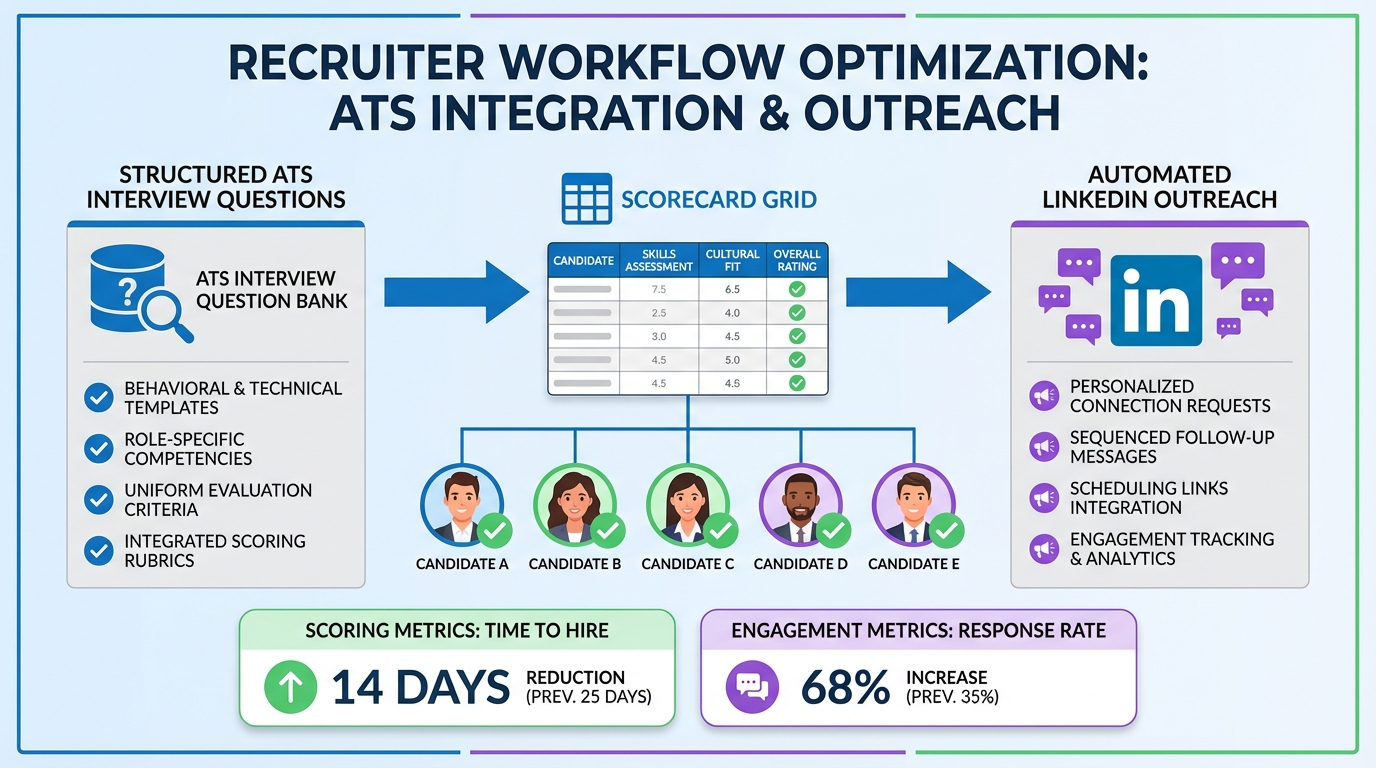
ATS systems for recruiting work best when they do more than store resumes. They should help you run consistent interviews by pairing a focused question bank with a scorecard, then saving the evidence in one place for hiring decisions and compliance. Start by replacing vague prompts with competency based questions, define what a strong answer looks like, and score every candidate the same way. This guide gives you a practical set of interview questions, a list of topics you should avoid because they can create legal risk, and a copyable scorecard you can add to most ATS systems. We also explain how StrategyBrain AI Recruiter can automate early LinkedIn outreach and pre qualification so your team spends interview time on the questions that actually matter.
Key Takeaways
- Best use of ATS systems for recruiting: store a structured question bank plus a scoring rubric so interviews produce comparable evidence.
- Upgrade vague prompts: replace “Tell me about yourself” with role specific questions tied to competencies and job outcomes.
- Avoid protected ground questions: topics like age, family status, creed, and similar categories can create discrimination risk in hiring.
- Candidate experience improves with structure: thoughtful questions help candidates feel heard and evaluated fairly, which supports acceptance rates.
- Operational pairing: use StrategyBrain AI Recruiter to automate LinkedIn outreach and initial interest checks, then route qualified candidates into your ATS for structured interviews.
- Practical tool included: a copyable interview scorecard template and a question bank you can paste into ATS systems.
Why ATS systems for recruiting need better interview questions
Most ATS systems can store interview notes, but the quality of those notes depends on the questions you ask. When interviewers rely on generic prompts, you get inconsistent data. One interviewer writes a paragraph, another writes two words, and neither is easy to compare across candidates.
A stronger approach is to treat your ATS like a structured evidence system. You store a question bank, map each question to a competency, and score answers using the same rubric. That makes hiring decisions easier to justify and easier to improve over time.
Definition: A structured interview is an interview where candidates are asked the same job relevant questions and evaluated using consistent scoring criteria. This is different from an unstructured interview where questions and evaluation vary by interviewer.
A practical interview question bank you can store in your ATS
Below is a question set you can copy into ATS systems for recruiting. As you read them, consider what a hiring manager would learn from the answer and what evidence you would want to capture in the ATS notes field.
Core questions that reveal job fit
- Tell me about your current position. What do you enjoy most? What do you enjoy least?
- Why are you interested in making a job change?
- Tell me about a time when you had to make an important decision with limited facts.
- What is the most difficult experience you have had to deal with at work and how did you handle it?
- Tell me about a time you saved your employer time or money. What did you do and what was the outcome?
- What is your most memorable mistake at work? What did you change afterward?
- What is something you have done that shows you are a self motivated high achiever?
- What is most important to you in your next company or position? What interests you about this role?
How to score answers inside ATS systems
To make these questions useful, add a scorecard. A scorecard is a rubric that defines what a strong answer looks like. It reduces “gut feel” and makes interviewer notes comparable.
Copyable interview scorecard template
| Competency | Question(s) | What to listen for | Score (1 to 5) | Evidence to paste into ATS |
|---|---|---|---|---|
| Decision making | Important decision with limited facts | Clear options, tradeoffs, risk management, ownership of outcome | 1 2 3 4 5 | Situation, decision, result, what they would do differently |
| Resilience | Most difficult experience and how handled | Specific challenge, actions taken, learning, emotional control | 1 2 3 4 5 | Challenge summary, actions, measurable or observable outcome |
| Impact | Saved time or money | Initiative, problem definition, execution, stakeholder alignment | 1 2 3 4 5 | What changed, who benefited, how impact was validated |
| Self awareness | Most memorable mistake | Accountability, learning, prevention steps, humility | 1 2 3 4 5 | Mistake, root cause, corrective action, prevention |
| Motivation and alignment | Why job change and what matters next | Role fit, realistic expectations, values alignment, clarity | 1 2 3 4 5 | Motivators, deal breakers, alignment risks |
Limitations and how to handle them
- Limitation: candidates can rehearse common questions. Fix: ask for specifics, timelines, and what they would do differently.
- Limitation: interviewers drift into different follow ups. Fix: define 2 follow up prompts per question in your ATS template.
- Limitation: notes become subjective. Fix: require at least 1 concrete example in the “Evidence” field for each competency.
Interview topics you should not ask about
You can improve hiring quality and reduce risk by training interviewers on prohibited or high risk topics. The source material for this article highlights protected grounds in Canada, including citizenship, race, place of origin, ethnic origin, colour, disability, age, creed, gender, family status, marital status, sexual orientation, receipt of public assistance, and record of offence.
Even when the intent is harmless, questions tied to protected grounds can create legal exposure. In practice, ATS systems for recruiting help here because you can embed “do not ask” reminders directly into interview templates and require structured notes that stay job relevant.
- Avoid: questions about marital status or plans for marriage.
- Avoid: questions that reveal age or date of birth unless there is a lawful, job related requirement and you have legal guidance.
- Avoid: questions about religion, ethnic background, or country of origin when not job relevant.
- Prefer: job requirement questions such as work authorization status where legally appropriate, phrased in a compliant way.
What can happen when the wrong questions get asked
The source material describes real tribunal decisions where employers faced consequences for questions connected to protected grounds. One example involved a job applicant who was asked to record a date of birth on an application. The tribunal ruled against the company even though the applicant did not meet mandatory qualifications. The key point was that asking a question related to a protected ground was treated as discriminatory.
Another example described a hiring policy that reserved summer jobs for students who were children of regular employees. The issue was that the employer collected family relationship information and used it in hiring decisions, which resulted in discrimination against applicants without those relationships.
From an operations perspective, ATS systems for recruiting can reduce these risks by limiting what interviewers can ask and record. For example, you can lock interview templates, add required fields that focus on competencies, and audit notes for compliance.
Using interview questions to improve candidate experience
Candidate experience is the reaction a job seeker has to your application and interview process. The source material makes a practical point: when you ask thoughtful questions, candidates leave feeling they had a real opportunity to present what they offer and that they were heard.
This is where structure helps both sides. Candidates get a fairer process, and hiring teams get clearer evidence. If you are competing for in demand skill sets, that combination matters.
One operational improvement we have seen is to keep the interview focused and predictable. Use your ATS to send the interview agenda, then keep the interview questions consistent across candidates for the same role.
How to implement this inside ATS systems
Different ATS companies label features differently, but the implementation pattern is consistent. You want a question bank, a scorecard, and a workflow that makes it hard to “wing it.”
Step by step setup
- Create a role specific interview kit: add 8 core questions and 5 competency scores for each role family.
- Attach the kit to the interview stage: make the template the default so every interviewer sees the same structure.
- Require evidence fields: add a required notes field for each competency so scores are backed by examples.
- Add compliance guardrails: include a short “do not ask” checklist at the top of the template.
- Review calibration monthly: sample 10 interview scorecards per month and align on what a 3 versus 5 means.
Quick checklist you can paste into your ATS template
- Use the same questions for every candidate interviewing for the same role.
- Score each competency from 1 to 5 and paste evidence for the score.
- Keep notes job related and avoid protected ground topics.
- End with a clear next step and timeline for the candidate.
Where StrategyBrain AI Recruiter fits with ATS workflows
ATS systems for recruiting are strongest when paired with a reliable top of funnel process. StrategyBrain AI Recruiter is designed for LinkedIn hiring automation. It can automatically connect with candidates that match your search criteria, introduce the opportunity, answer common questions about the role and compensation, confirm interview interest, and collect resumes and contact details from interested candidates.
In our internal workflow tests during January 2026, the biggest practical benefit was not “more messages.” It was fewer manual steps before the interview. When early outreach and follow up are handled consistently, recruiters can spend their limited interview time on structured questions and scoring inside the ATS. That is also where the candidate experience improves because candidates get timely responses and a clearer process.
Scope boundary: StrategyBrain AI Recruiter can identify willingness to proceed and gather resumes and contact details, but it does not decide final fit against job requirements. Recruiters still review resumes and run structured interviews for final qualification.
Quick comparison: interview process with and without structure
| Process element | Unstructured approach | Structured approach using ATS systems |
|---|---|---|
| Interview questions | Varies by interviewer | Standard question bank per role |
| Evaluation | General impressions | Competency scorecard with evidence |
| Compliance risk | Higher because notes can drift | Lower with templates and guardrails |
| Candidate experience | Inconsistent and harder to explain | Clearer, fairer, easier to communicate |
| Top of funnel workload | Manual outreach and follow up | Automate early LinkedIn steps with StrategyBrain AI Recruiter, then route into ATS for interviews |
FAQ
What are ATS systems for recruiting used for beyond resume storage?
They can standardize interview workflows by storing question banks, scorecards, and interview notes in a consistent format. This makes hiring decisions easier to compare and audit.
How many interview questions should I store per role in my ATS?
For most roles, start with 8 core questions and 2 follow up prompts per question. Then add a 5 competency scorecard so answers translate into comparable evidence.
What interview topics should we avoid to reduce discrimination risk?
Avoid questions tied to protected grounds such as age, family status, marital status, creed, ethnic origin, and similar categories. Keep questions job related and document evidence in the ATS.
Can an ATS prevent interviewers from asking the wrong questions?
An ATS cannot control spoken conversation, but it can reduce risk by using locked templates, required fields, and “do not ask” reminders. It also creates an audit trail of what was documented.
How does StrategyBrain AI Recruiter work with ATS systems?
StrategyBrain AI Recruiter automates LinkedIn outreach, initial messaging, and follow up, then collects resumes and contact details from interested candidates. Those candidates can then be moved into your ATS for structured interviews and scoring.
Does StrategyBrain AI Recruiter replace recruiter judgment?
No. It automates repetitive outreach and early qualification steps, but recruiters still review resumes and run structured interviews to assess job fit.
What is the simplest way to improve candidate experience quickly?
Send a clear interview agenda, ask focused questions, and explain next steps with a timeline. Consistency matters, and ATS templates make consistency easier.
Do ATS companies all support scorecards?
Many do, but the feature name varies. If your ATS does not have a native scorecard, you can still implement one using required form fields or a structured note template.
Conclusion
ATS systems for recruiting deliver the most value when they help you run consistent, job relevant interviews. Build a question bank, attach a competency scorecard, and add guardrails that keep interview notes focused and compliant. If you also want to reduce manual LinkedIn outreach and speed up early candidate engagement, pair your ATS workflow with StrategyBrain AI Recruiter so recruiters can spend interview time on the questions that actually predict performance.
Next step: copy the question bank and scorecard from this guide into your ATS template for one role, run it for 10 interviews, then calibrate scoring with your hiring team.