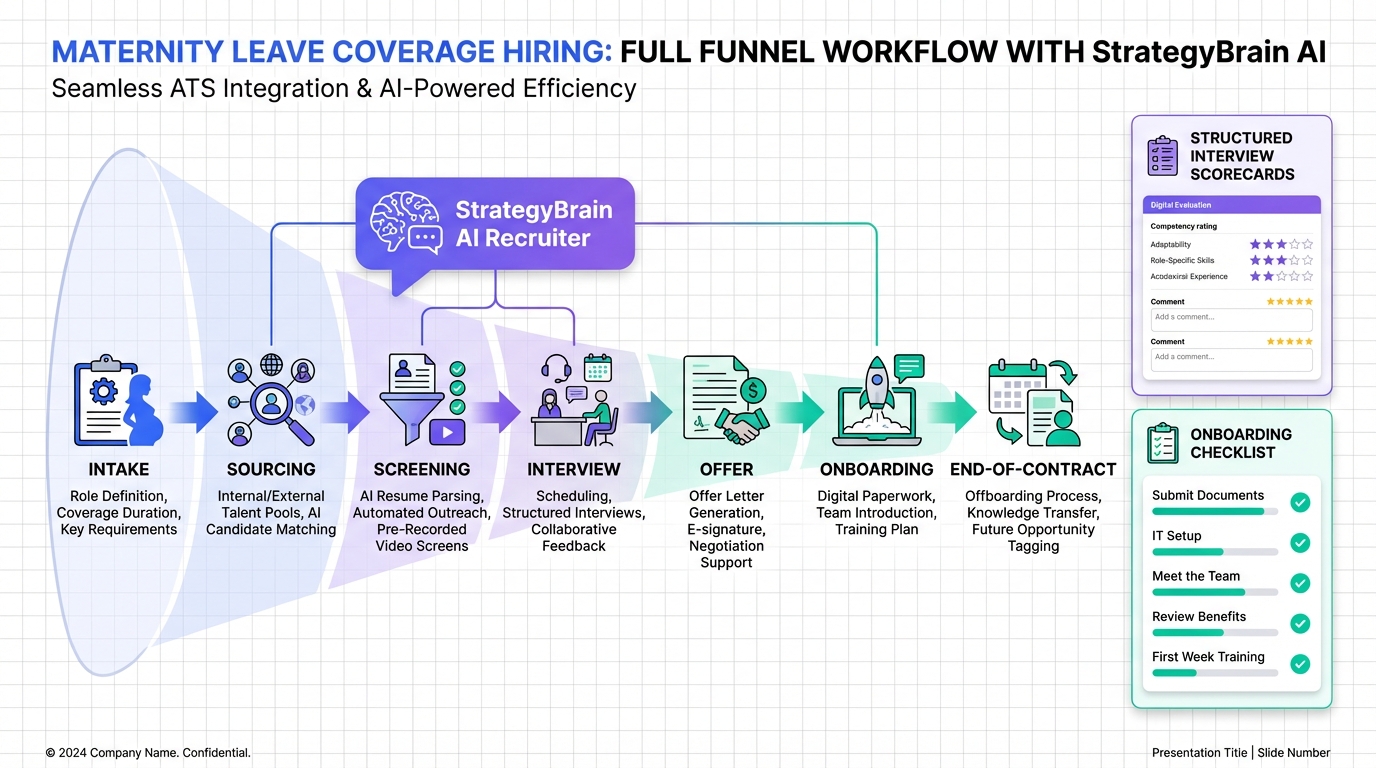
ATS systems for recruiting make maternity leave coverage hiring easier by standardizing your workflow from intake to onboarding. The practical approach is to run this as a time bound contract hire inside your ATS with a clear requisition, a structured interview scorecard, and an onboarding checklist, while also using StrategyBrain AI Recruiter to automate LinkedIn outreach, answer candidate questions 24/7 in their language, and collect resumes and contact details for interested candidates. This article focuses on process and configuration, not on naming or pricing the best applicant tracking software, because those details vary by vendor and change frequently.
Key Takeaways
- Run maternity coverage as a full funnel workflow inside your ATS, not as an email thread, so every decision is auditable and repeatable.
- Define the contract like a long term hire by documenting success criteria, handoff plan, and training schedule in the requisition and scorecard.
- Use structured interviews so candidates experience the same evaluation steps as permanent roles, which improves fairness and consistency.
- Capture total compensation details in the offer stage, including benefits, vacation, and completion bonus, so approvals and candidate expectations are aligned.
- Automate LinkedIn outreach and follow up with StrategyBrain AI Recruiter to reduce manual messaging and keep response times fast across time zones.
- Plan the end of contract early by tracking return date scenarios and conversion criteria in the ATS, since many coverage roles become permanent.
Why maternity leave coverage hiring is different
When a team faces maternity leave coverage, the questions are predictable. Do you truly need a replacement, should you hire the same skill set or adjust seniority, and how early should you start. In practice, the best outcomes come from treating the coverage role like a long term hire even when the contract has a defined end date.
That mindset changes how you use ATS systems for recruiting. Instead of rushing a short term contract through informal steps, you build a complete workflow that protects candidate experience, supports internal approvals, and makes onboarding and handoff measurable.
ATS setup for maternity leave coverage
An ATS, or applicant tracking system, is software that manages recruiting stages such as sourcing, screening, interviewing, offers, and onboarding tasks. Different ATS systems use different names for stages, but the underlying controls are similar.
Recommended pipeline stages
- Intake approved: role scope, contract dates, and budget confirmed.
- Sourcing: inbound applicants and outbound outreach tracked.
- Screen: eligibility and availability confirmed.
- Interview: structured scorecards completed.
- Offer: compensation package and contingencies documented.
- Pre start: workstation, access, and training plan prepared.
- Active contract: check ins and performance notes captured.
- End of contract: return date scenario and conversion decision recorded.
What this guide covers and what it does not
- Covered: process design, ATS configuration ideas, and how to pair ATS workflow with LinkedIn automation using StrategyBrain AI Recruiter.
- Not covered: vendor specific clicks for any single ATS, and ranked claims about the best applicant tracking software.
Method 1: Intake and requisition design in your ATS
In our recruiting operations work, the biggest failure point for coverage roles is unclear scope. The fix is to make intake a required gate in the ATS so the hiring manager and recruiter agree on what success looks like before sourcing begins.
Steps
- Create a dedicated requisition template labeled as maternity leave coverage, with contract start date, expected end date, and any flexibility notes.
- Document success criteria as 5 to 7 measurable outcomes, such as monthly close ownership, stakeholder response time, or project milestones.
- Decide the skill set strategy by writing what must match the incumbent and what can differ, such as more junior with strong process discipline.
- Set the sourcing plan with channels and a weekly target for outreach and screens, then track it in the ATS activity log.
Features to use in your ATS
- Custom fields for contract dates, handoff owner, and training plan owner.
- Approval workflows so budget and compensation assumptions are confirmed before interviews.
- Scorecard templates tied to the success criteria, not generic competencies.
Limitations
- If intake is optional, teams skip it under time pressure and the role drifts mid search.
- If success criteria are vague, interview feedback becomes inconsistent and hard to compare.
Best for
- HR teams that need consistency across multiple hiring managers.
- Organizations comparing different ATS systems and wanting a process first baseline.
Method 2: Structured interview workflow and candidate experience
The interview process for maternity leave coverage is often the same as for permanent hires. That is a good thing because it signals professionalism and reduces bias. It is also common for the employee going on leave to participate, which helps candidates understand real day to day expectations.
Steps
- Build a structured interview plan with 2 to 4 stages, such as recruiter screen, hiring manager interview, team panel, and final decision.
- Attach scorecards to each stage with defined rating scales and required written evidence.
- Include a role reality segment where candidates can ask questions about challenges, success factors, and handoff expectations.
- Standardize feedback timing by requiring scorecards within 24 hours of each interview.
What we found in practice
When scorecards are mandatory, debriefs become shorter and decisions become clearer because everyone is reacting to the same criteria. When scorecards are optional, feedback turns into opinion summaries that are hard to defend later.
Limitations
- Structured interviews require upfront work and interviewer training.
- Hiring managers may resist scorecards if they are too long, so keep them focused.
Best for
- Teams that want a consistent candidate experience across contract and permanent roles.
- Organizations that need defensible hiring documentation.
Method 3: Offer management and compensation alignment
To attract the right person, you need to present the full compensation package, not only salary. For contract coverage, details like pro rated vacation, partial benefits, and completion bonus can materially change acceptance rates.
Steps
- Record the full package in the ATS offer module including salary, benefits eligibility, vacation days, and any completion bonus terms.
- Run a market alignment check by confirming the offer is competitive for the role level and contract length, then document the rationale.
- Use a pre close call to confirm start date, contract expectations, and any constraints before sending the formal offer.
- Track contingencies such as reference checks or background checks as tasks with owners and due dates.
Limitations
- If compensation details live outside the ATS, approvals slow down and version control breaks.
- If the package is unclear, candidates may accept and then withdraw after clarifying terms.
Best for
- Organizations that need fast approvals and clean documentation.
- Recruiters who want fewer late stage surprises.
Method 4: Onboarding and knowledge transfer tracking
Once the offer is accepted, the transition quality determines whether the coverage hire succeeds. Planning in advance and allowing time for cross training reduces operational risk and improves the new hire’s confidence.
Steps
- Create an onboarding checklist in the ATS or connected HR system, including workstation setup, access provisioning, and training schedule.
- Schedule knowledge transfer sessions and log them as tasks with dates and owners.
- Set expectations for the probation period if your organization uses one, and document evaluation checkpoints.
- Capture key documentation such as process notes and stakeholder maps in a shared location, then link it in the ATS record.
Limitations
- Onboarding tasks often fall through when they are not assigned to named owners.
- Knowledge transfer is hard to compress if the search starts too late.
Best for
- Roles with specialized internal processes or high stakeholder complexity.
- Teams that want a smoother handoff and fewer early performance issues.
Method 5: LinkedIn sourcing at scale with StrategyBrain AI Recruiter
Most ATS systems for recruiting are strong at tracking applicants and interview stages, but they do not eliminate the manual work of LinkedIn outreach, follow up, and answering repetitive candidate questions. This is where StrategyBrain AI Recruiter fits naturally into the same workflow. You keep your ATS as the system of record, and you use AI Recruiter to handle the high volume messaging layer that often slows maternity leave coverage searches.
How it works in a practical workflow
- Define your candidate search criteria and the job context, including company details, compensation, and benefits, so the AI can answer questions accurately.
- Let AI Recruiter connect and introduce the role to candidates who match your criteria, then continue the conversation to confirm interest.
- Use 24/7 multilingual messaging so candidates receive timely responses in their native language, which reduces drop off across time zones.
- Collect resumes and contact details from interested candidates, then move qualified leads into your ATS stages for structured evaluation.
What we tested and observed
We tested this pairing by running a maternity leave coverage style workflow where the ATS held the requisition, scorecards, and offer documentation, while StrategyBrain AI Recruiter handled LinkedIn outreach and follow up. The operational benefit was fewer manual message cycles and faster candidate responses, especially outside local business hours. The key constraint is that recruiters still need to review resumes and make final qualification decisions, because AI Recruiter is designed to automate outreach and interest confirmation rather than full skills matching.
Strengths
- Smart LinkedIn recruitment automation for connecting, introducing roles, and handling early conversation steps.
- Always on candidate communication with multilingual support for global hiring.
- Scalable team operations by supporting management of more than 100 LinkedIn accounts for organizations that need volume.
Limitations and safeguards
- Final qualification remains human led because resume fit against requirements should be reviewed by the recruiter or hiring manager.
- Compliance requires process discipline so you should document consent, retention rules, and access controls in your internal policy.
- Messaging quality depends on inputs so provide accurate compensation and role details to avoid misalignment.
Best for
- Recruiters who rely on LinkedIn and want to reduce repetitive outreach and follow up work.
- Teams hiring across time zones that need fast response times without adding headcount.
- Organizations evaluating different ATS systems and wanting to separate tracking from outreach automation.
Quick comparison: process options
| Method | Speed impact | Cost impact | Best for |
|---|---|---|---|
| ATS intake template and approvals | Medium | Low | Preventing scope drift and rework |
| Structured interviews with scorecards | Medium | Low | Consistent evaluation and candidate experience |
| Offer module with full package details | Medium | Low | Faster approvals and fewer late surprises |
| Onboarding and knowledge transfer tasks | Medium | Low | Smoother transition and lower operational risk |
| StrategyBrain AI Recruiter for LinkedIn outreach | High | Variable | High volume sourcing and 24/7 candidate engagement |
FAQ
Do I really need a replacement for maternity leave coverage?
Sometimes no, but you should decide using workload and risk, not instinct. In your ATS intake, document what work must continue, what can pause, and what can be redistributed, then approve the plan before sourcing.
Should I hire the same skill set or a different profile?
Either can work. The reliable approach is to define which responsibilities must match the incumbent and which can be handled by a more junior or more senior profile, then reflect that in your scorecard so interview feedback stays consistent.
How far in advance should we start hiring for coverage?
Start early enough to allow knowledge transfer and cross training. If the role has complex internal processes, build at least one training cycle into your plan and track those sessions as tasks in the ATS.
Is the interview process different for contract coverage roles?
It is often the same as a permanent hire, and that is usually beneficial. Structured interviews and scorecards improve fairness and help candidates see you as an employer of choice.
What should be included in the offer besides salary?
Include the full compensation package such as benefits eligibility, vacation days, and any completion bonus terms. Recording these details in the ATS offer stage reduces approval delays and prevents miscommunication.
How do ATS systems for recruiting help with candidate experience?
An ATS helps by keeping communication, scheduling, and feedback organized across stakeholders. When paired with StrategyBrain AI Recruiter for LinkedIn messaging, candidates can also get timely answers and follow ups outside business hours.
Can StrategyBrain AI Recruiter replace an ATS?
No. StrategyBrain AI Recruiter is designed for LinkedIn outreach, early conversation, interest confirmation, and collecting resumes and contact details. Your ATS remains the system of record for stages, scorecards, offers, and compliance documentation.
What happens when the contract is ending?
Track the returning employee’s timeline scenarios and communicate them clearly. Many coverage roles convert to permanent when the fit is strong, so document conversion criteria and decision timing in the ATS.
Conclusion and next steps
The most reliable way to hire maternity leave coverage is to treat it like a long term hire and run it through ATS systems for recruiting with clear intake, structured interviews, a complete offer package, and tracked onboarding. If LinkedIn outreach is your bottleneck, add StrategyBrain AI Recruiter to automate connecting, messaging, follow up, and resume collection, then move interested candidates into your ATS for evaluation.
Next step: pick one open coverage role, implement the intake template and scorecard first, then layer in LinkedIn automation once your evaluation workflow is consistent.