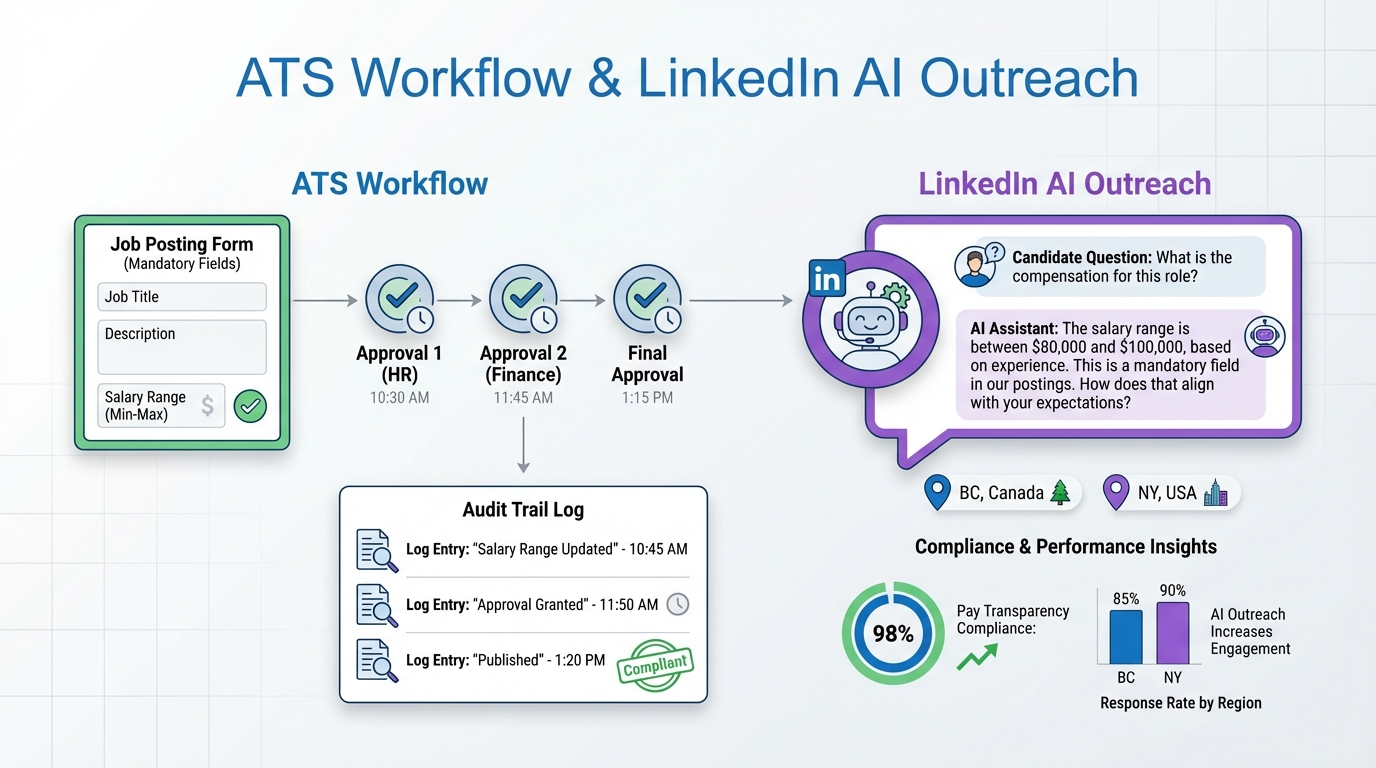
ATS systems for recruiting help you comply with pay transparency requirements by forcing a salary range field in every job posting, blocking pay history questions in application forms, and preserving an audit trail of what was published. In practice, you update your applicant tracking system templates so recruiters cannot publish a public job ad unless the pay range is present and the workflow language avoids pay history. This matters because British Columbia’s pay transparency rules took effect on November 1, 2023, and New York enacted pay transparency requirements on September 17, 2023. This article focuses on operational steps inside an ATS and your LinkedIn outreach process. It does not provide legal advice, and it does not replace an employment lawyer.
Key Takeaways
- Compliance starts in the ATS: Make “pay range” a required field for every publicly advertised role and lock publishing until it is filled.
- Stop collecting pay history: Remove pay history questions from ATS application forms and recruiter intake templates.
- Keep an audit trail: Store the exact job ad text and pay range that was posted, plus timestamps and approver identity.
- Standardize recruiter language: Use ATS-approved templates so outreach and screening stay consistent with the posted range.
- LinkedIn outreach needs guardrails: StrategyBrain AI Recruiter can answer candidate questions about role, company, and compensation using your approved range and messaging.
- Use a lawyer for policy decisions: This guide is operational, not legal advice.
What changed in pay transparency and why ATS workflows matter
In the source article we reviewed, the author highlights two dates that recruiters should treat as operational deadlines: British Columbia’s pay transparency rules effective November 1, 2023, and New York’s pay transparency requirements enacted September 17, 2023. The core idea is simple: employers should not ask applicants about previous salary, and public job postings should include an expected salary or wage range.
That sounds straightforward until you scale hiring across teams, locations, and hiring managers. Without ATS enforcement, pay range fields get skipped, job ads drift into vague language, and recruiters end up re-asking compensation questions inconsistently. An ATS is the best place to prevent those errors because it controls job creation, approvals, publishing, and recordkeeping.
The 6 ATS controls to implement for pay transparency
1) Required pay range fields for public postings
Configure your ATS so a job cannot be published publicly unless a pay range is entered. “Pay range” should be structured data, not free text, so you can report on it later.
- Field design: Minimum pay, maximum pay, currency, and pay period (hourly or annual).
- Validation: Minimum must be less than maximum, and both must be numeric.
- Publishing rule: Public job boards and career site publishing are blocked until the range is present.
2) Remove pay history questions from forms and scripts
The source article states that these laws prevent employers from asking about previous salaries. In ATS terms, that means you should remove pay history fields from application forms, recruiter intake forms, and screening scorecards.
- Application form: Delete any “current salary” or “previous salary” questions.
- Recruiter templates: Update call scripts and email templates stored in the ATS.
- Hiring manager intake: Remove pay history prompts from requisition kickoff forms.
3) Consistent job ad language and banned phrases list
The source article criticizes vague job ads that say “depends on experience,” “up to,” or “starting at.” Even if your jurisdiction allows some flexibility, those phrases create confusion and increase candidate churn. Your ATS can reduce this by standardizing templates and adding content checks.
- Template library: One approved template per job family.
- Content guardrails: Flag or block disallowed phrases in public job ads.
- Compensation section: Always include the pay range in a dedicated section so it is not accidentally removed.
4) Approval workflow and audit trail
When pay transparency is debated internally, the operational risk is not only what you intended to post, but what actually went live. Your ATS should store the final approved job ad text, the pay range, and who approved it.
- Approver roles: Recruiter, hiring manager, and HR or compensation approver.
- Versioning: Keep every revision of the job ad and pay range.
- Timestamps: Record publish date and modification date for each public posting.
5) Candidate communication consistency across channels
Pay transparency is not only a job ad problem. Candidates ask compensation questions in email, phone screens, and LinkedIn messages. If your team answers inconsistently, trust drops and you risk internal misalignment. This is where your ATS templates and your outreach tooling must match.
In our experience reviewing recruiting operations, the fastest way to reduce inconsistency is to store a single “compensation narrative” in the ATS and reuse it everywhere: job ad, recruiter outreach, and screening notes.
6) Reporting for internal fairness checks
The source article includes a fairness point about being consistent with pay for men and women. While an ATS is not a full compensation analytics platform, it can still help you spot process issues by reporting on posted ranges by role, location, and department.
- Range coverage: Percentage of public postings with a range present.
- Range spread: Difference between minimum and maximum by job family.
- Change log: How often ranges are edited after approval.
A practical ATS workflow you can copy
This is a copyable workflow you can implement in most ATS systems for recruiting. The goal is to make compliance the default, not a reminder in a Slack message.
-
Create the requisition using an approved template.
Start from a job family template that already includes a compensation section and the required pay range fields.
-
Enter the pay range before drafting outreach.
Do this early so every downstream message and interview plan references the same range.
-
Run an ATS content check.
Flag vague phrases and confirm the job ad does not ask for pay history. If your ATS cannot do this automatically, add a checklist step in the approval task.
-
Route for approval and lock the posting.
Require an approver to sign off on the pay range and the final job ad text. Store the approved version in the ATS record.
-
Publish publicly only after approval.
Ensure the public posting includes the pay range and that the ATS stores the publish timestamp.
-
Use the same compensation narrative in screening.
Recruiters can still ask whether a candidate would consider a move within the posted range, which the source article notes as a practical conversation that can still happen. Keep the question framed around the posted range, not pay history.
Quick checklist for recruiters
- Pay range is entered as structured fields in the ATS.
- Public job ad includes the pay range section.
- Application form does not request pay history.
- Outreach templates reference the same range.
- Approval and timestamps are stored in the ATS.
Where StrategyBrain AI Recruiter fits in a compliant workflow
Many teams treat the ATS as the system of record and LinkedIn as the system of action. That split is exactly where pay transparency can break down, because candidates ask compensation questions in direct messages long before they apply.
StrategyBrain AI Recruiter is designed for LinkedIn recruiting automation. It can automatically connect with candidates that match your search criteria, introduce the opportunity, answer questions about the role, company, and compensation, confirm interview interest, and collect résumés and contact information from interested candidates. When you feed it the same pay range and approved compensation narrative that lives in your ATS, you reduce the risk of inconsistent answers across recruiters and time zones.
Two capabilities matter most for pay transparency operations. First, it provides 24/7 multilingual communication so candidates get timely responses in their native language, which helps avoid misunderstandings about pay ranges. Second, it supports scaling across many LinkedIn accounts, which is useful when you need consistent outreach at high volume without every recruiter rewriting compensation language.
Important boundary: StrategyBrain AI Recruiter can help qualify interest and collect résumés, but it does not decide whether a résumé fully matches job requirements. Recruiters still make the final qualification decision after reviewing the résumé.
Common edge cases recruiters ask about
Can we still discuss compensation expectations?
Yes. The source article notes employers can ask whether a candidate would leave their current job for the offered pay range, and if not, what range they would accept. Operationally, keep the conversation anchored to the posted range and document it in the ATS notes.
What if a hiring manager wants flexibility for a “star” candidate?
The source article suggests employers may still offer different pay rates to land a top candidate. If your internal policy allows this, handle it through an approval workflow. Update the ATS record with the approved exception and keep the audit trail.
What if the role changes after posting?
If responsibilities or seniority change, treat it as a new version of the posting. Update the pay range if needed, re-approve, and keep both versions in the ATS for traceability.
What if we recruit across multiple jurisdictions?
Use the strictest template as your default, then add jurisdiction-specific fields if required. This reduces operational complexity. For policy decisions, consult an employment lawyer.
Quick comparison: manual process vs ATS enforcement vs AI outreach
| Approach | Speed | Consistency | Best for |
|---|---|---|---|
| Manual recruiter process | Varies by recruiter | Low to medium | Small teams with low hiring volume |
| ATS enforcement (templates, required fields, approvals) | Fast once configured | High for job ads and applications | Teams that need repeatable compliance and audit trails |
| ATS plus StrategyBrain AI Recruiter for LinkedIn | High for outreach and follow up | High across messaging channels | Teams scaling LinkedIn sourcing while keeping compensation messaging aligned |
FAQ
What are ATS systems for recruiting?
ATS systems for recruiting are applicant tracking systems that manage job postings, applications, screening workflows, and hiring documentation. They help standardize how roles are created, approved, and published.
How can an ATS help with pay transparency compliance?
An ATS can require a pay range field before a job is published, remove pay history questions from forms, and store an audit trail of the final posting text, approvals, and timestamps. This turns compliance into a workflow rule instead of a reminder.
Do pay transparency rules mean we cannot discuss compensation in interviews?
No. You can discuss compensation, but the source article emphasizes that employers should not ask for pay history and should publish pay ranges in job postings. Keep discussions anchored to the posted range and document decisions in the ATS.
Should we remove “depends on experience” from job ads?
Operationally, yes. The source article calls out vague phrases like “depends on experience,” “up to,” and “starting at” as time-wasters for candidates. Use a clear range and explain what drives placement within the range.
How does StrategyBrain AI Recruiter support pay transparency on LinkedIn?
StrategyBrain AI Recruiter can use your approved job information, including compensation range, to automate LinkedIn outreach and answer candidate questions consistently. It also supports 24/7 multilingual messaging so candidates receive timely, clear responses.
Does StrategyBrain AI Recruiter replace an ATS?
No. An ATS remains the system of record for applications, approvals, and hiring documentation. StrategyBrain AI Recruiter complements the ATS by automating LinkedIn outreach, follow up, and initial interest qualification.
Can an AI recruiter decide if a candidate is qualified?
StrategyBrain AI Recruiter can identify willingness to communicate or interview and collect résumés and contact details. Final qualification against job requirements should be done by a recruiter after reviewing the résumé.
Is this article legal advice?
No. This is an operational guide for configuring recruiting workflows. For hiring policy decisions, retain a qualified employment lawyer, as the source article recommends.
Conclusion and next steps
If you hire in jurisdictions affected by pay transparency rules, the most reliable approach is to make your ATS systems for recruiting enforce the basics: publish a pay range, stop collecting pay history, and keep a clean audit trail. Then, align your LinkedIn outreach with the same approved compensation narrative so candidates get consistent answers before they apply.
Next steps: update your ATS templates and approval workflow this week, run a spot check on your last 20 public postings for missing ranges, and standardize your LinkedIn messaging. If LinkedIn outreach volume is high, consider using StrategyBrain AI Recruiter to automate candidate engagement while keeping compensation communication consistent with your ATS record.