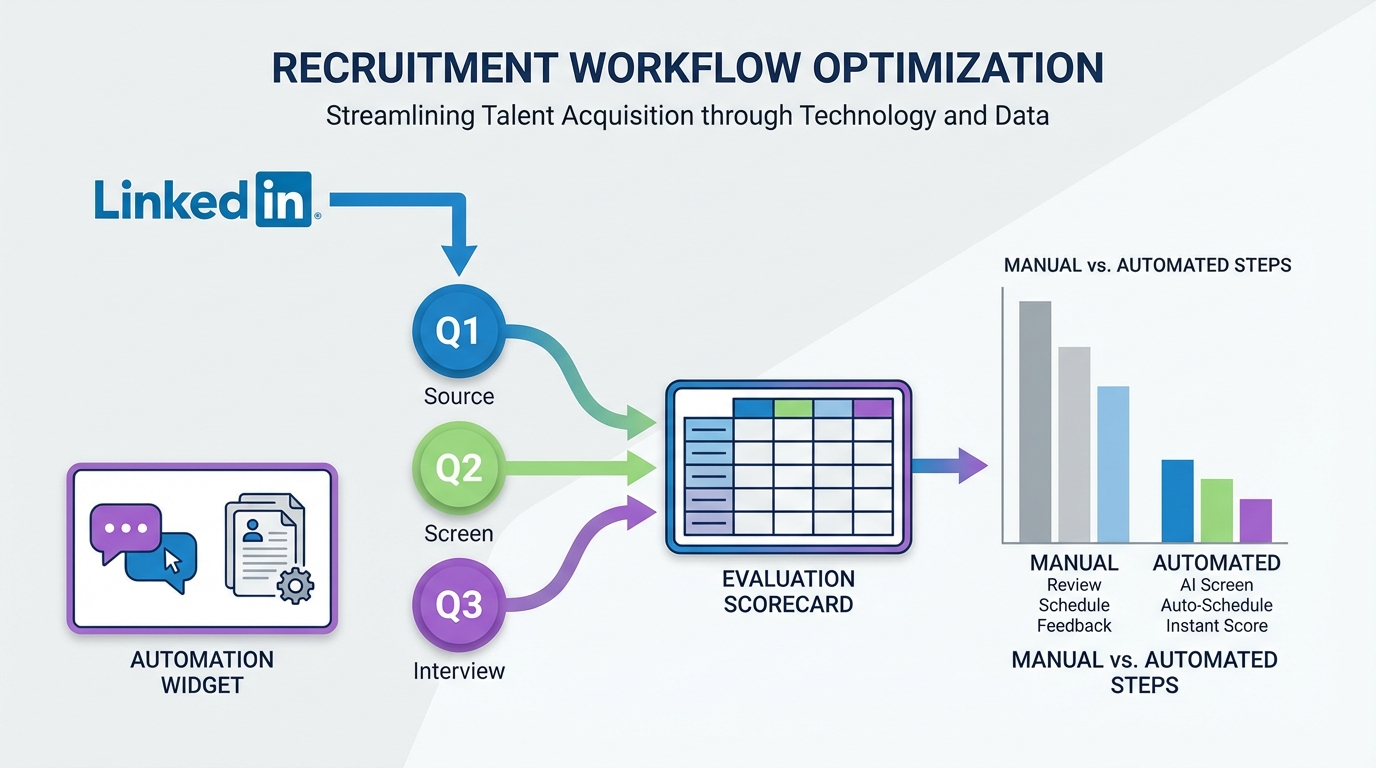
To automate recruitment without turning interviews into a resume reading session, use three open ended “power questions” to drive a real conversation, then standardize how you capture and evaluate the answers. In our hiring workflows, the biggest win comes from pairing a structured interview scorecard with recruitment automation for the repetitive steps before and after the interview. For example, StrategyBrain AI Recruiter can automate LinkedIn outreach, answer candidate questions about the role and compensation, confirm interview interest, and collect resumes and contact details, so the human interview time is spent on motivation, work style, and work ethic rather than logistics.
Why resumes stop helping once interviews start
Resumes are useful early in the hiring cycle, but their value drops sharply once you are face to face with a candidate. At the interview stage, the resume should function as a memory aid for work history, not the script for the conversation.
We have watched interviews stall when a hiring manager studies the resume while the candidate waits, which leaves less time to understand work ethic, career motivations, and fit. If you want to automate recruitment responsibly, this is the moment to shift from document review to structured conversation.
What “power questions” do for employer brand and fit
Power questions are open ended prompts that invite candidates to share context and meaning, not just facts. They work well because they create a conversation, they cannot be answered in a single sentence, and they improve the candidate experience because people feel understood.
Traditional interview questions often test job knowledge. The three questions below are designed to reveal how a person works, what motivates them, and what kind of environment helps them do their best work. This assumes your prescreening already verified baseline experience, technical skills, and certifications.
The 3 interview questions that get beyond the resume
1) Can you tell me about a defining event in your past that affects the way you work today?
This question often creates a pause, and that is normal. In our experience, the silence is productive because it forces reflection rather than rehearsed answers. If the candidate changes stories mid answer, that can be a good sign that they are searching for what is most relevant.
- What you learn: values, resilience, decision making patterns, and what they consider meaningful.
- How to probe: ask what changed in their behavior afterward and what they do differently today.
2) What would you like your next supervisor to know about you in order to make this your best working experience?
Most candidates can answer quickly, but the value comes from staying with it. The longer you explore, the more you learn about self awareness, preferred working conditions, and career direction.
- What you learn: coaching needs, communication style, and what “good management” means to them.
- How to probe: ask for a concrete example of a past supervisor behavior that helped or hurt performance.
3) Tell me about some of the things you do in your current job that are above what is expected of you or outside of your job description
This is the most revealing question in many interviews because it surfaces work ethic and intrinsic motivation. It is simple, but it opens the door to understanding why someone contributes beyond the minimum.
- What you learn: initiative, ownership, and what they do when nobody is watching.
- How to probe: ask what motivates those extra actions and what outcome they were trying to create.
How to turn these questions into recruitment process automation
These questions become far more powerful when you make them repeatable. The goal is not to “automate the interview,” but to automate the structure around it so decisions are consistent and scalable.
Step by step workflow
- Predefine what “good” looks like for the role. Write 3 to 5 evaluation criteria such as safety mindset, teamwork, learning speed, or customer communication.
- Use the same three questions for every candidate. Consistency reduces bias and makes comparisons easier.
- Capture answers in a scorecard immediately. Use a 1 to 5 scale per criterion and require one evidence note per score.
- Automate the follow up steps. Send next step messages, collect missing documents, and schedule interviews using your recruitment automation stack.
- Review as a panel using the same evidence. Discuss the notes, not the resume, and decide what to validate in references or a work sample.
Copyable scorecard template
You can paste this into a document or ATS note field and reuse it.
| Section | What to record |
|---|---|
| Question 1 defining event | Summary in 2 sentences; behavior change described; evidence quote |
| Question 2 best supervisor experience | Preferred management style; environment needs; example from past role |
| Question 3 above expectations | List of extras; motivation; impact on team or output |
| Ratings | 1 to 5 for each criterion; one evidence note per rating |
| Next validation | What to verify in references or work sample; specific questions to ask |
Limitations and how to handle them
- These questions do not replace skills verification. Use them after prescreening confirms baseline qualifications.
- Some candidates are not strong storytellers. Give time to think, then ask for a smaller example from the last 12 months.
- Consistency can drift across interviewers. Calibrate scoring monthly by reviewing 3 anonymized scorecards as a team.
Where StrategyBrain AI Recruiter fits in a modern workflow
If your bottleneck is LinkedIn outreach and early back and forth, this is where an AI recruiter can create real leverage. StrategyBrain AI Recruiter is built for LinkedIn hiring and focuses on automating the initial outreach and interest qualification, not the final hiring decision.
- Smart LinkedIn recruitment automation: automatically connects with candidates that match your search criteria, introduces the opportunity, answers questions about the role, company, and compensation, and confirms interview interest.
- Resume and contact capture: collects resumes and contact details from interested candidates, including email submissions and LinkedIn file uploads, then surfaces what was received for recruiter review.
- 24/7 multilingual communication: responds and follows up around the clock in the candidate’s native language, which supports global hiring across time zones.
- Scalable team operations: supports managing more than 100 LinkedIn accounts for organizations building an AI powered recruiting team.
In our experience, the cleanest division of labor is this: let recruitment process automation handle repetitive messaging and document collection, then use the three interview questions above to evaluate fit and motivation in a structured, human led conversation.
Quick comparison: manual vs automated recruitment workflow
| Workflow area | Manual approach | Automated recruitment approach |
|---|---|---|
| LinkedIn outreach | Recruiter sends connection requests and messages one by one | AI assisted outreach and follow up using StrategyBrain AI Recruiter |
| Candidate Q&A | Recruiter answers repeated questions across time zones | 24/7 multilingual responses for common role and process questions |
| Interview structure | Conversation drifts back to the resume | Three standardized open ended questions plus a scorecard |
| Decision quality | Harder to compare candidates consistently | Evidence based notes and consistent criteria across interviews |
FAQ
What does it mean to automate recruitment without losing the human touch?
It means automating repetitive steps such as outreach, follow up, scheduling, and document collection, while keeping human judgment for fit, ethics, and final selection. The interview remains human led, but the process around it becomes consistent and scalable.
Are these three questions meant to replace technical interview questions?
No. They are designed to reveal work style, motivation, and fit after you have already confirmed baseline skills. Use them alongside role specific validation such as a work sample, reference checks, or a technical screen.
How do I score answers fairly across different interviewers?
Use a shared scorecard with defined criteria and require one evidence note per rating. Then run a monthly calibration where interviewers compare scoring on the same anonymized responses and align on what a 3, 4, and 5 mean.
How does StrategyBrain AI Recruiter support recruitment automation on LinkedIn?
It automates initial LinkedIn outreach, introduces the job opportunity, answers candidate questions about the role and compensation, confirms interview interest, and collects resumes and contact details. Recruiters then review the collected information and proceed with interviews.
Does StrategyBrain AI Recruiter decide whether a candidate is qualified for the job?
No. It identifies willingness to communicate or interview and helps collect the information needed to proceed. Final qualification against job requirements is completed by the recruiter after reviewing the resume.
Can recruitment automation work for global hiring?
Yes, if your workflow supports timely communication across time zones and languages. StrategyBrain AI Recruiter is designed for 24/7 multilingual candidate messaging, which can reduce delays and misunderstandings in international pipelines.
What should I do if a candidate struggles with the “defining event” question?
Give them time, then offer a narrower prompt such as a challenge from the last 12 months that changed how they work. The goal is reflection and learning, not a dramatic story.
Is it compliant to automate LinkedIn recruiting and store candidate data?
Compliance depends on your policies and implementation. StrategyBrain AI Recruiter states it complies with privacy regulations in the EU, United States, and Canada, and that customer provided data is not used to train AI models, with encrypted and isolated storage per customer.
Conclusion
If you want to automate recruitment in a way that improves decision quality, start by changing what happens inside the interview. Use the three open ended questions to move beyond the resume, capture answers in a consistent scorecard, and compare candidates based on evidence rather than impressions.
Next, apply recruitment automation where it has the highest leverage: outreach, follow up, candidate Q&A, and resume and contact collection. If LinkedIn is your primary sourcing channel, StrategyBrain AI Recruiter can take over the repetitive front end of the conversation so your team can spend interview time on fit, motivation, and work ethic.
Next step: pick one role, run these three questions for 10 interviews, and review the scorecards as a team to refine your criteria before scaling the workflow.