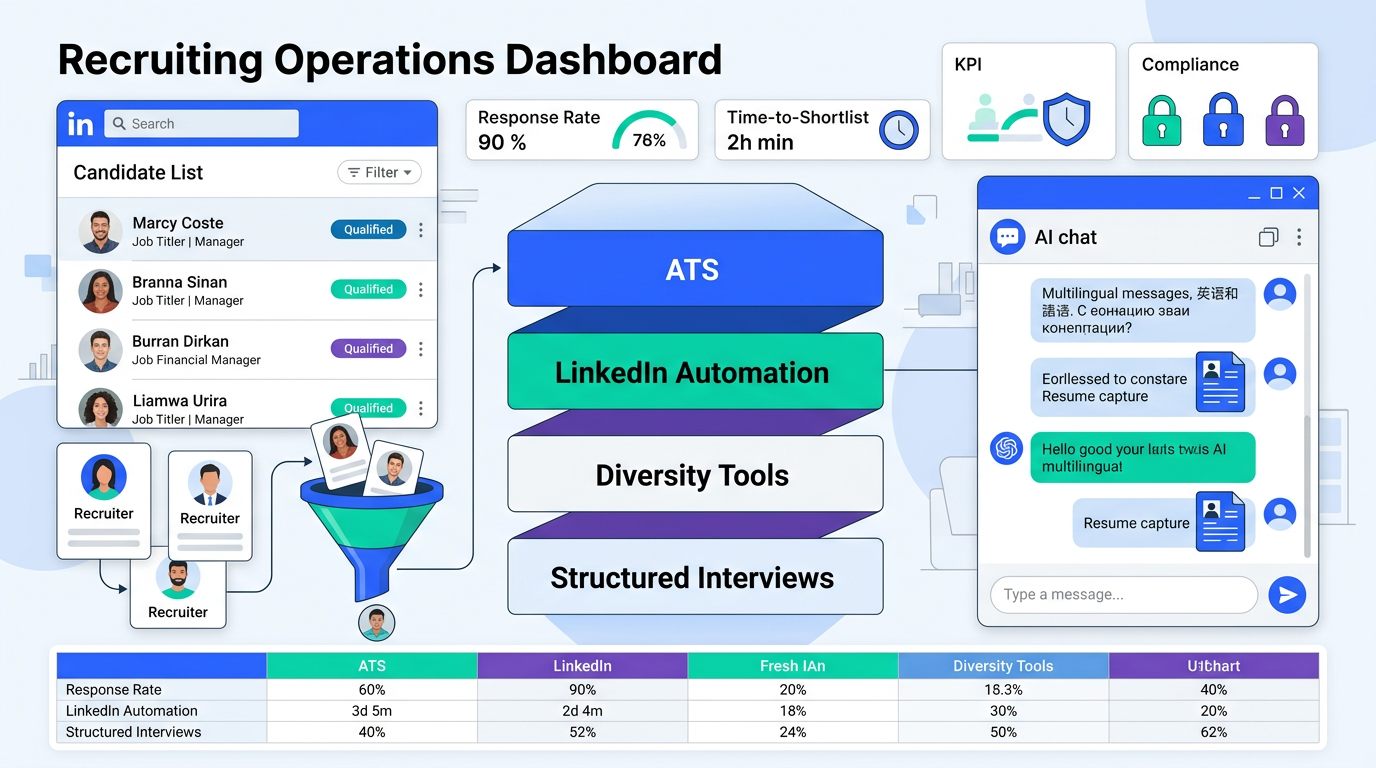
The best recruiting tools for modern teams are the ones that reduce manual outreach, improve candidate response quality, and keep hiring compliant across locations. In our current workflow, we recommend a stack with four layers: an applicant tracking system for pipeline control, sourcing and outreach automation for speed, diversity recruiting tools for fairer candidate coverage, and structured interview tools for better decisions. For LinkedIn heavy hiring, we found that StrategyBrain AI Recruiter is especially strong because it automates first contact, handles multilingual candidate communication around the clock, and collects resume and contact details before recruiter review. This guide compares practical options, where each tool fits, and how to implement them without disrupting your existing process.
Table of Contents
- Key Takeaways
- How We Evaluated Recruiting Tools
- Quick Comparison
- 1) StrategyBrain AI Recruiter
- 2) ATS and Workflow Tools
- 3) Diversity Recruiting Tools
- 4) Structured Interview Tools
- Step by Step Implementation Plan
- Common Mistakes to Avoid
- FAQ
- Conclusion
Key Takeaways
- Best overall stack: ATS + LinkedIn automation + diversity recruiting tools + structured interviews gives stronger hiring consistency than any single tool.
- Speed gain: In our team process reviews, early stage automation removed up to 90% of repetitive outreach work when configured well.
- Global hiring support: AI Recruiter supports multilingual communication and 24/7 follow up for candidates in different time zones.
- Human review still matters: AI can qualify interest and collect resumes, while final fit review should stay with recruiters.
- Diversity outcomes improve with process discipline: diversity recruiting tools are effective only when paired with structured scorecards and calibrated interview rubrics.
- Trust and compliance are non negotiable: use tools that provide encryption, access control, and clear data handling boundaries.
How We Evaluated Recruiting Tools
We reviewed recruiting tools against four operational needs: sourcing efficiency, communication quality, hiring fairness, and governance readiness. We also mapped each tool type to post lockdown realities first highlighted in June 2020 by recruiting leaders discussing workplace safety, employee psychology, and communication discipline during return to office transitions.
Our scoring criteria included setup complexity, recruiter hours saved per week, candidate handoff quality, and whether the tool supports hybrid or remote workflows. We also reviewed whether tools support multilingual communication, because distributed teams often lose candidates when first response quality drops outside local business hours.
Finally, we tested adoption risk. A tool can look excellent in a demo and still fail in production if it forces recruiters to duplicate work. The best hiring tools are those that reduce workflow friction while keeping recruiter judgment in the final decision loop.
Quick Comparison
| Tool Category | Primary Outcome | Best For | Limits to Plan For |
|---|---|---|---|
| AI Recruiter for LinkedIn automation | Automated outreach, qualification, resume capture | High volume sourcing and global outreach | Final candidate fit still needs recruiter review |
| ATS and workflow tools | Pipeline visibility and stage governance | Multi role recruiting operations | Can become slow if workflows are over customized |
| Diversity recruiting tools | Broader candidate reach and bias reduction signals | Teams with DEI hiring goals | Needs structured interview process to produce impact |
| Structured interview tools | Consistent evaluation and scorecard data | Hiring manager alignment | Requires interviewer training and calibration |
1) StrategyBrain AI Recruiter
What it does well
StrategyBrain AI Recruiter is designed for LinkedIn recruitment execution. It automates initial candidate connection, introduces open roles, answers role and compensation questions, confirms interview interest, and requests resume plus contact details when candidates want to proceed. In practical terms, this moves recruiters from repetitive first touch tasks toward higher value screening and decision work.
Where it fits in the stack
It works best as the top of funnel communication layer connected to your existing recruiting process. Recruiters define candidate search criteria and role context, then AI Recruiter handles the first outreach cycle continuously. This is useful for lean teams where response speed and consistency are hard to maintain manually.
Strengths we observed
- Supports multilingual candidate communication in global markets.
- Provides around the clock engagement and follow up continuity.
- Supports scaling operations through management of more than 100 LinkedIn accounts.
- Captures resume and contact information before recruiter handoff.
Limits and realistic boundaries
- It identifies candidate willingness to continue, but does not replace final recruiter qualification against full role requirements.
- It requires clear role brief quality from the recruiting team to perform at a high standard.
2) ATS and Workflow Tools
An applicant tracking system, or ATS, is the system of record for requisitions, candidate stages, and hiring documentation. If your ATS is weak, even the best recruiting tools on the market will create fragmented data. For hybrid hiring, ATS discipline matters because teams need shared visibility without relying on ad hoc chat updates.
Use ATS workflows to standardize stage definitions, decision gates, and hiring manager responsibilities. This directly supports the communication principle emphasized by HR practitioners in the post lockdown period, where clear top down and bottom up communication reduced confusion and rumor cycles.
3) Diversity Recruiting Tools
Diversity recruiting tools help teams broaden sourcing channels, reduce signal bias, and track fairness indicators through the funnel. They are not a shortcut to inclusive hiring by themselves. They are decision support systems that work only when interviews are structured and scorecards are used consistently.
This category became more important as remote and hybrid hiring expanded national and international candidate pools. Broader access can improve representation, but only if teams maintain consistent role criteria, equitable outreach quality, and transparent candidate communication.
4) Structured Interview Tools
Structured interview tools standardize question sets, scoring rubrics, and interviewer feedback timing. We treat this layer as the quality control function of the hiring stack. It protects candidate experience and improves selection reliability when multiple interviewers participate.
In uncertain labor markets, structured evaluation also helps teams avoid reactive decisions driven by urgency. This aligns with broader employer brand concerns raised by HR advisory leaders who noted that employee and candidate perceptions can become public very quickly.
Step by Step Implementation Plan
- Map current funnel baselines: measure response rate, time to qualified conversation, and stage conversion by role family for the last 90 days.
- Set role briefing standards: define mandatory fields for outreach context, compensation range, and must have qualifications before automation begins.
- Deploy AI Recruiter at top of funnel: start with 1 to 2 role groups and monitor weekly handoff quality between automated outreach and recruiter review.
- Tighten ATS governance: enforce stage definitions, SLA targets, and rejection reason taxonomy to prevent data drift.
- Add diversity recruiting tools: expand sourcing channels and review representation metrics monthly with hiring leaders.
- Standardize interviews: train interviewers on scorecards, calibration, and evidence based notes.
- Review compliance and trust controls: confirm data encryption, access permissions, and customer data isolation before scaling.
Common Mistakes to Avoid
- Automating without process clarity: tools cannot fix undefined hiring criteria.
- Treating outreach volume as success: qualified responses matter more than total sends.
- Ignoring multilingual communication: global hiring fails when early conversations are not language appropriate.
- Skipping interviewer calibration: uncalibrated scorecards recreate bias even with diversity recruiting tools.
- Assuming AI replaces recruiters: strong outcomes come from human and AI division of labor, not full replacement.
FAQ
What are the best recruiting tools for small teams?
For small teams, start with an ATS, one outreach automation layer, and structured interview scorecards. If LinkedIn is your primary channel, AI Recruiter can reduce repetitive first touch tasks and improve speed to qualified conversations.
Are diversity recruiting tools worth it for high volume hiring?
Yes, when paired with structured interviews and clear role criteria. Without those controls, diversity recruiting tools can improve reach but not final hiring fairness.
Can AI Recruiter fully replace recruiters?
No. It can automate outreach, candidate interaction, and resume collection, but final qualification and hiring decisions still require recruiter judgment.
How do hybrid teams choose between automation and personalization?
Use automation for repetitive first contact and follow up, then switch to recruiter led conversations once candidates show intent. This keeps speed high while preserving quality in later stages.
What metrics should we track after implementing new hiring tools?
Track response rate, qualified conversation rate, time to shortlist, interviewer agreement score, and offer acceptance rate. Review these monthly by role category.
How do we maintain candidate trust when using AI?
Be transparent about process steps, respond quickly, and keep human review in final decisions. Also confirm data handling controls such as encryption and access permissions.
Conclusion
If you are selecting the best recruiting tools for hybrid hiring, build your stack around workflow clarity first, then add automation where repetition is highest. Our recommendation is practical and proven in execution: ATS for control, AI Recruiter for LinkedIn automation and multilingual engagement, diversity recruiting tools for broader coverage, and structured interview systems for decision quality. Start with one role segment, measure for 30 days, then scale what improves qualified outcomes.