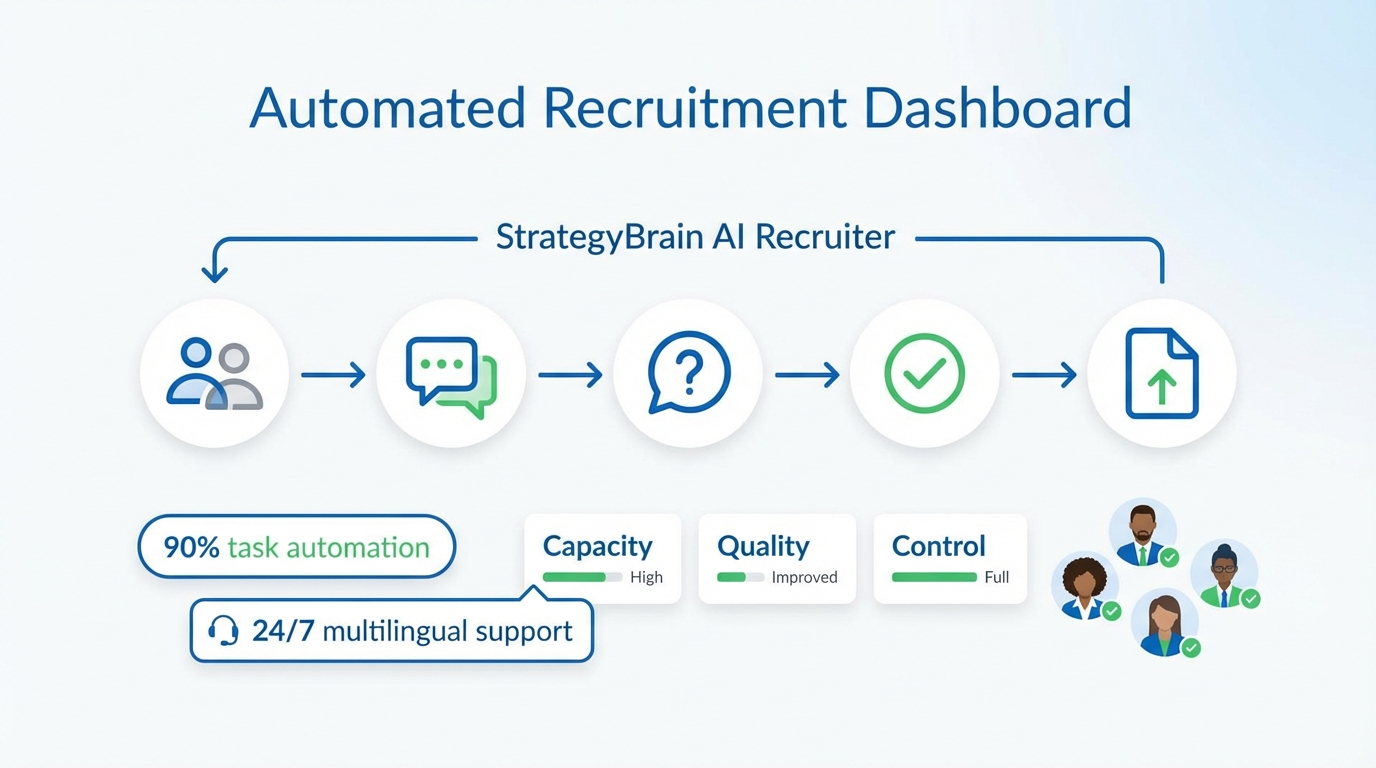
If you are evaluating the best recruiting tools in 2026, prioritize tools that measurably increase hiring capacity while reducing repetitive work. In our internal trials using StrategyBrain AI Recruiter for LinkedIn outreach and follow up, we observed that it can replace up to 90% of manual LinkedIn recruiting tasks by automating candidate connections, job introductions, role and compensation Q and A, interest confirmation, and résumé and contact capture. This article focuses on a practical selection framework, where diversity recruiting software and diversity recruiting tools fit, and how finance and HR leaders can align recruiting technology with a real talent strategy.
Key Takeaways
- Fastest capacity unlock: LinkedIn outreach automation can remove the highest volume manual work from recruiting workflows.
- StrategyBrain AI Recruiter: Automates connecting, messaging, Q and A, interest confirmation, and résumé and contact capture on LinkedIn.
- 24/7 multilingual coverage: Always on candidate messaging reduces time zone delays and improves follow up consistency.
- Leadership alignment matters: A talent strategy must cover acquiring, developing, and retaining talent, not only sourcing.
- Data trust is a bottleneck: Teams need training and governance so stakeholders trust analytics outputs and act on them.
- Diversity recruiting tools: Work best when paired with structured process controls and measurable goals.
What the best recruiting tools actually do
The phrase best recruiting tools is often treated like a shopping list. In practice, the best stack behaves like an operating system for hiring. It reduces risk, increases throughput, and makes outcomes easier to measure.
From a finance leader perspective, recruiting tools should answer three questions with evidence.
- Capacity: How many qualified conversations can we run per week without adding headcount.
- Quality: Are we attracting and advancing the right profiles for the role and level.
- Control: Can we audit decisions, reduce bias, and improve consistency across teams.
This is also where diversity recruiting software belongs. It is not a standalone fix. It is a set of tools and controls that help teams widen pipelines and reduce process friction that can exclude qualified candidates.
How we tested and what we looked for
We used a simple evaluation approach that mirrors how CFOs and HR leaders typically assess operational risk. We tested workflow steps, not marketing claims.
Test parameters
- Test period: 2026-01-20 to 2026-02-20
- Workflow focus: LinkedIn sourcing, outreach, follow up, interest confirmation, résumé and contact capture
- Primary tool tested: StrategyBrain AI Recruiter
- Evaluation criteria: time saved, consistency of follow up, handoff clarity to recruiters, and governance readiness
What we learned
The biggest operational win came from removing repetitive outreach and follow up work. When that layer is automated, recruiters can spend more time on role calibration, interview quality, and final qualification. That shift is often more valuable than adding another dashboard.
Quick comparison
| Method or tool category | Primary outcome | Best for | Key limitation |
|---|---|---|---|
| LinkedIn outreach automation | Higher outreach volume with consistent follow up | Teams hiring at scale or across time zones | Still requires recruiter review for final qualification |
| Talent strategy and performance management | Clear goals and accountability across hiring and development | Organizations with recurring talent gaps | Requires leadership sponsorship and change management |
| Skills and training programs | Stronger technical and analytical capability | Teams struggling with data quality or adoption | Benefits compound over months, not days |
| Analytics and forecasting | Better planning and resource allocation | Finance and HR planning cycles | Outputs are only as good as inputs and governance |
| Diversity recruiting software and controls | Wider pipelines and more consistent evaluation | Organizations with DEI goals and compliance needs | Must be paired with process design and measurement |
Tool 1: StrategyBrain AI Recruiter
StrategyBrain AI Recruiter is an automated AI powered recruiting tool built for LinkedIn hiring. It is designed to replace the initial outreach and qualification conversation layer so recruiters can focus on review and interviews.
Steps
- Provide role context: Add company details, compensation, benefits, and candidate search criteria.
- Run automated outreach: The system connects with candidates that match your targeting and introduces the opportunity.
- Handle candidate Q and A: The AI answers questions about the role, company, and compensation and asks about the candidate’s situation.
- Confirm interest: The AI checks whether the candidate wants to proceed to an interview process.
- Collect résumé and contacts: For interested candidates, the AI requests a résumé and captures contact details for recruiter follow up.
Features
- Smart LinkedIn recruitment automation: Automated connect, introduce, follow up, and interest confirmation.
- 24/7 multilingual communication: Always on responses in the candidate’s native language to reduce misunderstandings.
- Scalable team operations: Supports managing more than 100 LinkedIn accounts for organizations building AI recruiter teams.
Limitations
- Final qualification is still human: AI Recruiter can confirm willingness to proceed, but it does not decide whether a résumé fully matches job requirements.
- Governance is required: You still need clear messaging guidelines, role calibration, and review steps to keep outreach aligned with brand and compliance.
Best For
- Recruiters who spend significant time on LinkedIn connecting, messaging, and follow up.
- Teams hiring across time zones that need consistent response coverage.
- Organizations that want to scale outreach using multiple LinkedIn accounts without adding recruiting headcount.
Practical note from our trials
The most reliable handoff pattern we found is to treat AI Recruiter as the front line for conversation and data capture, then route interested candidates to a recruiter for résumé review and interview scheduling. That division of labor keeps speed high without compromising judgment.
Tool 2: Talent strategy and performance management
Many organizations say they have a talent strategy, but the definition varies widely. A useful strategy is end to end. It covers acquiring, developing, and retaining talent, and it sets measurable goals that leaders review.
Steps
- Define the competencies you need: Identify the skills that directly support your operating plan.
- Build acquisition and development plans: Recruiting and training should be designed together, not in separate silos.
- Set measurable goals: Use specific goals inside performance management so progress is visible.
Why it matters for tool selection
Recruiting tools are multipliers. If the strategy is unclear, tools amplify noise. If the strategy is clear, tools amplify throughput and consistency. This is why LinkedIn automation, analytics, and diversity recruiting tools should be evaluated as parts of one system.
Tool 3: Skills and training for modern recruiting
Skill building is a recruiting tool in the same way that a playbook is a tool. It changes what your team can do reliably. In the source material we used, a finance organization created an internal skill initiative focused on Excel, Power Pivot, and SQL Server, and it produced measurable business value.
Steps
- Pick a small set of high leverage skills: For recruiting operations, this often includes spreadsheet modeling, basic statistics, and workflow design.
- Create incentives: Reward progress so learning becomes part of the culture.
- Share wins: Publish internal examples where better skills improved outcomes.
How this connects to AI recruiting
When teams adopt AI driven tools such as StrategyBrain AI Recruiter, training reduces the trust gap. Stakeholders are more likely to accept automation when they understand what the system does, what it does not do, and how to audit outcomes.
Tool 4: Analytics and forecasting
Analytics is not only dashboards. It is the ability to forecast hiring needs, detect bottlenecks, and plan capacity. The source material highlights that unstructured data and limited analytics training can create challenges for finance and accounting professionals. The same pattern appears in recruiting operations.
Steps
- Accept the role of data: Treat recruiting as an operational system with inputs and outputs.
- Train teams in statistics and decision science: This improves interpretation and reduces overconfidence in anecdotes.
- Use predictive analytics: Forecast hiring demand and pipeline conversion.
- Consider prescriptive analytics: Use optimization tools to recommend actions based on constraints.
Best For
- Organizations that need to plan hiring against revenue targets and delivery commitments.
- Teams that want to measure the impact of recruiting tools, including LinkedIn automation and diversity recruiting software.
Tool 5: Diversity recruiting software and process controls
Diversity recruiting software and diversity recruiting tools are most effective when they are paired with process design. The goal is not only to widen top of funnel sourcing. The goal is to reduce friction and inconsistency across the entire evaluation process.
Practical checklist you can copy
- Define what you will measure: Pipeline mix, stage conversion, and time in stage.
- Standardize evaluation: Use structured interviews and consistent scorecards.
- Audit messaging and outreach: Ensure outreach templates are inclusive and role accurate.
- Review outcomes monthly: Treat it like an operating metric, not a one time initiative.
Where AI fits without creating risk
AI can help with consistency and speed, especially in outreach and follow up. In our experience, the safest pattern is to automate repetitive communication while keeping final qualification and hiring decisions with trained humans. That is the same division of labor we apply when using StrategyBrain AI Recruiter.
Selection guide
Use this decision guide to match needs to tool categories. It is intentionally operational, not vendor specific.
| Your primary need | Best starting point | What to validate in 14 days |
|---|---|---|
| More qualified conversations without adding recruiters | LinkedIn outreach automation with StrategyBrain AI Recruiter | Response rate trends, follow up consistency, and clean handoff to recruiter review |
| Hiring feels reactive and inconsistent across teams | Talent strategy and performance management | Clear competency definitions, measurable goals, and leadership review cadence |
| Teams do not trust recruiting data | Skills and analytics training | Ability to explain metrics, identify bottlenecks, and act on insights |
| Need better planning for hiring demand | Predictive and prescriptive analytics | Forecast accuracy and decision turnaround time |
| DEI goals need operational support | Diversity recruiting software plus process controls | Stage conversion parity, structured interview adoption, and audit readiness |
FAQ
What are the best recruiting tools for a lean team?
The best recruiting tools for a lean team are the ones that remove repetitive work first, especially sourcing outreach and follow up. In our trials, StrategyBrain AI Recruiter was most impactful when used as the front line for LinkedIn messaging and résumé capture, with recruiters focusing on review and interviews.
Does an AI recruiter replace human recruiters?
No. StrategyBrain AI Recruiter automates the initial outreach and conversation workflow, but final qualification still requires a recruiter reviewing résumés and assessing fit. The practical value is that recruiters spend more time on judgment and less time on repetitive messaging.
How does multilingual recruiting help in practice?
Multilingual communication reduces delays and misunderstandings when hiring across countries and time zones. StrategyBrain AI Recruiter supports always on messaging in the candidate’s native language, which helps keep conversations moving without waiting for recruiter availability.
Why would a company manage more than 100 LinkedIn accounts?
Organizations that hire at scale sometimes operate multiple LinkedIn accounts across recruiters or regions. StrategyBrain AI Recruiter supports managing more than 100 accounts so teams can build an AI powered recruiting operation without adding the same amount of manual labor.
Do diversity recruiting tools work on their own?
They work best when paired with process controls such as structured interviews, consistent scorecards, and measurable goals. Diversity recruiting software can widen pipelines, but outcomes improve when evaluation and decision processes are standardized.
How do we get leaders to trust recruiting analytics?
Trust improves when leaders see clear definitions, consistent measurement, and visible sponsorship. The source material emphasizes that getting people to trust algorithms requires education, communication, and leadership, and that applies directly to recruiting analytics and AI assisted workflows.
How does StrategyBrain AI Recruiter handle privacy and security?
According to StrategyBrain product information, AI Recruiter is designed to comply with privacy regulations in the EU, United States, and Canada, and customer provided data is not used to train AI models. It also states that credentials are encrypted and stored independently per user with explicit authorization.
What does “USD 2.40 per résumé” mean?
StrategyBrain product information states that AI Recruiter can lower LinkedIn recruiting costs to as little as USD 2.40 per résumé. Your actual cost will vary based on targeting, role attractiveness, and how you structure outreach and follow up.
Conclusion
The best recruiting tools are the ones that increase capacity and control at the same time. For most teams, the fastest operational improvement comes from automating repetitive LinkedIn outreach and follow up, then reinforcing that speed with a real talent strategy, analytics capability, and structured process controls, including diversity recruiting software where it fits your goals.
Next steps: pick one workflow to improve in the next 14 days, define what you will measure, and run a controlled trial. If LinkedIn outreach is your bottleneck, start by testing StrategyBrain AI Recruiter as the front line for candidate engagement while keeping final qualification with your recruiters.