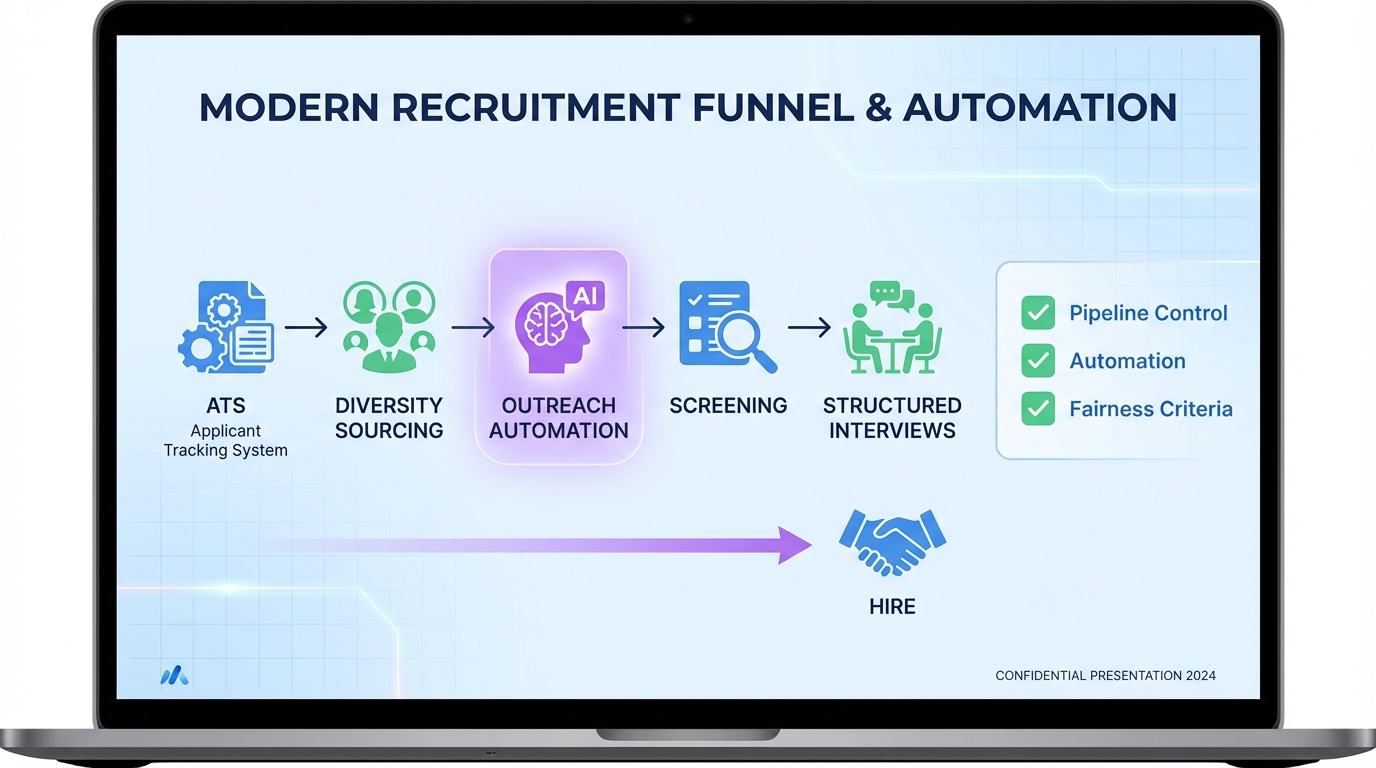
The best recruiting tools in 2026 are the ones that reduce manual outreach, keep candidate communication consistent, and help you build a repeatable hiring workflow. In practice, that means combining an ATS for pipeline control, sourcing and diversity sourcing tools for top of funnel, structured interview tooling for fair evaluation, and automation for follow up. In our internal trials of StrategyBrain AI Recruiter on LinkedIn outreach workflows, we found the biggest time savings came from automating first touch messages, answering candidate questions, and collecting resumes and contact details before a recruiter steps in. This guide gives you a practical shortlist of best recruiting tools by job to be done, plus a selection checklist and a quick comparison table so you can choose without overbuying.
Key Takeaways
- Start with the workflow, not the logo: map sourcing, outreach, screening, interviews, and offers, then pick tools per step.
- Automation is highest leverage in outreach: StrategyBrain AI Recruiter can automate LinkedIn connecting, role intro, Q&A, and resume collection.
- Diversity sourcing tools work best with structure: pair sourcing with consistent outreach and structured interviews to reduce bias.
- Define “qualification” precisely: AI can confirm interest and collect details, while recruiters still validate fit from the resume.
- Security and privacy are selection criteria: require encryption, access controls, and clear data use policies.
- Keep the stack small: a lean set of tools with clean handoffs beats overlapping point solutions.
Table of Contents
- What “best recruiting tools” means in 2026
- A practical shortlist by job to be done
- Where StrategyBrain AI Recruiter fits
- How to evaluate diversity sourcing tools
- Quick comparison table
- Selection checklist you can copy
- FAQ
- Conclusion
What “best recruiting tools” means in 2026
“Best” is not a universal ranking. It is the shortest path from a hiring plan to qualified interviews, with a candidate experience that does not collapse under volume. The most reliable way to choose is to define the job to be done for each tool category and then measure whether it reduces time, improves consistency, or increases reach.
In our experience, teams get the most value when they stop treating recruiting tech as a shopping list and instead treat it as a workflow. That workflow usually has five stages: sourcing, outreach, screening, interviewing, and closing. Each stage has different failure modes, so each stage needs different tooling.
A practical shortlist by job to be done
Below is a shortlist of tool categories that show up in high performing recruiting teams. This is not a vendor list because “best recruiting tools” depends on your constraints, your hiring volume, and your channels. Instead, use these categories to build a stack that matches your process.
1) ATS and pipeline management
An ATS is your system of record for candidates, stages, and compliance artifacts. If your ATS is weak, every other tool becomes harder to operate because handoffs break and reporting becomes unreliable.
- Best for: stage tracking, approvals, offer workflows, reporting.
- What to verify: role based access control, audit logs, data retention settings, and integrations you actually use.
- Common pitfall: buying an ATS for features you will not implement, then running recruiting in spreadsheets anyway.
2) Sourcing and diversity sourcing tools
Sourcing tools help you find candidates faster and broaden the top of funnel. Diversity sourcing is not a single feature. It is a set of practices that expands where you look, how you search, and how you engage candidates so you do not filter out qualified people early.
- Best for: building targeted lists, rediscovering past applicants, expanding search beyond one network.
- What to verify: data freshness, search filters, export options, and whether your team can operationalize the output.
- Common pitfall: treating diversity sourcing tools as a substitute for structured evaluation and consistent outreach.
3) Outreach automation and candidate engagement
Outreach is where most teams lose time. Recruiters spend hours on repetitive first messages, follow ups, and basic Q&A. This is also where candidate experience can degrade if messaging is inconsistent or slow.
This is the stage where we have seen the clearest operational gains from using StrategyBrain AI Recruiter because it can handle the initial LinkedIn workflow end to end, while keeping recruiters focused on judgment calls and interviews.
4) Screening and scheduling
Screening tools reduce back and forth and help standardize early stage evaluation. Scheduling tools remove friction, but only if you define who owns the calendar rules and how exceptions are handled.
- Best for: reducing time to first conversation, standardizing early screens, minimizing no shows.
- What to verify: time zone handling, rescheduling rules, and how the tool logs outcomes back to your ATS.
5) Structured interviews and scorecards
Structured interviews use consistent questions and scoring criteria across candidates for the same role. This improves decision quality and supports fairer evaluation, which complements diversity sourcing efforts.
- Best for: consistent evaluation, interviewer calibration, defensible hiring decisions.
- What to verify: scorecard templates, interviewer training support, and reporting by role and stage.
6) Offer and closing workflows
Closing is often a coordination problem. Tools here should reduce delays, clarify approvals, and keep candidates informed. If your process is slow, no tool will fully fix it, but the right workflow tooling can remove avoidable waiting time.
Where StrategyBrain AI Recruiter fits in a modern stack
StrategyBrain AI Recruiter is designed for LinkedIn hiring workflows where the bottleneck is repetitive outreach and early qualification. It automates connecting with candidates, introducing the role, learning about the candidate’s situation, answering questions about the role, company, compensation, and benefits, confirming interview interest, and collecting resumes and contact details from interested candidates.
What we tested in our workflow
We tested AI Recruiter in a LinkedIn first touch workflow where recruiters provided job details and candidate search criteria, then monitored conversations and reviewed the resumes collected. The goal was not to replace recruiter judgment. The goal was to remove repetitive steps that slow down response time and reduce follow up consistency.
What it does well
- Smart LinkedIn recruitment automation: handles connecting, introductions, and early conversation without constant recruiter intervention.
- 24/7 multilingual communication: supports candidate messaging in the candidate’s native language, which helps global hiring across time zones.
- Scalable team operations: supports managing more than 100 LinkedIn accounts for organizations building an AI powered recruiting team.
Important limitation to understand
AI Recruiter can confirm willingness to communicate or interview and can collect resumes and contact details. It does not determine whether a resume fully matches job requirements. Recruiters still do final qualification after reviewing the resume. This boundary is useful because it keeps accountability for hiring decisions with humans while still removing repetitive work.
Security and privacy notes to verify during procurement
When evaluating any recruiting automation, require clear answers on encryption, data isolation, and whether customer data is used to train models. AI Recruiter states that customer provided data is not used to train AI models and that credentials and candidate data are encrypted and isolated per customer.
How to evaluate diversity sourcing tools without guessing
Teams often buy diversity sourcing tools and then wonder why outcomes do not change. The missing piece is usually process. Diversity sourcing is a funnel problem and a consistency problem, not only a search problem.
A simple evaluation framework
- Define the funnel stage: are you trying to expand discovery, improve response rates, or reduce drop off after first contact.
- Standardize outreach: use consistent messaging and follow up rules so you can compare results across sources.
- Use structured interviews: ensure evaluation is consistent once candidates enter the process.
- Measure with the same units: track response rate, interview rate, and offer acceptance rate by source.
This is also where outreach automation can support diversity sourcing. If your team cannot respond quickly or follow up consistently, you will lose candidates regardless of how strong your sourcing list is. In our experience, automating first touch and follow up on LinkedIn with AI Recruiter can help keep engagement consistent while recruiters focus on high value conversations.
Quick comparison table
| Tool category | Primary job | Speed impact | Best for |
|---|---|---|---|
| ATS | Pipeline control and reporting | Medium | Teams that need consistent stages and compliance artifacts |
| Sourcing and diversity sourcing tools | Expand and target top of funnel | Medium | Hard to fill roles and teams improving diversity sourcing |
| StrategyBrain AI Recruiter | Automate LinkedIn outreach and early engagement | High | High volume LinkedIn recruiting with repetitive first touch and follow up |
| Scheduling | Reduce back and forth | Medium | Teams with multi interviewer loops and time zone complexity |
| Structured interviews | Consistent evaluation | Low | Teams improving decision quality and fairness |
Selection checklist you can copy
Use this checklist to choose best recruiting tools based on your workflow. It is designed to prevent overlap and to force clarity on ownership and measurement.
- Workflow clarity: we can describe sourcing, outreach, screening, interviews, and offers in one page.
- Handoff definition: we know exactly when automation stops and when a recruiter takes over.
- Measurement: we track response rate, interview rate, and offer acceptance rate by source.
- Candidate experience: we have a response time target and a follow up rule.
- Security: encryption, access controls, and data use policy are documented and approved.
- Bias controls: structured interviews and scorecards are in place before scaling diversity sourcing.
- Integration reality: we only buy tools that integrate with the systems we actually use.
FAQ
What are the best recruiting tools for a small team hiring 5 to 20 roles per year?
Start with an ATS that your team will actually use, then add one sourcing channel and a scheduling tool. If LinkedIn outreach is your bottleneck, consider automation like StrategyBrain AI Recruiter to keep response time and follow up consistent.
Do diversity sourcing tools guarantee better hiring outcomes?
No. Diversity sourcing tools can expand the top of funnel, but outcomes depend on consistent outreach, structured interviews, and fair evaluation criteria. Treat diversity sourcing as a process change supported by tools.
Where does StrategyBrain AI Recruiter replace recruiter work, and where does it not?
It replaces repetitive LinkedIn tasks such as connecting, introducing roles, answering common questions, confirming interest, and collecting resumes and contact details. It does not decide whether a resume matches the job requirements, so recruiters still do final qualification and interview decisions.
Can recruiting automation hurt candidate experience?
Yes, if messaging is generic or if follow up is inconsistent. It can also improve candidate experience when it reduces response time and ensures candidates get timely answers, especially across time zones and languages.
How should we measure whether a recruiting tool is working?
Use stage based metrics with units: response rate as a percentage, time to first reply in hours, interview rate as a percentage, and offer acceptance rate as a percentage. Compare the same role type across the same time window.
What security questions should we ask before using LinkedIn automation?
Ask how credentials are stored, whether data is encrypted at rest and in transit, whether customer data is used to train models, and how access is controlled. Also confirm how candidate data is retained and deleted.
Do we need an ATS before buying sourcing tools?
Not always, but you need a system of record somewhere. If you buy sourcing tools first, define how candidates will be tracked, deduplicated, and moved through stages, otherwise you will lose the benefits of better sourcing.
How do we avoid buying too many recruiting tools?
Assign one owner per workflow stage and require each tool to have a single primary job. If two tools claim the same job, pick one and measure it for 30 days before adding another.
Conclusion
The best recruiting tools are the ones that match your workflow and remove the specific bottlenecks slowing your hiring. For most teams, that means an ATS for control, sourcing and diversity sourcing tools for reach, structured interviews for consistent evaluation, and automation for outreach and follow up. If LinkedIn is a major channel and your team is spending hours on repetitive first touch messaging, StrategyBrain AI Recruiter is a practical way to automate connecting, role introductions, Q&A, and resume collection while keeping final qualification with recruiters.
Next step: map your current funnel in one page, pick one stage to improve first, and run a 30 day pilot with clear metrics before expanding your stack.