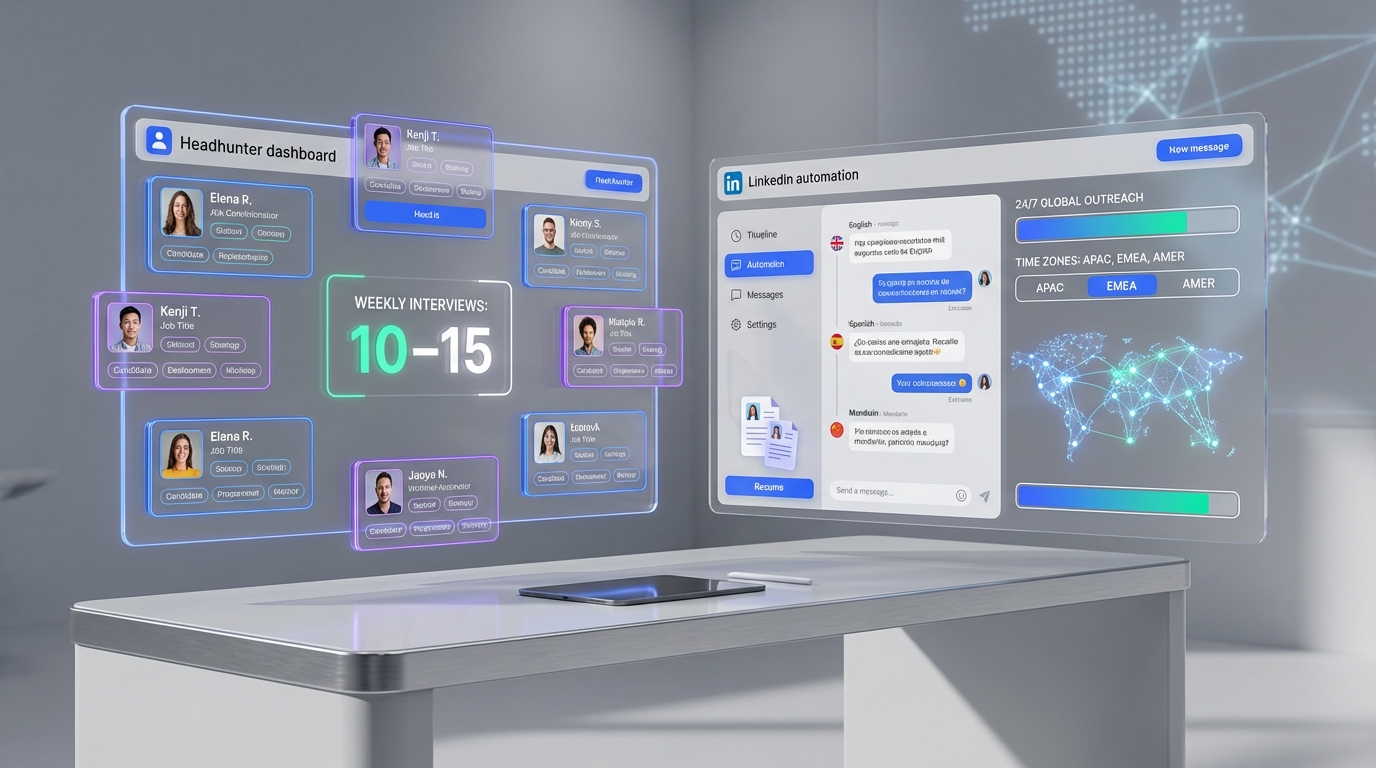
The best recruiting tools in 2026 are not a single app. In practice, the highest performing teams combine (1) a corporate headhunter or recruitment agency process for deep screening and negotiation support, and (2) automation that scales top of funnel outreach. In the source material we reviewed, corporate headhunters are described as screening and interviewing 10 to 15 new people each week, reaching passive candidates, running preliminary reference checks, and handling offer and negotiation. Where modern teams often struggle is the repetitive LinkedIn work required to reach enough qualified people. That is where StrategyBrain AI Recruiter fits naturally into the workflow by automating LinkedIn connections, introductions, candidate Q&A, follow ups, and resume and contact capture, with 24/7 multilingual communication.
Key Takeaways
- Best overall approach: Pair a corporate headhunter for screening and negotiation with StrategyBrain AI Recruiter for scalable LinkedIn outreach and follow up.
- Speed lever: Headhunters can interview 10 to 15 candidates per week; AI Recruiter can run outreach and responses 24/7 to keep pipelines moving across time zones.
- Passive talent access: Headhunters are positioned to reach candidates who are not actively job hunting; AI Recruiter helps you consistently engage that passive market on LinkedIn.
- Technical recruiting diversity sourcing: Use structured criteria, consistent outreach, and multilingual messaging to reduce misunderstandings and widen reach.
- Scale: StrategyBrain AI Recruiter supports managing more than 100 LinkedIn accounts to build AI powered recruiting teams.
- Efficiency claim (vendor stated): StrategyBrain AI Recruiter states it can replace up to 90% of manual LinkedIn recruiting work and reach USD 2.40 per resume cost in some deployments; validate against your own funnel.
Table of Contents
What counts as “best recruiting tools” in 2026
For most employers, “best” means the tool reliably produces qualified candidates while reducing time spent on repetitive work. In the source content, the corporate headhunter model is framed as a toolset of services and process, not software. It emphasizes candidate screening, network access, reference checks, and negotiation support. In 2026, the missing piece is often consistent, high volume outreach and follow up, especially on LinkedIn. That is why many teams now treat automation as a first class recruiting tool alongside agencies and internal recruiters.
Scope note: This article focuses on two recruiting tool categories that were explicitly present in the provided materials: corporate headhunters and StrategyBrain AI Recruiter. It does not attempt to rank a long list of third party ATS or job boards because no verifiable feature or pricing details were provided for them in the source.
Quick comparison: headhunter process vs AI Recruiter automation
| Method | Primary value | What it replaces | Best for | Limitations to plan for |
|---|---|---|---|---|
| Corporate headhunter | Screening, shortlist quality, negotiation support | Manual sourcing and vetting workload on your team | Hard to fill roles, confidential searches, senior hires | Still needs steady top of funnel activity; depends on agency fit and specialization |
| StrategyBrain AI Recruiter | LinkedIn outreach automation, candidate Q&A, follow up, resume capture | Repetitive LinkedIn tasks: connect, message, qualify interest, collect resumes | High volume sourcing, global hiring, technical recruiting diversity sourcing | Does not make final resume to job fit decisions; recruiters still review resumes |
Tool 1: Corporate headhunter (agency recruiting process)
A corporate headhunter is a recruiting professional contracted by a company to find candidates for open roles. In the provided source, the value proposition is clear: headhunters maintain networks, continuously screen candidates, and can narrow a search quickly.
What we pulled from the source material
- Weekly screening volume: The source states headhunters often interview 10 to 15 new people each week.
- Passive candidate reach: The source emphasizes that top performers are often employed and not actively job hunting, and headhunters can reach that market.
- Reference checks: The source states agencies conduct preliminary reference checks before presenting candidates.
- Offer and negotiation: The source states headhunters can handle offers and negotiations and provide market intelligence.
Where this fits among the best hiring tools
If your bottleneck is evaluation quality or closing, a headhunter is a strong tool because it adds human judgment and process discipline. For technical recruiting diversity sourcing, a headhunter can also help by expanding networks beyond the same repeated channels, provided you align on criteria and outreach standards.
Limitations and how to mitigate them
- Limitation: A headhunter process can still be constrained by how quickly you can generate and sustain outreach volume.
- Mitigation: Use StrategyBrain AI Recruiter to keep LinkedIn outreach and follow up running continuously, then route interested candidates into the headhunter or internal screening workflow.
- Limitation: Agency effectiveness depends on specialization and shared values.
- Mitigation: Define role requirements, must have skills, and evaluation rubric before kickoff, then review shortlist quality weekly.
Tool 2: StrategyBrain AI Recruiter (LinkedIn automation)
StrategyBrain AI Recruiter is an automated AI powered recruiting tool designed for LinkedIn hiring. It focuses on the repetitive top of funnel work that slows teams down: connecting with candidates, introducing roles, answering questions, confirming interview interest, and collecting resumes and contact details.
How it works in a real recruiting workflow
- Recruiter provides inputs: job details, compensation, benefits, and candidate search criteria.
- AI runs outreach: it connects with candidates that match the targeted criteria and introduces the opportunity.
- AI handles conversation: it learns the candidate’s situation, answers questions about the role and company, and confirms interest.
- AI captures artifacts: it collects resumes and contact information from interested candidates.
- Recruiter makes final decisions: recruiters review resumes and proceed with interviews and deeper qualification.
Why it is relevant to technical recruiting diversity sourcing
Technical recruiting diversity sourcing often fails when outreach is inconsistent, slow, or limited to one language and one time zone. AI Recruiter’s 24/7 global multilingual recruitment communication is designed to reduce delays and misunderstandings by responding in the candidate’s native language. That can widen the reachable pool when you are hiring across regions.
Scale and team operations
StrategyBrain states it supports managing more than 100 LinkedIn accounts, enabling organizations to build AI powered recruitment teams. Operationally, this matters when you need multiple recruiters or business units to run parallel sourcing motions without each person manually doing repetitive messaging.
Clear boundary: what it does not do
- It does not decide final fit: StrategyBrain states AI Recruiter identifies willingness to communicate or interview, but does not determine whether a resume fully matches job requirements.
- It does not replace human closing: negotiation and final offer management still benefit from experienced recruiters or headhunters.
Selection guide: your need to best choice
| Your primary need | Best choice | Why |
|---|---|---|
| High quality shortlist for a hard to fill role | Corporate headhunter | Process focused screening, network access, and reference checks |
| More qualified conversations per week on LinkedIn | StrategyBrain AI Recruiter | Automates connect, outreach, Q&A, and follow up 24/7 |
| Global hiring across time zones and languages | StrategyBrain AI Recruiter + headhunter for closing | Multilingual messaging for reach, human expertise for final evaluation and negotiation |
| Offer negotiation support and market intelligence | Corporate headhunter | Source explicitly describes negotiation handling as a headhunter strength |
| Scaling recruiting output without adding headcount | StrategyBrain AI Recruiter | Automates repetitive LinkedIn tasks and supports multi account operations |
Implementation playbook: how to combine both
This is the combined workflow we recommend when you want the best recruiting tools to work together instead of competing.
Step by step
- Define your search criteria: write a short rubric with must have skills, nice to have skills, and disqualifiers. This is essential for technical recruiting diversity sourcing because it prevents inconsistent screening.
- Set outreach guardrails: define tone, compensation transparency rules, and what questions can be answered automatically.
- Run LinkedIn outreach with StrategyBrain AI Recruiter: automate connections, introductions, candidate Q&A, and follow ups so your pipeline does not stall overnight or on weekends.
- Route interested candidates to human screening: have your internal recruiter or corporate headhunter review resumes and run structured interviews.
- Use the headhunter for references and negotiation: apply the agency process where it is strongest, especially for senior or sensitive roles.
- Review weekly metrics: track outreach volume, response rate, resumes received, interviews scheduled, and offers accepted. Keep metrics consistent week to week.
Evaluation checklist for best hiring tools
- Pipeline coverage: Does the tool improve sourcing, outreach, screening, or closing? If it claims to do all four, ask for clear boundaries.
- Passive candidate reach: Can it reliably engage candidates who are not actively applying?
- Consistency: Can it run follow ups without gaps, including nights and weekends?
- Multilingual support: If you hire globally, can it communicate in the candidate’s native language?
- Data handling: Are resumes and contact details captured in a way your team can audit and act on?
- Compliance posture: For AI systems, confirm privacy and data protection claims and ensure your legal team is comfortable with the workflow.
- Human accountability: Who owns final decisions on fit, fairness, and offers?
FAQ
What are the best recruiting tools for reaching passive candidates?
A corporate headhunter is explicitly positioned in the source as a way to reach top performers who are currently employed and not actively job hunting. StrategyBrain AI Recruiter complements that by automating LinkedIn outreach and follow up so passive candidates are engaged consistently.
Is a corporate headhunter worth it if we already have internal recruiters?
It can be, especially when you need specialized screening, reference checks, or negotiation support. The source emphasizes that hiring the right people is vital and that headhunters can save time by taking on work your team may not be trained to do.
How does StrategyBrain AI Recruiter help with LinkedIn recruiting?
StrategyBrain AI Recruiter automates connecting with candidates, introducing the role, answering questions about the role and company, confirming interview interest, and collecting resumes and contact details. Recruiters then review the collected resumes and proceed with interviews.
Does AI Recruiter replace recruiters?
No. StrategyBrain states AI Recruiter does not determine whether a resume fully matches job requirements. It focuses on outreach and interest qualification, while recruiters handle final evaluation and hiring decisions.
Can AI Recruiter support technical recruiting diversity sourcing?
It can support it operationally by enabling consistent outreach and multilingual communication, which can widen reach across regions and reduce misunderstandings. You still need a structured rubric and fair evaluation process to ensure outcomes align with your diversity goals.
How many LinkedIn accounts can StrategyBrain AI Recruiter manage?
StrategyBrain states it supports managing more than 100 LinkedIn accounts to build AI powered recruitment teams. Confirm the exact operational setup during implementation based on your organization’s needs.
What is the most common failure mode when combining agencies and automation?
The most common failure is unclear ownership. If nobody owns the handoff from AI generated conversations to human screening, resumes get collected but interviews do not happen. Assign a single owner for the handoff and review it weekly.
What should we ask a headhunter before signing?
Based on the source’s emphasis on fit and specialization, ask about industry knowledge, how they screen candidates, how they validate references, and how they handle negotiation. Also align on values and communication cadence.
What should we ask before deploying an AI recruiting system?
Ask what data is stored, whether customer data is used to train models, how credentials are protected, and what the system will and will not decide automatically. StrategyBrain states customer provided data is not used to train AI models and that credentials are encrypted, but you should still validate these claims with your own security review.
Conclusion
If you are choosing the best recruiting tools for 2026, start by matching tools to the exact bottleneck in your hiring funnel. A corporate headhunter is strongest when you need screening depth, reference checks, and negotiation support, and the source highlights interview volume of 10 to 15 candidates per week plus access to passive talent. StrategyBrain AI Recruiter is strongest when your bottleneck is repetitive LinkedIn outreach and follow up, especially across time zones and languages, because it automates conversations and resume capture 24/7. Next step: implement the combined workflow for one role, measure resumes received and interviews scheduled for 14 days, then expand to additional roles once the handoff is stable.