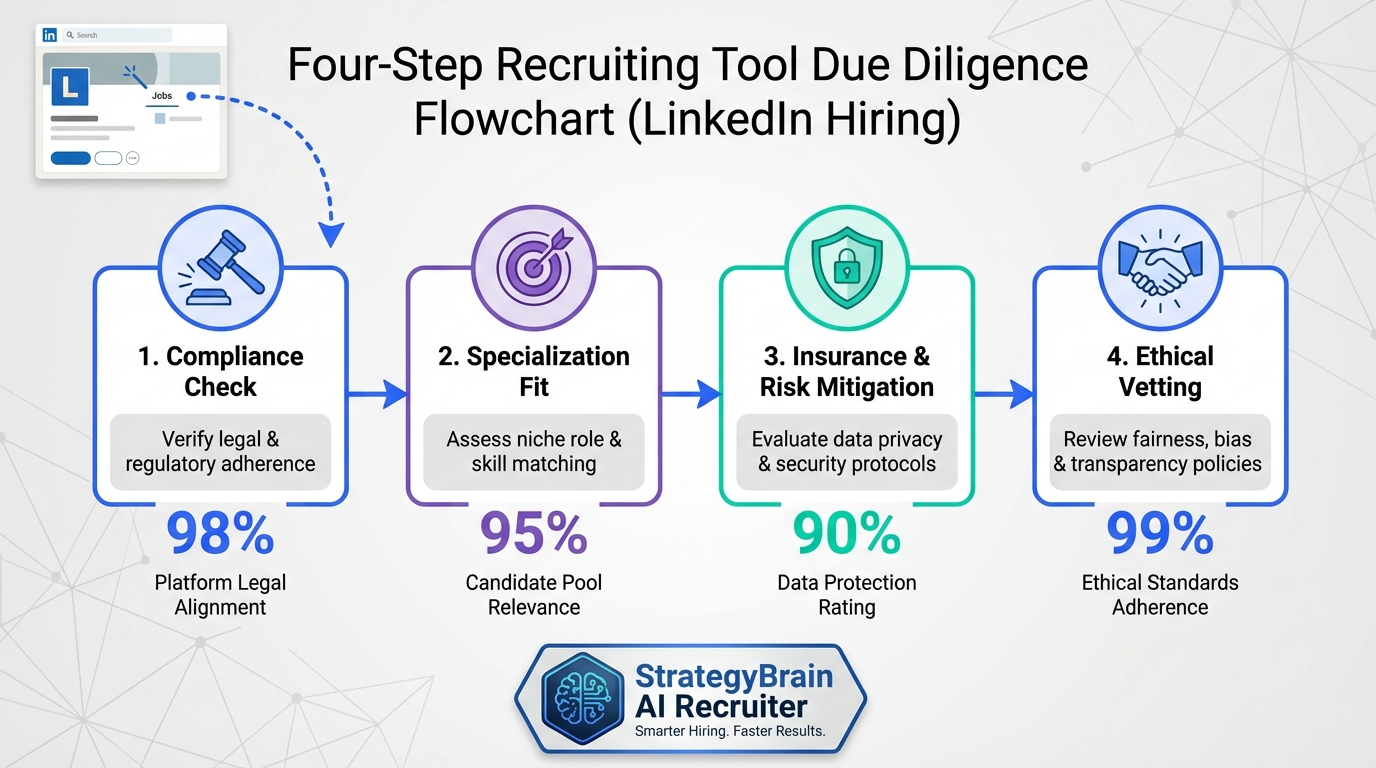
If you are evaluating the best recruiting tools, the fastest way to avoid expensive mistakes is to run a short due diligence screen before you sign anything. We use a four question framework that works for recruiting agencies, staffing vendors, and modern recruiting platforms: confirm legal compliance, verify specialization, check insurance and corporate legitimacy, and validate ethics. In 2026, we also add one practical layer: if your tool touches LinkedIn outreach or candidate messaging, you should test whether it can maintain consistent, compliant communication at scale. That is where StrategyBrain AI Recruiter is often a fit because it automates LinkedIn connection and messaging workflows, supports 24/7 multilingual conversations, and collects resumes and contact details for interested candidates while keeping the recruiter in control of final qualification.
Key Takeaways
- Start with compliance: Ask how the vendor complies with employment standards and human rights obligations in every province or state where you hire.
- Demand specialization evidence: The best recruiting tools show recent, relevant roles and can explain your job family and labor market constraints.
- Verify risk coverage: Confirm error and omissions insurance and general liability coverage, plus whether the business is incorporated.
- Audit ethics: Require a written code of ethics and clear rules on poaching from clients or re recruiting placed candidates.
- Modern layer for LinkedIn: If outreach happens on LinkedIn, test message quality, follow up timing, and multilingual support under real load.
- Where StrategyBrain AI Recruiter fits: It automates LinkedIn connecting, outreach, Q and A, and follow up, then captures resumes and contact details for interested candidates.
How to use this guide
This is a buyer side checklist you can apply to any recruiting vendor, including diversity recruiting tools and diversity recruiting platforms. It is not legal advice. The goal is to reduce preventable risk and improve selection quality by forcing clear answers before you commit budget.
We recommend a two pass process. First, run the four methods below as a 20 to 30 minute screen. Second, if the vendor passes, do a short pilot with one role and measure response quality, candidate experience, and recruiter time saved.
Method 1: Compliance and licensing
Compliance is the first filter because the downside is asymmetric. A vendor that cannot explain its legal obligations can create liability even if it delivers candidates. In Canada, some provinces regulate employment agencies through licensing requirements, and even where licensing is not required, employers and vendors still must comply with employment standards and human rights legislation.
Steps
- Ask what laws apply: Request a plain language explanation of the employment standards and human rights obligations that apply to your hiring locations.
- Ask about licensing status: If the vendor operates as an employment agency in a jurisdiction with licensing, ask how they obtain and maintain the license.
- Ask how staff are trained: Require a description of onboarding and ongoing training for recruiters or operators who interact with candidates.
- Ask how compliance is monitored: Look for documented processes, not verbal assurances.
What to look for in an answer
- Specificity: They can name the categories of legislation that apply and describe how they operationalize compliance.
- Process: They have a repeatable training and audit approach.
- Boundaries: They can explain what they do not do, and when they escalate to your legal or HR team.
How this applies to AI and LinkedIn automation
If your recruiting tool automates candidate messaging, your compliance risk shifts from individual recruiter behavior to system behavior. When we pilot LinkedIn automation, we review message templates, follow up cadence, and how the system handles sensitive topics such as compensation, eligibility, and candidate questions. StrategyBrain AI Recruiter is designed for this workflow by automating initial outreach and Q and A while leaving final qualification decisions to the recruiter.
Limitations
- This guide cannot determine whether a vendor is compliant in your specific jurisdiction. You still need internal review for high risk roles or regulated industries.
Method 2: Specialization and proof of fit
Specialization is the difference between a vendor that sends resumes and a partner that understands your constraints. The best recruiting tools and teams can explain your role requirements, typical compensation bands, and the candidate pool without guessing.
Steps
- Ask what roles they fill today: Request examples of current or recent searches that match your job family and seniority level.
- Ask how they source: Have them walk through sourcing channels, screening steps, and how they validate candidate interest.
- Ask for references: Speak with someone in your industry who has used them across multiple hires.
- Run a micro pilot: Give one role and measure candidate response quality and recruiter time spent.
Where diversity recruiting tools fit
Many teams buy diversity recruiting platforms expecting better outcomes without changing process. In practice, the tool must support your sourcing strategy and candidate experience. During evaluation, ask how the platform expands reach, reduces friction for candidates, and supports consistent communication. If LinkedIn is a primary channel, automation can help maintain timely follow up across time zones and languages, which is one reason teams consider StrategyBrain AI Recruiter for global pipelines.
Limitations
- References can be biased. Use them to validate process consistency, not to outsource your decision.
Method 3: Insurance and corporate legitimacy
Recruiting mistakes can become expensive because hiring is where many employment disputes begin. A professional vendor should carry appropriate insurance and operate as a legitimate business entity. This is not about bureaucracy. It is about whether the vendor is prepared to stand behind their work.
Steps
- Confirm error and omissions insurance: Ask whether they carry E and O coverage and what it is intended to cover.
- Confirm general liability insurance: Ask for proof of coverage and the policy holder name.
- Confirm incorporation: Verify the legal business name and where it is registered.
- Ask about internal policies: Request written policies for health and safety obligations and any workers compensation requirements that apply to their operations.
AI tool specific checks
If the vendor is software, add two questions. First, how are credentials stored and protected if the tool connects to recruiter accounts. Second, is customer data used to train models. StrategyBrain AI Recruiter states that customer provided data is not used to train AI models and that credentials are encrypted and stored per user with explicit authorization.
Limitations
- Insurance does not guarantee quality. It is a baseline signal that the vendor operates like a professional service provider.
Method 4: Ethics and placement boundaries
Ethics is not a soft topic in recruiting. It is a practical control that protects your brand and reduces conflict of interest. A vendor should be able to explain how they avoid behavior that undermines clients, candidates, or both.
Steps
- Request a written code of ethics: Ask for the policy and how it is enforced.
- Ask about placement boundaries: Confirm whether they recruit from current clients or re recruit candidates they previously placed.
- Ask for an integrity example: Request a real scenario where a candidate or client misrepresented information and how the vendor handled it.
- Review candidate communication standards: If messaging is automated, confirm how the system avoids misleading claims and how it escalates edge cases to a human.
How StrategyBrain AI Recruiter supports ethical consistency
One operational advantage of automation is consistency. When we test LinkedIn workflows, we look for a clear handoff point where the AI stops and the recruiter takes over. StrategyBrain AI Recruiter focuses on initial outreach, answering role and company questions, confirming interview interest, and collecting resumes and contact details. It does not decide whether a resume matches the job requirements, which keeps final selection responsibility with the recruiter.
Limitations
- A written ethics policy is only useful if it is enforced. Ask who owns enforcement and what happens when the policy is violated.
Quick Comparison
| Evaluation Method | Time to Run | What It Protects | Best For |
|---|---|---|---|
| Compliance and licensing | 10 minutes | Legal and regulatory risk | Any vendor that represents your brand to candidates |
| Specialization and proof of fit | 10 minutes | Quality of shortlist and speed to hire | Hard to fill roles and niche industries |
| Insurance and corporate legitimacy | 5 minutes | Financial and operational risk | Retainers, high volume hiring, or long term partnerships |
| Ethics and placement boundaries | 10 minutes | Brand risk and conflicts of interest | Executive search, agency relationships, and automated outreach |
Practical templates
Copy and paste vendor interview script
- Compliance: Which employment standards and human rights obligations do you design your recruiting process around in our hiring locations?
- Licensing: Where you operate, do you require an employment agency license, and how do you maintain it?
- Training: How do you train new recruiters or operators on compliance and candidate communication?
- Specialization: What roles like ours have you filled in the last 12 months, and what sourcing channels did you use?
- References: Can you provide references from our industry who have worked with you across multiple hires?
- Insurance: Do you carry error and omissions insurance and general liability insurance, and under what legal entity?
- Ethics: Do you recruit from current clients or re recruit candidates you placed previously?
- Integrity scenario: Tell us about a time a candidate or client misrepresented information and how you handled it.
- Automation controls: If messaging is automated, what is the escalation path to a human recruiter and what topics are restricted?
One page scoring rubric
| Category | Score 0 | Score 1 | Score 2 |
|---|---|---|---|
| Compliance | Vague answers, no process | General awareness, partial process | Clear obligations, documented training and monitoring |
| Specialization | No relevant examples | Some relevant examples | Strong recent examples plus clear sourcing and screening method |
| Insurance and legitimacy | Cannot verify | Verifiable but incomplete | Verifiable, complete, and transparent |
| Ethics | No written policy | Policy exists, weak enforcement | Policy exists, clear boundaries, credible enforcement |
| Candidate communication | Inconsistent or risky messaging | Mostly consistent, limited controls | Consistent, auditable, with escalation and multilingual support |
FAQ
What makes a tool one of the best recruiting tools for my company?
A tool earns that label when it reduces recruiter time while maintaining compliant, consistent candidate communication and producing qualified, interested candidates. Use the four method checklist in this guide to validate compliance, specialization, insurance, and ethics before you evaluate features.
Do diversity recruiting tools guarantee better hiring outcomes?
No. Diversity recruiting tools and diversity recruiting platforms can expand reach and improve process consistency, but outcomes still depend on role definition, sourcing strategy, and candidate experience. Treat them like any other vendor and run the same due diligence checks.
How do I evaluate a recruiting tool that automates LinkedIn outreach?
Test message quality, follow up cadence, escalation to a human, and how the system handles compensation and role questions. Also verify how credentials are stored and whether customer data is used to train models.
What does StrategyBrain AI Recruiter actually automate on LinkedIn?
StrategyBrain AI Recruiter automates connecting with candidates, introducing the role, answering questions about the role and company, confirming interview interest, and collecting resumes and contact details from interested candidates. Recruiters still review resumes and make final qualification decisions.
Can StrategyBrain AI Recruiter communicate with candidates in different languages?
Yes. It is designed for 24/7 multilingual candidate messaging so candidates can receive timely responses in their native language, which can reduce misunderstandings in global hiring workflows.
How many LinkedIn accounts can StrategyBrain AI Recruiter manage?
It supports managing more than 100 LinkedIn accounts so organizations can build AI powered recruiting teams and scale outreach capacity.
Does AI Recruiter decide if a candidate is qualified?
No. It identifies willingness to communicate or interview and collects resumes and contact details, but it does not determine whether the resume matches job requirements. That final step remains with the recruiter.
What is a practical red flag when choosing a recruiting vendor?
A major red flag is when the vendor cannot explain compliance obligations or refuses to provide proof of insurance and a written ethics policy. Another red flag is when they promise outcomes without describing a repeatable sourcing and screening process.
Conclusion
The safest way to choose the best recruiting tools is to treat selection like risk management first and feature comparison second. Start with compliance and licensing, confirm specialization with evidence, verify insurance and corporate legitimacy, and require an ethics policy with clear placement boundaries. Then run a small pilot to measure candidate experience and recruiter time saved.
If your hiring relies heavily on LinkedIn and you need consistent follow up across time zones and languages, consider testing StrategyBrain AI Recruiter as part of your pilot. Use the interview script and scoring rubric above to keep the evaluation objective and repeatable.