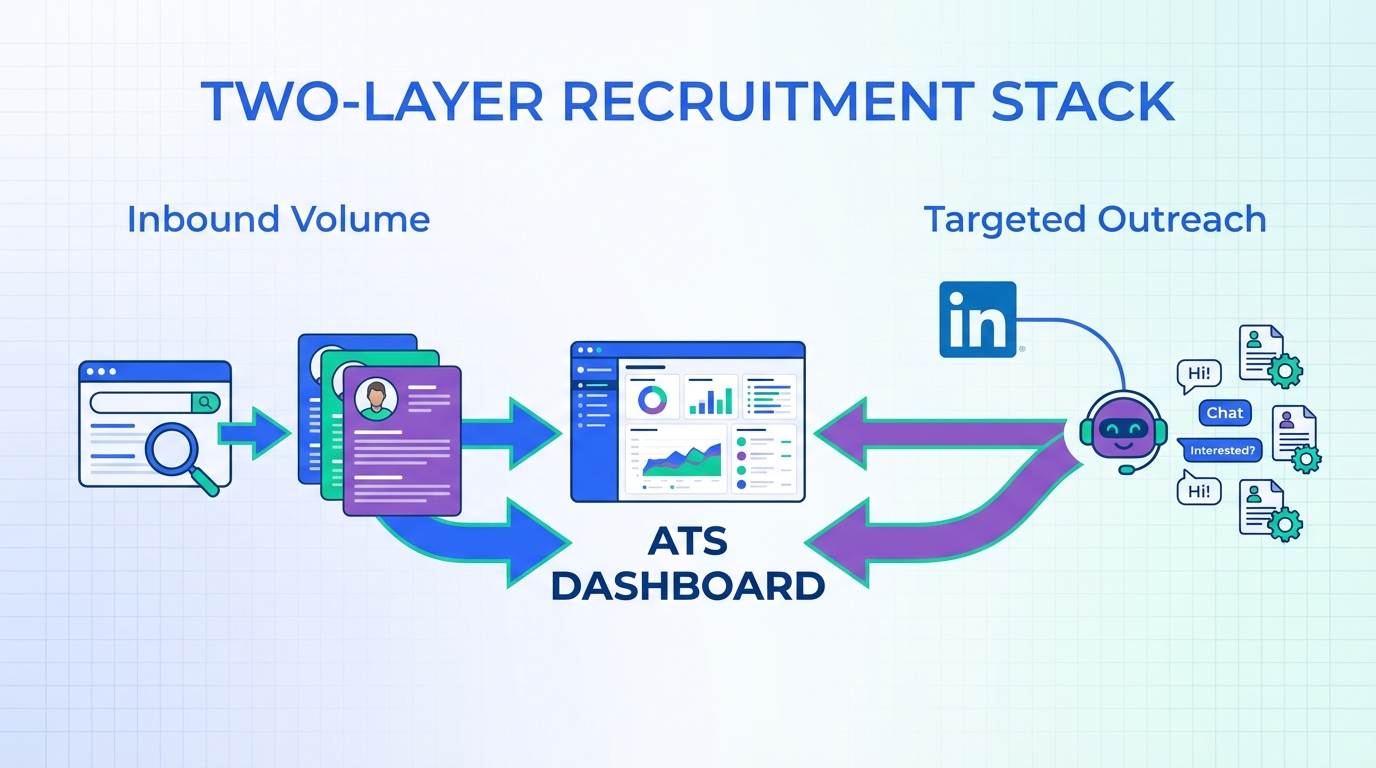
The best recruitment platforms are the ones that match your role type and your response channel. In practice, most hiring teams get the best results by combining (1) a broad job board for inbound applicants and (2) LinkedIn outreach for targeted sourcing. When we reviewed real recruiting workflows, the slowest step was consistent outreach, follow up, and early qualification, not job posting. That is where StrategyBrain AI Recruiter fits naturally into a modern stack: it automates LinkedIn connecting, introduces the role, answers candidate questions about the company and compensation, confirms interview interest, and collects resumes and contact details so recruiters can focus on final screening and interviews.
Key Takeaways
- Use a two layer stack: job boards for inbound volume, LinkedIn outreach for hard to fill roles.
- Speed comes from follow up: automating outreach and qualification removes the biggest day to day bottleneck.
- StrategyBrain AI Recruiter automates LinkedIn connecting, role introduction, Q and A, interest confirmation, and resume plus contact capture.
- Global hiring is a messaging problem: 24/7 multilingual communication reduces delays across time zones.
- Scale requires process: managing many LinkedIn accounts enables an AI powered recruiting team model.
- Compliance matters: privacy and data handling should be evaluated alongside sourcing reach.
What counts as a recruitment platform
In this guide, a recruitment platform is any system that helps you attract, source, engage, and convert candidates into interviews. That includes job boards, applicant tracking systems (ATS), professional networks, staffing partners, and automation tools.
Scope note: This article focuses on choosing the best recruiting platforms and the best sites to recruit employees. It does not provide legal advice on employment, immigration, or privacy compliance. You should validate requirements with your legal and security teams.
Quick comparison
| Platform type | Primary value | Best for | Main limitation | Where StrategyBrain AI Recruiter helps |
|---|---|---|---|---|
| Job boards | Inbound applicant volume | High volume roles, faster top of funnel | More unqualified applicants, slower screening | Use LinkedIn automation to target higher fit candidates in parallel |
| LinkedIn sourcing | Targeted outreach | Specialized roles, passive candidates | Manual messaging and follow up consumes recruiter time | Automates connecting, messaging, Q and A, interest confirmation, resume capture |
| ATS | Pipeline tracking and compliance workflow | Structured hiring, reporting, collaboration | Does not create candidates by itself | Feeds qualified leads by collecting resumes and contact details from LinkedIn |
| Staffing agencies | Outsourced sourcing and screening | Urgent hires, niche markets, limited internal capacity | Cost and less direct control of candidate experience | Reduces internal workload so you can reserve agencies for truly hard searches |
| Career site and referrals | Employer brand and warm leads | Long term hiring, culture fit | Slower ramp without traffic | LinkedIn outreach can drive targeted traffic to your roles and brand story |
How we evaluated platforms
We evaluated recruitment platform choices using a workflow lens rather than a feature checklist. In our experience, teams rarely fail because they cannot post a job. They fail because they cannot sustain high quality outreach, follow up, and early qualification while managing multiple roles.
Evaluation criteria
- Candidate reach: does the platform match where your target candidates spend time.
- Response speed: how quickly you can start conversations and keep them moving.
- Qualification efficiency: how much manual work is required before you get a resume and contact details.
- Global readiness: ability to communicate across time zones and languages.
- Operational scalability: whether the process can scale across multiple recruiters and roles.
- Trust and compliance: privacy, security, and data handling expectations.
What we did not do
We did not publish vendor by vendor pricing or claim performance benchmarks for third party platforms because those details were not provided in the source material and can change frequently. Instead, we provide a selection framework you can apply to any shortlist.
Platform types and when to use each
1) Job boards for inbound applicants
Job boards are often the best sites to recruit employees when you need volume quickly. They work best when the role is common enough that candidates are actively searching and when your screening process can handle higher applicant counts.
Where teams get stuck: recruiters spend hours sorting and chasing incomplete applications. If your time to first response is slow, good candidates move on.
How to pair with StrategyBrain AI Recruiter: run LinkedIn outreach in parallel so you are not dependent on inbound volume. AI Recruiter can keep conversations moving 24/7 and collect resumes and contact details from interested candidates, which reduces the time you spend waiting for applicants to complete forms.
2) LinkedIn sourcing for targeted roles
LinkedIn sourcing is a core channel for specialized hiring because it supports targeted searches and direct outreach. The tradeoff is that manual outreach is repetitive and easy to deprioritize when recruiters are busy.
What StrategyBrain AI Recruiter automates on LinkedIn: it connects with candidates that match your search criteria, introduces the opportunity, learns about the candidate work situation, answers questions about the role, company, and compensation, confirms interview interest, and collects resumes and contact information from interested candidates.
Limitations to be aware of: AI Recruiter can confirm willingness to proceed, but it does not decide whether a resume fully matches job requirements. Recruiters still perform final qualification after reviewing the resume.
3) ATS for pipeline control
An applicant tracking system (ATS) is the system of record for candidates, stages, and hiring decisions. It is essential for structured hiring, but it does not solve sourcing by itself.
Practical integration mindset: treat your ATS as the destination. Use your best recruitment platforms to generate candidates, then standardize how resumes and contact details enter the ATS. AI Recruiter supports this by collecting resumes and contact details during LinkedIn conversations so recruiters can move qualified candidates into the ATS faster.
4) Staffing partners for urgent or niche searches
Staffing agencies can be effective when you need speed, niche expertise, or you lack internal sourcing capacity. The cost is typically higher and you may have less control over candidate experience.
How to use agencies strategically: reserve them for roles where your internal channels have failed. If you automate the repetitive LinkedIn work with AI Recruiter, your internal team can cover more searches and reduce dependency on external partners.
5) Career site and referrals for long term compounding
Your career site and referral program are long term assets. They tend to produce higher trust candidates, but they require consistent traffic and internal participation.
How LinkedIn automation supports this: AI Recruiter can run consistent outreach that drives qualified candidates into your process, which helps your brand and referral flywheel because candidates actually receive timely responses and clear information.
A recommended stack for most teams
If you are building a shortlist of the best recruiting platforms without overcomplicating your stack, start with this practical baseline and adjust based on role difficulty.
Baseline stack
- Job board for inbound applicants and quick visibility.
- LinkedIn sourcing for targeted outreach.
- StrategyBrain AI Recruiter to automate LinkedIn connecting, messaging, Q and A, interest confirmation, and resume plus contact capture.
- ATS to manage stages, interviews, and hiring decisions.
When to add more
- High volume hourly hiring: add screening automation and scheduling tools if your ATS does not cover them.
- Global hiring: prioritize multilingual communication and 24/7 responsiveness to reduce time zone delays.
- Multiple recruiters or regions: consider an operating model that can manage many LinkedIn accounts as a coordinated team.
Step by step selection process
-
Define your candidate channel first.
Write down where your ideal candidates are most likely to respond: job boards, LinkedIn, referrals, or agencies. This prevents buying tools that look impressive but do not match your market.
-
Choose one inbound source and one outbound source.
For most teams, inbound is a job board and outbound is LinkedIn. This combination reduces risk because you are not dependent on a single channel.
-
Fix the follow up bottleneck.
If recruiters cannot consistently message and follow up, add automation. StrategyBrain AI Recruiter is designed for this exact gap on LinkedIn by handling initial outreach, candidate questions, interest confirmation, and resume plus contact collection.
-
Standardize what “qualified” means at the top of funnel.
Decide what you need before an interview invite. At minimum, you need confirmed interest, a resume, and a reliable contact method.
-
Validate privacy and security expectations.
Confirm how candidate data is stored and used. For AI Recruiter, customer provided data is not used to train AI models, and credentials and candidate data are encrypted and isolated per customer.
-
Run a two week pilot with one role.
Track time to first response, number of meaningful conversations, and how many resumes plus contact details you collect. Then expand to additional roles once the workflow is stable.
Common mistakes to avoid
- Buying more platforms instead of improving response speed. Candidates often drop because they do not hear back quickly, not because you lacked reach.
- Relying on inbound only for specialized roles. For niche hiring, outbound sourcing is usually required.
- Not capturing resumes and contact details early. If you cannot move from chat to a resume, your pipeline stalls.
- Ignoring global communication needs. Time zones and language gaps create delays that look like low interest.
- Skipping compliance review. Data handling and privacy expectations should be part of platform selection, not an afterthought.
FAQ
What are the best recruitment platforms for most employers?
The best recruitment platforms for most employers combine a job board for inbound applicants with LinkedIn for targeted outreach. Adding StrategyBrain AI Recruiter helps by automating LinkedIn outreach and early qualification so recruiters spend more time on interviews and final screening.
What are the best sites to recruit employees quickly?
Job boards can generate applicants quickly for common roles, but speed also depends on response time. If your team cannot follow up consistently, LinkedIn outreach with StrategyBrain AI Recruiter can keep conversations moving and collect resumes and contact details faster.
Is LinkedIn enough as a recruiting platform?
LinkedIn can be enough for some specialized roles, but most teams still benefit from an inbound channel and an ATS for pipeline tracking. LinkedIn becomes significantly more scalable when outreach and follow up are automated with an AI recruiter workflow.
What does StrategyBrain AI Recruiter actually do on LinkedIn?
It automatically connects with candidates within your search criteria, introduces the job opportunity, answers questions about the role, company, and compensation, confirms interview interest, and collects resumes and contact information from interested candidates.
Does AI Recruiter decide if a candidate is qualified?
No. It identifies willingness to communicate or interview and collects the resume and contact details. Recruiters still review the resume to determine fit against job requirements.
Can AI Recruiter support global hiring?
Yes. It provides 24/7 multilingual communication so candidates can interact in their native language and you can maintain momentum across time zones.
How does AI Recruiter handle resumes and contact details?
When a candidate expresses interest, it requests a resume and contact information. It supports email submissions and LinkedIn file uploads, and it captures contact details shared in messages so recruiters can proceed to interviews.
How should I evaluate privacy and security for recruiting platforms?
Ask whether candidate data is used to train models, how credentials are stored, and whether data is encrypted and isolated per customer. AI Recruiter states that customer data is not used to train AI models and that data is encrypted and isolated with customer specific keys.
Conclusion
The best recruitment platforms are not a single tool. They are a workflow that reliably turns attention into interviews. Start with one inbound channel and LinkedIn outbound sourcing, then remove the biggest bottleneck by automating outreach and early qualification. If LinkedIn is part of your strategy, StrategyBrain AI Recruiter can handle connecting, messaging, Q and A, interest confirmation, and resume plus contact capture so your team can focus on final screening and hiring decisions.
Next step: pick one hard to fill role and run a two week pilot where you track time to first response, number of meaningful conversations, and resumes plus contact details collected. Use those results to finalize your recruiting platform stack.