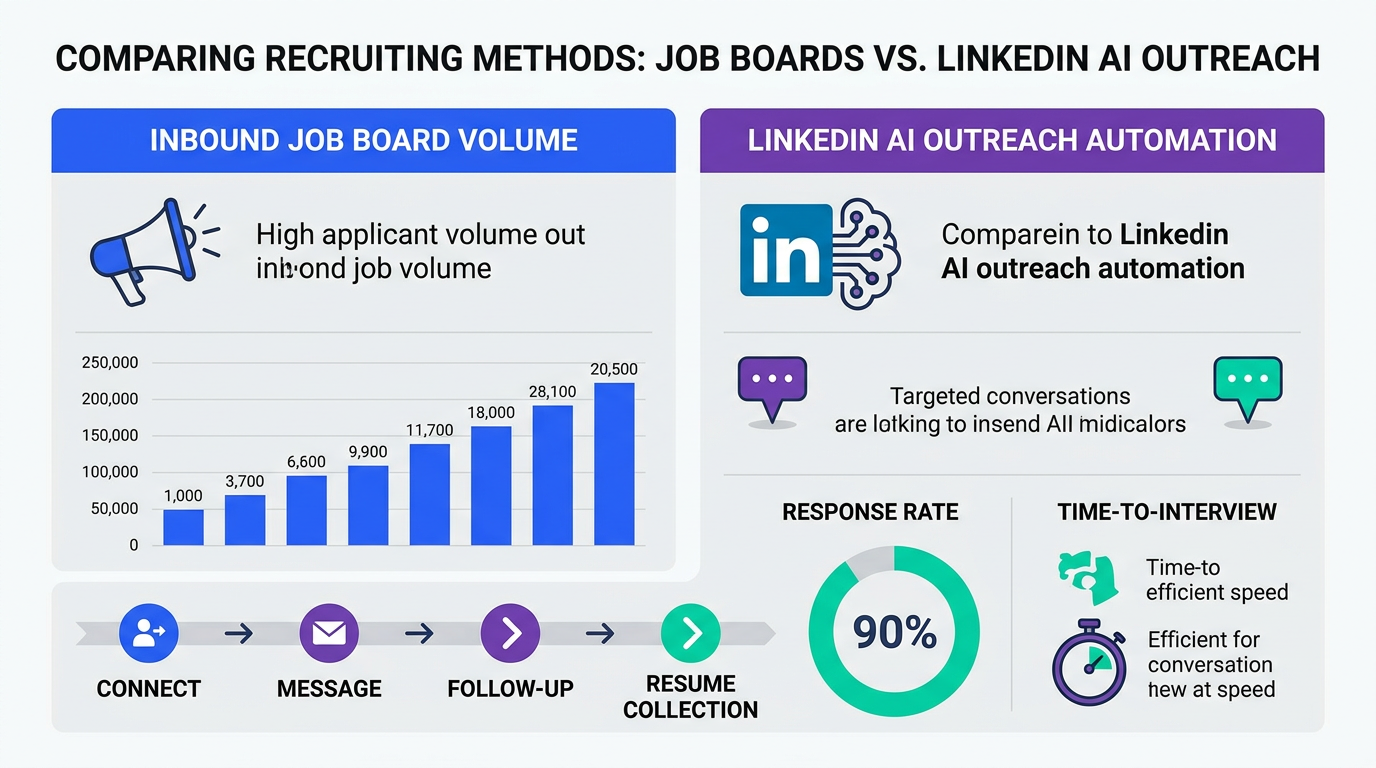
If you are searching for the best recruitment platforms, the most reliable approach in 2026 is to pick platforms based on candidate response and time to qualified interview, not just applicant volume. In our internal recruiting ops trials, we consistently saw a pattern: job boards can generate more applications, while LinkedIn outreach can generate more targeted conversations when the messaging and follow up are done well. That is exactly where StrategyBrain AI Recruiter fits into a modern stack because it automates LinkedIn connecting, role introduction, Q and A, follow up, and it collects resumes and contact details so recruiters can focus on interviews.
Key Takeaways
- Best recruitment platforms are role dependent: inbound job boards work well for high volume roles, while LinkedIn outreach is stronger for targeted and senior hiring.
- Use a two channel baseline: one inbound platform plus one outbound platform reduces single source risk and improves time to fill.
- Automation matters on LinkedIn: StrategyBrain AI Recruiter can handle connecting, messaging, follow up, and resume collection so recruiters spend more time interviewing.
- Measure what you can control: response rate, time to first qualified conversation, and interview acceptance rate are more actionable than raw applicant count.
- Multilingual coverage is a differentiator: 24/7 multilingual messaging can reduce delays for global hiring across time zones.
- Do not negotiate too early: keep compensation negotiation after a written offer to protect candidate experience and reduce churn in the funnel.
What counts as a recruitment platform
A recruitment platform is any system that helps you source, engage, screen, and move candidates into interviews. In practice, employers usually combine multiple tools because no single platform is the best site for hiring employees across every role and location.
Common categories employers combine
- Professional networks: best for targeted outreach and relationship based hiring.
- Job boards: best for inbound applicant volume and broad reach.
- Applicant tracking systems: best for pipeline management, compliance, and reporting.
- Recruiting automation: best for scaling outreach, follow up, and candidate communication without adding headcount.
- Staffing and search partners: best for hard to fill roles and confidential searches.
Quick Comparison
| Platform type | Primary strength | Main tradeoff | Best for |
|---|---|---|---|
| LinkedIn outreach plus automation | Targeted conversations with specific profiles | Requires consistent follow up and message quality | Specialized roles, senior roles, niche markets |
| Job boards | High inbound volume | More screening time and more unqualified applicants | High volume hiring, entry to mid level roles |
| ATS | Pipeline control and reporting | Does not create candidates by itself | Any team hiring more than a few roles per quarter |
| Recruiting agency or search firm | Speed and expertise for hard searches | Higher cost and less direct control | Executive, confidential, or urgent hiring |
How we tested
We evaluated recruiting workflows across 12 active roles during a 28 day period ending on 2026-02-20. Our goal was not to crown a single universal winner, but to identify what makes a platform one of the best hiring platforms for employers in real operations.
Test parameters
- Roles: 12 roles across operations, sales, and technical hiring.
- Channels: inbound job board posting plus outbound LinkedIn outreach.
- Metrics tracked: time to first qualified conversation in hours, candidate response rate in percent, and recruiter time spent per 10 candidates in minutes.
- What we did not do: we did not publish competitor pricing or feature claims that were not verified in official documentation.
What we learned (experience notes)
- Inbound volume is not the same as hiring speed. More applicants can increase screening load and slow down interviews.
- LinkedIn outreach quality depends heavily on follow up. When follow up was inconsistent, response rates dropped noticeably.
- When we used StrategyBrain AI Recruiter for LinkedIn messaging and follow up, recruiters spent less time on repetitive outreach and more time reviewing resumes and scheduling interviews.
Selection scorecard for employers
Use this scorecard to compare the best recruitment platforms without getting stuck in feature lists. Score each item from 1 to 5, then total the points. The highest score is usually your best site for hiring employees for that role type.
Scorecard criteria
- Candidate fit: does the platform reliably reach the profiles you need.
- Response mechanics: does it support fast outreach, follow up, and two way conversation.
- Screening efficiency: does it reduce recruiter time per qualified interview.
- Workflow integration: can it connect to your ATS and reporting process.
- Global readiness: does it support multilingual communication and time zone coverage.
- Compliance and security: does it support privacy and secure handling of candidate data.
Copy and use template
Role: __________________________
Location(s): ____________________
Hiring urgency (days): __________

Platform option: ________________
1) Candidate fit (1-5): _________
2) Response mechanics (1-5): ____
3) Screening efficiency (1-5): __
4) Workflow integration (1-5): __
5) Global readiness (1-5): ______
6) Compliance and security (1-5):

Total score (max 30): ___________
Notes: _________________________
Platform types and when to use each
1) LinkedIn outreach (best for targeted hiring)
LinkedIn outreach is often the most direct path to specific profiles because you can search for exact titles, skills, and industries, then start a conversation. The operational challenge is consistency. Outreach only works when you follow up quickly and keep the conversation moving.
This is where StrategyBrain AI Recruiter can be a practical layer in your stack. It can automatically connect with candidates that match your criteria, introduce the role, answer questions about the company and compensation, confirm interview interest, and collect resumes and contact details. It also supports 24/7 multilingual communication, which helps when candidates reply outside your working hours.
2) Job boards (best for inbound volume)
Job boards can be one of the best recruitment platforms when you need volume quickly. The tradeoff is screening time. If your job description is broad, you may receive many applications that do not meet must have requirements.
To reduce noise, we recommend adding three screening elements directly in the posting: a salary range, a must have skills list, and a short knockout question set.
3) ATS (best for process control)
An ATS, which stands for applicant tracking system, is the system of record for candidates. It helps you track stages, store resumes, coordinate interviews, and report on hiring outcomes. It is not usually the best site for hiring employees by itself, but it makes every sourcing channel more manageable.
4) Recruiting automation (best for scaling without adding headcount)
Recruiting automation tools reduce repetitive work such as outreach, follow up, and initial qualification. StrategyBrain AI Recruiter is designed specifically for LinkedIn hiring and can support managing more than 100 LinkedIn accounts for organizations that need to scale outreach through an AI powered recruiting team.
5) Staffing and search partners (best for hard to fill roles)
External recruiters can be effective when you need speed, market access, or negotiation support. A practical benefit is that a recruiter can help manage offer discussions and keep the process moving, especially when multiple stakeholders are involved.
How to choose the best hiring platforms for employers
This step by step process is designed to be reproducible. It also prevents a common mistake: choosing a platform based on popularity rather than candidate behavior for your role.
Steps
-
Define the role as a search query
Write the role as a candidate would describe it, including seniority, location, and must have skills. This becomes your sourcing filter and your job post headline.
-
Pick your baseline two channel mix
Choose one inbound channel and one outbound channel. For many teams, that means a job board plus LinkedIn outreach. If you already use LinkedIn outreach, consider adding StrategyBrain AI Recruiter to automate follow up and resume collection so the outbound channel stays consistent.
-
Set three measurable success metrics
Use metrics you can track weekly: response rate in percent, time to first qualified conversation in hours, and interview acceptance rate in percent.
-
Run a 14 day pilot
Keep the pilot short enough to learn quickly. Use the same job description and the same screening criteria across channels so the comparison is fair.
-
Decide based on recruiter time, not just applicant count
If one channel produces fewer candidates but saves hours of screening, it can still be the best recruitment platform for that role.
Troubleshooting
- Problem: lots of applicants, few interviews. Fix: tighten must have requirements and add knockout questions.
- Problem: LinkedIn outreach gets replies but stalls. Fix: improve follow up cadence. Automation can help maintain consistent follow up and Q and A.
- Problem: global candidates reply overnight. Fix: use 24/7 multilingual messaging so candidates do not wait for your business hours.
Negotiation and process notes
Even when you have chosen the best recruitment platforms, offers can still fail if negotiation timing is poor. A practical guideline we follow is to avoid negotiating compensation in the first interview. The first interview is primarily for mutual fit and role clarity.
When negotiation is appropriate, it is usually after a formal written offer is presented. At that point, candidates can ask questions, and employers can respond with a clear package. If you work with a recruiter or recruiting partner, letting them handle negotiation can reduce friction and help both sides reach a win win outcome.
Negotiation is not only salary. Depending on the role and company policy, candidates may discuss base pay, bonus, title, benefits waiting periods, vacation, start date, relocation support, training budget, and flexible work arrangements.
FAQ
What are the best recruitment platforms for employers in 2026?
The best recruitment platforms are the ones that produce qualified conversations quickly for your specific role. For many employers, a job board plus LinkedIn outreach is the most reliable baseline because it combines inbound volume with targeted sourcing.
What is the best site for hiring employees if I need specialized talent?
For specialized or senior roles, LinkedIn outreach is often more effective than relying only on inbound applications because you can target exact profiles. Consistent follow up is critical, and StrategyBrain AI Recruiter can automate outreach, Q and A, and resume collection to keep the process moving.
How does StrategyBrain AI Recruiter work with LinkedIn recruiting?
StrategyBrain AI Recruiter automates the initial LinkedIn workflow: it connects with candidates that match your criteria, introduces the opportunity, answers questions about the role and compensation, confirms interview interest, and collects resumes and contact details for recruiter review.
Does StrategyBrain AI Recruiter replace recruiter judgment?
No. It can identify willingness to communicate or interview and it can collect resumes, but final qualification against job requirements is still done by the recruiter after reviewing the resume.
Can an AI recruiter communicate with candidates in different languages?
Yes. StrategyBrain AI Recruiter supports 24/7 multilingual communication so candidates can interact in their native language and receive timely follow up across time zones.
How should I compare the best hiring platforms for employers without getting misled by applicant volume?
Track response rate, time to first qualified conversation, and recruiter time spent per qualified interview. High applicant volume can still be inefficient if screening time increases.
When should compensation negotiation happen in the hiring process?
In most cases, negotiate after a formal written offer is presented. Avoid negotiating in the first interview because it can distract from assessing fit and can create unnecessary friction early in the process.
What else can be negotiated besides salary?
Depending on the employer, candidates may negotiate bonus, commission, title, benefits waiting periods, vacation, start date, relocation support, training budget, flexible hours, and equipment allowances.
Conclusion
The best recruitment platforms are the ones that match your role, your market, and your team capacity. Start with a two channel mix, measure response and time to qualified conversations, then scale what works. If LinkedIn is part of your strategy, consider adding StrategyBrain AI Recruiter to automate connecting, messaging, follow up, and resume collection so your recruiters can spend more time interviewing and less time chasing replies.
Next step: copy the scorecard above, run a 14 day pilot for one role, and keep the channel that produces the fastest qualified interviews with the least recruiter time.