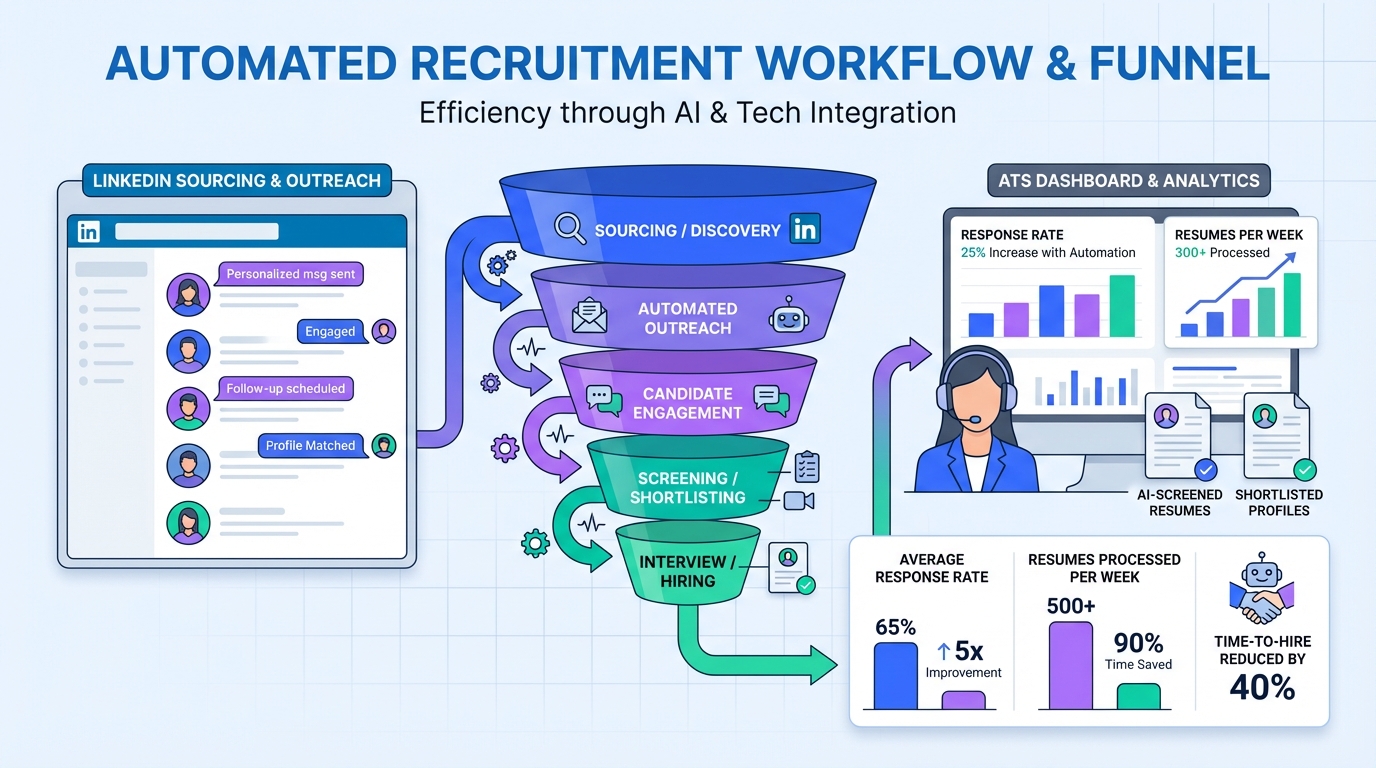
The best recruitment platforms are the ones that match your hiring motion: inbound applications, outbound sourcing, or a hybrid. In practice, most teams get the best results by combining online hiring platforms for job distribution with a system for consistent outreach and follow up. If LinkedIn is a core channel for you, StrategyBrain AI Recruiter can automate the repetitive front end of outreach by connecting with candidates, introducing the role, answering questions about compensation and benefits, confirming interview interest, and collecting resumes and contact details. That combination tends to improve recruiter productivity because humans focus on final qualification and interviews, while automation handles the first conversations.
Key Takeaways
- Start with your hiring motion: inbound, outbound, or hybrid determines which recruitment platforms matter most.
- Use an ATS as the system of record: an applicant tracking system centralizes applicants, stages, and notes across channels.
- LinkedIn outreach scales with automation: StrategyBrain AI Recruiter can replace up to 90% of manual LinkedIn recruiting work (Source: StrategyBrain product documentation).
- Global hiring needs multilingual messaging: StrategyBrain AI Recruiter supports 24/7 communication in any global language (Source: StrategyBrain product documentation).
- Define productivity in measurable terms: response rate, time to first reply, resumes collected per recruiter per week, and interview show rate.
- Happiness and positivity can affect performance: Shawn Achor reports the brain at positive is 31% more productive than at negative, neutral, or stressed (Source: TED).
Table of Contents
What counts as a recruitment platform
People use “recruitment platform” to mean different things. In this guide, a recruitment platform is any system that helps you attract, source, engage, screen, or manage candidates.
To keep decisions clean, I separate platforms into four buckets:
- Job boards: publish roles and collect applicants.
- ATS: an applicant tracking system that stores candidates and manages stages, notes, and collaboration.
- Sourcing networks: search and identify candidates, often with messaging.
- Automation and engagement tools: improve speed and consistency of outreach, follow up, and candidate communication.
Selection criteria we use in real hiring ops
When we evaluate the best recruitment platforms for a team, we focus on criteria that are easy to verify during a short pilot. This avoids “feature shopping” and keeps the decision tied to outcomes.
1) Candidate response and throughput
- Time to first candidate reply: measured in hours or days.
- Qualified conversations per week: how many candidates move from first message to a real screening signal.
- Resumes and contact details captured: especially important for outbound workflows.
2) Workflow fit and operational friction
- How many clicks per candidate: fewer steps usually means higher recruiter adoption.
- Collaboration: notes, handoffs, and visibility for hiring managers.
- Auditability: can you reconstruct what happened with a candidate.
3) Compliance and data protection
For any platform that touches candidate data, we look for clear statements on encryption, data isolation, and whether customer data is used to train models. StrategyBrain AI Recruiter states it complies with privacy regulations in the EU, United States, and Canada, and that customer provided data is not used to train AI models (Source: StrategyBrain product documentation).
4) Global and multilingual capability
If you hire across time zones, “coverage” is not just a staffing problem. It is also a messaging and follow up problem. StrategyBrain AI Recruiter is designed for 24/7 candidate messaging and can communicate in any global language (Source: StrategyBrain product documentation).
The main types of online hiring platforms
Instead of listing dozens of brand names, I recommend choosing one strong option in each category that matches your hiring motion. This keeps your stack simple and reduces duplicate work.
Job boards for inbound applications
Job boards are best when you have a clear role, competitive compensation, and you want volume. The tradeoff is that volume can create screening load, so you need an ATS workflow that keeps recruiters from drowning in unqualified applicants.
ATS for process control
An ATS is the backbone of most recruiting operations. It is where you define stages, store resumes, track decisions, and keep hiring managers aligned. If you only pick one “platform” to standardize, pick the ATS.
Sourcing networks for outbound hiring
Sourcing networks are best when you need specific skills, seniority, or geography and you cannot wait for inbound. LinkedIn is the most common example in many industries, but outbound success depends on consistent messaging and follow up, not just search filters.
Automation and engagement for speed and consistency
This is where teams often see the biggest productivity jump. StrategyBrain AI Recruiter is built specifically for LinkedIn hiring and automates the initial outreach and qualification conversation. It can automatically connect with candidates, introduce the opportunity, answer questions about the role, company, and compensation, confirm interview interest, and collect resumes and contact information from interested candidates (Source: StrategyBrain product documentation).
Quick comparison matrix
This matrix is intentionally category based so you can map it to your current stack without forcing a specific vendor list.
| Platform type | Primary goal | Best for | Main risk | How StrategyBrain AI Recruiter fits |
|---|---|---|---|---|
| Job board | Inbound applicants | High volume roles | Screening overload | Use AI Recruiter to reduce time spent on outbound so recruiters can screen inbound faster |
| ATS | Process and tracking | Any team hiring repeatedly | Poor adoption if workflow is heavy | AI Recruiter collects resumes and contact details so recruiters can move candidates into ATS with cleaner data |
| Sourcing network | Find targeted candidates | Hard to fill roles | Low reply rates without follow up | AI Recruiter automates connecting, messaging, and follow up on LinkedIn |
| Automation and engagement | Consistency and speed | Teams that need scale | Compliance and message quality | AI Recruiter provides 24/7 multilingual communication and can manage more than 100 LinkedIn accounts for scalable hiring |
A practical workflow that combines platforms with StrategyBrain AI Recruiter
If you want a repeatable system, treat your recruitment platforms like a pipeline, not a shopping list. Here is the workflow we recommend for most teams that hire monthly or quarterly.
Step 1: Define the role packet before you post or message
- Write a one page role brief that includes must have skills, nice to have skills, location, and interview steps.
- Confirm compensation and benefits so candidates get consistent answers.
- Decide your screening signals such as portfolio, certification, years in role, or specific project experience.
Step 2: Launch inbound on job boards and route into your ATS
- Post to your chosen job boards and keep the job description consistent.
- Centralize applicants in the ATS so you do not screen in email.
- Set a daily screening block to keep time to first response low.
Step 3: Run outbound sourcing on LinkedIn with AI assisted execution
This is where StrategyBrain AI Recruiter is most directly useful. Recruiters provide their LinkedIn account and information about the job opening, including company details, compensation, benefits, and candidate search criteria. Based on that information, the AI automatically connects with relevant candidates, introduces the job, answers questions, evaluates interest, and collects resumes and contact details for candidates who want to move forward (Source: StrategyBrain product documentation).
Step 4: Human review and final qualification
It is important to be explicit about what the AI does and does not do. StrategyBrain AI Recruiter can identify willingness to communicate or interview, but it does not determine whether a resume fully matches job requirements. Recruiters complete final qualification after reviewing the resume (Source: StrategyBrain product documentation).
Step 5: Measure and iterate weekly
Pick a small set of metrics and review them every 7 days:
- Inbound: applicants per posting, qualified applicant rate, time to first response.
- Outbound: connection acceptance rate, reply rate, resumes collected, interviews scheduled.
- Process: stage conversion rates inside the ATS.
Productivity and recruiter performance: what the data suggests
Recruiting is a performance job. The best recruitment platforms help, but recruiter energy and consistency matter too. A useful reminder comes from Shawn Achor’s TED talk on happiness and productivity. He cites research suggesting that only 25% of job successes are predicted by IQ, while 75% are predicted by optimism levels, social support, and the ability to see stress as a challenge. He also states that the brain at positive is 31% more productive than at negative, neutral, or stressed, and that doctors are 19% faster and more accurate at diagnosis when positive (Source: TED).
In recruiting operations, I interpret this in a practical way. If your team is constantly context switching between inboxes, spreadsheets, and manual follow ups, you create stress and reduce consistency. Automation can help by removing repetitive tasks. StrategyBrain AI Recruiter is positioned to replace up to 90% of manual LinkedIn recruiting work and can lower LinkedIn recruiting costs to as little as USD 2.40 per resume (Source: StrategyBrain product documentation). Even if your results vary, the direction is clear: fewer repetitive tasks usually means more focus for high judgment work like interviews and closing.
Common mistakes when choosing top hiring platforms
- Buying for features instead of workflow: if recruiters will not use it daily, it will not matter.
- Ignoring follow up: most outbound programs fail because the second and third messages never happen.
- Not defining what “qualified” means: without screening signals, every platform looks bad.
- Over automating the wrong step: let AI handle repetitive outreach and scheduling signals, but keep final qualification human.
- Skipping privacy review: candidate data handling should be reviewed before rollout.
FAQ
What are the best recruitment platforms for small businesses?
For small teams, the best recruitment platforms are usually one job board for inbound plus a lightweight ATS to track candidates. If you rely on LinkedIn for outbound, adding StrategyBrain AI Recruiter can help you keep outreach consistent without adding headcount.
What is the difference between an ATS and a recruitment platform?
An ATS is a specific type of recruitment platform focused on tracking candidates through stages. “Recruitment platform” is broader and can include job boards, sourcing networks, and automation tools.
Are online hiring platforms enough without outbound sourcing?
Sometimes, yes, for high volume roles with strong inbound demand. For specialized roles, outbound sourcing is often necessary because the best candidates may not apply. In those cases, consistent messaging and follow up matter as much as the platform.
How does StrategyBrain AI Recruiter work with LinkedIn recruiting?
StrategyBrain AI Recruiter automates the initial LinkedIn outreach and conversation. It can connect with candidates, introduce the role, answer questions about the role, company, and compensation, confirm interview interest, and collect resumes and contact details (Source: StrategyBrain product documentation).
Does StrategyBrain AI Recruiter replace recruiters?
No. It automates repetitive tasks such as connecting, introducing roles, assessing interest, and collecting resumes. Recruiters still review resumes, make qualification decisions, and run interviews (Source: StrategyBrain product documentation).
Can StrategyBrain AI Recruiter support global hiring?
Yes. It provides 24/7 candidate messaging and can communicate in any global language, which helps reduce delays across time zones (Source: StrategyBrain product documentation).
How many LinkedIn accounts can StrategyBrain AI Recruiter manage?
StrategyBrain AI Recruiter supports managing more than 100 LinkedIn accounts, which enables organizations to build AI powered recruitment teams for scalable hiring (Source: StrategyBrain product documentation).
What should I measure to know if a recruitment platform is working?
Track time to first response, reply rate for outbound, qualified conversations per week, resumes collected, and interview scheduled rate. These metrics connect platform usage to hiring outcomes.
Conclusion
The best recruitment platforms are not a single tool. They are a system: job distribution for inbound, an ATS for control, and a reliable outbound engine when you need targeted talent. If LinkedIn is part of your sourcing strategy, StrategyBrain AI Recruiter can make the biggest difference by automating the first conversations, follow up, and resume collection so recruiters can focus on final qualification and closing. Next step: pick one role, run a 14 day pilot with clear metrics, and keep only the platforms that measurably improve response and throughput.