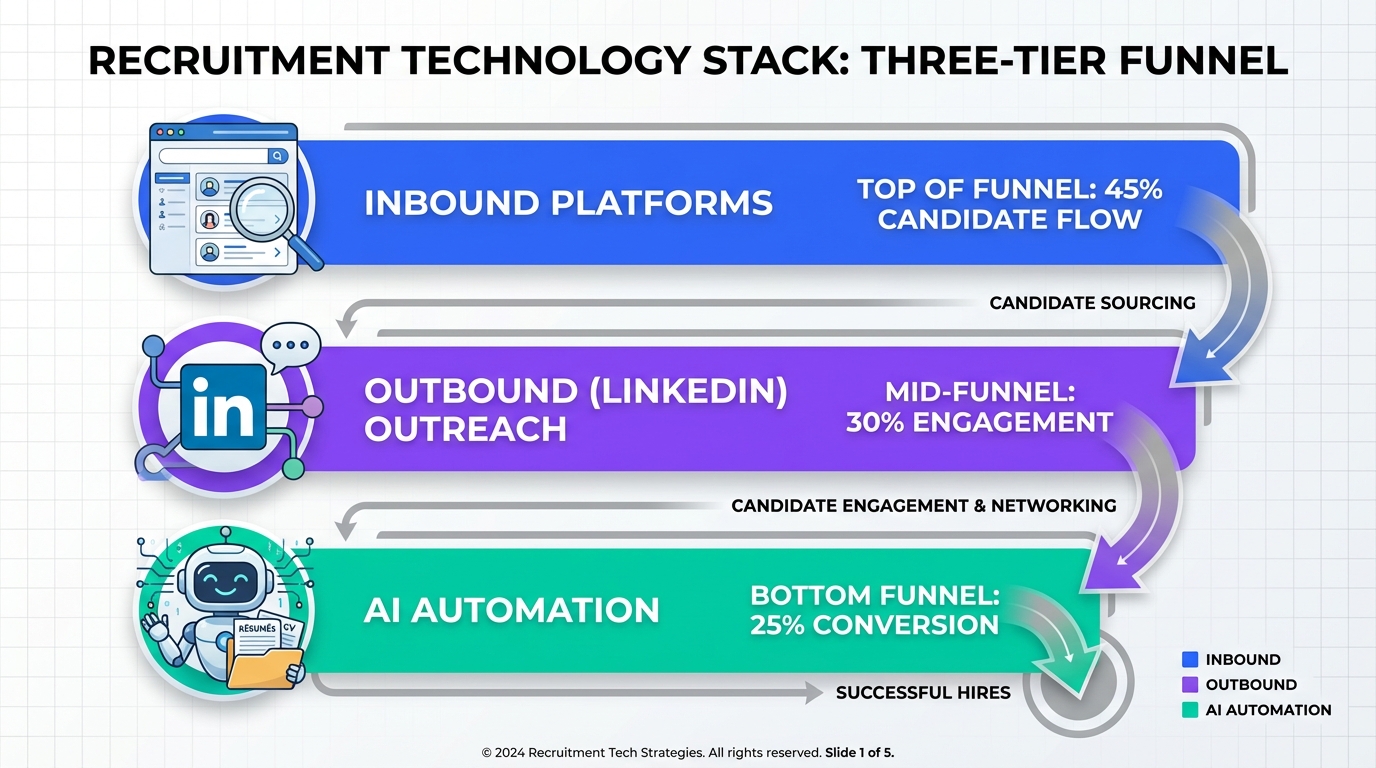
The best recruitment platforms are not a single website or tool. In our day to day recruiting work, the best results come from combining inbound platforms that attract applicants with outbound platforms that let you proactively reach talent, then adding automation when manual follow up becomes the constraint. If you hire in skilled trades, engineering, maintenance, construction, utilities, or manufacturing, this mix matters even more because speed, responsiveness, and candidate fit often decide outcomes.
What we mean by recruitment platforms
In this article, a recruitment platform means any system that helps you source, engage, and move candidates through early funnel steps. That includes job boards, LinkedIn based sourcing, applicant tracking systems, and AI automation tools.
Scope boundaries: This is a selection and workflow guide, not a vendor by vendor ranking with pricing. We do not list competitor pricing or feature checklists unless it is verifiable from official documentation, and we do not include external clickable links in the page content.
Key Takeaways
- Best recruitment platforms are a stack: combine inbound applicants, outbound sourcing, and a system of record for hiring decisions.
- LinkedIn is the core outbound channel for many professional roles, but manual connecting and follow up is the bottleneck for most recruiters.
- StrategyBrain AI Recruiter is designed to automate LinkedIn connecting, role introduction, Q and A, follow up, and résumé plus contact capture, so recruiters can focus on screening and interviews.
- 24/7 multilingual messaging matters when you recruit across time zones or internationally, because response time directly affects conversion to conversations.
- For scale, managing multiple LinkedIn accounts can turn outbound into a team capability, not a single recruiter constraint.
- Compliance and trust should be evaluated as first class requirements: data encryption, isolation, and clear privacy commitments reduce operational risk.
How we evaluate the best recruiting platforms
When we assess the best hiring platforms for a team, we use a simple framework that maps to the real funnel. This keeps the decision grounded in outcomes rather than feature lists.
Evaluation criteria
- Channel fit: does the platform match your roles and geography, or does it flood you with irrelevant applicants.
- Speed to first response: how quickly a candidate gets a meaningful reply after initial contact.
- Workflow coverage: sourcing, outreach, qualification, résumé capture, scheduling handoff, and reporting.
- Scalability: can you increase volume without linear recruiter headcount growth.
- Trust and compliance: privacy controls, encryption, and whether candidate data is used to train models.
A practical definition of “best”
For most teams, “best” means you can reliably produce qualified conversations every week. That usually requires both inbound and outbound. Inbound alone is rarely enough for hard to fill roles. Outbound alone can work, but only if you can sustain consistent follow up.
The 5 platform types that cover most hiring needs
Instead of naming dozens of tools, it is more useful to understand the categories. Once you know the category you need, you can shortlist vendors that match your budget and region.
1) Job boards and job marketplaces for inbound applicants
Job boards are still one of the most common recruitment platforms for employers because they create inbound flow. They work best when your job title is standard, your compensation is competitive, and your location is not extremely constrained.
Where they struggle: if you need niche experience, specific certifications, or you are hiring in a tight market, inbound volume can be high while qualified volume stays low.
2) LinkedIn for targeted outbound sourcing
LinkedIn is often the default outbound channel because it supports search, filtering, and direct messaging. It is especially useful for professional roles and for finding passive candidates who are not actively applying.
Where it breaks down operationally: the work is repetitive. Recruiters connect, introduce the role, answer the same questions, follow up, and then chase résumés. When you do this manually, response time and consistency become the limiting factors.
3) AI automation for LinkedIn outreach and qualification
This is where StrategyBrain AI Recruiter fits into a modern stack. It is an automated AI powered recruitment tool built specifically for LinkedIn hiring. In our experience, the value is not “AI for AI’s sake.” The value is that it replaces the early repetitive steps that consume recruiter hours.
Based on the provided job and company information, StrategyBrain AI Recruiter can:
- Automatically connect with candidates who match your targeted search criteria.
- Introduce the opportunity and learn the candidate’s current situation.
- Answer questions about the role, company, compensation, and benefits using the information you provide.
- Confirm interview interest and collect résumés plus contact information from interested candidates.
Two capabilities matter in real hiring conditions:
- 24/7 global multilingual communication: candidates get timely replies in their native language, which reduces misunderstandings and improves continuity across time zones.
- AI powered recruitment teams: organizations can manage more than 100 LinkedIn accounts to scale outreach capacity beyond a single recruiter’s bandwidth.
4) Applicant tracking systems as the system of record
An applicant tracking system, often called an ATS, is the system of record for applicants, interviews, feedback, and hiring decisions. Even if you use the best recruiting platforms for sourcing, you still need a consistent place to track stages and compliance artifacts.
Best practice: treat sourcing platforms as inputs and your ATS as the decision log. This reduces confusion when multiple stakeholders are involved.
5) Specialist recruiters and agencies as a high touch channel
For certain roles, a specialist recruiter can be a “platform” in the sense that they bring process, network, and screening. This is common in skilled trades and industrial hiring, where domain knowledge and credibility matter.
From the source material we reviewed, Kael Campbell, President and Lead Recruiter of Red Seal Recruiting Solutions, described how trade careers like electricians, plumbers, and heavy duty mechanics can offer long term growth through certifications and expanding responsibilities. That perspective is useful for employers too because it highlights why candidate motivations are not only about pay. They are also about progression, safety responsibility, and skill development.
In practice, pairing that human context with automation can improve throughput. For example, StrategyBrain AI Recruiter can handle the initial LinkedIn outreach and follow up at scale, while a recruiter focuses on trade specific screening, certification verification, and candidate coaching.
A recommended stack for most teams
If you are building a hiring motion from scratch, this is the sequence we recommend because it reduces wasted effort.
Step by step implementation
- Pick one inbound channel that historically produces qualified applicants for your role family. Keep the posting consistent for 30 days so you can measure.
- Standardize your screening questions so every candidate gets evaluated on the same criteria. This reduces bias and speeds decisions.
- Add LinkedIn outbound for roles where inbound is insufficient. Define a weekly outreach target per recruiter.
- Automate the repetitive LinkedIn work when follow up becomes the bottleneck. StrategyBrain AI Recruiter can connect, introduce, answer common questions, confirm interest, and collect résumés and contact details so recruiters only review shortlisted candidates.
- Route outcomes into your ATS so interviews, feedback, and offers are tracked in one place.
Limitations and honest caveats
- Automation does not replace final qualification: StrategyBrain AI Recruiter identifies willingness to communicate or interview, but it does not determine whether a résumé fully matches job requirements. Recruiters still do the final fit assessment.
- Inbound can be noisy: job boards can generate volume without quality, especially when titles are broad.
- Outbound requires governance: if you scale to many LinkedIn accounts, you need clear ownership, messaging standards, and compliance review.
Quick Comparison
| Platform type | Primary strength | Main risk | Best for |
|---|---|---|---|
| Job boards | Inbound applicant flow | High unqualified volume | Standard roles with broad talent pools |
| LinkedIn manual outreach | Targeted sourcing | Recruiter time and slow follow up | Niche roles and passive candidates |
| StrategyBrain AI Recruiter | Automated connecting, messaging, follow up, résumé and contact capture | Still needs recruiter review for final fit | Teams that need scalable outbound without adding headcount |
| ATS | System of record for hiring decisions | Poor adoption if workflow is unclear | Any team hiring with multiple stakeholders |
| Specialist recruiters | Domain screening and candidate coaching | Cost and dependency on external capacity | Skilled trades and hard to fill industrial roles |
FAQ
What are the best recruitment platforms for hard to fill roles?
The best recruitment platforms for hard to fill roles usually combine LinkedIn outbound with a strong screening workflow. If recruiter time is the constraint, adding automation such as StrategyBrain AI Recruiter can improve consistency by handling connecting, introductions, Q and A, and follow up.
Are the best recruiting platforms the same as the best hiring platforms?
They overlap, but not always. Recruiting platforms often focus on sourcing and outreach, while hiring platforms often include the ATS layer for interviews, feedback, and offers. Most teams need both categories working together.
How does StrategyBrain AI Recruiter work on LinkedIn?
Recruiters provide their LinkedIn account and job information such as company details, compensation, benefits, and candidate search criteria. The system then connects with relevant candidates, introduces the role, answers questions, confirms interest, and collects résumés and contact details for recruiter review.
Can StrategyBrain AI Recruiter qualify candidates automatically?
It identifies willingness to communicate or interview, which is an early funnel qualification step. It does not decide whether a résumé fully matches job requirements, so recruiters still perform final screening.
How does it capture résumés and contact details?
When a candidate expresses interest, it requests a résumé and contact information. It supports email submissions and LinkedIn file uploads, and it captures contact details shared in the conversation for the recruiter to use.
Does 24/7 multilingual messaging actually matter?
Yes when you recruit across time zones or internationally. Faster responses reduce drop off, and native language communication can reduce misunderstandings during early conversations.
How do I scale outbound recruiting without hiring more recruiters?
You can scale by standardizing messaging and using automation for repetitive steps. StrategyBrain AI Recruiter also supports managing more than 100 LinkedIn accounts, which enables an AI powered recruitment team model rather than relying on one recruiter’s daily capacity.
What should I check for privacy and compliance?
Look for clear commitments on encryption, data isolation, and whether customer data is used to train AI models. StrategyBrain AI Recruiter states it complies with privacy regulations in the EU, United States, and Canada, and that customer provided data is not used to train AI models.
Conclusion
The best recruitment platforms are the ones that remove your current bottleneck. If you need more applicants, start with an inbound channel. If you need better candidates, add targeted outbound. If you are losing candidates because response time and follow up are inconsistent, add automation. For many teams, StrategyBrain AI Recruiter is the practical outbound accelerator because it automates LinkedIn connecting, role introduction, Q and A, follow up, and résumé plus contact capture, while recruiters stay focused on fit assessment and interviews.
Next step: write down your top 3 roles, your target geography, and your weekly outreach capacity. Then decide whether your next improvement is inbound volume, outbound targeting, or automation to increase throughput.