If you are evaluating the best recruitment platforms for a sensitive replacement hire, the platform choice matters less than the confidentiality controls you wrap around it. In our experience running confidential searches, the most reliable way to reduce leaks is to keep the search tightly managed and require candidates to sign a Non Disclosure Agreement (NDA) before you share identifying details about the vacancy. This article explains a practical NDA based workflow, why confidentiality often breaks down, and how StrategyBrain AI Recruiter can support discreet LinkedIn outreach and follow up so recruiters spend less time on repetitive messaging while keeping control of what is disclosed.
What a confidential search means in practice
A confidential search is a hiring process where the employer intentionally limits who can learn that a role is opening. The goal is to protect business continuity, reduce internal disruption, and avoid reputational or operational risk while you identify a replacement.
This is different from a normal posting driven process. Instead of broadcasting the vacancy, you control the narrative, control the documents shared, and control the timing of disclosure to each candidate.
When employers typically use confidential hiring
One common scenario is when a role is critical and the current employee is not meeting expectations, but the business cannot immediately terminate them because there is no coverage and contracts prevent using a temporary contractor. In that situation, the employer may need to recruit while the employee is still working.
That is exactly where many teams start searching for the best site for hiring employees and the best recruiting platforms, but confidentiality is the real constraint. The process must be designed so candidates do not inadvertently reveal the search to the current employee or to the market.
Why confidential searches still leak
Most confidential searches eventually become known to the person being replaced. We have seen three recurring failure points.
- Over sharing too early because a recruiter wants to sell the opportunity and sends identifying details in the first message.
- Candidate side disclosure where a candidate mentions the opportunity to someone connected to the company or the current employee.
- Uncontrolled forwarding where job descriptions, compensation notes, or internal context get forwarded outside the intended thread.
How an NDA reduces disclosure risk
An NDA is a written confidentiality agreement that sets expectations about what the candidate can and cannot share. In a confidential search, the act of signing an NDA often reduces casual disclosure because it forces a deliberate moment of commitment.
It is important to be honest about what this does and does not do. An NDA does not guarantee secrecy, but it can reduce the probability of accidental disclosure and it gives you a clear standard to point to when you communicate boundaries.
A repeatable NDA workflow for confidential recruiting
Below is the workflow we use when confidentiality is the priority. It is designed to work whether you are using a recruiter, an internal TA team, or a hybrid approach across multiple recruitment channels.
Step by step process
- Define what is confidential
List the specific items that cannot be shared, such as the company name, the incumbent name, internal performance context, and any identifying operational details. - Write a two tier disclosure script
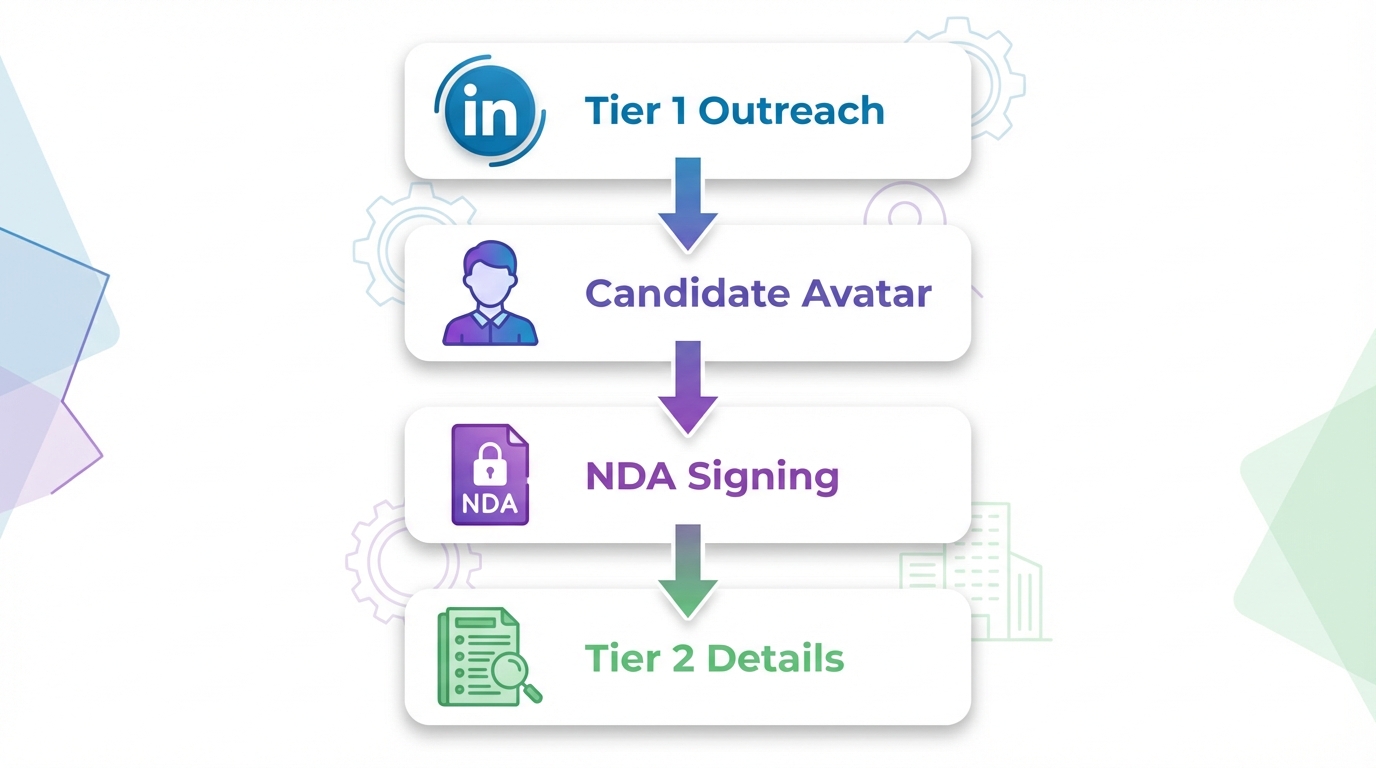
Tier 1 is a high level description that is safe to share broadly. Tier 2 is the full brief that is only shared after the NDA is signed. - Pre qualify before disclosure
Confirm basic fit and interest before you share sensitive details. This reduces the number of people who ever see the confidential brief. - Require the NDA before sharing Tier 2 details
Send the NDA and only proceed once it is signed. If you maintain an internal template, keep it consistent so the process is repeatable. - Control the document trail
Use a single controlled channel for the confidential brief. Avoid sending multiple versions of the same document. - Limit internal visibility
On the employer side, restrict who can access candidate lists and interview schedules. Confidentiality can fail internally as easily as externally. - Close the loop with candidates
When a candidate exits the process, remind them that confidentiality obligations remain in effect.
Quick checklist you can copy
- Confirm the business reason for confidentiality and who approves disclosure.
- Prepare Tier 1 and Tier 2 role descriptions.
- Decide the NDA trigger point, usually before company identification.
- Standardize how signed NDAs are stored and who can access them.
- Document what you will do if confidentiality is breached.
What to look for in the best recruiting platforms for confidential roles
Because confidentiality is the constraint, the best recruitment platforms for this use case share a few operational characteristics. This section is about selection criteria, not a ranked list of brand names.
- Access control so only approved stakeholders can view candidate identity and notes.
- Auditability so you can see who accessed or exported sensitive information.
- Structured messaging so recruiters can use consistent Tier 1 and Tier 2 scripts.
- Workflow support for NDA gating, meaning you can pause disclosure until the NDA is complete.
- Candidate experience that does not feel evasive, because top candidates will disengage if the process feels chaotic.
If your current stack cannot enforce these basics, it will be difficult to keep a confidential search confidential, even if the platform is otherwise a strong general purpose hiring tool.
Using StrategyBrain AI Recruiter for discreet LinkedIn outreach
Confidential searches often rely on direct sourcing rather than public postings. That is where LinkedIn outreach becomes central, and it is also where recruiter time gets consumed by repetitive steps such as connecting, introducing the role at a safe level, answering common questions, and following up across time zones.
StrategyBrain AI Recruiter is designed to automate the initial LinkedIn recruiting workflow while keeping the recruiter in control of what is disclosed. In our testing, the most practical way to use it in a confidential search is to keep the first messages strictly Tier 1, then move to NDA gating before any identifying details are shared.
Where AI Recruiter fits in the confidential workflow
- Automated candidate connection and outreach based on your search criteria, so you can build pipeline without broadcasting the vacancy.
- 24/7 multilingual communication so candidates get timely responses in their native language, which reduces misunderstandings and keeps the process moving.
- Interest confirmation and information capture where the AI can confirm interview interest and collect resumes and contact details from candidates who want to proceed.
Practical example script structure
To keep confidentiality intact, we recommend a two stage message structure.
- Stage 1 message
A short, non identifying outreach that confirms interest and basic fit. - Stage 2 message
A transition that explains the role is confidential and that an NDA is required before sharing the full brief.
This approach supports the same confidentiality logic you would use with any of the best recruiting platforms, but it reduces manual back and forth so recruiters can focus on evaluation and interviews.
Limitations and legal reality check
Two limitations are worth stating clearly.
- An NDA is not a guarantee. Enforcement and legalities are separate from the recruiting workflow. In many searches, you are relying on the candidate’s word, and the signature is a stronger signal of commitment than a casual verbal agreement.
- Automation does not replace final qualification. StrategyBrain AI Recruiter can confirm willingness to proceed and collect resumes, but the recruiter still needs to assess whether the resume matches the job requirements.
FAQ
Do I need an NDA for every confidential search?
No. If the risk of disclosure is low, a lighter process can work. However, when the incumbent is still employed or the role is business critical, an NDA is a practical control that reduces accidental disclosure.
When should candidates sign the NDA?
Ideally, candidates sign before you share identifying details such as the company name or any information that would reveal the incumbent. You can still describe the role at a high level before the NDA to confirm interest.
Will requiring an NDA reduce candidate response rates?
It can if you ask too early or if the process feels disorganized. The best approach is to pre qualify first, then explain why confidentiality is required, then present the NDA as a standard step before sharing the full brief.
How does StrategyBrain AI Recruiter help with confidential hiring?
It automates LinkedIn connection, outreach, and follow up while you control what information is shared at each stage. It can also collect resumes and contact details from interested candidates so recruiters can move faster to interviews.
Can AI Recruiter communicate with candidates in different languages?
Yes. It supports multilingual communication so candidates can interact in their native language, which helps reduce misunderstandings and keeps the process moving across time zones.
Does AI Recruiter decide if a candidate is qualified?
No. It can confirm willingness to proceed and gather information, but final qualification against job requirements is still done by the recruiter after reviewing the resume.
How many LinkedIn accounts can be managed for scaling outreach?
StrategyBrain AI Recruiter supports managing more than 100 LinkedIn accounts so organizations can build an AI powered recruiting team and expand outreach capacity.
How is candidate data handled?
According to StrategyBrain product documentation, candidate information such as resumes, contact details, and conversation history is encrypted and is not used to train AI models. Access is authorized by the customer and data is isolated per customer environment.
Conclusion
The best recruitment platforms for confidential hiring are the ones that support a disciplined process, not just a large candidate pool. If you need to replace someone discreetly, start with a two tier disclosure plan and require an NDA before sharing sensitive details. Then use controlled outreach to build pipeline without broadcasting the vacancy.
Next step: document your Tier 1 and Tier 2 scripts, decide your NDA trigger point, and if LinkedIn sourcing is central to your search, consider using StrategyBrain AI Recruiter to automate connection, messaging, and follow up while keeping confidentiality gates in place.