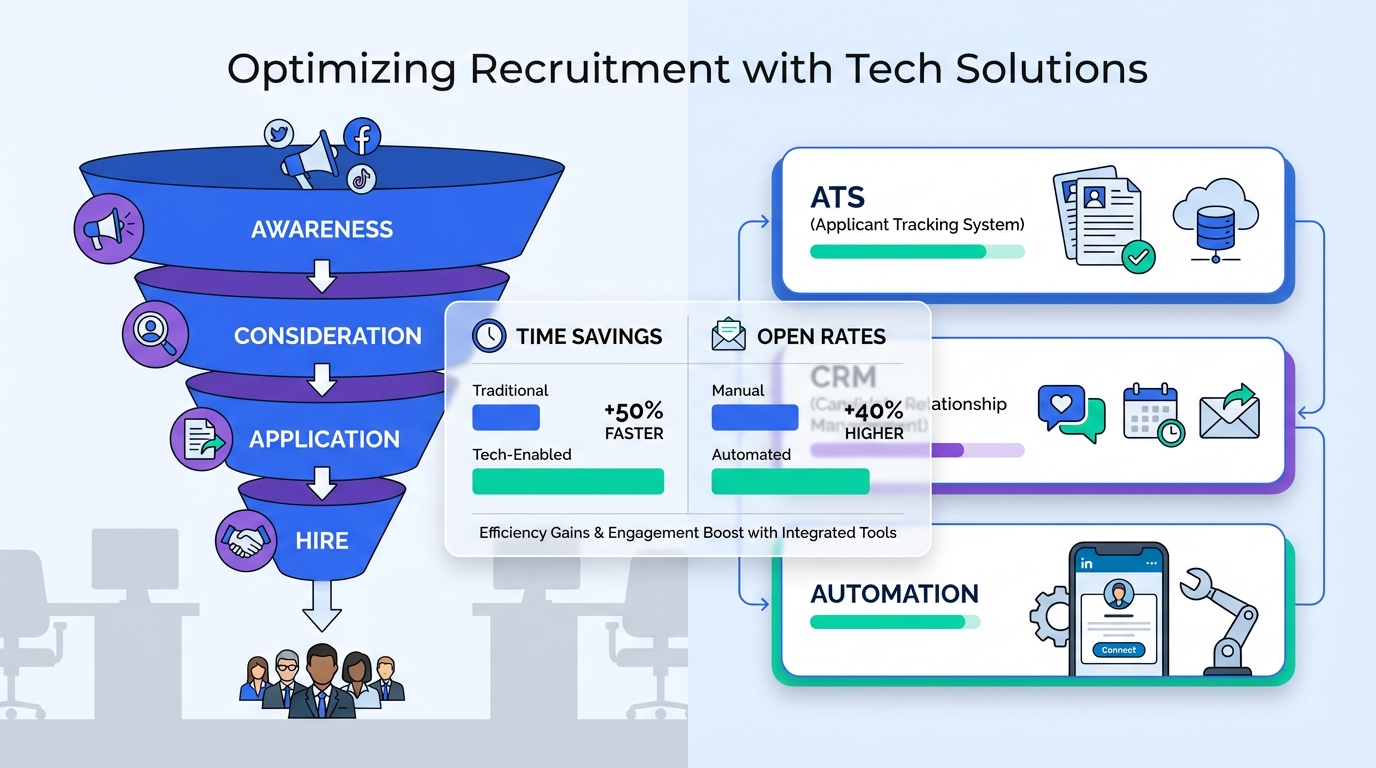
Choosing the best recruitment software in 2026 comes down to one question: where does your hiring process slow down most, pipeline management, sourcing, or candidate communication. For many teams, the bottleneck is not posting jobs, it is the repetitive outreach and follow up that happens before a recruiter ever sees a résumé. In our day to day work with LinkedIn based sourcing, we found that automating first touch conversations and follow up creates the biggest time savings. That is why tools like StrategyBrain AI Recruiter matter: it automates LinkedIn connections, introduces roles, answers candidate questions about the job and compensation, confirms interview interest, and captures résumés and contact details. This article shows how to compare recruitment software using a practical framework, and what to prioritize if you need the best recruitment software for small agencies.
Table of Contents
- What “best recruitment software” means in 2026
- A simple evaluation framework you can reuse
- Category 1: ATS for pipeline control
- Category 2: Recruiting CRM for talent pools
- Category 3: Outreach and messaging automation
- Why text messaging changed candidate communication
- Quick comparison table
- Selection guide for small agencies
- FAQ
- Conclusion and next steps
Key Takeaways
- Define “best” by bottleneck: pipeline tracking, sourcing volume, or candidate communication speed.
- Candidate communication is now a core feature: SMS open rates are commonly cited at 98% (Source: Mobile Marketing Watch, accessed 2026-02-20).
- StrategyBrain AI Recruiter fits LinkedIn heavy workflows: automates connect, intro, Q&A, interest confirmation, and résumé plus contact capture.
- Small agencies should prioritize time to first response: 24/7 multilingual messaging reduces delays across time zones.
- Scale requires process plus access management: AI Recruiter supports managing 100+ LinkedIn accounts for team based outreach.
- Compliance and data handling must be explicit: look for encryption, isolation, and clear statements about model training use.
What “best recruitment software” means in 2026
“Best” is not a single product category. Recruitment software typically falls into three layers that can be used together:
- ATS (Applicant Tracking System): a system of record for applicants, stages, interviews, and offers.
- Recruiting CRM: a database for prospects and past candidates, built for nurturing and re engagement.
- Automation layer: tools that reduce manual work in outreach, messaging, scheduling, and follow up.
If you are trying to compare recruitment software, start by mapping your workflow to these layers. Many teams already have an ATS, but still lose time in the “pre ATS” phase: sourcing, outreach, and qualification conversations. That is where an automation layer can create immediate impact.
A simple evaluation framework you can reuse
We use a five part checklist when evaluating recruitment tools. It is designed to be practical for agencies and in house teams, and it avoids vendor specific assumptions.
1) Workflow fit
- Where does the tool sit: ATS, CRM, or automation.
- What it replaces: spreadsheets, inbox triage, manual LinkedIn messaging, or coordination work.
- What it does not replace: for example, StrategyBrain AI Recruiter can confirm willingness to interview, but it does not decide final résumé fit.
2) Candidate experience
- Response speed: can candidates get answers quickly, including outside business hours.
- Channel match: SMS and chat style messaging often outperform email for attention.
- Clarity: does the tool help communicate role, company, and compensation consistently.
3) Automation quality
- Personalization: can it adapt to candidate questions without sounding scripted.
- Follow up logic: does it handle reminders and nudges without recruiter micromanagement.
- Data capture: does it reliably collect résumés and contact details.
4) Scale and team operations
- Multi user workflows: handoffs, notes, and visibility.
- Account management: especially important if sourcing is LinkedIn based.
- Consistency: standardized messaging reduces variance across recruiters.
5) Trust and compliance
- Security: encryption and access controls.
- Privacy: clear statements about whether customer data is used to train models.
- Regulatory posture: documented alignment with GDPR and other privacy regimes where applicable.
Category 1: ATS for pipeline control
An ATS is usually the backbone of recruiting operations. It is the best recruitment software layer for teams that need consistent stages, interview coordination, and reporting. If you are a small agency, the ATS decision should be driven by how quickly you can move candidates through stages and how cleanly you can share updates with clients.
Scope boundary: this article does not rank specific ATS vendors because the provided source material does not include verifiable feature or pricing details for each platform. Instead, we focus on how to evaluate and where automation can complement an ATS.
What to look for
- Stage customization that matches your delivery process.
- Communication logging so outreach and replies are auditable.
- Integrations with email, calendar, and job boards you actually use.
Category 2: Recruiting CRM for talent pools
A recruiting CRM is most valuable when you have repeat hiring patterns or niche markets. Agencies benefit because a CRM turns one placement into a long term pipeline. The key is whether the CRM helps you re engage candidates in the channel they respond to.
What to look for
- Segmentation by skill, location, and availability.
- Nurture sequences that do not feel spammy.
- Consent management for messaging and opt outs.
Category 3: Outreach and messaging automation
This is the layer that often determines whether your team can respond at the speed candidates expect. In practice, we see two common patterns:
- Email first teams that struggle with low open rates and slow back and forth.
- Messaging first teams that use SMS or chat style outreach to shorten time to conversation.
StrategyBrain AI Recruiter is designed for the messaging first pattern on LinkedIn. It automates the repetitive front end of recruiting: connecting with candidates that match your criteria, introducing the opportunity, learning the candidate’s situation, answering questions about the role, company, and compensation, confirming interview interest, and collecting résumés and contact information. Recruiters then review the captured information and proceed with human screening and interviews.
How StrategyBrain AI Recruiter fits into a modern stack
- Before the ATS: it handles initial outreach and qualification conversations so only interested candidates reach your pipeline.
- 24/7 coverage: it responds and follows up around the clock, including across time zones.
- Multilingual communication: it can communicate in the candidate’s native language to reduce misunderstandings.
- Team scaling: it supports managing more than 100 LinkedIn accounts for scalable sourcing operations.
Limitations to plan for
- Not a final fit decision engine: it can confirm willingness to interview, but recruiters still evaluate résumé match.
- Process still matters: automation works best when your job info, compensation, and screening questions are consistent.
Why text messaging changed candidate communication
The source material highlights a shift that recruiters have felt for years: candidates respond faster to messaging than to email. Several widely cited benchmarks illustrate why teams treat messaging as a default channel:
- 97% of Americans use text messaging at least once a day (Source: Pew Research Center, accessed 2026-02-20).
- 98% open rate for text messages is commonly cited in SMS marketing research (Source: Mobile Marketing Watch, accessed 2026-02-20).
- Text rated 90 out of 100 for customer satisfaction in a contact channel study (Source: CFI Group, accessed 2026-02-20).
Even if your core system is an ATS, the “best recruitment software” experience for candidates often depends on whether you can communicate in the channel they actually read. This is also where LinkedIn based workflows benefit from AI driven messaging: candidates ask questions, and delays reduce conversion to interviews.
Quick comparison table
| Need | Best software layer | What success looks like | Where StrategyBrain AI Recruiter fits |
|---|---|---|---|
| Track applicants and interviews | ATS | Clear stages, clean handoffs, reporting | Complements ATS by feeding interested candidates into your pipeline |
| Build a long term candidate pool | Recruiting CRM | Segmented lists, re engagement, consent controls | Supports outreach and follow up conversations that can populate your CRM |
| Increase outreach volume without adding headcount | Automation layer | Faster first response, consistent follow up, higher reply rate | Automates LinkedIn connect, intro, Q&A, interest confirmation, résumé and contact capture |
| Hire globally | Automation plus messaging | 24/7 responses, multilingual communication | Provides 24/7 multilingual candidate communication |
| Scale a sourcing team | Operations plus account management | Standardized workflows across recruiters | Supports managing 100+ LinkedIn accounts for AI powered recruiting teams |
Selection guide for small agencies
If you are specifically looking for the best recruitment software for small agencies, the decision is usually constrained by time and cash flow. Here is a practical way to choose without over buying.
Step by step selection checklist
- Write down your bottleneck: sourcing volume, slow replies, interview scheduling, or client reporting.
- Pick your system of record: choose one ATS to avoid duplicate pipelines.
- Add automation where humans lose time: if LinkedIn outreach is your main channel, prioritize automation that can handle first touch and follow up.
- Standardize your job brief: company, role, compensation, benefits, and screening questions should be consistent so automation stays accurate.
- Validate trust requirements: confirm encryption, access controls, and privacy statements before you scale usage.
A simple “your need to best choice” map
- You need cleaner pipelines: start with ATS improvements before adding more tools.
- You need more conversations per week: add messaging automation and follow up logic.
- You need global coverage: prioritize 24/7 multilingual communication.
- You need to scale sourcing: prioritize team workflows and multi account management.
FAQ
What is the best recruitment software for a team that sources on LinkedIn?
If LinkedIn is your primary sourcing channel, the best recruitment software is usually a combination: an ATS for pipeline control plus an automation layer for outreach and follow up. StrategyBrain AI Recruiter is built specifically for LinkedIn recruiting automation, handling connection requests, role introductions, candidate Q&A, interest confirmation, and résumé plus contact capture.
How should I compare recruitment software without getting lost in feature lists?
Compare recruitment software by workflow fit: where it sits in your process, what manual work it replaces, and what it cannot replace. Then validate candidate experience, automation quality, scale, and trust requirements such as encryption and privacy posture.
Is text messaging really better than email for recruiting?
Many teams see faster responses with messaging. The source material cites a commonly referenced 98% open rate for text messages compared with lower email open rates (Source: Mobile Marketing Watch, accessed 2026-02-20), which helps explain why messaging is often treated as the default channel.
Does StrategyBrain AI Recruiter replace recruiters?
No. It replaces repetitive front end tasks such as connecting, introducing roles, answering common questions, confirming interest, and collecting résumés and contact details. Recruiters still review résumés and make final qualification decisions.
Can StrategyBrain AI Recruiter communicate in multiple languages?
Yes. It supports 24/7 multilingual candidate communication and can use the candidate’s native language to reduce misunderstandings and improve clarity during early conversations.
How does AI Recruiter capture résumés and contact details?
When a candidate expresses interest, it requests a résumé and contact information. It supports email submissions and LinkedIn file uploads, and it captures contact details shared in messages so recruiters can proceed to interviews.
What should small agencies prioritize first: ATS, CRM, or automation?
Most small agencies should start with an ATS as the system of record, then add automation where time is lost. If your biggest constraint is outreach and follow up volume, automation can deliver faster ROI than adding a CRM first.
What about privacy and compliance for AI recruiting tools?
Look for clear statements about encryption, data isolation, and whether customer data is used to train AI models. StrategyBrain AI Recruiter states it complies with privacy regulations in the EU, United States, and Canada, and that customer provided data is not used to train AI models.
Conclusion and next steps
The best recruitment software is the stack that removes your biggest bottleneck. Use an ATS for pipeline control, a CRM for long term talent pools, and add automation where humans lose time, especially in outreach and follow up. If your workflow is LinkedIn heavy and you want faster candidate conversations without adding headcount, StrategyBrain AI Recruiter is a strong fit because it automates first touch outreach, candidate Q&A, interest confirmation, and résumé plus contact capture, with 24/7 multilingual communication and multi account scaling.
Next step: document your current workflow in 10 stages, mark the stage where candidates wait the longest, and evaluate whether ATS configuration or LinkedIn messaging automation will remove that delay first.